Most trend articles about mobile gaming start by telling you that more people own smartphones than ever. In Singapore, that observation stopped being useful several years ago.
Look at the two numbers that matter. Singapore had 9.79 million active cellular mobile connections at the end of 2025, equal to 166% of the population, but that figure actually fell by roughly 99,000 connections over the previous twelve months. Over broadly the same period, the median mobile download speed rose by 50.45 Mbps, a 44.1% increase. (Source: DataReportal, Digital 2026: Singapore, drawing on GSMA Intelligence and Ookla data.)
That is the whole story in miniature. The number of people to connect is no longer growing. What people can do once connected is growing fast.
So the interesting question for 2026 is not whether Singaporeans will play on their phones. It is what they now expect once they do: how quickly a game loads, how fast money moves, how few steps stand between opening an app and playing, and how much control they have over their own activity.
For readers who want the wider picture of formats, payments and rules, our guide to online gambling in Singapore covers the ground beyond mobile devices.
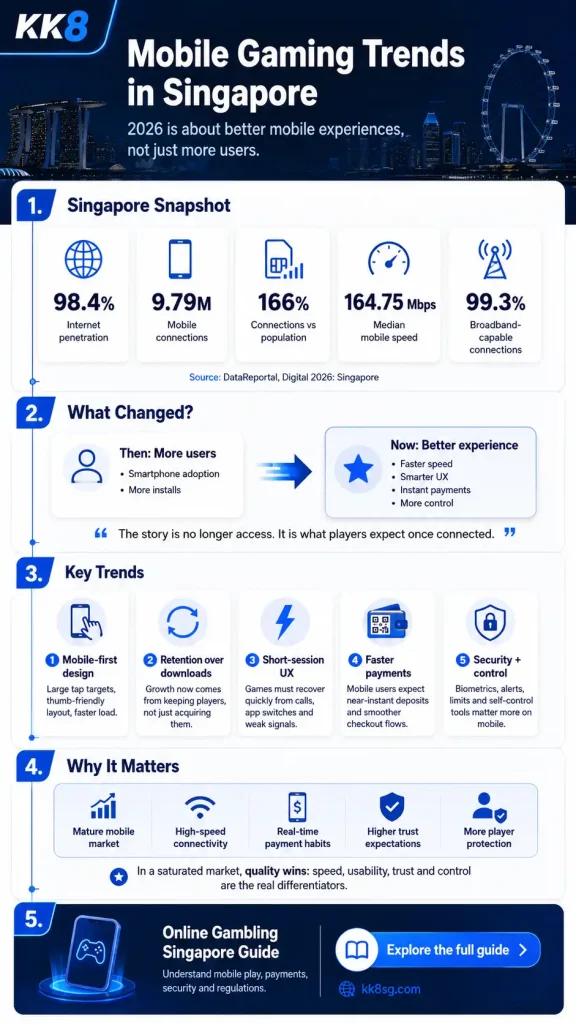
Mobile gaming in Singapore: the numbers behind the trend
Singapore’s connectivity profile is close to a ceiling. Understanding where the headroom actually is matters more than repeating the penetration figure.
| Metric | Singapore | Direction |
| Internet users | 5.78 million | +0.9% year on year |
| Internet penetration | 98.4% of population | Effectively saturated |
| Cellular mobile connections | 9.79 million | Down 1.0% year on year |
| Mobile connections vs population | 166% | Multiple SIMs and eSIMs are normal |
| Broadband-capable connections (3G/4G/5G) | 99.3% | Near-complete |
| Median mobile download speed | 164.75 Mbps | Up 44.1% year on year |
| Median fixed download speed | 394.30 Mbps | Up 32.5% year on year |
Figures from DataReportal’s Digital 2026: Singapore report, published November 2025 and based on data collected in October 2025. Mobile speed data is from Ookla and covers cellular networks only, not Wi-Fi.
Two clarifications worth making, because both are frequently misread.
First, 166% does not mean everyone owns 1.66 phones. Mobile connections include work SIMs, travel eSIMs, tablets, mobile broadband dongles and connected devices. It is a measure of connections, not people.
Second, “broadband-capable” is not the same as “uses mobile data.” Some of those connections are voice and SMS plans. DataReportal is explicit about this caveat, and it is a distinction most trend articles quietly drop.
The honest summary: Singapore has already finished the adoption phase. What is still improving is capacity and quality. That is why the meaningful changes in mobile gaming are now happening in experience design rather than in reach.
Trend 1: mobile-first design is now the baseline
There is a real difference between mobile compatible and mobile first, and most players can feel it within about ten seconds even if they cannot name it.
Mobile compatible means a desktop product that has been made to fit a smaller screen. The lobby still shows 200 game tiles in a grid. Navigation still assumes a mouse. Menus sit at the top of the screen, out of reach of a thumb.
Mobile first means the phone was the design starting point. In practice that looks like:
- Primary actions placed in the lower third of the screen, where a thumb naturally rests
- Tap targets sized generously, since fingers are far less precise than cursors
- Search and “recently played” surfaced before browsing, because scrolling a long grid on a phone is tiring
- Portrait orientation supported properly, not just tolerated
- Loading that prioritises what the player sees first rather than the whole page at once
That last point has a measurable dimension. Google’s Core Web Vitals now include Interaction to Next Paint, which measures how quickly a page visibly responds when a user taps something. A platform can have a fast first load and still feel broken if every tap lags. Mobile users read that lag as untrustworthiness, not slowness.
The insight worth taking away: a desktop interface compressed onto a phone is not a mobile product. It is a desktop product that a phone user has to work harder to use.
Trend 2: the industry has shifted from downloads to retention
This is the most consequential change in mobile gaming, and it is largely invisible to players.
The older growth model: more downloads produce more users, which produce more revenue. Companies competed primarily on user acquisition, which is the paid marketing spend used to get an app installed.
The current model: a better experience produces higher retention, which produces longer player relationships and more revenue per player. Acquisition still matters, but it is no longer the main lever.
Three things pushed the industry this way.
First, install growth in mature markets flattened. In a country where almost everyone is already online and already has games installed, there is no large untapped pool left to convert.
Second, acquisition got more expensive and harder to measure after platform-level privacy changes reduced how precisely advertisers could track which ads produced which installs. When you cannot measure acquisition well, you stop over-investing in it.
Third, and most tellingly, revenue kept growing even as install growth slowed. Newzoo’s 2026 Global Games Market Report forecasts a total games market of US$213.9 billion, up 6.1% year on year, with mobile the largest segment at US$121.1 billion (+6.8%). Newzoo also revised its final 2025 estimate upward to US$201.6 billion, attributing part of the difference to stronger mobile performance including direct-to-consumer and mini-game revenue.
That revision is the interesting detail. Growth is coming from deeper monetisation of existing players and from new distribution channels, not from a fresh wave of first-time mobile gamers.
| Earlier model | 2026 model | |
| Primary metric | Installs | Day 7 and Day 30 retention |
| Main investment | Paid acquisition | Live operations and content cadence |
| Growth assumption | Market is expanding | Market is mature |
| Player value | Measured at install | Measured over months |
| Biggest risk | Rising ad costs | Churn after the first week |
Two terms explained, since the brief audience may not know them:
Retention is simply the percentage of players who come back. Day 1 retention means those who return the day after first playing. Day 30 retention is the harder and more valuable number.
LiveOps, short for live operations, means running a game as an ongoing service: seasonal events, rotating content, scheduled updates and offers. It is the difference between a game that ships once and a game that has something new on a Tuesday.
One caveat on the market figures above: Newzoo’s games market data covers consumer spending on games software and services and explicitly excludes gambling. It describes the mobile games industry, not the online gambling industry. They are related businesses with different economics and very different regulation.
Trend 3: short, interrupted sessions are reshaping mobile UX
Desktop play tends to be deliberate. You sit down, you have time, you close the laptop when you are done.
Mobile play is different in a way that design has been slow to accommodate. A session on a phone is routinely interrupted by a message, a call, a screen lock, an app switch, or a handover between Wi-Fi and cellular data as someone walks out of a building.
This is not a claim about where Singaporeans play or what they play. It is a claim about how phones work. Any product used on a phone in a dense, highly connected city will encounter these interruptions constantly.
Good mobile design assumes interruption rather than treating it as an error:
- Session recovery. If the connection drops mid-round, the state is preserved and restored rather than lost.
- Graceful network handover. Moving from Wi-Fi to 5G should not force a re-login.
- Fast resume. Returning to a backgrounded app should not mean reloading everything.
- Persistent preferences. Settings, favourites and filters survive the session.
- Fewer authentication steps on return, without weakening security, which is where biometrics have become genuinely useful.
A concrete example: a player is in the middle of a live-dealer round when a call comes in. On a poorly built platform, they return to a logged-out lobby with no clear record of what happened. On a well-built one, they return to the table with the round resolved and visible in their history. The underlying game is identical. The experience is not.
Trend 4: faster payments have become part of the experience
Payments used to sit outside the product. You went away, did a bank transfer, came back later. That gap has closed in almost every category of digital service, and expectations have transferred.
Singapore is an unusually clear case. PayNow lets people transfer funds using a mobile number or identifier rather than account details, settling in near real time on the FAST rails. SGQR standardised QR payments across providers. For most Singaporean adults, “money moves instantly and I confirm it on my phone” is simply how money now works.
Once that becomes normal, a service that takes two working days to process something feels not just slow but suspicious. The expectations now carried into any transactional app include:
- Confirmation within seconds, not hours
- No manual entry of long account numbers
- Clear status at every stage, including pending states
- Verification handled in-app rather than by email chain
For a general explanation of how transactions are structured on gaming platforms, see how online casino payments work and our comparison of PayNow and other payment methods.
An important qualification. The existence of fast payment rails says nothing about what those rails may lawfully be used for. In Singapore, the Singapore Police Force took over responsibility for blocking payment transactions connected to unlawful remote gambling from 1 January 2025. Speed of settlement and legality of purpose are separate questions, and readers should not treat one as evidence of the other. See the regulatory section below.
Trend 5: live and real-time formats keep expanding
Live formats, meaning anything streamed or synchronised in real time between multiple participants, have grown across mobile gaming: real-time multiplayer matches, streamed competitive events, and live-dealer table games where a human dealer is broadcast to players.
The technical reason is worth understanding because it is commonly explained wrongly.
Real-time experiences are limited less by bandwidth (how much data you can move) than by latency (how long each piece takes to arrive) and jitter (how inconsistent that timing is). A 165 Mbps connection with unstable timing produces a worse live experience than a slower connection with steady timing. This is why a video call can stutter on a fast connection.
What has improved in Singapore is not only headline speed but network consistency, which is what makes synchronous formats viable on a phone at all. When latency is low and stable, a live-streamed table feels responsive. When it is not, the delay between action and response breaks the illusion immediately.
For readers new to the distinction between live-streamed and software-generated games, our explainer on live casino versus RNG games covers it. RNG stands for random number generator, the software that determines outcomes in games without a live dealer.
Trend 6: AI has moved from development tool into the player experience
It is worth being unromantic about this. AI in mobile gaming in 2026 is mostly doing quiet operational work rather than transforming anything.
Where it is genuinely in use:
- Recommendations. Surfacing relevant content from large catalogues, which matters more on a phone where browsing is expensive in attention.
- Support triage. Classifying and routing queries, resolving routine ones, escalating the rest.
- Fraud and anomaly detection. Flagging unusual login locations, device changes or transaction patterns. This is probably the highest-value application and the least discussed.
- Difficulty and pacing adjustment in skill-based games.
- Asset and content production in development pipelines.
- Segmentation, meaning grouping players by behaviour to decide what to show whom.
Where it creates problems:
- Privacy. Personalisation requires behavioural data. In Singapore that sits under the Personal Data Protection Act, and the more granular the profiling, the more careful the handling has to be.
- Transparency. Players are rarely told why they are being shown something.
- Cold starts and bad inferences. Recommendation systems generalise from thin data and get people wrong.
- Over-personalisation. This one deserves emphasis. In any context involving spending, a system optimised purely for engagement can push people toward more activity than they intended. Personalisation and player protection can pull in opposite directions, and pretending otherwise is not credible.
Anyone claiming AI has revolutionised mobile gaming is overselling it. Anyone claiming it is irrelevant has not looked at fraud detection.
Trend 7: security has become part of the interface
Security used to be treated as backend infrastructure. On mobile it is now something players see and judge, and it directly affects whether they stay.
The shift is from security that adds friction to security that removes it. Biometric unlock through the device’s own secure hardware is faster than typing a password, not slower. Passkeys, which use cryptographic keys stored on the device instead of a shared secret, are both harder to phish and quicker to use.
What mobile users increasingly expect as standard:
| Feature | What it does | Why mobile users notice |
| Biometric login | Uses the device’s face or fingerprint sensor | Removes typing on a small keyboard |
| Passkeys | Replaces passwords with device-held keys | Nothing to phish or reuse |
| Device recognition | Flags logins from unfamiliar hardware | Catches account takeover early |
| Transaction verification | Confirms payments separately from login | Limits damage if a session is compromised |
| Account alerts | Notifies on changes to email, password, payout details | Early warning the user actually sees |
| Session timeouts | Ends idle sessions | Protects a phone left unattended |
One local signal of where this is heading: Singapore’s banks have been moving customers away from SMS one-time passwords toward in-app digital tokens, because SMS codes are vulnerable to interception and SIM-swap attacks. Consumer expectations are being set by banking apps, and other services are measured against that standard whether they like it or not.
Trend 8: apps and browsers are serving different needs
The claim that apps are replacing browsers is repeated constantly and is not accurate. The two have diverged toward different jobs.
| Mobile app | Mobile browser | |
| Installation | Required | None |
| First access | Slower, requires download | Immediate |
| Notifications | Native push | Limited, permission-dependent |
| Biometric login | Well supported | Supported via passkeys, less consistently |
| Updates | User or store-managed | Automatic on the server |
| Device switching | Per-device install | Follows the user across devices |
| Storage on device | Ongoing | Minimal |
| Commitment | Higher | Lower |
The practical pattern: browsers win at trial and low-commitment access, apps win at frequency and depth. A person evaluating a service for the first time will almost always start in a browser. A person using something several times a week will usually prefer an app.
Progressive web apps sit between the two, offering an installed-app feel from a browser, though with some platform limitations.
One point specific to gambling apps that is often missed: major app stores impose their own requirements on real-money gambling applications, including restrictions on which jurisdictions an app may be distributed in and who may submit it. Distribution is therefore shaped by store policy and licensing, not only by user preference.
Our full comparison sits at mobile casino app vs browser.
Compare your options: see how mobile apps and browser-based play differ in access, updates, security and everyday usability.
Trend 9: mobile esports is now an established structure
Singapore’s competitive mobile scene is a useful proof point precisely because it is unglamorous and organised.
MPL Singapore, the Mobile Legends Professional League for Singapore, ran its eleventh season in 2026. The format includes a regular season, playoffs, and a challenger bracket with promotion and relegation, with the champion qualifying for regional competition. That structure matters more than any single result: promotion, relegation and qualification pathways are the marks of an actual competitive ecosystem rather than a series of one-off tournaments.
Mobile Legends: Bang Bang is also scheduled to appear as a medal event at the 2026 Asian Games, which places mobile competition inside mainstream multi-sport structures.
The broader point for this article is short: mobile is no longer treated as a lesser platform for competitive play. It is simply a platform.
Trend 10: player protection tools are moving onto the phone
If mobile makes participation easier and more frequent, then the tools that help people manage that participation have to live on mobile too. Leaving them buried in a desktop account settings page is a design failure with real consequences.
Tools that are becoming standard:
- Deposit and spending limits, set in advance rather than in the moment
- Session reminders, which display elapsed time during play
- Activity history, presented plainly rather than as a downloadable statement
- Cooling-off periods, a short self-imposed break
- Self-exclusion, a longer or permanent block
- Notification controls, so a person can stop marketing prompts
In Singapore, the National Council on Problem Gambling administers exclusion orders, including self-exclusion, and family members can apply in defined circumstances. These are formal mechanisms, separate from any tool an individual platform provides.
The principle underneath all of this is simple. Convenience is not neutral. A format that reduces friction for playing should also reduce friction for stopping. Our responsible gambling guide covers the available tools in more detail.
What these trends mean for Singapore specifically
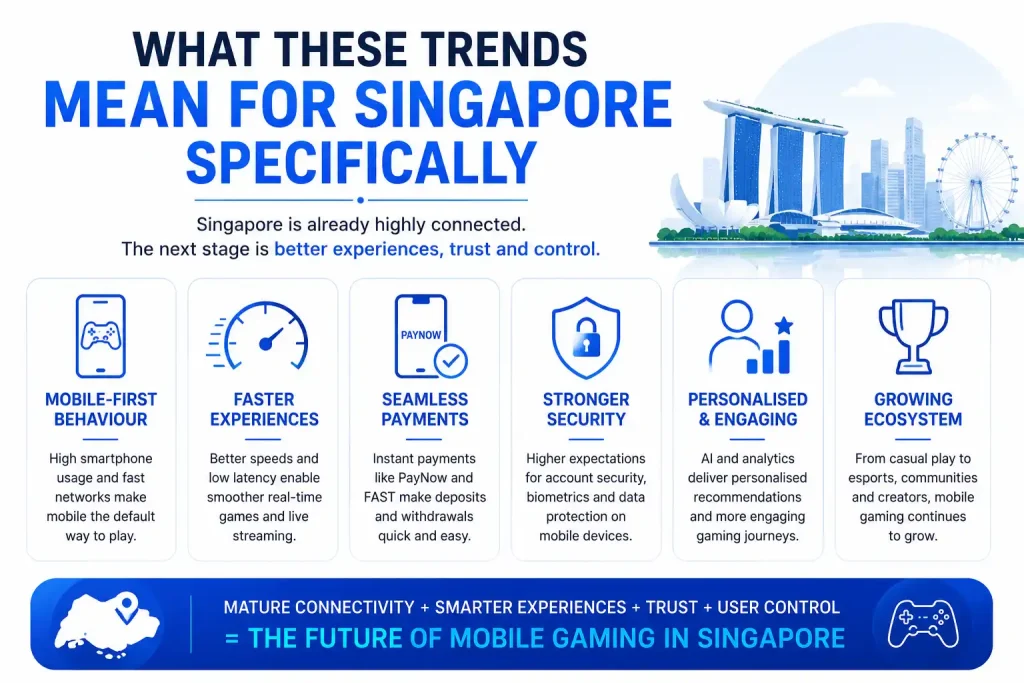
Singapore combines five conditions that few markets have simultaneously:
- Near-total internet penetration with no meaningful growth left in reach
- Mobile connection numbers that exceed population and are no longer rising
- Rapidly improving network speed and consistency
- Mature, near-instant digital payments that have reset consumer expectations
- A strict and actively enforced gambling regulatory framework
Put together, these produce a specific conclusion, and it is not “mobile gambling is growing in Singapore.”
It is that the competitive ground has moved entirely to quality. When everyone already has access, when connections are already fast, and when the legal boundaries are firmly drawn, the variables that remain are experience, speed, trust, payment handling, security and player control. Those are the things that differentiate, and they are also the things that are hardest to fake.
A market that has run out of new users has to get better at serving the ones it has. That is the actual 2026 story.
Mobile gaming trends to watch beyond 2026
Predictions age badly, so these are kept conservative and limited to things already visibly underway:
- Deeper personalisation, with the accompanying pressure for clearer disclosure about how it works
- Cross-device continuity, where a session genuinely resumes across phone, tablet and desktop
- Passwordless authentication becoming the default rather than an option
- Better fraud detection, driven by account-takeover pressure rather than by innovation for its own sake
- Payments embedded further into the experience, with fewer redirects
- Player-protection tooling improving, partly through regulatory pressure
- More regulatory attention to mobile specifically, since that is where activity now sits
Deliberately excluded: metaverse casinos, VR displacing smartphones, and blockchain restructuring mainstream gaming. Each has been forecast repeatedly for years without materialising at scale. If that changes, the evidence will be visible before the predictions are worth making.
Singapore regulatory context
Technical accessibility and legal availability are two different things, and this distinction is the single most important item in this article for Singapore readers.
According to the Gambling Regulatory Authority (GRA), it is unlawful for any person to provide unlicensed remote gambling services in or from Singapore, or from outside Singapore to persons situated in Singapore. The GRA states that Singapore Pools (Private) Limited is the only operator it has licensed to provide remote gambling services.
Since 1 January 2025, the Singapore Police Force has handled the blocking of access to unlawful remote gambling services, the advertising of such services, and related payment transactions.
Three implications follow:
- A website loading on a Singapore phone is not evidence that the service is authorised here.
- A licence issued by an overseas regulator does not authorise a service to be provided to people located in Singapore.
- Enforcement covers advertising and payments, not only the services themselves.
Anyone unsure of the current position should check the GRA directly rather than relying on commercial websites, including this one. For fuller explanations, see Singapore gambling laws explained and remote gambling in Singapore explained.
Frequently Asked Questions
What are the biggest mobile gaming trends in 2026?
Mobile-first design, a shift from downloads toward player retention, AI used mainly for recommendations and fraud detection, growth in live and real-time formats, faster payments, security built into the interface, and stronger player-protection tools.
Is mobile gaming growing in Singapore?
Not in terms of reach. Internet penetration is 98.4% and mobile connections actually declined slightly in the year to October 2025. Growth now comes from deeper engagement, faster networks and better experiences rather than from new users.
Why is mobile gaming so popular in Singapore?
High smartphone usage, fast and consistent mobile networks, mature digital payments and a population accustomed to doing most daily tasks on a phone.
How is 5G changing mobile gaming?
Mainly through lower and more consistent latency, which matters more than raw speed for live and multiplayer formats. Singapore’s median mobile download speed rose 44.1% in the year to August 2025, but for real-time play, timing consistency is the more important improvement.
Are mobile gaming apps better than browsers?
Neither is better in general. Browsers suit first-time and occasional access with no installation. Apps suit frequent use, offering notifications, biometric login and stored preferences.
Explore more online gaming guides
Learn how payments, mobile access, security and Singapore’s regulations shape the wider online gaming experience.
Sources
- DataReportal, Digital 2026: Singapore (published November 2025, data from October 2025), incorporating GSMA Intelligence and Ookla figures
- Newzoo, Global Games Market Report 2026
- Gambling Regulatory Authority of Singapore, guidance on unlawful remote gambling activities
- Liquipedia / MOONTON, MPL Singapore Season 11 competition structure