The future of online gambling is being decided in two places at once: inside product teams building faster and more personalised platforms, and inside regulators deciding how much of that is allowed to reach players. Most trend articles only cover the first half. That is why predictions from five years ago about virtual reality casinos and crypto-first betting have aged badly, while unglamorous changes like automated identity checks and behavioural monitoring have quietly reshaped how real platforms work.
This guide covers what is actually changing, which technologies have genuine momentum, which are still mostly marketing, and what it all means for readers in Singapore, where online gambling in Singapore sits under one of the strictest frameworks in the region.
Quick Answer: What Will the Future of Online Gambling Look Like?
Expect mobile-first platforms as the default, more artificial intelligence in both recommendations and harm detection, faster payments, more interactive live dealer gaming, and much heavier identity verification. Alongside that, expect stricter product rules: stake caps, spending controls, affordability checks and mandatory player protection tools.
The important distinction is that these developments are not moving at the same speed. Mobile and live dealer gaming are already mainstream. AI and instant payments are scaling now. Virtual reality and metaverse gambling remain small, and have stayed small for years despite constant coverage.
How Online Gambling Is Changing
The direction of travel is clear in regulated markets that publish real numbers.
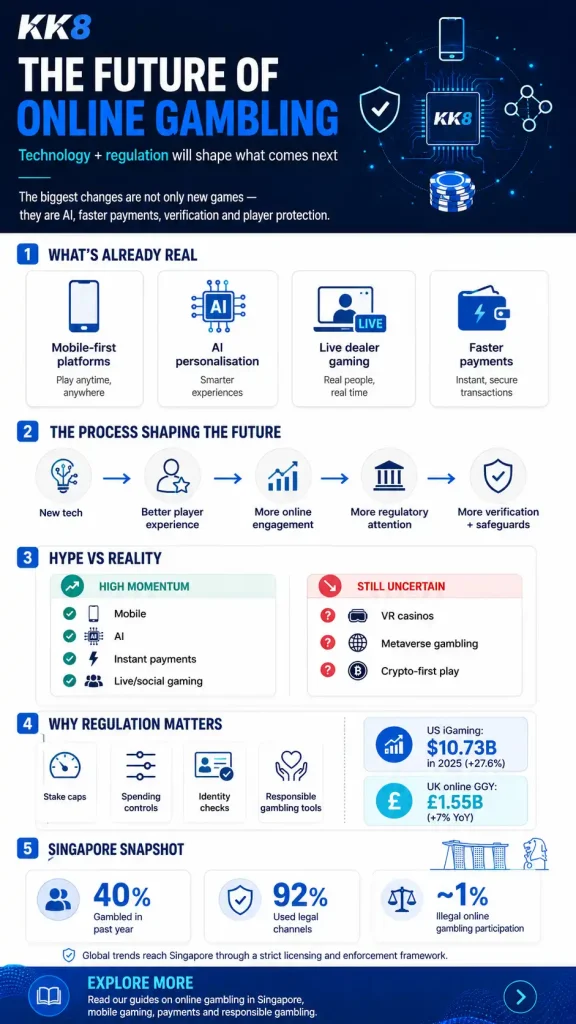
In the United States, regulated iGaming revenue grew 27.6% in 2025 to a record $10.73 billion, according to the American Gaming Association. The more telling detail sits underneath that figure: in both Pennsylvania and New Jersey, online casino revenue exceeded land-based commercial casino revenue for the first time.
In Great Britain, the Gambling Commission’s operator dataset for January to March 2026 recorded online gross gambling yield (GGY, meaning the amount operators keep after paying out winnings) of £1.55 billion, up 7% year on year. But average monthly active accounts actually fell 1% to 13.4 million.
Together these say something more useful than a market forecast. Growth is coming from deeper engagement within existing player bases and from online taking share from physical venues, not from an endless supply of new players. That is precisely the kind of growth that attracts regulatory attention, which is why the technology story and the regulation story cannot be separated. If you are new to the mechanics, start with how online gambling works.
7 Trends That Could Shape the Future of Online Gambling
1. AI will change both personalisation and player protection
Most coverage of AI in online gambling stops at recommendations. The dual role is what matters.
Commercially, machine learning drives recommendations, search, dynamic lobbies, support automation and fraud detection. On the protection side, the same modelling flags unusual deposit patterns, lengthening sessions, chasing behaviour after losses and account takeover signals.
That creates a real tension: the models that make a platform more engaging and the models that detect someone playing too much are built from the same behavioural data. Regulators are increasingly interested in whether operators use that capability in both directions.
2. Mobile-first gambling will become the default
Mobile is not a future technology. It is the existing baseline, so the useful question is what comes next.
Realistic development areas: app performance on mid-range devices, lighter web clients for data-constrained markets, biometric login instead of passwords, deposit flows with fewer screens, and better live video over mobile networks. Our mobile casino gaming guide covers how mobile differs from desktop play today.
3. Live casino technology will become more interactive
Live dealer gaming is the clearest bridge between physical and digital play, and it absorbs a lot of engineering effort: lower streaming latency, higher video quality, multiple camera angles and game-show formats built for mobile screens. The direction is toward shared, event-style experiences rather than solitary play, which targets the one thing online products have struggled to reproduce, namely atmosphere.
4. Faster payments could become a major competitive factor
Cash out speed is one of the most common complaints about online gambling platforms, so real-time deposits, faster payouts, instant bank transfers and digital wallets are an obvious competitive lever.
The trade-off is rarely mentioned. Faster money movement leaves less time to catch fraud and money laundering, so instant payments arrive alongside stronger verification, transaction monitoring and source-of-funds checks. Speed at the front end means more scrutiny behind it. See online casino deposits for how this runs today.
5. Identity and security technology will become more important
Some of the biggest future gambling technologies will operate behind the screen rather than inside the games.
The relevant terms are worth defining. KYC (Know Your Customer) is the process of verifying who a player actually is. AML (Anti-Money Laundering) covers the controls that stop platforms being used to move criminal funds. Geolocation confirms where a player is physically located, which matters because gambling licences are territorial.
Add biometric authentication, device fingerprinting, age assurance and cybersecurity, and this becomes the layer that determines whether a platform can legally operate at all. Our guide to online casino security features explains what players can check themselves.
6. VR, AR and blockchain may grow more slowly than the hype suggests
Virtual reality casinos have been called imminent for about a decade. The barriers are practical: headset ownership is low, sessions are tiring, development costs are high, and none of it is more convenient than a phone. Augmented reality has potential for overlays, but adoption is limited.
Blockchain has narrower and more plausible uses: tamper-evident transaction records, verifiable outcome logs (often marketed as “provably fair”) and settlement between operators and suppliers. That is a very different claim from crypto becoming the default deposit method.
7. Social gambling experiences may become more important
Multiplayer tables, tournaments, leaderboards, live chat and shared jackpots are all attempts to rebuild the social element of a physical casino floor. This is one of the more likely growth areas because it needs no new hardware, no new payment rails and no regulatory change, only better product design.
Which Online Gambling Technologies Are Real, and Which Are Still Hype?
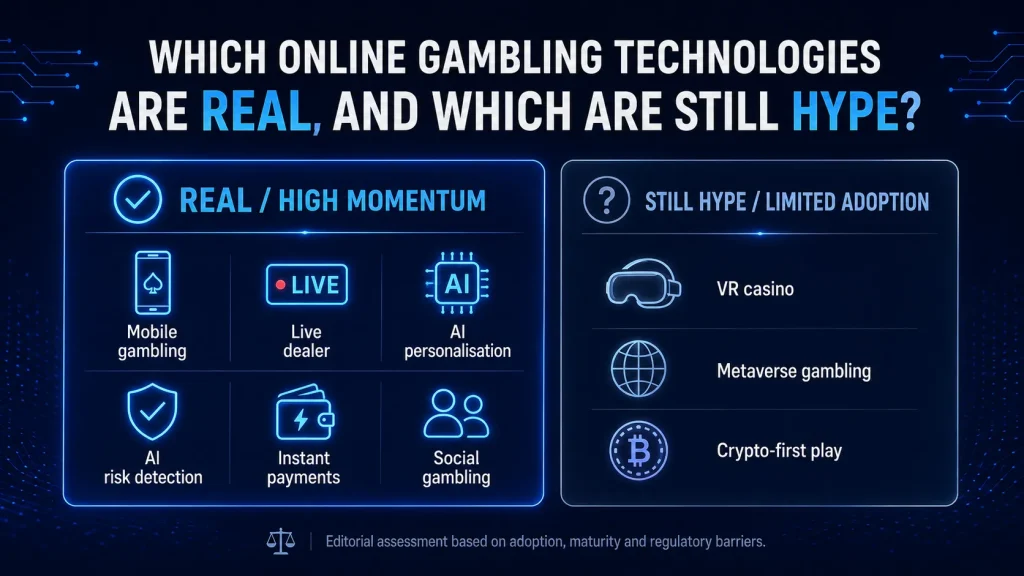
The table below is an editorial assessment based on current adoption, technology maturity and regulatory barriers. It is not a scientific ranking.
| Trend | Adoption today | Future potential | Main barrier |
| Mobile gambling | High | Very high | Regulation |
| Live dealer | High | High | Infrastructure cost |
| AI personalisation | Growing | Very high | Privacy and data rules |
| AI risk detection | Growing | High | Accuracy and false positives |
| Instant payments | Growing | High | Compliance and fraud controls |
| Social gambling | Growing | Medium to high | Regulation |
| Blockchain | Limited | Medium | Adoption and licensing |
| VR casino | Limited | Medium | Hardware ownership |
| Metaverse gambling | Very limited | Low | User demand |
The pattern is consistent. Technologies that improve something players already do tend to scale. Technologies that ask players to change hardware or habits tend to stall.
Regulation Could Shape the Future More Than Technology
Technology asks what platforms can do. Regulation asks what they should be allowed to do. In the last few years, regulation has been the stronger force.
Great Britain is the clearest worked example. Stake limits for online slots came into force in 2025: a maximum of £5 per game cycle for players aged 25 and over from 9 April 2025, and £2 for players aged 18 to 24 from 21 May 2025. This was a direct rule about product design, not a technology decision.
The effect showed up in operator data. In the January to March 2026 quarter, the Gambling Commission recorded total sessions up 18% to 202 million while average spins per session fell from 136 to 124 and GGY per session dropped from £4.01 to £3.82. Sessions lasting more than an hour fell 12%. Players were logging in more often and spending less per visit.
A single regulatory instrument changed session behaviour across an entire national market faster than any product innovation of the same period. Age verification, advertising rules, affordability checks and deposit controls all work the same way. For the local position, see Singapore gambling laws.
Responsible Gambling Technology Will Become Part of Product Design
Player protection is moving from a settings page into the core product: self-exclusion, deposit and loss limits, session reminders, reality checks, automated warnings and behavioural risk scoring.
The scale is already significant. The Gambling Commission reported 5.2 million customer interactions in the January to March 2026 quarter, up 32% year on year, with the majority automated. Direct interactions by staff fell 9% over the same period, and several operators had refined their markers-of-harm algorithms.
That is the real trend: harm detection is moving from manual review to automated systems running continuously in the background. It raises fair questions about accuracy and false positives, but the direction is unlikely to reverse. Our guide to responsible gambling in Singapore covers the tools and support available locally.
Will Online Gambling Replace Physical Casinos?
Probably not completely. The two formats compete on different things.
| Online | Physical |
| Convenience and 24/7 access | Atmosphere and occasion |
| Very large game range | Live social interaction |
| Mobile access anywhere | Physical chips, tables, dealers |
| Faster digital payments | Hospitality, food, entertainment |
| Lower minimum stakes | Destination and travel appeal |
The more likely outcome is hybrid. Live dealer studios, social multiplayer formats and casino apps tied to physical resorts all point toward blending rather than replacement. The US data supports this reading: online overtaking land-based revenue in Pennsylvania and New Jersey happened while land-based revenue was still growing.
What Does the Future of Online Gambling Mean for Singapore?
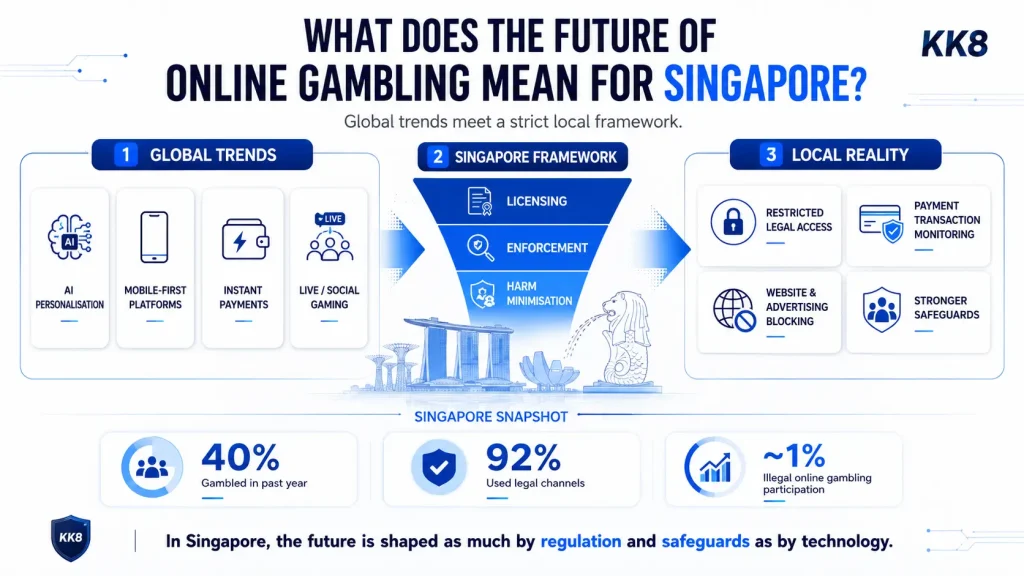
Global trends do not arrive in Singapore unchanged. They arrive filtered through a framework built around licensing, enforcement and harm minimisation.
Gambling in Singapore is regulated through licensing rather than open access. The Ministry of Home Affairs reaffirmed in June 2026 that all gambling activity is illegal unless licensed, authorised or exempted under the Gambling Control Act, and that this applies to online and in-person operators alike. If you are unsure where a specific site stands, read is online gambling legal in Singapore? before anything else.
Technology may develop faster than local access
Global operators will keep shipping better apps, faster payouts and more AI-driven features. Legal availability in Singapore is a separate question from whether the technology exists. A platform being technically impressive says nothing about whether it is authorised here, which is why how to verify an online casino website is a more useful skill than tracking feature announcements.
Enforcement technology will grow alongside gambling technology
This is the part international trend articles miss. Enforcement is also getting more technical. Since 1 January 2025, the Singapore Police Force has handled blocking of access to unlawful remote gambling services, their advertising and associated payment transactions, and directions can be issued under the Online Criminal Harms Act requiring service providers to restrict access.
So in Singapore, two technology curves run in parallel: gambling platforms getting more capable, and website blocking, payment controls and digital enforcement getting more capable at the same time.
Singapore’s future is likely to focus on safeguards
The local baseline is stable rather than expanding. The National Council on Problem Gambling’s 2023 survey found that 40% of residents aged 18 and above had gambled in the past year, down from 44% in 2020 and 52% in 2017. Around 92% of gamblers bet through legal channels. Illegal online gambling participation was about 1%, up from 0.3% in 2020, which the NCPG noted was consistent with global trends.
| Global trend | Singapore consideration |
| Online market growth | Restricted legal access |
| AI personalisation | Privacy and responsible use |
| Instant payments | Payment transaction monitoring |
| Mobile-first products | Regulatory and licensing controls |
| More cross-border platforms | Website and advertising blocking |
For more on how these dynamics are playing out locally, see online gambling trends in Singapore.
Want more local context? Read our full guide to online gambling in Singapore, including how the market works and the rules players should understand.
What Could Online Gambling Look Like by 2030?
Scenarios, not predictions.
| Confidence | What it looks like |
| Likely | Mobile-first as the norm, wider AI use in personalisation and support, faster payouts, more live and game-show formats, stronger identity checks, automated risk monitoring as standard |
| Possible | Broader biometric verification, more social and multiplayer formats, narrow blockchain use for records and settlement, more prescriptive affordability rules |
| Still uncertain | Mainstream VR casinos, metaverse gambling venues, cryptocurrency as a dominant payment method |
Anything in the first row is already visible in operator data today. Anything in the third has been forecast repeatedly without materialising.
Key takeaway
-
The future of online gambling will be shaped as much by trust, verification and player protection as by new games and technology. The most consequential changes of the past few years were a stake limit and a wave of automated harm-detection systems, not a new immersive format. Anyone assessing where the industry goes next should watch the regulators as closely as the product roadmaps.
Frequently Asked Questions
What is the future of online gambling?
Mobile-first, more automated and more heavily verified. AI shapes both personalisation and harm detection, payments get faster, and regulation increasingly dictates product design.
How will AI change online gambling?
In two directions: recommendations, search and support on the commercial side, and detection of unusual spending, long sessions and fraud on the protection side.
Will VR casinos become popular?
Unlikely in the near term. Headset ownership is low and development costs are high. VR looks more like a niche format than a replacement for phone-based play.
Will cryptocurrency become the main online gambling payment method?
Doubtful in regulated markets. Volatility, AML obligations and licensing conditions all work against it. Blockchain’s realistic uses are in records and settlement.
Will online gambling replace physical casinos?
Not completely. Online wins on convenience and range, physical venues on atmosphere and hospitality. A hybrid future is more likely than replacement.
What is the future of online gambling in Singapore?
It depends on the local framework, not global trends. Gambling stays illegal unless licensed, authorised or exempted, and policy focus remains on verification, blocking and harm minimisation.