Skip to content

The Premier League is England’s top domestic football league. Its 20 clubs play each other twice over a season, and the club with the most points is crowned champion. The UEFA Champions League is a separate European competition: 36 leading clubs from across the continent play a league phase, then knockout rounds and a single final.
The two are closely linked. Where an English club finishes in the Premier League decides whether it plays in the Champions League the following season, which is why clubs like Arsenal and Liverpool compete in both at the same time.
This guide sets out the difference between the Premier League and Champions League, explains how qualification works using real 2026/27 examples, and covers what Singapore viewers need to know about kickoff times. For more explainers like this one, browse our football guides.
Premier League vs Champions League: key differences
The table below covers the essentials. The sections after it explain the parts that most often cause confusion.
| Premier League | UEFA Champions League | |
| Type | Domestic league (England) | European club competition |
| Organiser | The Premier League | UEFA |
| Number of clubs | 20 | 36 in the league phase |
| Matches per club | 38 (19 home, 19 away) | 8 in the league phase, then knockout ties for those who progress |
| How the winner is decided | Most points after 38 matches | Knockout rounds ending in a one-off final |
| How clubs get in | Stay in the league or win promotion from the Championship | Qualify through their domestic league, a European title or an extra performance place |
| What happens at the bottom | Bottom three relegated to the Championship | No relegation; clubs placed 25th to 36th are eliminated |
| Season | August to May | Qualifiers from July; 2026/27 final on 5 June 2027 |
| Usual match days | Mostly weekends | Mostly Tuesday and Wednesday nights in Europe |
What is the Premier League?
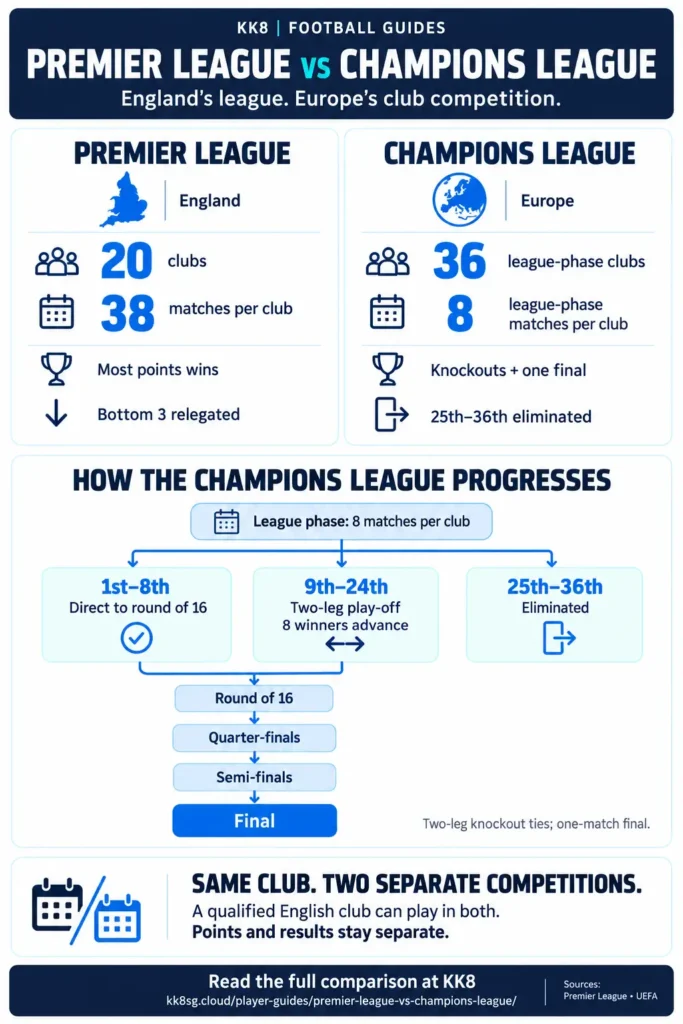
The Premier League is the top division of English football. Twenty clubs play every other club home and away, giving 38 matches each and 380 in total. A win earns three points, a draw one and a defeat none. If two clubs finish level on points, goal difference usually separates them.
The league is a long race for consistency. Arsenal won the 2025/26 title, and the 2026/27 season began on 22 August 2026.
At the bottom, the three lowest-placed clubs are relegated to the English Football League Championship and replaced by three promoted clubs. At the top, final positions decide which clubs play in European competitions the following season.
New to English football? Read our guide to how the Premier League works for the full rules on tiebreakers, promotion and relegation.
What is the Champions League?

The Champions League is UEFA’s top club competition, open to the strongest clubs from Europe’s national leagues. Real Madrid, the most successful club in its history, competes alongside English, Italian, German, French and other qualifiers.
Since 2024/25, the competition has used a single league phase instead of the old eight groups of four. In 2026/27 it works like this:
- League phase: 36 clubs are placed in one table. Each club plays eight different opponents, four at home and four away, and does not face clubs from its own country.
- Top eight: qualify directly for the round of 16.
- 9th to 24th: play a two-legged knockout play-off for the remaining eight places in the round of 16.
- 25th to 36th: are eliminated.
- Knockouts: two-legged round of 16, quarter-finals and semi-finals, then a one-off final. The 2026/27 final is at the Estadio Metropolitano in Madrid on 5 June 2027.
The Champions League is not a second English league. England supplied five of the 36 clubs in 2026/27, and each of them played opponents from other countries only.
How are the Premier League and Champions League connected?
The Premier League table is effectively the entry list for next season’s European competitions. Finishing positions in May decide which English clubs play in the Champions League from the following September. That is why the race for fourth or fifth place often matters almost as much to clubs as the title race.
How do Premier League teams qualify for the Champions League?
There are three routes:
- League position: the top four Premier League clubs earn automatic places in the league phase.
- European Performance Spot: UEFA awards one extra place to each of the two countries whose clubs performed best in Europe the previous season. It goes to the next-highest club in that country’s league.
- European titles: winning the Champions League or Europa League earns a place even if the club finishes outside the qualifying positions in its league.
Here is how the five English places for 2026/27 were filled, based on the 2025/26 final table:
| Club | 2025/26 Premier League finish | Route into the 2026/27 Champions League |
| Arsenal | 1st (champions) | League position |
| Manchester City | 2nd | League position |
| Manchester United | 3rd | League position |
| Aston Villa | 4th | League position (Villa also won the 2025/26 Europa League) |
| Liverpool | 5th | European Performance Spot |
Aston Villa is a useful example of the title route. Had Villa finished outside the top five, its Europa League win would still have taken it into the Champions League.
Why can England have five Champions League teams?
England finished in the top two of UEFA’s 2025/26 association rankings, alongside Spain, so it earned a European Performance Spot for 2026/27. Liverpool secured fifth place with a 1-1 draw against Brentford on the final day, and that was enough. Without the extra spot, fifth would have meant the Europa League.
It was the second season in a row England received the extra place, but it is not guaranteed. The spot depends on how all English clubs perform across the Champions League, Europa League and Conference League each season. A poor European campaign by English clubs in 2026/27 could mean only four places for 2027/28.

Can a club play in both competitions in the same season?
Yes. A qualified English club plays its full 38-match Premier League schedule and its Champions League fixtures alongside it. The two run in parallel but never mix.
Take an illustrative week for Arsenal. Say they win 2-0 away in the Champions League on Tuesday, then draw 1-1 in the Premier League on Saturday. The win adds three points to their Champions League league-phase table only. The draw adds one point to their Premier League total only. Goals, points and goal difference never carry across.
A club can also win both trophies in one season. Manchester City did it in 2022/23, when they also won the FA Cup to complete a treble.
Which is harder to win: Premier League or Champions League?
Neither is automatically harder. They test different things.
| Premier League | Champions League |
| Rewards consistency across 38 matches | League phase followed by knockouts |
| Mostly familiar domestic opponents | Leading clubs from several European leagues |
| Points decide the champion | Knockout ties and a final decide the champion |
| A poor month can be recovered over a long season | One bad night in a knockout tie can end the campaign |
Recent history shows the difference. Chelsea won the Champions League in 2011/12 after finishing sixth in the Premier League. Liverpool won it in 2018/19 in a season when 97 league points were still only enough for second.
Which trophy is tougher in a given season depends on the opponents, squad depth, injuries and form. A deep squad suits a league season; a team that peaks at the right moment can thrive in knockouts.
Premier League vs Champions League: match schedules
Premier League matches are played mainly on Saturdays and Sundays, with some Friday and Monday games and a few midweek rounds. Champions League league-phase matches are played on Tuesday and Wednesday nights, with a few exceptions such as the opening week.
Remaining 2026/27 league-phase dates are 20/21 October, 3/4 November, 24/25 November and 8/9 December 2026, then 19/20 January and 27 January 2027. All dates are UEFA’s published schedule and can change.
For clubs in both, this means two matches a week for long stretches. Managers rotate squads, plan travel around away trips across Europe and manage recovery time between a Wednesday night match and a Saturday lunchtime kickoff.
Watching the Premier League and Champions League in Singapore
For Singapore viewers, the biggest practical difference is the clock. Premier League matches usually fall in the late evening or after midnight. Champions League matches land in the early hours, so a “Tuesday night” European tie is a Wednesday morning match in Singapore.
Singapore does not use daylight saving time, but the UK and Europe do. When European clocks go back on 25 October 2026, most kickoffs move one hour later in Singapore Time (SGT) until 28 March 2027.
| Typical kickoff (local time in Europe) | SGT until 24 Oct 2026 | SGT from 25 Oct 2026 |
| Premier League, Saturday 3pm UK | 10pm Saturday | 11pm Saturday |
| Premier League, Saturday 5:30pm UK | 12:30am Sunday | 1:30am Sunday |
| Premier League, 8pm UK | 3am next day | 4am next day |
| Champions League, 6:45pm Central European Time | 12:45am next day | 1:45am next day |
| Champions League, 9pm Central European Time | 3am next day | 4am next day |
The 2026/27 Champions League final kicks off at 9pm in Madrid on Saturday 5 June 2027, which is 3am on Sunday 6 June in Singapore.
On broadcasters: StarHub holds Premier League rights in Singapore, and the league’s own streaming service, Premier League+, launched here in August 2026 in partnership with StarHub. UEFA lists beIN as its Champions League broadcast partner for Singapore in 2026/27. Packages and prices change, so check each provider before subscribing.
Find out how to watch the Premier League in Singapore, including viewing options and kickoff times.
Keep exploring
- Explore more football guides, competition formats and match information.
- For fixtures and the latest football markets, visit KK8 Sports. For adults aged 18 and over. Please play responsibly
Sources
- UEFA: Liverpool and Real Betis secure the 2026/27 European Performance Spots
- UEFA: 2026/27 Champions League teams, dates, format and final
- UEFA: Where to watch the Champions League (2026/27 broadcast partners)
- Premier League: Which clubs have qualified for Europe
- theScore: Liverpool seal fifth Champions League place on final day
- MustShareNews: Premier League+ launches in Singapore
Frequently Asked Questions
Is the Champions League part of the Premier League?
No. The Premier League is England’s domestic league, run by the Premier League. The Champions League is a separate European competition run by UEFA. They are connected only through qualification: a club’s Premier League finish decides whether it plays in the next season’s Champions League.
Can a team win both the Premier League and Champions League?
Yes. Both titles can be won in the same season because the competitions run in parallel. Manchester City won both in 2022/23, along with the FA Cup. Manchester United did the same treble in 1998/99.
Does winning the Premier League guarantee Champions League qualification?
Yes. The Premier League champion always finishes in the top four, and the top four in England receive automatic places in the next season’s Champions League league phase. Arsenal qualified for 2026/27 this way after winning the 2025/26 title.
Why do some Premier League teams not play in the Champions League?
Only four or five English clubs qualify in a normal season. Clubs just below them usually go into the Europa League or Conference League instead. For 2026/27, Bournemouth and Sunderland qualified for the Europa League and Brighton for the Conference League.
Does the Champions League have relegation?
No. Clubs placed 25th to 36th in the league phase are eliminated, but they do not drop into another division. Every season, entry to the Champions League starts again, based on how clubs performed in their domestic leagues and in Europe.
Can a team win the Champions League without winning its domestic league?
Yes, and it happens often. Chelsea won in 2011/12 after finishing sixth in the Premier League, and Liverpool won in 2018/19 after finishing second. Winning the Champions League also earns a place in the following season’s competition.