Skip to content


“Why do odds change in betting? Because a price is a running estimate, not a fixed verdict. Bookmakers adjust it as new information arrives (injuries, suspensions, confirmed lineups), as money builds up on one side, and as they manage how much they could lose on each result.
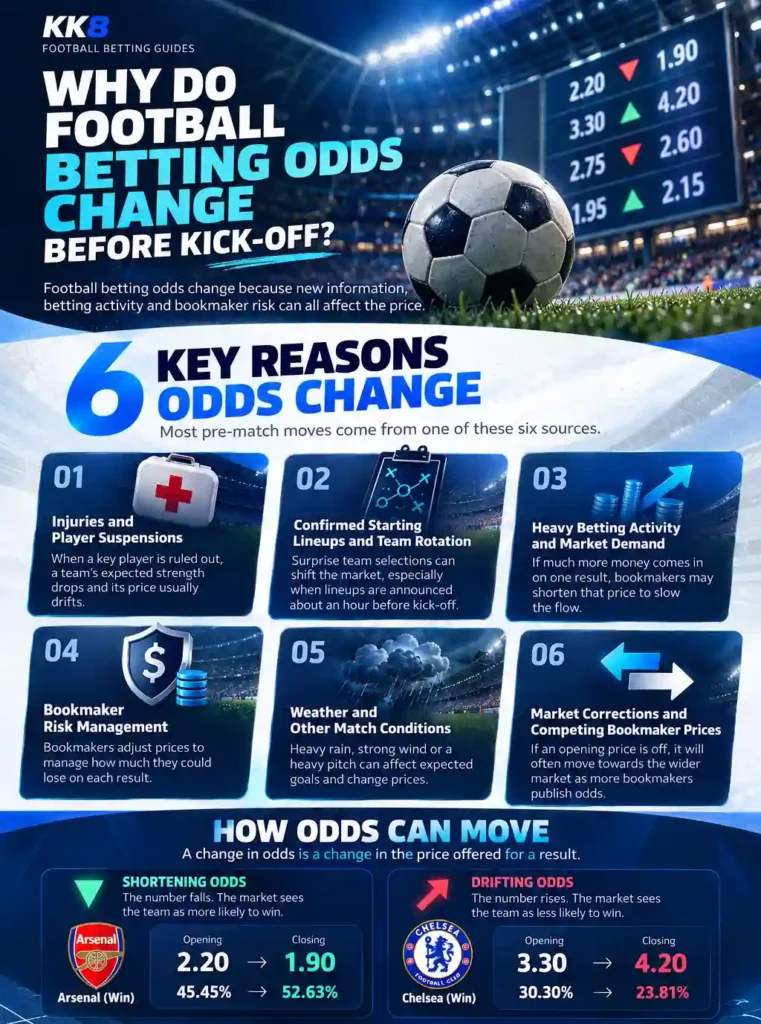
Say Arsenal open at decimal odds of 2.20 to beat Chelsea. An hour before kick-off, the same bet is priced at 1.90. No football has been played. What changed is the market’s view of the match and the bookmaker’s position on it.
This guide covers what those moves mean, the six most common causes, and why a falling price is not a prediction that a team will win. If decimal odds are new to you, start with how football betting odds work.
What Does It Mean When Football Odds Change?
What Are Shortening Odds?
Odds shorten when the number falls. Arsenal moving from 2.20 to 1.90 is a shortening price. Implied probability rises from 45.45% (1 ÷ 2.20) to 52.63% (1 ÷ 1.90). The market now rates an Arsenal win as more likely, and the payout for backing it gets smaller.
What Are Drifting Odds?
| Movement | Decimal odds | Implied probability | Return on a winning S$10 bet |
| Shortening (Arsenal) | 2.20 to 1.90 | 45.45% to 52.63% | $22.00 to $19.00 |
| Drifting (Chelsea) | 3.30 to 4.20 | 30.30% to 23.81% | $33.00 to $42.00 |
Why Do Football Betting Odds Change Before Kick-Off?
Most pre-match moves come from one of six sources. Some change what the bookmaker expects to happen on the pitch. Others only change how the bookmaker wants to price it.
1. Injuries and Player Suspensions
When a key player is ruled out, the team’s expected strength drops and its price usually drifts. How far depends on who is missing and who replaces them: a first-choice goalkeeper with an untested backup matters more than a squad winger with a capable deputy.
Timing matters as much as severity. An injury reported a week ago is already in the price, so the manager confirming it at the pre-match press conference rarely moves the odds again. Odds react to news the market didn’t have, not to news it already priced in.
2. Confirmed Starting Lineups and Team Rotation
Team sheets are usually published around an hour before kick-off. If they match what everyone expected, prices barely move. A surprise is different: a manager resting three regulars ahead of a European tie, or a striker returning earlier than reported, is genuinely new information and can shift the market within minutes.
3. Heavy Betting Activity and Market Demand
If much more money arrives on one result than the bookmaker expected, it may shorten that price to slow the flow and lengthen the others to attract bets on the other side. On betting exchanges, where customers bet against each other, prices move directly with supply and demand. Large bets from customers a bookmaker regards as well informed tend to move prices further than the same total spread across casual bettors.
4. Bookmaker Risk Management
A bookmaker watches its liability: how much it would have to pay out on each result. If one outcome would cost too much, its price may be cut even with no news at all. This is also why different bookmakers show different odds for the same match. Each has its own customers, its own exposure and its own margin. For the full picture, see how bookmakers set football odds.
5. Weather and Other Match Conditions
Heavy rain, strong wind or a heavy pitch tends to slow a game and lower expected goals. That shows up most in over/under goals markets, but it can also narrow the gap between a passing side and a direct, physical underdog in the match result market. Late venue changes and fixture congestion can have a similar effect.
6. Market Corrections and Competing Bookmaker Prices
Sometimes the opening price is simply off. As more bookmakers publish odds and more money enters, outliers get pulled toward the consensus. If one bookmaker offers Arsenal at 2.30 while the rest sit near 2.10, it will usually cut its price quickly. That looks like movement, but nothing about the match has changed.
Why Do Odds Sometimes Change Just Before Kick-Off?
The last few hours before a match are when the most new information arrives at once. Confirmed lineups, late fitness news and a large share of the betting volume all tend to land close to kick-off, so prices are often busiest then.
A typical pre-match market moves through these stages, though timings vary by competition and fixture:
- Opening odds. Bookmakers publish first prices, often several days ahead, based on their models and recent form.
- Early team news. Press conferences and injury reports confirm or rule out players. Prices adjust to anything unexpected.
- The market builds. More money comes in, more bookmakers price the game, and outlying odds move toward the consensus.
- Lineups confirmed. Team sheets appear about an hour out. Surprises here cause the sharpest late moves.
- Closing odds. The last price available before the match starts.
Not every match follows this pattern. A quiet mid-table fixture may barely move, while a big Premier League game with a late fitness doubt can swing several times in an afternoon. Once the match starts, prices follow what happens on the pitch, which is a different market. See live betting vs pre-match betting.
Opening Odds vs Closing Odds: What's the Difference?

Opening odds are the first prices a bookmaker offers on a match. Closing odds are the last prices available before kick-off. The gap between them sums up everything the market learned in between.
| Opening odds | Closing odds | |
| When | When the market first opens, often days ahead | Just before kick-off |
| Based on | Pricing models, form, early expectations | The same, plus team news, lineups and betting activity |
| Information included | Limited | As much as the market has |
| How stable | Most likely to be adjusted | Usually the most settled pre-match price |
Closing odds are generally treated as the market’s best-informed pre-match estimate, because they have absorbed the most information. That’s why experienced bettors often compare the price they took with the closing price. Regularly getting a better price than the close suggests their read of a match was ahead of the market, but it says nothing about whether any single bet wins.
In 1X2 football betting (home win, draw, away win), the three prices are linked. When one shortens, at least one of the others usually drifts. Comparing all three at opening and closing tells you more than tracking one price on its own.
Example: How Team News Can Change Football Odds
The match and all odds below are hypothetical, used for illustration only. They are not historical or live prices.
Arsenal host Chelsea in a Premier League match. Arsenal open at 2.20. On the morning of the game, reports say Chelsea’s first-choice centre-back has failed a fitness test, and Arsenal shortened to 2.05. An hour before kick-off, the team sheet confirms an inexperienced replacement, late money comes in on the home side, and Arsenal close at 1.90.
| Stage | Arsenal win odds | Implied probability |
| Opening odds | 2.20 | 45.45% |
| Injury news emerges | 2.05 | 48.78% |
| Final pre-match price | 1.90 | 52.63% |
The quoted implied probability of an Arsenal win rose by 7.18 percentage points. That is the market’s estimate moving, not proof that Arsenal’s real chance rose by exactly that amount.
The other two prices moved as well:
| Result | Opening odds | Closing odds |
| Arsenal win | 2.20 (45.45%) | 1.90 (52.63%) |
| Draw | 3.40 (29.41%) | 3.60 (27.78%) |
| Chelsea win | 3.30 (30.30%) | 4.20 (23.81%) |
| Total implied probability | 105.17% | 104.22% |
Notice that the totals are above 100%. The next section explains why, and why it matters when you read any price change.
Do Changing Odds Mean a Team Is More Likely to Win?
How to Understand Football Odds Movement

When you see a price move, run through these checks before reading anything into it:
- Identify the market. A move in the match result price means something different from a move in over/under goals or Asian Handicap. Weather, for example, tends to show up in goal lines first.
- Compare prices at different times. Note the opening price and the current one, and look at every outcome in the market, not just the one that moved.
- Look for the cause in credible team news. Check official club channels and the Premier League website before trusting a rumour. If there is no news, the move may come from money or a correction.
- Ask whether the news is actually new. Information that has been public for days is usually already in the price.
- Separate probability from margin. If every outcome shortens at once, the bookmaker has likely widened its margin rather than changed its view.
- Compare across bookmakers. A move at one bookmaker may simply reflect its own exposure.
For more on markets and terminology, explore football betting and our other football explainers.
Frequently Asked Questions
Why do betting odds suddenly drop?
A sudden drop, called shortening, usually follows unexpected team news or a wave of money on one result. It can also be a bookmaker correcting a price that was out of line with the market.
If the odds change after I place a bet, does my bet change too?
Generally not. A bet is normally settled at the odds confirmed when it was accepted, and later moves affect new bets only. The operator’s terms and applicable rules decide the details.
Why do football odds change before kick-off?
Bookmakers adjust prices as injuries, lineups, betting activity and other information change the estimated likelihood of each result, and as they manage their own exposure.
What is the difference between opening odds and closing odds?
Opening odds are the first prices published for a market. Closing odds are the last prices available before the match starts.
Can football betting odds change without team news?
Yes. Betting volume, market liquidity, competitor prices and bookmaker risk management can all move odds when nothing has happened to either team.
Do lower odds mean a team is going to win?
No. Lower decimal odds mean a higher implied probability, not a certain result. A team priced at 1.50 is still expected to fail to win about a third of the time.
Frequently Asked Questions
- Unlawful Remote Gambling Activities, Gambling Regulatory Authority of Singapore
- Premier League, official site, for team news referenced in the checklist