Casino payment verification is the check that connects three things: your account, a specific transaction, and the bank or e-wallet account the money came from. If those three do not line up, the payment gets flagged.
That is why plenty of people run into this after they have already passed identity checks. Their ID was fine. The problem was something else, usually a name that reads differently on a bank statement, a screenshot missing a reference number, or a transaction the reviewer simply cannot find.
This guide explains what is being compared, why it fails, and what to check before sending anything else.
Explore more: Online Gambling Singapore Guide
Quick answer: Why does casino payment verification fail?
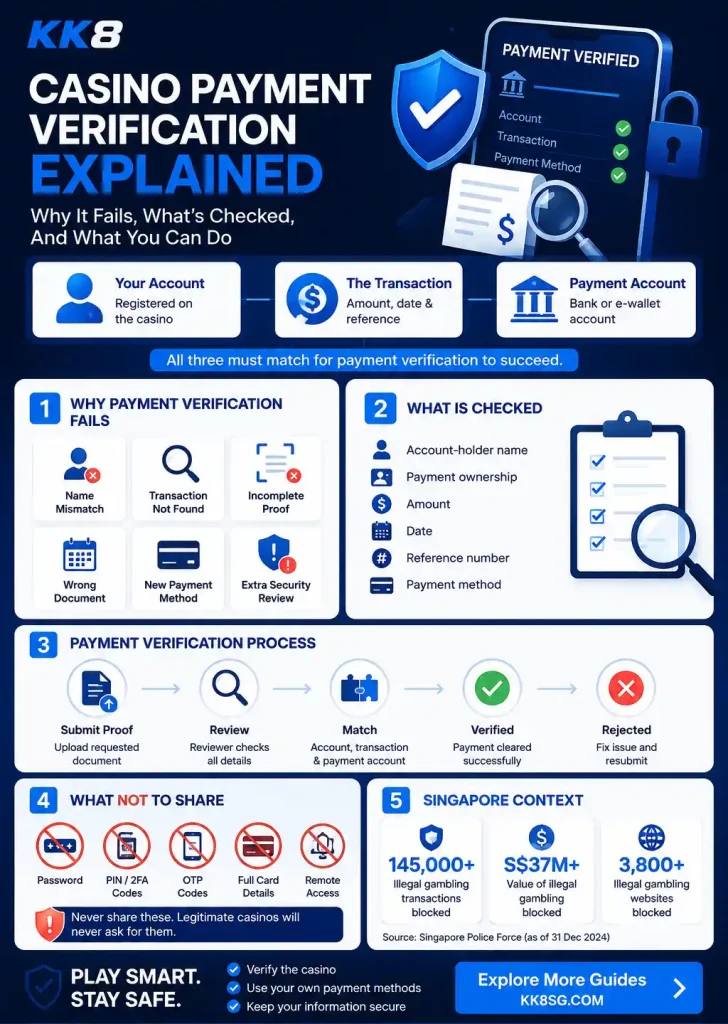
Most rejections come down to a mismatch that the reviewer cannot resolve from what you sent. The account-holder name on the payment does not match the name registered on the gaming account. The transaction cannot be located because the amount, date or reference does not match the record. The document is cropped, blurred, or shows the wrong statement period. Or the payment came from a method that has not been reviewed yet.
Fewer failures are caused by the payment being genuinely wrong. Most are caused by the evidence being incomplete.
| Common cause | What it usually looks like |
| Name mismatch | Payment sent from an account in someone else’s name |
| Transaction not found | Amount, date or reference does not match |
| Incomplete proof | Cropped screenshot, name or transaction cut off |
| Wrong document | Statement covers the wrong month |
| New payment method | A second method used that has not been reviewed |
| Extra security review | Larger amount, new device, or unusual activity |
What is casino payment verification?
Think of it as three records that need to agree:
Gaming account → the transaction → bank or payment account
The gaming account says who the registered holder is. The transaction says how much moved, when, and with what reference. The bank or e-wallet account says whose money it was.
Payment verification asks whether those three records describe the same person and the same event. When they do, it clears. When one link is missing or contradicts another, it does not.
An operator may run this check for anti-money laundering and fraud-prevention reasons, and because paying withdrawals out to a person who is not the depositor creates obvious risk. Whether an individual operator applies these checks properly is a separate question, and one worth reading about in our guide on How Online Casino Security Works.
Payment verification vs account verification
These get confused constantly, and the confusion is the reason so many people say “but I’m already verified.”
Account or KYC verification
This checks who you are. It usually looks at:
- full name
- date of birth
- an identity document
- residential address
Pass it once and it generally stays passed.
Payment verification
This checks the payment and who owns it. It usually looks at:
- the account-holder name on the payment source
- the payment method itself
- the transaction amount
- the transaction date
- the transaction reference
This one can be triggered again and again, because every new payment method or unusual transaction is a new thing to check.
| Check | Account verification | Payment verification |
| Identity document | Yes | Sometimes |
| Account-holder name | Yes | Yes |
| Payment method | No | Yes |
| Transaction details | No | Yes |
| Proof of payment | No | Yes |
A verified identity does not verify a payment. That is the single most useful thing to understand here.
What is actually being checked
When a reviewer opens your submission, they are trying to match a short list of data points.
| Data point | What they compare it against |
| Account-holder name | The name registered on the gaming account |
| Payment ownership | Whether the payer and the account holder are the same person |
| Amount | The credited or requested transaction amount |
| Date | The date on the internal transaction record |
| Reference number | The transaction ID or bank reference |
| Payment method | Whether that method is already linked and reviewed |
If any one of these cannot be confirmed from what you submitted, the whole submission usually bounces back. The reviewer is not guessing on your behalf.
7 common casino payment verification issues
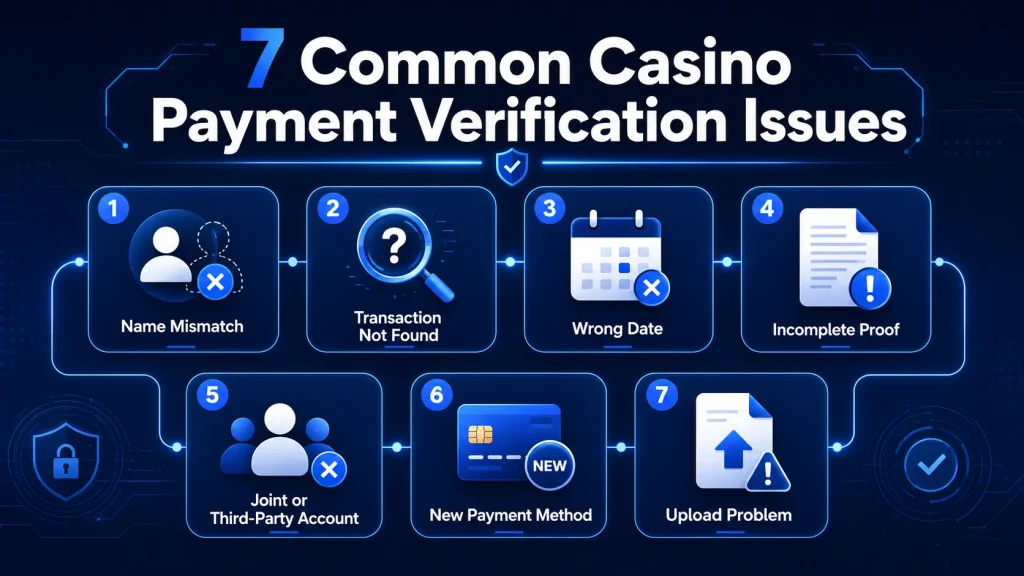
1. The account-holder name does not match
This is the most frequent cause and the hardest to fix.
If the online gaming account is registered as Tan Wei Ming and the payment arrives from a bank account held by Lim Siew Hoon, the reviewer cannot connect the payment to the account holder. It does not matter that the two people know each other.
Softer versions of this also cause trouble:
- registered as “Wei Ming Tan,” bank account reads “TAN WEI MING”
- registered with an English name only, bank account carries the full legal name including a Chinese name
- a maiden name on one record and a married name on the other
The first two are usually resolvable by correcting the registered name to match your legal name on your ID. The third normally needs supporting documentation. A payment genuinely made by someone else is a different situation, and there is no workaround for it. Ownership checks exist precisely to catch that.
2. The transaction cannot be matched
The reviewer is searching for one specific line item. Common reasons they cannot find it:
- the amount submitted differs from the amount credited, often because of a bank or intermediary fee
- no reference or transaction ID is visible
- the wrong transaction was submitted, for example an earlier deposit of a similar amount
- the statement covers a period that does not include the transaction date
Example: you transferred $300 but $298.50 was credited after a fee. The proof shows $300, the internal record shows $298.50. To an automated matcher those are two different transactions.
3. The transaction date looks different
Banks record several dates for one payment: the date you initiated it, the date it was processed, and the date it posted to the account. A transfer made late on a Friday night may post on Monday.
If your proof shows one date and the operator’s record shows another, do not assume the transaction is wrong. Submit the full transaction record showing the reference and status rather than a single date field.
4. The document is wrong or incomplete
A cropped screenshot is the classic rejection. If the reviewer cannot see the account-holder name, the transaction, and enough context to know it is a real record, they cannot approve it.
Frequent problems:
- account-holder name cropped out of the top of the statement
- only the amount visible, no reference or date
- a payment confirmation screen instead of the transaction record itself
- a statement from the wrong account
- a photo of a screen, taken at an angle, partly unreadable
5. The payment came from a joint or third-party account
A joint account can be legitimate and still trigger review, because two names appear on it. Expect to be asked for additional evidence that you are one of the named holders.
A genuine third-party payment, where the money came from someone else entirely, is a different matter. Operators are generally required to reject it, and looking for ways around that check creates a worse problem than a delayed deposit.
6. A different payment method was used
Payment methods are usually reviewed one at a time.
- Deposit A: bank transfer from your DBS account. Verified.
- Deposit B: e-wallet you have never used on the account before. Not verified.
The second method has its own review, even though your identity and your first method both cleared. This surprises people who assume verification is account-wide.
7. Technical and upload problems
Not everything that fails is a data problem:
- HEIC or unusual file formats that the system cannot open
- files over the size limit that silently fail to upload
- a page that appears to submit but does not
- an image compressed until the text is unreadable
If a submission disappears without any rejection reason, this is worth ruling out before you re-send documents.
PayNow and online banking in Singapore
If you pay by PayNow or local bank transfer, name matching is the part most likely to cause friction, and a recent change makes it more visible.
The Association of Banks in Singapore discontinued the PayNow nickname feature for retail customers on 6 June 2026. Nicknames had been available since PayNow launched in 2017, and scammers had been exploiting them to impersonate businesses, government agencies and trusted individuals. From that date, selected letters of the payee’s registered account name are shown to the payer instead, with the rest masked for privacy.
The practical effect is that the registered account name now carries more weight than it used to. It is the name the payer sees, and it is the name that appears on the transaction record.
Case one
- Online gaming account: Tan Wei Ming
- PayNow account holder: Tan Wei Ming
The payer and the account holder are the same person. Nothing to question.
Case two
- Online gaming account: Tan Wei Ming
- PayNow account holder: a different person
The money moved, but there is no line connecting it to the account holder. That is what an ownership question looks like, and no amount of resubmitting the same screenshot resolves it.
Individual operators handle PayNow proof differently. Some ask for the transaction record from your banking app, some ask for a statement extract. Ask which one they need rather than sending both and hoping.
For background on how the deposit itself moves before any of this happens, see How Online Casino Deposits Work.
What to do if payment verification is rejected
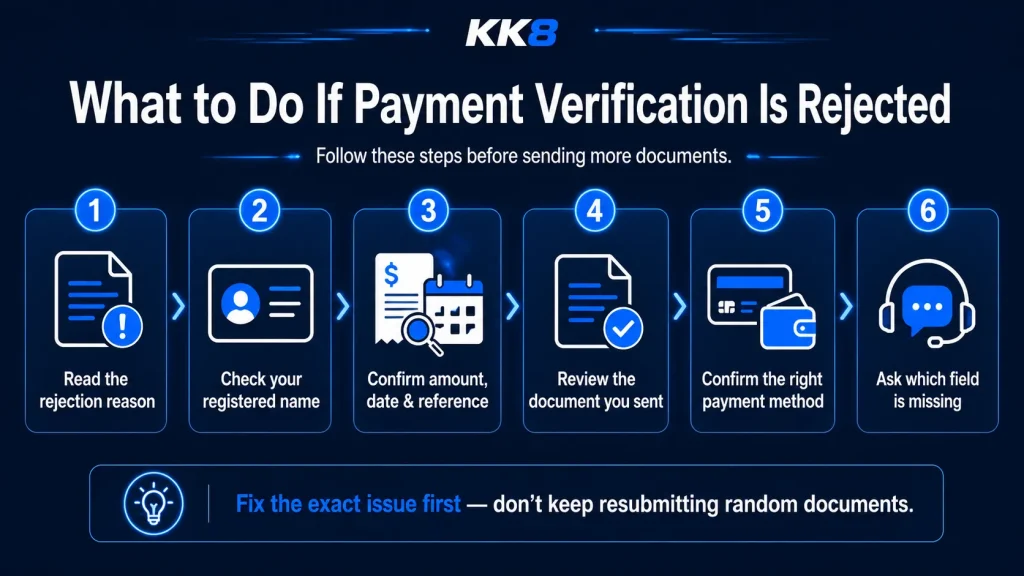
Work through this in order. Sending more documents before you know what failed is the main reason people end up on their fourth rejection.
Step 1. Read the exact rejection reason. “Verification failed” and “document does not show account-holder name” are different problems. If the message is generic, that is your first question to support.
Step 2. Check the registered name against your ID. Not against what you assume it is. Open the account settings and compare it character by character with your identity document.
Step 3. Confirm the amount, date and reference. Match them to the transaction record on your banking or e-wallet app, not to memory. Watch for fee deductions changing the amount.
Step 4. Check what your submitted document actually shows. Open the file you sent. Can a stranger see the account-holder name, the transaction line, the amount, the date and the reference? If not, that is the fix.
Step 5. Confirm you are verifying the right payment method. People routinely submit proof for the method they usually use rather than the one under review.
Step 6. Ask support what specific field is missing. One precise question beats five different documents. “Which field on the proof could you not read?” gets a useful answer.
This process is for correcting genuine information. If the underlying facts do not support the payment, for instance the money really did come from someone else’s account, no document fixes that.
If the delay is on a deposit rather than a verification request, What to Do If a Casino Deposit Is Delayed covers that separately.
What you should never share
There is a firm line between verification information and account credentials. Verification never requires the second category.
| Reasonable to be asked for | Never share with anyone |
| Transaction reference number | Online banking password |
| Amount and date of payment | Card PIN |
| Redacted statement showing the transaction | One-time password (OTP) |
| Identity document | 2FA authentication code |
| Account-holder name | Singpass password |
| Payment method last digits | Remote access to your device |
ScamShield, Singapore’s national anti-scam resource, advises people not to disclose passwords, banking credentials, card details or OTPs, and warns against payment links and QR codes sent by unknown parties.
No legitimate payment review needs your OTP. An OTP authorises a transaction. It does not prove one happened.
Payment verification vs withdrawal processing
People often assume a withdrawal on a fast payment method should arrive within minutes. Verification usually sits before processing even begins.
A withdrawal typically moves through:
- Account review (is the account in good standing?)
- Payment method review (is this method verified and owned by the account holder?)
- Security and risk review (does anything look unusual?)
- Payment processing (the money actually moves)
A fast rail like PayNow only affects step four. If a withdrawal is sitting at step two, the speed of the payment method is irrelevant. This is the usual explanation for “instant withdrawals” that are not instant.
More detail on the sequence is in How Online Casino Withdrawals Work.
When verification requests become a red flag
A single delayed or rejected verification is normal and proves nothing. A pattern is different.
Treat these as warnings:
- repeated rejections with no explanation of which field failed
- any request for a banking password, PIN or OTP
- being asked to deposit again to “unlock,” “release” or “activate” a withdrawal
- being told to send documents to a personal WhatsApp, Telegram or Gmail account rather than an official channel
- requirements that keep changing after each submission
- pressure to act immediately
The “pay to release your winnings” request deserves particular attention. A legitimate withdrawal is never contingent on sending more money in. That framing is a well-documented scam pattern, covered further in Common Online Gambling Scams.
Before sending identity or financial documents anywhere, it is worth checking whether the website itself can be verified at all. Our guide on How to Verify an Online Casino covers what to look for.
Frequently Asked Questions
What is casino payment verification?
A check used to confirm that a payment method, a specific transaction and the registered account holder all belong together. It focuses on the payment rather than on your identity alone.
Why did my casino payment verification fail?
Usually a mismatched account-holder name, transaction details that cannot be located, an incomplete or cropped document, or the use of a payment method that has not been reviewed yet.
Why is a casino asking for proof of payment?
To match a specific transaction to a payment method and to the person who holds the account. Without a reference, amount and date, the transaction often cannot be identified.
Is payment verification the same as KYC verification?
No. KYC checks who you are. Payment verification checks a particular payment and its ownership, which is why an already-verified account can still be asked for it.
Why is my payment verification still pending?
It may still be in document, transaction, ownership or security review. Manual reviews take longer outside business hours and on weekends.
How long should payment verification take?
It varies by operator and there is no universal standard. If it stretches well beyond the timeframe stated in the terms with no explanation of what is outstanding, ask for the specific field that is missing.
Can payment verification delay a withdrawal?
Yes. Payment review normally happens before the withdrawal reaches processing, so the speed of the payment method itself is not the limiting factor.
Should I give a casino my banking password or OTP for verification?
No. ScamShield advises never disclosing banking credentials or OTPs to anyone. No legitimate verification process requires them.
Can I use my spouse’s bank account to deposit?
Payments from an account held by another person generally fail ownership checks and can cause withdrawals to be blocked. Joint accounts you are named on are a separate case and usually need extra documentation.
This guide is informational and does not constitute legal or financial advice. Verification requirements, document standards and processing times vary between operators, banks and payment providers, and they change over time. Always check the current terms of the service you are using, and confirm anything relating to your own bank or e-wallet account directly with the provider that holds it.
Sources
- Gambling Regulatory Authority, Unlawful Remote Gambling Activities: https://www.gra.gov.sg/harm-minimisation/unlawful-remote-gambling-activities
- Association of Banks in Singapore, PayNow nickname discontinuation (29 April 2026): https://www.abs.org.sg/e-payments/pay-now
- Ministry of Home Affairs, Number of Illegal Gambling Websites and Apps Blocked and Banned in Singapore: https://www.mha.gov.sg/media-room/newsroom/number-of-illegal-gambling-websites-and-apps-blocked-and-banned-in-singapore/
- ScamShield, Phishing Scams: https://www.scamshield.gov.sg/i-want-protection-from-scams/learn-to-recognise-scams/phishing-scams/