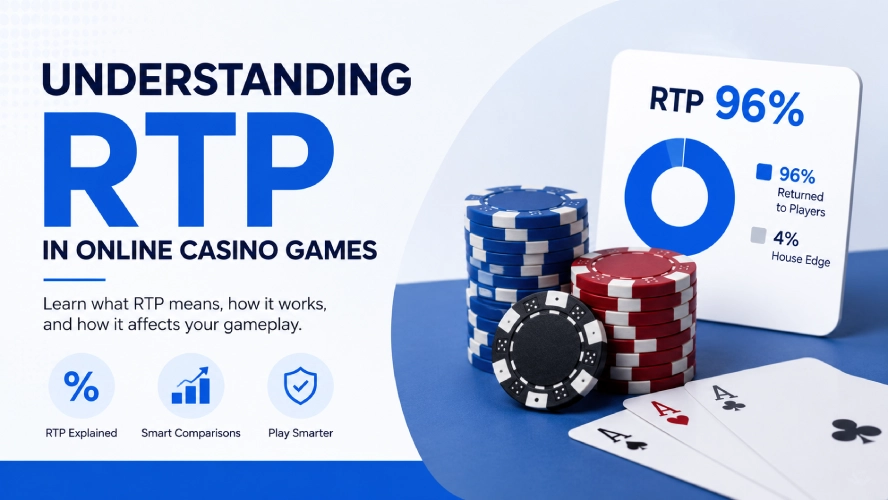
Return to Player, usually shortened to RTP, is one of the most common figures shown in online casino games. It tells you how much of the total money wagered a game is designed to return to players over a long period.
A slot with an RTP of 96% is designed to return $96 for every $100 wagered across a large number of rounds. The remaining $4 represents the game’s theoretical house edge. This does not mean every player receives $96 back after wagering $100. Short sessions often produce results far above or below the stated RTP.
Understanding this difference helps you read game information more accurately and compare casino games with less confusion.
If you are new to online gaming, read our Online Casino Singapore guide for a broader overview of casino games, payments and platform checks.
What Does RTP Mean in Casino Games?
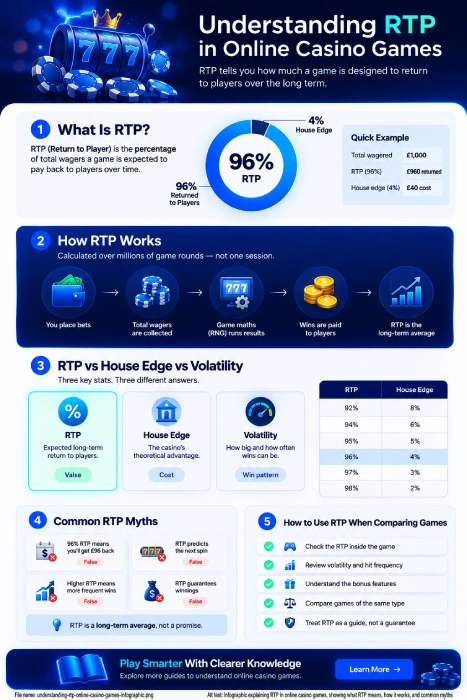
RTP stands for Return to Player. It represents the theoretical percentage of all wagered money returned as winnings over time.
The basic formula is:
RTP = Total winnings ÷ Total wagers × 100
Suppose a game records $1,000,000 in wagers and returns $960,000 in winnings.
Its recorded RTP would be:
$960,000 ÷ $1,000,000 × 100 = 96%
RTP focuses on total wagering, not the amount deposited.
A player might deposit $50 but place 200 bets of $1 by reusing winnings. In this case, the total amount wagered is $200, not $50.
This distinction matters because theoretical losses are based on turnover.
Explore More: Online Casino Terms Explained
RTP Applies to Total Wagers, Not Deposits
Many players confuse their deposit with their total wagering amount. Consider this example:
| Item | Amount |
| Starting deposit | $50 |
| Stake per round | $1 |
| Number of rounds | 200 |
| Total wagered | $200 |
| Game RTP | 96% |
| Theoretical return | $192 |
| Theoretical cost | $8 |
The player started with $50 but generated $200 in turnover.
At 96% RTP, the theoretical cost is 4% of $200, which equals $8.
The formula is:
Theoretical cost = Total wagers × House edge
This does not mean the player will lose exactly $8. The result of a single session may differ widely.
RTP and House Edge
RTP and house edge describe the same game from opposite perspectives. RTP measures the theoretical amount returned to players. House edge measures the theoretical amount retained by the game.
The relationship is simple:
House edge = 100% − RTP
| RTP | House Edge |
| 92% | 8% |
| 94% | 6% |
| 95% | 5% |
| 96% | 4% |
| 97% | 3% |
| 98% | 2% |
A higher RTP means a lower theoretical house edge. This does not remove risk. It only reduces the expected cost per pound wagered over a long period.
What Does a 96% RTP Mean?
A 96% RTP means the game is mathematically designed to return 96% of total wagers over a large sample.
It does not mean:
- You have a 96% chance of winning
• You will receive $96 after wagering $100
• Every session finishes close to 96%
• The game will repay earlier losses
• The next round is more likely to win
Each round follows the game’s rules and random outcome system. RTP describes long-term value. It does not predict timing.
Why Your Results Rarely Match the Published RTP
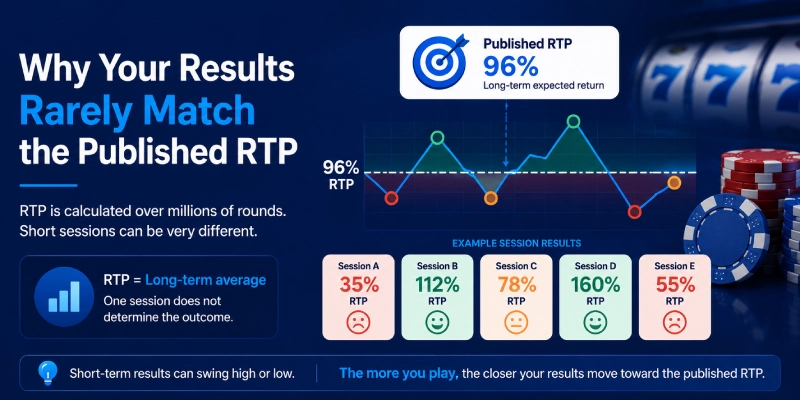 Published RTP figures are based on large volumes of play. A single player might complete only a few hundred rounds. That sample is too small to reflect the game’s long-term mathematical average.
For example, a 96% RTP slot might produce these short-term results:
| Session | Total Wagered | Total Returned | Observed RTP |
| A | $100 | $35 | 35% |
| B | $100 | $112 | 112% |
| C | $100 | $78 | 78% |
| D | $100 | $160 | 160% |
All four results are possible. Observed RTP becomes more stable as the number of rounds increases, but individual outcomes still remain unpredictable.
This is why RTP should be treated as a long-term cost indicator rather than a session forecast.
Theoretical RTP vs Actual RTP
Theoretical RTP and actual RTP are related, but they are not the same.
| Metric | Theoretical RTP | Actual RTP |
| Meaning | Designed mathematical return | Return recorded from completed play |
| Source | Game mathematics | Real wagering data |
| Timeframe | Long-term expectation | Selected reporting period |
| Stability | Fixed for a game configuration | Changes as new results are added |
| Predicts one session | No | No |
Theoretical RTP comes from the game’s design.
Actual RTP is calculated from recorded results:
Actual RTP = Total winnings ÷ Total wagers × 100
A game designed with 96% RTP might record 93%, 98% or another figure over a limited period. This does not automatically show an error. Sample size and volatility affect the result.
RTP vs Volatility
RTP measures expected long-term return. Volatility measures how widely short-term results may move.
Two games might both have 96% RTP but offer different playing patterns.
| Game | RTP | Volatility | Typical Pattern |
| Game A | 96% | Low | Smaller wins appearing more often |
| Game B | 96% | High | Fewer wins with larger potential payouts |
Game A and Game B have the same theoretical return, but the balance movement feels different.
A higher RTP does not mean lower volatility. A lower-volatility game does not always have a higher RTP. These figures should be reviewed separately.
Learn More: What Is Volatility in Slot Games?
RTP vs Hit Frequency
Hit frequency shows how often a game produces a winning result. For example, a game with a 25% hit frequency produces a winning result on roughly one in four rounds across its mathematical model.
Hit frequency does not show whether those wins are large enough to cover the stake.
A $1 round returning $0.20 still counts as a winning result in many game statistics, even though the player lost $0.80 overall.
This creates an important distinction:
- RTP measures the value returned
• Hit frequency measures how often wins occur
• Volatility measures the size and spread of results
Reviewing all three gives a clearer view of a game’s structure.
Is a Higher RTP Better?
From a mathematical cost perspective, a higher RTP is preferable. The effect becomes clearer as total wagering increases.
| Total Wagered | Cost at 94% RTP | Cost at 96% RTP | Cost at 98% RTP |
| $100 | $6 | $4 | $2 |
| $500 | $30 | $20 | $10 |
| $1,000 | $60 | $40 | $20 |
| $5,000 | $300 | $200 | $100 |
The difference between 94% and 98% RTP is $40 per $1,000 wagered. This remains a theoretical comparison. Short-term results might not follow these figures.
What Is Considered a Good RTP?
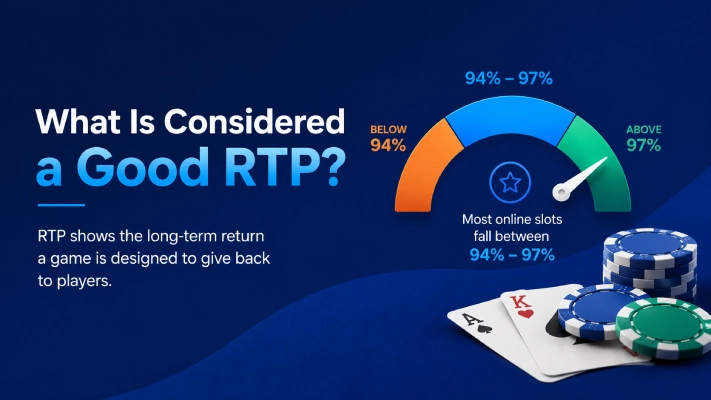
There is no single figure that applies to every casino game. For online slots, many games fall within a broad range of around 94% to 97%. Some sit below or above this range.
Table games use different rules and calculations. Blackjack RTP depends on factors such as:
- Number of decks
- Dealer rules
- Blackjack payout
- Double-down rules
- Player decisions
Baccarat and roulette also have different house edges depending on the selected bet.
For this reason, RTP comparisons work best between games of the same type. Comparing a slot with blackjack based on RTP alone gives an incomplete picture.
Where to Find a Game’s RTP
RTP usually appears in one of these areas:
- Game information menu
- Help section
- Paytable
- Rules page
- Provider documentation
- Casino game description
Look for labels such as:
- Return to Player
- RTP
- Payout percentage
- Theoretical return
- Player return
The in-game information screen is usually the most relevant source because it relates to the version currently loaded.
RTP Verification Checklist
Before relying on an RTP figure, check:
□ The percentage appears inside the game
□ The provider is clearly named
□ The figure applies to the current version
□ Optional features use the same RTP
□ Jackpot contributions are explained
□ The information is dated
□ The figure refers to theoretical RTP
□ Different stake levels do not change the setting
This check is useful when two websites publish different figures for the same game.
How Bonus Features Affect RTP
A game’s total RTP might include several parts:
- Base-game wins
- Free-spin features
- Bonus rounds
- Progressive jackpot contributions
- Optional feature purchases
- Side bets
Some optional features use a separate RTP. A bonus purchase, for example, might have a different mathematical return from standard play. Learn more in our guide to Understanding Online Casino Bonuses.
Common RTP Misunderstandings
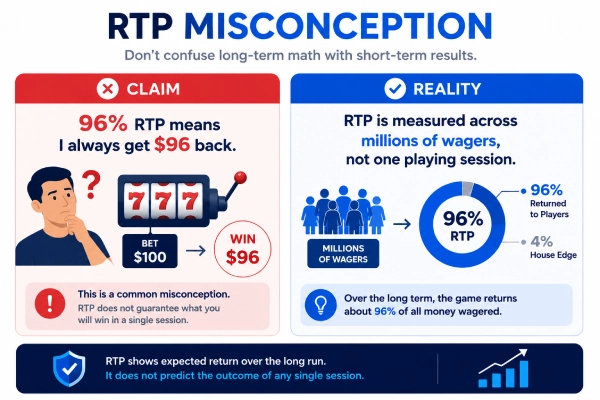
“A 96% RTP means I get $96 back”
Not necessarily. The figure applies across total wagers over a large sample. One player might receive much less or much more during a short session.
“High RTP means frequent wins”
No. Win frequency depends on hit frequency. Prize size and balance swings depend on volatility.
“RTP predicts the next result”
No. RTP does not identify when a win will happen.
“A game must repay losses to reach its RTP”
No. Games do not track a player’s losses and schedule future wins to correct the percentage.
“Every casino offers the same version”
Not always. Some providers offer several RTP configurations.
How to Use RTP When Comparing Games
RTP is useful, but it should not be the only comparison point. Use this framework:
| Metric | Question It Answers |
| RTP | What is the expected long-term cost? |
| Volatility | How large might balance swings be? |
| Hit frequency | How often do winning results appear? |
| Maximum payout | What is the largest possible prize? |
| Feature structure | How are bonuses triggered? |
| Rules | Do stake choices or side bets change the return? |
A game with high RTP might still have high volatility, rare bonus rounds or a low hit frequency. Review the full game information before drawing conclusions.
Responsible Use of RTP Information
RTP helps explain game mathematics. It does not turn casino games into an investment. Every casino game with a house edge has a negative expected value for the player over time. A higher RTP reduces the theoretical cost. It does not guarantee profit. Treat RTP as an educational comparison tool, not a winning strategy.
Frequently Asked Questions
What does RTP mean in an online casino?
RTP means Return to Player. It shows the theoretical percentage of total wagers returned as winnings over a long period.
Is 96% RTP good?
A 96% RTP is common for many online slots. It means the game has a theoretical house edge of 4%. A higher RTP results in a lower expected cost over large wagering volumes.
Does a 96% RTP mean a 96% chance of winning?
No. RTP measures returned value, not the chance of winning a round or finishing a session in profit.
Does RTP apply to one session?
No. RTP is based on long-term game mathematics. One session might finish far above or below the published percentage.
Is RTP the same as house edge?
They describe opposite sides of the same calculation. A game with 96% RTP has a 4% house edge.
Is RTP the same as volatility?
No. RTP measures expected long-term return. Volatility measures the size and frequency of balance swings.
Where do I find a game’s RTP?
Check the information menu, help section, paytable or provider documentation. The in-game information screen usually gives the most relevant figure.
Why does the same slot show different RTP percentages?
Some providers release several mathematical configurations of the same game. Different platforms might use different versions.
Does higher RTP guarantee better results?
No. Higher RTP lowers the theoretical cost over time, but short-term outcomes remain unpredictable.