Tag: Casino Payments

  • What to Do If a Casino Deposit Is Delayed

    What to Do If a Casino Deposit Is Delayed

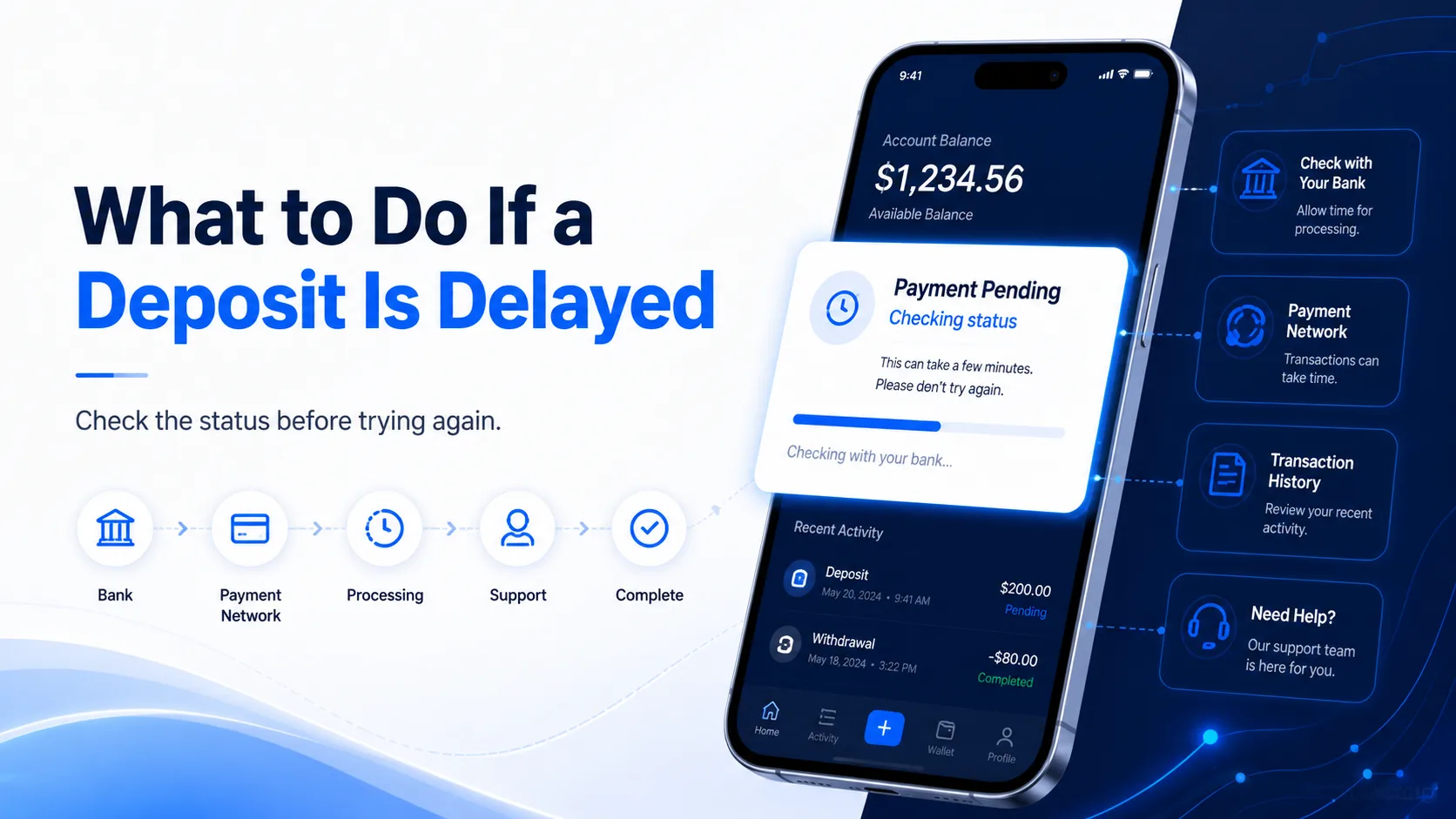
    A casino deposit delay can be confusing, especially when money has already left your bank account but your account balance has not changed. However, a delayed deposit does not always mean the money is lost. The transaction may still be pending with your bank, payment provider, payment network, or the system responsible for adding the funds to your account.

    The most important thing is to find out where the payment is stuck before trying again. Check the transaction status in your bank or payment app, compare it with your account transaction history, and keep the payment reference. If the bank shows that the payment was completed but the deposit is still missing, you may need to contact support so the transaction can be traced.

    For a broader overview of platforms, payments, regulation and player safety, see our Online Gambling Singapore Guide.
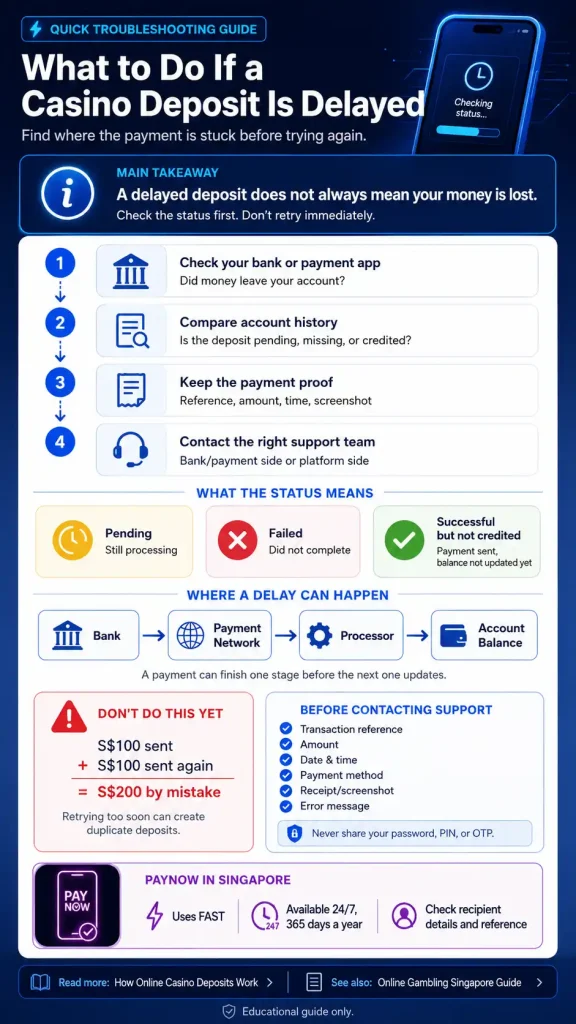
    What to do if a casino deposit is delayed, including checking payment status, avoiding duplicate deposits, and contacting support

    Why Can a Casino Deposit Be Delayed?

    Understanding how online casino deposits work can help explain why a payment may be delayed. Depending on the payment method, several systems may need to process and confirm the transaction before the funds appear in your account.

    Bank Processing Delay

    Your bank may still be processing the payment. If the transaction is marked as pending, it usually means the payment has started but has not reached a final status.

    In this situation, checking with the bank may be more useful than immediately contacting the receiving platform because the payment may not have fully left the banking system yet.

    Payment Provider Delay

    Some transactions pass through a payment gateway or payment processor before reaching the final receiving system. A temporary technical problem, maintenance period, or processing queue can slow this step.

    Payment Authentication Was Not Completed

    Card payments and some digital payment methods may require an extra security check. If the authentication step is closed too early or fails, the transaction may remain incomplete or be rejected.

    Transaction Limits or Restrictions

    Banks and payment services can apply daily limits, transaction limits, or security controls. A payment that exceeds one of these limits may be rejected or held for review.

    Always check the rules shown by your bank or payment provider rather than assuming the receiving platform caused the problem.

    Account-Crediting Delay

    Sometimes the payment itself has completed, but the user’s balance has not updated yet.

    This happens because payment completion and account crediting are separate steps. The payment system may confirm that money was transferred while the receiving platform still needs to identify the payment and connect it to the correct account.

    Incorrect Payment Details

    An incorrect amount, payment reference, account identifier, or recipient can also cause problems. Before contacting support, compare the payment details with the instructions that were displayed when the transaction was made.

    First Check the Status of Your Payment

    The fastest way to understand a casino deposit delay is to compare what your bank shows with what the receiving account shows.

    Bank or Payment Status Platform Status What It May Mean What to Do
    No transaction Nothing showing Payment may never have started Check payment steps again
    Pending Pending Payment is still being processed Wait and check the bank status
    Successful Pending Payment completed but account processing may continue Keep the transaction reference
    Successful Nothing showing Payment may need to be traced Contact support with evidence
    Failed Nothing showing Payment did not complete Check bank/payment provider reason
    Reversed Nothing showing Funds may have been returned Check your bank balance/history
    Successful Credited Payment completed normally No action required

    This table is more useful than looking only at the account balance. The status on both sides can help show which part of the payment process needs attention.

    Pending vs Failed vs Completed but Not Credited

    These three situations may look similar because the balance has not changed, but they are not the same problem.

    Pending Deposit

    A pending transaction has started but has not reached a final result.  For example, you make a $50 payment and your banking app displays:

    Status: Pending

    The best first step is usually to check the bank or payment provider because the payment itself is still being processed.

    Failed Deposit

    A failed payment did not complete. Possible reasons include payment authentication problems, insufficient funds, transaction limits, incorrect payment information, or a security check. If your bank says the transaction failed, do not treat it as a missing successful deposit.

    Completed but Not Credited

    This situation deserves more attention. Your bank may show:

    Status: Successful

    while the receiving balance still shows no deposit.

    That means the payment appears to have completed at the payment level, but the receiving account may not yet have been credited. Keep the transaction reference and check the platform’s payment history before contacting support.

    What to Do If a PayNow Deposit Is Delayed
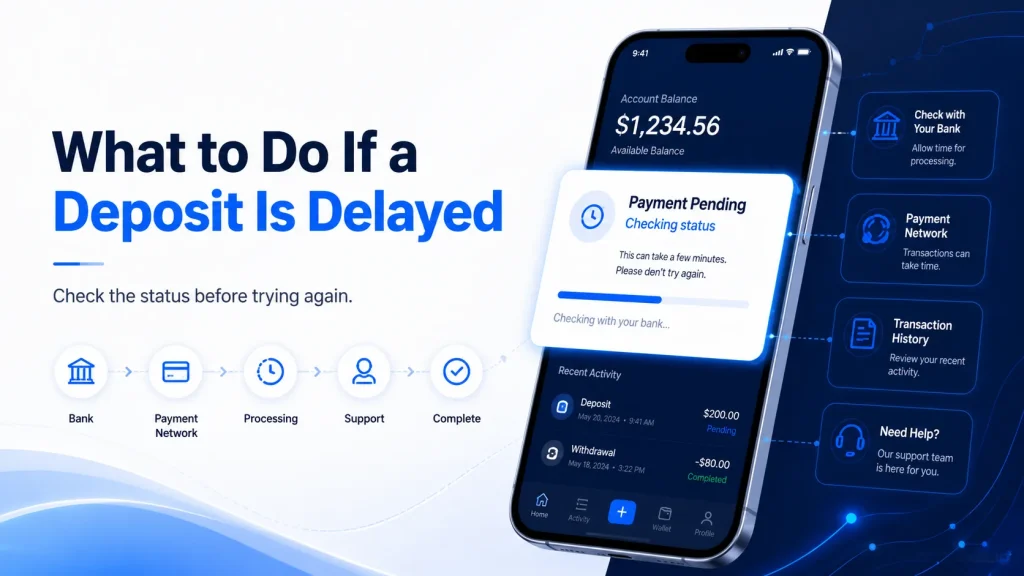
    PayNow deposit delay guide showing a pending transfer, bank status check, recipient verification, and transaction reference steps

    For Singapore users, PayNow deserves separate attention because it works differently from a traditional bank transfer.

    The Association of Banks in Singapore states that PayNow allows participating bank and major payment institution customers to send SGD through FAST using details such as a mobile number, NRIC/FIN, or Virtual Payment Address. PayNow is available 24 hours a day, 365 days a year and is designed for instant transfers.

    If a PayNow payment does not appear where expected, check these points first:

    • Was the transaction successful in your banking app?
    • Did you send the correct amount?
    • Did you confirm the correct recipient before paying?
    • Is there a transaction reference?
    • Does the payment appear in your account transaction history?
    • Does the receiving platform show it as pending?

    Since June 2026, ABS says the PayNow nickname feature for retail customers has been removed. Instead, selected letters from the registered payee’s name are shown to the payer before payment as an added safeguard against impersonation scams. This makes checking the displayed recipient details before confirming a transfer particularly important.

    Different payment methods can have different processing steps. See our comparison of PayNow vs other payment methods.

    How Long Should You Wait for a Casino Deposit?

    There is no single processing time that applies to every deposit. Timing depends on the payment method and where the delay occurs.

    Payment Method General Payment Behaviour Possible Delay Point
    PayNow Designed for fast or instant SGD transfers Receiving/account-crediting process
    Bank transfer Depends on transfer type Bank or reconciliation process
    Debit/credit card Often processed quickly Authentication, issuer or processor
    E-wallet Often fast Wallet provider or verification
    Other payment service Provider-dependent Payment gateway or processor

    PayNow itself is built on FAST for instant SGD transfers, according to ABS. However, an instant transfer does not guarantee that a separate third-party account balance will always update at the same moment.

    Instead of relying on an arbitrary rule such as “wait exactly 10 minutes,” check the actual transaction status. A successful payment that remains missing needs a different response from a transaction that is still marked pending.

    Payment technology continues to change how deposits are processed. See our guide to Online Gambling Payment Trends.

    Should You Make Another Deposit If the First One Is Delayed?

    Usually, you should first find out what happened to the original payment. Repeating the same payment too quickly creates the risk of a duplicate transaction.

    For example:

    You deposit $100. After several minutes, the balance has not been updated, so you send another $100. The first transaction later finishes as well. You have now transferred $200 when you intended to send $100.

    Instead of retrying immediately, check whether the first transaction is pending or successful. If the status is unclear, keep the payment reference and ask the relevant support team to investigate.

    What Information Should You Prepare Before Contacting Support?

    Support teams can investigate a missing payment more easily when you provide clear transaction details.

    Prepare:

    Information Why It Helps
    Transaction reference Identifies the payment
    Deposit amount Helps match the transaction
    Date Narrows the search
    Exact or approximate time Helps locate the transaction
    Payment method Shows which payment system was used
    Transaction status Shows whether it is pending or successful
    Payment receipt/screenshot Provides supporting evidence
    Error message Helps diagnose technical problems

    Do not send sensitive security information such as your banking password, PIN, OTP, or full login details.

    A legitimate support investigation should not require your banking password or one-time security code.

    When Should You Contact Your Bank or Payment Provider?

    Contact your bank or payment provider when the problem appears to be on the payment side.

    Examples include:

    • the transaction has remained pending;
    • the payment was rejected;
    • an unexpected amount was deducted;
    • the transaction was reversed;
    • you believe money was sent to the wrong recipient;
    • you do not recognise the transaction.

    If you accidentally transferred money using incorrect PayNow details, contact your bank promptly rather than trying to correct the problem by sending another payment.

    When Should You Contact Platform Support?

    Platform support is more relevant when:

    • your bank shows a successful payment;
    • the recipient details appear correct;
    • you have a valid transaction reference;
    • the platform still shows the deposit as pending;
    • the transaction does not appear in your account history.

    Provide the transaction information in one message where possible. This reduces the need for repeated questions and makes the payment easier to trace.

    How to Reduce the Risk of Future Deposit Problems

    No payment method can guarantee that every transaction will complete without delay, but a few simple checks can reduce avoidable problems.

    Before confirming a transaction, check the recipient information, payment amount, and any reference required by the platform. Keep the payment receipt until the balance has updated.

    Do not repeatedly press a payment button or send a second transfer because the first one appears slow. Check its status first.

    It also helps to understand how your chosen payment method works. PayNow, bank transfers, cards, and e-wallets can follow different processing and verification steps.

    Payment methods can differ in speed, verification and processing steps. Compare PayNow vs other payment methods before choosing how to pay.

    A Note for Singapore Readers

    Payment troubleshooting should also be considered separately from whether a gambling service is lawful.

    Singapore’s Gambling Regulatory Authority states that gambling is prohibited unless it is licensed or exempted. GRA also states that Singapore Pools is the only operator currently licensed by GRA to provide remote gambling services, and participation in unlicensed remote gambling is an offence in Singapore.

    This article explains payment troubleshooting for educational purposes. It does not confirm that any particular gambling platform is legal, licensed, or safe to use.

    Frequently Asked Questions

    Why Is My Casino Deposit Pending?

    A pending deposit normally means the transaction has started but has not reached a final status. Check both your bank or payment app and the receiving account’s transaction history. If your bank still shows the payment as pending, the bank or payment provider may be the best place to check first.

    Why Was Money Deducted but My Balance Did Not Update?

    Payment completion and account crediting can be separate processes. Your bank may record a successful transfer before the receiving system finishes matching and crediting the transaction to your account. Keep the transaction reference and contact support if the balance remains unchanged.

    How Long Does a Casino Deposit Take?

    There is no universal time. Processing depends on the payment method, bank, payment provider, security checks, and the receiving system. Look at the actual transaction status rather than assuming that every deposit should take the same amount of time.

    Should I Deposit Again If My First Deposit Is Missing?

    It is safer to determine the status of the first transaction before trying again. If the first payment later completes, retrying too early could result in two payments instead of one.

    What Should I Do If My PayNow Deposit Is Not Showing?

    Check whether your bank says the PayNow transaction was successful, confirm the amount and recipient details, save the transaction reference, and check the receiving account’s payment history. If PayNow shows a completed transfer but the funds are still not credited, contact the relevant support team with the transaction details.

    What Details Should I Give Support for a Missing Deposit?

    Provide the transaction reference, payment amount, date, time, payment method, current status, and a payment receipt or screenshot if needed. Never provide your banking password, PIN, or OTP.

    Do baccarat roadmaps predict the next result?

    No reliable mathematical basis shows a roadmap predicting the next independent baccarat outcome. Roadmaps record and organise previous results. They do not remove the game’s built-in house edge.

    What is the difference between live baccarat and RNG baccarat?

    Live baccarat presents a physical table, real cards and a live dealer through video. RNG baccarat generates and presents the game through software. Both formats still centre on comparing Player and Banker totals against nine.

    Final Takeaway

    When a deposit is delayed, the first goal should not be to make another payment. It should be to identify where the original transaction is currently sitting.

    Check your bank status first, compare it with the receiving account’s transaction history, keep the transaction reference, and only escalate the issue once you know whether the payment is pending, failed, reversed, or completed but not credited.

    This simple diagnostic approach reduces confusion, lowers the risk of duplicate payments, and gives support teams better information if the transaction needs to be traced.
  • PayNow vs Other Casino Payment Methods

    PayNow vs Other Casino Payment Methods

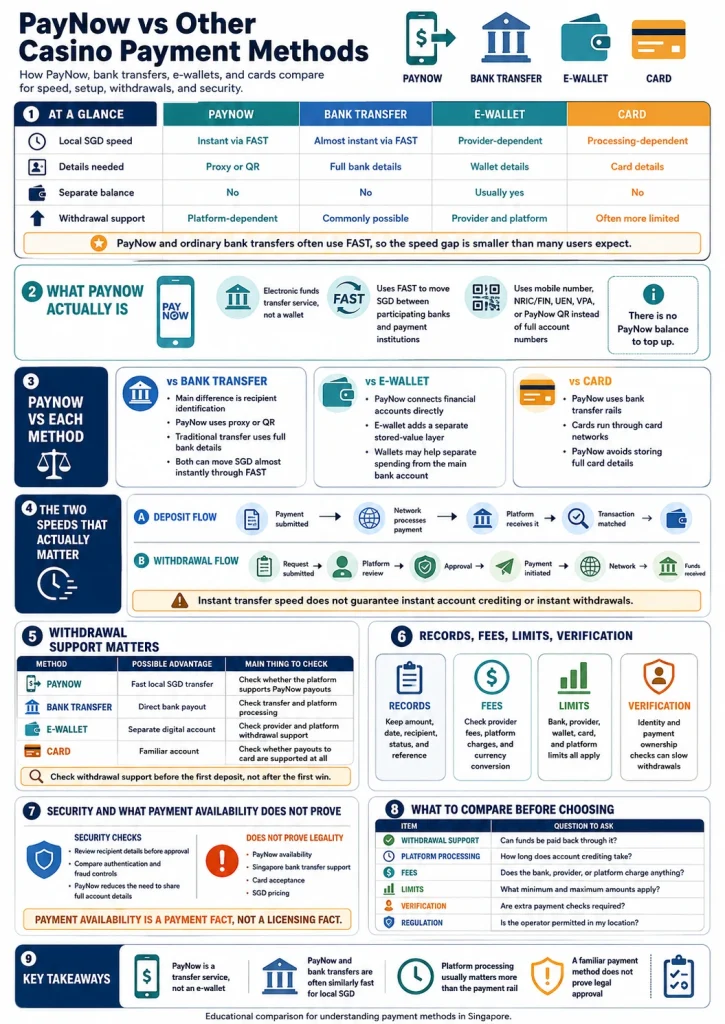
    Online gambling platforms can support different payment methods, including PayNow, bank transfers, e-wallets and cards. Each works differently in terms of transaction speed, convenience, verification and withdrawal support.

    For Singapore users comparing online gambling payment options, PayNow is particularly relevant because it supports instant SGD transfers through Singapore’s FAST payment infrastructure. However, the fastest or most convenient method will depend on the platform and transaction type.

    For a broader explanation of online gambling, payments and how platforms operate, read our Online Gambling Singapore Guide.

    paynow vs casino payment methods

    At a Glance

    Factor PayNow Bank Transfer E-Wallet Card
    Local SGD speed Instant via FAST Almost instant via FAST Provider-dependent Processing-dependent
    Details needed Proxy or QR Full bank details Wallet details Card details
    Separate balance No No Usually yes No
    Withdrawal support Platform-dependent Commonly possible Provider and platform Often more limited

    Note the second row carefully. PayNow runs on FAST, and ordinary bank transfers can use FAST too, so the speed gap between them is often smaller than people assume.

    What PayNow Actually Is

    PayNow is an electronic funds transfer service, not a wallet. It lets customers of participating banks and major payment institutions send and receive SGD through FAST using registered identifiers instead of account numbers.

    Supported identifiers include mobile number, NRIC/FIN, UEN for businesses, Virtual Payment Address, and PayNow QR.

    The distinction matters because PayNow is built on Singapore’s existing FAST infrastructure rather than operating as a stored-value account. There is no PayNow balance to top up.

    For the basic payment process, read How PayNow Transfers Work in Singapore.

    PayNow vs Bank Transfer

    Both move money directly between financial accounts. The real difference is how the recipient is identified, not how fast the money travels.

    PayNow uses a mobile number, NRIC/FIN, UEN, VPA or QR code, while a traditional transfer needs the bank name, account number and recipient details. When both run on FAST, SGD moves almost instantly either way.

    So the honest comparison is “banking details versus an identifier”, not “slow versus instant”. PayNow’s advantage is fewer fields and less room for a typo, which matters most on a phone. It does not remove the need to check the recipient, and a mistyped proxy sends money just as irreversibly as a mistyped account number.

    For a more detailed comparison, read PayNow vs Bank Transfer for Online Casinos.

    PayNow vs E-Wallet

    Both are digital, but structurally different.

    PayNow connects participating financial accounts through FAST. An e-wallet adds another account layer between you and the merchant, holding stored value, linking to a bank account or card, and keeping its own balance. Some payment institutions participate in PayNow, so it can connect eligible e-wallet accounts too.

    Neither is automatically better. PayNow suits users wanting direct bank-based transfers without another balance to manage. An e-wallet suits users wanting payment activity separated from their main bank account.

    One practical difference: an extra wallet layer means an extra place funds can sit, and an extra provider whose withdrawal support the platform must also accept.

    For the dedicated comparison, read PayNow vs E-Wallet for Casino Deposits.

    PayNow vs Credit Card

    These use entirely different systems. PayNow transfers SGD through participating financial institutions on FAST, while a card transaction runs through the card network and issuing institution.

    PayNow: Select payment > Open banking app > Review recipient > Approve transfer Card: Enter or select card > Payment authorised > Transaction processed

    The information requirement is the meaningful distinction. PayNow works from a QR code or proxy, while cards require details to be entered or stored. For anyone reluctant to leave card details with a platform, that matters, and it limits what is exposed if the platform is later compromised.

    For the dedicated comparison, read PayNow vs Credit Card for Online Gambling.

    The Two Speeds That Actually Matter

    Payment network speed is how fast money moves through the financial system. PayNow is instant through FAST, and FAST transfers move SGD almost instantly between participating institutions.

    Platform processing speed is how fast the platform finds the transaction, matches it to your account, credits the deposit, reviews a withdrawal and sends a payout.

    A deposit runs through both:

    Payment submitted > Network processes payment > Platform receives it > Transaction matched > Balance updated

    This is why a banking app can show “transfer successful” while the platform still shows “deposit processing”. No payment rail can speed up the second stage.

    Withdrawals invert the problem:

    Request submitted > Platform review > Approval > Payment initiated > Network > Funds received

    The platform controls four steps before the payment method is involved at all. A withdrawal under review for hours has not reached PayNow yet, so a faster rail changes nothing about that wait.

    Read Which Payment Method Is Fastest for Singapore Players? for a deeper comparison.

    Withdrawal Support Is the Underrated Factor

    Method Possible Advantage Main Thing to Check
    PayNow Fast local SGD transfer Whether the platform supports PayNow payouts
    Bank transfer Direct bank payout Transfer and platform processing
    E-wallet Separate digital account Provider and platform withdrawal support
    Card Familiar account Whether payouts to card are supported at all

    Most people choose a method by looking at deposits, then discover the platform pays out differently. A platform might accept one method for deposits and use another entirely for withdrawals, with card payouts the most commonly restricted. Check withdrawal support before the first deposit, not after the first win.

    Transaction Records and Missing Deposits

    PayNow and bank transfers appear in banking transaction histories, e-wallet payments in the wallet’s own records, and card payments in card statements. A clear record gives the amount, date, recipient, status and reference, which is what support needs when a platform says a payment has not arrived.

    The practical rule: if your banking side shows success but the gaming balance has not updated, check the platform’s deposit status before sending anything again. A second transfer to fix a matching problem creates two payments to reconcile instead of one.

    Read Why Is My PayNow Deposit Not Showing?

    Fees, Limits and Verification

    Three fee sources are worth checking, since users often check only one: the payment provider’s fees, the platform’s deposit or withdrawal charges, and currency conversion where source and receiving currencies differ. Local SGD PayNow transfers avoid the conversion issue entirely.

    Limits come from as many directions: bank settings, provider rules, card limits, wallet limits, and the platform’s own caps. A method can be instant and still unsuitable above your allowed limit, and PayNow remains subject to your bank’s daily local transfer limits.

    Verification can undo any speed advantage. A platform may need to confirm the account holder name, payment ownership, bank details or identity. A payment can transfer successfully while account-level verification remains incomplete, which matters most at withdrawal, where ownership checks often precede release.

    For troubleshooting, read Payment Verification Issues Explained.

    Security and What Payment Availability Does Not Prove

    Compare security processes rather than declaring one method safest. Authentication, recipient verification, device security and fraud controls all matter, on the payment side and the platform side alike.

    PayNow’s design means you never need the recipient’s full account number, which limits what information moves around. It does not protect against sending funds to the wrong recipient, so reviewing details before approval remains the step that matters.

    For payment safety, read Is PayNow Safe for Online Casino Transactions?

    Separately, and this is the point most worth taking away: a familiar payment method proves nothing about an operator. PayNow availability, Singapore bank transfers, card acceptance and SGD pricing are payment facts, not licensing facts.

    GRA states that gambling is prohibited unless licensed or exempted, and that unlicensed remote gambling supplied from overseas to people in Singapore is unlawful. Payment verification and operator verification are separate checks.

    For more detail, read How to Verify an Online Casino.

    What to Compare Before Choosing

    Check Question to Ask
    Withdrawal support Can funds be paid back through it?
    Platform processing How long does account crediting take?
    Fees Does the bank, provider or platform charge anything?
    Limits What minimum and maximum amounts apply?
    Verification Are extra payment checks required?
    Regulation Is the gambling operator permitted in my location?

    Transfer speed is deliberately absent, because for local SGD it is rarely the constraint. Platform processing, withdrawal support and limits decide the actual experience far more often than the rail does.

    There is no universal best casino payment method Singapore users should pick. PayNow suits direct SGD transfers with no separate balance to manage, bank transfers suit those preferring traditional account details, e-wallets suit users wanting separation from their main bank flow, and cards suit those wanting one familiar method across services. The choice still depends on what the operator supports in both directions.

    Common Misconceptions

    “PayNow is faster than every bank transfer.”

    Not necessarily. PayNow runs on FAST, and ordinary FAST transfers move SGD between participating institutions almost instantly too.

    “PayNow is an e-wallet.”

    No. It is an instant funds-transfer service connecting participating banks and payment institutions through FAST, with no separate balance.

    “PayNow guarantees an instant casino deposit.”

    No. The transfer can complete instantly while the platform still needs to identify and credit it.

    “The same method must be used for withdrawals.”

    Not always. Deposit and withdrawal options follow the platform’s own payment rules.

    “A casino accepting PayNow must be legal in Singapore.”

    Incorrect. Payment availability does not determine gambling licensing.

    Frequently Asked Questions

    Is PayNow better than other casino payment methods?

    It is convenient for Singapore users because it supports instant SGD transfers through FAST. Whether it is better depends on platform support, withdrawal availability, limits and fees.

    What is the difference between PayNow and bank transfer?

    PayNow uses FAST but identifies recipients through a mobile number, NRIC/FIN, UEN or VPA, while a traditional transfer uses full account details. Both move SGD almost instantly.

    Is PayNow better than an e-wallet for casino deposits?

    PayNow transfers directly between participating financial accounts, while an e-wallet adds a separate account layer. Which suits you depends on your setup and what the platform supports.

    Is PayNow faster than a credit card?

    PayNow is instant through FAST, while cards run on a different network. Final deposit speed still depends on the receiving platform either way.

    Does accepting PayNow mean an online casino is legal in Singapore?

    No. GRA states that Singapore Pools is the only operator licensed by GRA to provide remote gambling services in Singapore.

  • What Makes Fast Casino Payments Important Today?

    What Makes Fast Casino Payments Important Today?

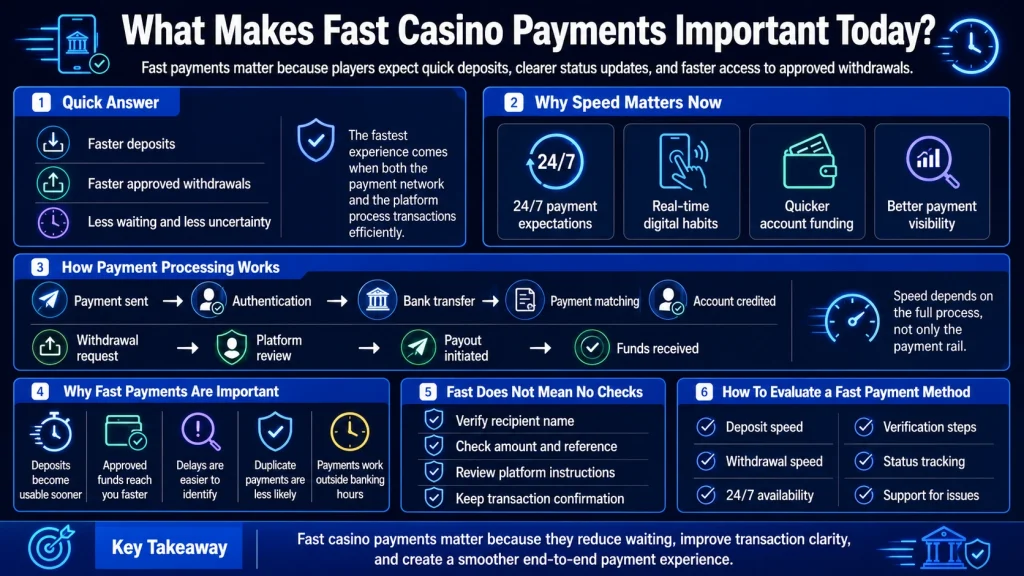
    Fast casino payments matter because players increasingly expect deposits and withdrawals to work with the same speed and convenience as other digital payments. In Singapore, services such as PayNow already let users send and receive SGD almost instantly through FAST, 24 hours a day and 365 days a year. This payment environment influences what users expect when they fund or withdraw from an online account.

    Speed, though, involves more than how quickly money moves between banks. A casino payment might pass through payment confirmation, account matching, platform processing, verification, withdrawal approval, and the banking network. Fast casino payments therefore depend on the entire transaction process, not only the payment rail.

    For an overview of using real-time bank payments for online gaming transactions, read our PayNow Casino Singapore guide.

    fast casino payments

    Quick Answer

    Fast casino payments reduce the time between sending money and seeing it credited, or between requesting a withdrawal and receiving the funds. They also make transaction status easier to understand because players spend less time wondering whether a payment is still processing.

    Real-time payment systems such as PayNow support almost immediate movement of funds between participating financial institutions. The Bank for International Settlements defines fast payment systems as infrastructure where payment messages and final funds become available in real time or near real time, typically on a 24/7 basis.

    For online casinos, this creates an important distinction. A bank transfer might happen almost instantly, but the casino still needs to process the deposit or approve a withdrawal. The fastest experience comes when both stages work efficiently.

    What Are Fast Casino Payments?

    Fast casino payments are deposit or withdrawal methods designed to reduce the waiting time associated with moving money between a player and an online gaming account.

    Examples include:

    • PayNow
    • Real-time bank transfers
    • Selected e-wallets
    • Instant payment networks
    • Some card deposit methods

    The definition of “fast” differs between deposits and withdrawals. A deposit might appear shortly after payment confirmation, while a withdrawal often requires additional platform processing before money is released.

    This means an instant casino payment should not automatically be interpreted as an instant withdrawal.

    Why Payment Speed Matters More Today

    Digital payment habits have changed what users expect from online transactions. Real-time payment systems let consumers and businesses transfer funds outside traditional banking hours, reducing delays associated with older batch-based payment processes.

    BIS research notes that fast payment systems increase payment efficiency by making funds available close to real time and supporting transfers across multiple banks and payment service providers.

    Singapore users already have access to this type of infrastructure through FAST and PayNow. PayNow allows retail customers of participating banks and major payment institutions to send SGD instantly using identifiers such as a mobile number, NRIC/FIN, or Virtual Payment Address instead of entering a full account number.

    For online gaming payments, this raises expectations around deposit confirmation and withdrawal speed.

    1. Fast Deposits Reduce Waiting Before Funds Are Available

    The most obvious advantage of fast online casino deposits is shorter waiting time between making a payment and having the funds available in an account.

    A typical deposit involves several stages:

    1. The player chooses a payment method.
    2. Payment information is provided.
    3. The player approves the payment.
    4. The banking or payment network sends the money.
    5. The platform identifies the transaction.
    6. The gaming account balance is updated.

    With PayNow, the bank-transfer stage is designed to happen almost instantly through FAST.

    The platform still needs to match the incoming transaction to the correct account. This explains why an instant bank transfer and an instant casino deposit are related but not identical.

    For a closer comparison, see Instant PayNow Deposits vs Manual Transfers.

    2. Fast Withdrawals Improve Access to Approved Funds

    Deposit speed gets attention because it determines how quickly a transaction begins. Withdrawal speed is often more important because it determines when approved funds reach the player’s account.

    A withdrawal normally includes two stages.

    Stage 1: Casino Processing

    The platform receives the withdrawal request and reviews it. This might include identity checks, account verification, transaction review, payment ownership checks, or withdrawal conditions.

    Stage 2: Payment Transfer

    After approval, the platform initiates the payout through the selected payment channel.

    Even when the banking rail works in real time, the first stage might still add waiting time. As a result, fast casino withdrawals depend heavily on the platform’s internal processing rather than only the technical speed of PayNow or FAST.

    For a full explanation of the process, read How to Withdraw Casino Winnings with PayNow.

    3. Faster Payments Make Transaction Problems Easier to Identify

    Long processing times create uncertainty. If a transfer normally takes hours or days, a player has less information about when a delay becomes unusual.

    Real-time payments narrow this window.

    For example, PayNow is designed to send and receive SGD instantly through FAST. If the banking app shows a transfer as successful but the casino balance is still unchanged, the issue is more likely to involve transaction matching or platform crediting rather than the initial bank transfer.

    Similarly, if a casino withdrawal remains marked Pending, the payment might not yet have entered the PayNow transfer stage.

    This makes transaction status important when troubleshooting.

    How Casino Payment Processing Time Works

    Casino payment processing time should be separated into individual stages rather than treated as one number.

    Payment Stage What Happens Possible Source of Delay
    Payment initiation Player starts transaction Incorrect details
    Authentication Bank confirms payment Failed authentication
    Bank transfer Funds move through payment network Network or bank issue
    Payment matching Platform identifies transaction Missing reference
    Account crediting Balance is updated Internal processing
    Withdrawal review Platform checks payout Verification
    Payout initiation Funds are released Processing queue
    Receiving bank Funds reach account Banking issue

    Understanding these stages helps explain why two platforms accepting the same payment method might still offer different processing speeds.

    The payment method controls only part of the process.

    4. Real-Time Payments Work Outside Traditional Banking Hours

    Older payment methods were often influenced by banking hours, weekends, or settlement cycles. Fast payment infrastructure changes this model.

    PayNow operates 24/7 and 365 days a year. FAST also supports almost instant SGD transfers between participating institutions.

    This is particularly relevant to online services because users do not operate only during normal banking hours.

    A payment method available on evenings and weekends offers a different experience from one requiring users to wait for the next business day.

    5. Payment Speed Helps Reduce Duplicate Transactions

    One practical problem with slow payments is duplicate deposits.

    Suppose a player sends SGD100 but does not see the amount reflected quickly. If the player assumes the payment failed and immediately sends another SGD100, the total transferred becomes SGD200.

    Fast transaction confirmation reduces this risk because users get clearer feedback sooner.

    The safer approach is still to check the banking transaction status before repeating a payment. A bank status of Successful means the banking stage completed, even if the receiving platform has not updated the balance yet.

    If you experience this issue, read Why Is My PayNow Deposit Not Showing? before making another transfer.

    6. Fast Payments Do Not Remove the Need for Security Checks

    Speed should not come at the expense of transaction verification.

    PayNow displays recipient information before a transfer is confirmed so the sender has an opportunity to verify the recipient. The service also avoids requiring a sender to know the recipient’s complete bank account number when using a registered PayNow identifier.

    Before confirming any payment, check:

    • Recipient name
    • Payment amount
    • Payment reference
    • Selected bank account
    • Platform payment instructions
    • Transaction confirmation

    Fast transfers mean mistakes might also move quickly. Recipient verification remains important even when the payment process takes only seconds.

    Are Instant Casino Payments Always Better?

    Not automatically.

    Payment speed is one factor when choosing a casino payment method. Other factors matter as well, including security, availability, withdrawal support, fees, transaction limits, verification requirements, and dispute procedures.

    A payment method offering a fast deposit but slow withdrawals might not provide the best overall payment experience.

    You should compare the complete transaction cycle:

    Deposit speed → Account crediting → Withdrawal approval → Payout speed

    This is more useful than comparing deposit time alone.

    For a broader comparison, read Which Payment Method Is Fastest for Singapore Players?

    Fast Casino Payment Methods Compared

    Payment Method Deposit Potential Withdrawal Support Main Consideration
    PayNow Real-time bank transfer Depends on platform Platform processing
    E-wallet Often fast Often supported Provider availability
    Bank transfer Depends on network Widely used Settlement method
    Credit card Often quick for deposits More variable Payout restrictions
    Manual transfer Depends on matching Depends on platform More manual processing

    The table describes general payment characteristics rather than guaranteed processing times. Actual speed depends on the financial institution, platform, account verification status, and transaction conditions.

    If you are comparing bank payments with cards, see PayNow vs Credit Card for Online Gambling.

    PayNow and Fast Casino Payments in Singapore

    PayNow is particularly relevant to discussions about fast casino payments because it operates on Singapore’s FAST infrastructure.

    PayNow lets eligible customers send SGD between participating banks and major payment institutions almost instantly. Users send funds using registered identifiers rather than needing the recipient’s traditional bank account details.

    FAST itself was launched in 2014 as an electronic funds transfer service that moves Singapore dollar funds between participating institutions almost instantly.

    The important distinction for players is this:

    PayNow transfer speed ≠ casino processing speed

    If PayNow completes a transfer in seconds but the platform takes several minutes to identify the deposit, the player’s total waiting time is determined by both systems.

    How to Evaluate a Fast Casino Payment Method

    Check Why It Matters
    Deposit processing time Shows how quickly funds become usable
    Withdrawal processing time Shows how quickly approved funds reach you
    24/7 availability Reduces reliance on banking hours
    Platform processing Affects total waiting time
    Payment status Helps identify delays
    Verification requirements Might affect withdrawals
    Fees Changes the total transaction cost
    Transaction limits Determines suitable payment size
    Security controls Helps protect payment details
    Support process Matters when a transaction fails

    A method that performs well across these areas is more useful than one offering fast deposits alone.

    Why PayNow Has Changed Payment Expectations

    PayNow is part of a wider shift toward retail fast payment systems. BIS research describes fast payment systems as infrastructure designed to make funds available in real time or near real time across participating financial institutions, while also improving efficiency in digital payments.

    For Singapore users, PayNow has made instant bank-to-bank transfers a normal part of everyday payments. The service has operated since July 2017 for participating banks and expanded to participating major payment institutions in February 2021.

    When users become accustomed to real-time domestic payments, long and unclear online payment processing becomes easier to notice.

    Our guide Why PayNow Has Become Popular for Online Casinos in Singapore looks more closely at this shift.

    What Will Make Casino Payments Faster in the Future?

    Future improvements are likely to focus on more than raw transfer speed. Real-time payment networks already move funds quickly, so the next gains are likely to come from better platform integration, automated payment matching, clearer transaction data, faster verification, and more efficient withdrawal processing.

    The key goal is reducing the time between each stage.

    For deposits:

    Payment sent → Payment identified → Account credited

    For withdrawals:

    Request submitted → Withdrawal approved → Payment sent → Funds received

    Reducing delays between these steps creates a faster end-to-end experience.

    For more detail on where payment technology is heading, read The Future of Real-Time Payment Methods for Online Casinos.

    Fast Casino Payment Checklist

    Before choosing or using a payment method, check:

    • How quickly deposits are normally processed.
    • How long withdrawals require.
    • Whether payments operate 24/7.
    • Whether the method supports both deposits and withdrawals.
    • Whether your account needs verification first.
    • Whether transaction fees apply.
    • Whether deposit or withdrawal limits exist.
    • Whether payment status is visible.
    • Whether the platform provides transaction references.
    • Whether support is available for delayed payments.

    Fast payment infrastructure is useful, but clear processing information is equally important.

    Frequently Asked Questions

    What are fast casino payments?

    Fast casino payments are deposit or withdrawal methods designed to reduce the time needed to move funds between a player, payment provider, bank, and gaming account. Real-time payment systems such as PayNow support almost immediate SGD bank transfers, though platform processing still affects total transaction time.

    Which casino payment method is fastest in Singapore?

    PayNow is one of the fastest underlying bank-transfer options because it uses FAST to send SGD almost instantly between participating institutions. E-wallets and some other payment methods also offer quick processing. The final deposit or withdrawal speed still depends on the platform.

    Are fast online casino deposits instant?

    A PayNow bank transfer might happen almost instantly, but the platform still needs to identify and credit the payment. A fast bank transfer therefore does not guarantee the casino balance updates at the same moment.

    Why do fast casino withdrawals take longer than deposits?

    Withdrawals often require platform approval before money is sent. Verification, transaction checks, payment ownership checks, and internal processing might occur before the payment reaches the banking network.

    Does PayNow work 24 hours a day?

    Yes. PayNow is available 24/7, 365 days a year for participating institutions, making it suitable for real-time SGD transfers outside traditional banking hours.

  • The Future of Real Time Payment Methods for Online Casinos

    The Future of Real Time Payment Methods for Online Casinos

    The future of casino payment methods is moving toward faster settlement, fewer payment steps, stronger verification, and better connections between domestic and cross-border payment networks. In Singapore, PayNow already provides instant SGD transfers through FAST, while newer initiatives are looking at how instant payments could become easier to use for online checkout and international transfers.

    For online gaming payments, the important change is not simply whether a transaction is labelled “instant.” The wider payment process includes selecting a method, confirming recipient information, authenticating the transaction, processing the payment, matching it to an account, and handling withdrawals. Future casino payments are therefore likely to focus on reducing friction across the entire process rather than only increasing transfer speed.

    This reflects a wider shift in how digital payments have changed online gambling in Singapore, with payment systems becoming faster, more connected, and easier to use across different stages of the player journey.

    For a broader explanation of PayNow payments used by Singapore players, read our PayNow Casino Singapore guide.

    future of casino payment methods

    Quick Answer

    The future of online casino payments is likely to centre on real-time bank transfers, integrated mobile checkout, QR interoperability, faster cross-border payments, better payment data, and stronger fraud controls. Singapore is already moving in this direction. PayNow supports instant transfers through FAST, while the PayNow Generation 2 study announced in June 2026 is examining upgrades such as improved QR interoperability, smoother online checkout, request-to-pay, structured payment data, micro-payment infrastructure, expanded cross-border connections, offline payment capabilities, and support for new automated commerce use cases.

    These developments do not mean every online gaming platform will adopt every feature. They show where Singapore’s broader instant-payment infrastructure is heading, and they provide useful signals for the next generation of casino payments.

    Why Real-Time Payments Matter for Online Casinos

    Payment speed affects both deposits and withdrawals, but speed alone does not determine the overall experience. A deposit might move through the banking network instantly while the receiving platform still needs to identify and credit it. A withdrawal might require platform review before any bank transfer begins.

    This distinction is already visible with PayNow. The Association of Banks in Singapore describes PayNow as an instant SGD transfer service operating through FAST, 24 hours a day and 365 days a year.

    Future casino payment technology will therefore need to address several stages together: payment initiation,How PayNow Transfers Work in Singapore? authentication, transaction matching, account crediting, payout approval, and status tracking.


    1. Real-Time Bank Payments Will Become More Integrated

    One of the clearest payment trends is deeper integration between merchants, apps, banks, and instant-payment networks.

    Today, a PayNow user might scan a QR code, switch to a banking app, verify the recipient, enter or confirm an amount, and approve the transfer. Future systems aim to reduce some of these steps.

    The PayNow Generation 2 study announced by MAS and the Association of Banks in Singapore includes work on deep-linking within PayNow QR codes for online checkout. The stated goal is to reduce the number of payment steps and create a smoother checkout process for online merchants.

    For digital casino payment methods, similar payment flows would mean fewer manual steps between selecting PayNow and completing a transaction.

    What This Could Mean for Players

    A more integrated payment journey might involve selecting PayNow on a payment page, moving directly into the relevant banking flow, reviewing the transaction, and returning to the platform after approval.

    This would reduce reliance on manually copying payment information or switching between several screens. It would also make correct recipient verification more important because faster checkout should not remove transaction checks.

    2. QR Payments Will Become More Interoperable

    QR codes are already part of Singapore’s payment system. PayNow QR is integrated with SGQR, allowing users to make payments through participating banking and payment apps.

    The next stage is broader interoperability.

    In June 2026, MAS and ABS said they were exploring improvements between QR PayNow and NETS QR so consumers could scan and pay merchants regardless of which of the two schemes a merchant uses. A pilot was targeted for the end of 2026.

    This matters for the future of casino payment methods because payment systems become easier to integrate when merchants and users rely on compatible standards rather than separate closed payment flows.


    3. Cross-Border Real-Time Payments Will Expand

    Singapore has already connected PayNow with instant-payment systems in other countries. Current linkages include PromptPay in Thailand, UPI in India, and DuitNow in Malaysia. These systems support fast or near-real-time cross-border transfers through participating financial institutions.

    The wider direction is moving beyond individual country-to-country connections.

    Project Nexus was developed by the BIS Innovation Hub to connect domestic instant-payment systems through a standardised multilateral model. BIS says participating countries incorporated Nexus Global Payments in 2025 to move the project toward live implementation. The model aims to allow participating payment systems to connect once and reach other systems within the network.

    Why Cross-Border Connectivity Matters

    Many online platforms operate across several markets. A payment system that connects domestic instant-payment networks more efficiently could reduce reliance on slower international transfer processes.

    This does not mean Singapore users will automatically gain access to every overseas payment recipient. Financial institutions, platform policies, regulatory rules, supported corridors, currency conversion, and transaction screening will still affect availability.

    The broader direction is clear: next generation casino payments will increasingly operate within payment networks designed for faster cross-border connectivity.

    4. Payment Data Will Become More Useful

    Payment speed solves only part of the problem. Businesses also need to know who sent the payment, what transaction it relates to, and how it should be recorded.

    The PayNow Generation 2 study lists structured data fields for automated reconciliation among the longer-term capabilities being explored.

    This is particularly relevant to online payments. A platform might receive money instantly but still experience a delay if it cannot match the transfer to the correct user or order.

    Better transaction data could improve this process.

    Current Payment Challenge Future Payment Direction Possible Benefit
    Manual payment matching Structured payment data Faster account reconciliation
    Several checkout steps Deep-linked payment flows Simpler payment process
    Separate QR schemes Greater QR interoperability Wider payment compatibility
    Slow international transfers Connected instant-payment networks Faster cross-border processing
    Limited payment status information Richer transaction messaging Clearer payment tracking
    Manual payment requests Request-to-pay More structured payment initiation


    5. Request-to-Pay Could Change How Payments Start

    Traditional payments usually begin with the customer manually entering or selecting payment information.

    Request-to-pay changes the process. Instead of asking the customer to manually create the transaction, a merchant or service sends a structured payment request that the customer reviews and approves.

    Request-to-pay is among the longer-term capabilities included in the PayNow Generation 2 study.

    For future casino payments, a similar model could reduce errors associated with entering amounts, references, or recipient information manually. The customer would still need to review and approve the request through the relevant payment service.

    6. Micro-Payments Could Receive More Attention

    MAS and ABS are also examining a micro-payments rail as part of longer-term PayNow development.

    Micro-payment infrastructure is designed to process low-value transactions efficiently. While this work is not specific to online casinos, it shows how payment infrastructure is becoming more specialised for different transaction types.

    For online platforms more broadly, efficient low-value processing might create new payment models where traditional card costs or processing structures are less suitable.

    7. Security Will Develop Alongside Payment Speed

    Faster payments create a simple challenge: users have less room to correct mistakes after confirming a transaction.

    PayNow already includes recipient verification before payment confirmation. ABS states that the sender sees the recipient’s display name before completing the transfer, helping the sender verify where the money is going.

    Future payment systems will need to balance speed with authentication, recipient verification, fraud controls, transaction monitoring, and dispute handling. The PayNow Generation 2 study also identifies fraud prevention and dispute resolution among areas for further development.

    For players, this means faster payments should not replace basic transaction checks.

    Before making a payment, read How to Keep Your PayNow Casino Transactions Secure.

    8. Instant Withdrawals Will Depend on More Than Payment Rails

    Real-time bank infrastructure does not automatically create instant casino withdrawals.

    A withdrawal normally has two broad stages. The platform reviews and approves the payout first. The payment provider or banking network processes the transfer second.

    Even if the second stage becomes faster, identity verification, account checks, promotion conditions, transaction reviews, or manual payout approval might still delay the first stage.

    This is why the future of casino payment methods should be measured by end-to-end payout time rather than only the technical speed of the payment network.

    For current troubleshooting, read Why Is My PayNow Withdrawal Delayed?

    Will PayNow Remain Important for Singapore Players?

    PayNow is already built into Singapore’s domestic payment infrastructure. It supports participating banks and major payment institutions, operates through FAST, supports QR payments, and connects with several overseas instant-payment systems.

    Current PayNow Generation 2 work also indicates that Singapore intends to continue developing its instant-payment infrastructure rather than replacing it with an entirely separate model. MAS and ABS are studying changes across customer experience, business payments, network coverage, and payment-system capabilities.

    For this reason, PayNow and related real-time bank payment infrastructure are likely to remain relevant when discussing the future of online casino payments for Singapore users.

    What About E-Wallets, Cards and Other Payment Methods?

    Real-time bank payments are only one part of future casino payments. E-wallets, cards, bank transfers, and other regulated payment services will continue serving different needs.

    Cards offer established international acceptance. E-wallets provide an additional payment account between the user and merchant. Real-time bank payments reduce the need to enter full card or bank account details for individual transfers. Cross-border instant-payment networks aim to improve international transfers.

    The future is therefore less likely to involve one payment method replacing every other method. Different payment systems will compete on speed, cost, checkout convenience, security, availability, and withdrawal support.

    For a direct comparison, see PayNow vs E-Wallet for Casino Deposits.

    What Will Define the Next Generation of Casino Payments?

    Five factors are likely to matter most when evaluating future casino payment technology.

    Faster End-to-End Processing

    Players will increasingly judge payment methods by how long the full deposit or withdrawal takes, not just the underlying bank transfer.

    Fewer Checkout Steps

    Deep links, QR codes, and integrated payment approval could reduce manual actions between selecting a payment method and completing the transaction. Singapore’s PayNow Generation 2 work already identifies this as a priority area.

    Better Payment Matching

    Structured transaction information could help merchants identify and reconcile payments with fewer manual checks.

    Wider Cross-Border Connectivity

    Projects such as Nexus show how domestic instant-payment systems are moving toward multilateral connections rather than relying only on separate bilateral links.

    Stronger Transaction Controls

    Recipient verification, fraud prevention, authentication, transaction monitoring, and dispute processes will stay important as transfers become faster.

    Future Casino Payment Methods Checklist

    When comparing new payment methods in the future, do not judge them only by claims such as “instant” or “fast.”

    What to Check Why It Matters
    Deposit processing Shows how quickly funds reach the account
    Withdrawal processing Measures practical payout speed
    Bank or wallet support Determines availability
    Transaction verification Helps prevent incorrect transfers
    Fees Affects the real cost of using the method
    Cross-border support Matters for international transactions
    Payment status tracking Helps identify delays
    Security controls Protects account and payment information
    Refund or dispute process Matters when a transaction goes wrong

    Frequently Asked Questions

    What is the future of casino payment methods?

    The main direction is toward faster bank transfers, more integrated checkout, improved QR interoperability, richer payment information, better cross-border connectivity, and stronger security controls. Singapore’s PayNow Generation 2 work provides current examples of several of these developments.

    Will casino payments become completely instant?

    The banking transfer itself might take place in seconds, but casino deposits and withdrawals involve additional platform processing. Account verification, transaction matching, withdrawal approval, and security reviews can still add time.

    Will PayNow become faster in the future?

    PayNow already supports instant SGD transfers through FAST. Current development is therefore focused less on making the underlying domestic transfer simply “faster” and more on improving usability, interoperability, checkout, business payment functions, and network coverage.

    What is PayNow Generation 2?

    PayNow Generation 2 is a study led by MAS and the Association of Banks in Singapore to examine the next stage of Singapore’s instant-payment infrastructure. Areas announced in June 2026 include QR interoperability, improved online checkout, business payment features, network expansion, and several longer-term payment capabilities.

    Will cross-border casino payments become faster?

    Cross-border instant-payment infrastructure is expanding. PayNow already has links with selected overseas systems, while Project Nexus is designed to connect multiple national instant-payment networks through a standardized model. Whether a specific gaming transaction is supported still depends on participating institutions, payment corridors, platform policies, and applicable requirements.