
Singapore keeps getting more digital. Payments clear in seconds, identity checks happen on a phone, and almost every service assumes you are on mobile. It would be easy to assume gambling has simply followed that curve upward.
The data says something more interesting. Overall gambling participation in Singapore has fallen for three survey cycles in a row, while reported illegal online gambling has risen from a very low base. Those two lines are moving in opposite directions, and most trend articles miss it entirely.
This guide separates what Singapore data actually supports from what is global industry marketing. It covers participation, mobile access, payments, enforcement, verification and the technologies people keep asking about. If you want the foundations first, start with our overview of Online Gambling Singapore.
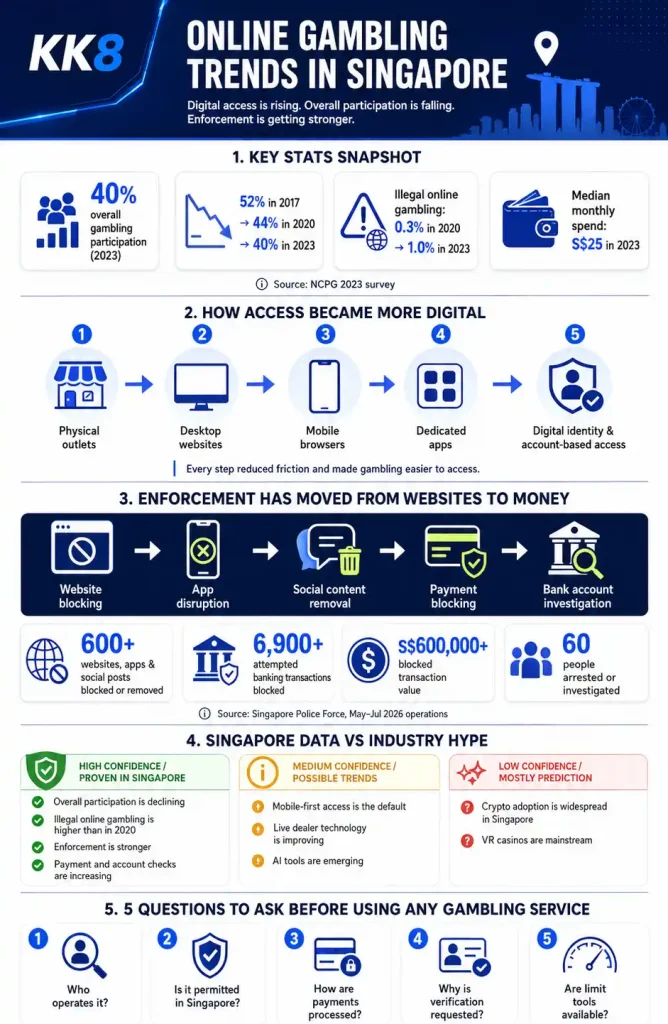
Online Gambling in Singapore at a Glance
| Indicator | What the data shows |
| Overall gambling participation | 40% of residents in 2023 |
| 2020 participation | 44% |
| 2017 participation | 52% |
| Reported illegal online gambling | About 1% in 2023, up from 0.3% in 2020 |
| Problem and pathological gambling rate | 1.1%, broadly stable since 2017 |
| Median monthly gambling spend | S$25 in 2023, up from S$15 in 2020 |
| Only GRA-licensed remote gambling operator | Singapore Pools (Private) Limited |
| Enforcement direction | Websites, apps, advertising, payments and bank accounts |
Participation figures: National Council on Problem Gambling, Survey on Participation in Gambling Activities among Singapore Residents 2023, published November 2024.
Two terms matter before going further.
Remote gambling is gambling conducted through the internet or other remote communication, which is the legal category that covers online casino games, online betting and gambling apps. Regulated remote gambling in Singapore means a service provided by an operator licensed by the Gambling Regulatory Authority (GRA). The GRA states that Singapore Pools is currently the only operator it has licensed to provide remote gambling services. Everything else offered to people in Singapore falls outside that licence, which is what the law calls an unlicensed or unlawful remote gambling service.
That distinction runs through every trend below. For the full legal picture, see our guide to Singapore gambling laws.
Trend 1: Overall Gambling Is Declining While Online Behaviour Shifts
The NCPG runs a national survey roughly every three years. Its gambling participation rate is simply the share of residents aged 18 and above who took part in at least one gambling activity in the past year.
That rate has fallen consistently:
| Survey year | Participation rate |
| 2017 | 52% |
| 2020 | 44% |
| 2023 | 40% |
The 2023 figure is the lowest since the survey series began in 2005, when it stood at 58%. The 2023 round polled 3,007 residents between July 2023 and March 2024, with a 73% response rate.
At the same time, the share of respondents reporting illegal online gambling rose from 0.3% in 2020 to about 1% in 2023. NCPG described that increase as consistent with rising global trends.
Here is where most articles overreach. A move from 0.3% to 1% is a meaningful proportional jump, but it is still roughly one respondent in a hundred, and it is measured within a shrinking pool of gamblers overall. It is not evidence of an online gambling boom in Singapore.
The honest reading is narrower and more useful:
Fewer Singapore residents gamble at all, but among those who do, a small and growing minority report using illegal online channels. Meanwhile, 92% of gamblers in the 2023 survey placed bets through Singapore Pools.
Two more details add texture. Median monthly gambling spend rose from $15 in 2020 to $25 in 2023, though that is still below the $30 recorded in 2017. And 69% of gamblers bet less than once a week. Fewer people are gambling, and most of them are doing it infrequently.
One limitation is worth stating plainly. Surveys rely on self-reporting, and people are less likely to admit to activity that is illegal. The 1% figure should be treated as a floor, not a precise measurement.
Trend 2: Access Is Becoming More Digital and Lower Friction
The clearest structural trend is not about how many people gamble. It is about how easy access has become.
The path has shifted over roughly two decades:
Physical outlets → desktop websites → mobile browsers → dedicated apps → account-based digital identities
Each step removed friction. A trip to a physical outlet has natural limits: opening hours, travel time, cash in hand. An app on a home screen has almost none. This is the same friction reduction that made food delivery and mobile banking mainstream, applied to a category where friction had a protective function.
If you want the mechanics of how these platforms actually operate, our guide on how online gambling works walks through the components.
Mobile Access
Mobile-first design is now the default across digital services, and gambling platforms are no exception. Practical implications include responsive layouts built for a phone screen, apps with saved login credentials, biometric sign-in, push notifications, and video streaming that holds up on mobile data.
You will see claims like “80% of Singapore gamblers now use mobile casinos” circulating in trend roundups. There is no reliable public Singapore dataset supporting a number like that. What can be said, accurately, is that mobile-first access is the global norm and that Singapore has high smartphone penetration and mature mobile payment infrastructure, which makes mobile-first access the realistic default here too.
Live Casino Technology
A live dealer game is a table game streamed in real time from a studio, with a human dealer, where players place bets through an interface rather than with physical chips. It sits between a random number generator (RNG) game, where outcomes are produced by software, and a physical table.
The technology has improved steadily: lower streaming latency, better mobile video compression, multi-camera angles and real-time chat with dealers. That improvement is well documented globally.
What is not documented is Singapore-specific adoption. Treat live dealer growth as a global product trend that shapes what users encounter, not as a measured Singapore behaviour.
Understand the bigger picture: Read our Online Gambling Singapore Guide for a clear overview of formats, payments, safety and regulations.
Trend 3: Digital Payments Are Changing User Expectations
Singapore consumers have been trained by everyday services to expect a specific payment experience: instant transfers, QR codes, real-time confirmation in a banking app, and digital wallets that work without thinking about them.
That expectation transfers. Users now assume any online transaction will be immediate, traceable and visible in real time, and they read delays as a failure rather than as a normal process.
An important caution here. It is tempting to claim that instant payment rails are widely used for online casino deposits in Singapore. There is no reliable public data establishing that, and stating it would be guesswork. The defensible point is about expectations, not usage: a population accustomed to instant, confirmable payments will judge every platform against that standard.
For how deposit flows are structured in practice, see how online casino deposits work.
Faster Payments Also Create New Risks
Speed cuts both ways. When money moves in seconds, so does money connected to fraud, and financial institutions have responded with more monitoring rather than less.
That produces a set of controls users now run into regularly:
- Payment verification, where a transaction is held pending additional confirmation
- Transaction monitoring, where unusual patterns trigger review
- Payment blocking, where a financial institution is directed or chooses to prevent a transaction from completing
- Account misuse detection, where an account is flagged for behaving inconsistently with its stated owner
Faster payments do not always mean automatic approval. Banks and platforms may apply additional checks, which can lead to casino payment verification requests.
Having trouble with a payment? Learn why some payments require additional verification before they clear.
Trend 4: Enforcement Has Moved From Websites to Money
This is the most concrete, best-evidenced trend in Singapore, and it deserves more than a disclaimer paragraph.
Since 1 January 2025, the Singapore Police Force has taken over responsibility for blocking access to unlawful remote gambling services, the advertising of those services, and related payment transactions. That consolidation matters. Blocking a website, blocking an ad and blocking a payment now sit under one enforcement body.
The Escalation Chain
Enforcement has expanded well beyond a domain blocklist:
Website blocking → app disruption → social media content removal → payment blocking → bank account investigation → prosecution of people facilitating transactions
The last two links are the significant change. Enforcement now reaches individuals who never placed a bet, but who supplied the financial infrastructure that let others do so.
What the 2026 Enforcement Numbers Show
Police reported on 25 July 2026 that between 1 May and 20 July 2026 they conducted intensified gambling suppression operations around the 2026 FIFA World Cup period.
| Enforcement measure | Reported figure |
| People arrested or under investigation | 60, aged 17 to 79 (46 men, 14 women) |
| Websites, apps and social media content blocked or removed | More than 600 |
| Attempted banking transactions blocked | At least 6,900 |
| Value of blocked transactions | More than S$600,000 |
Source: Singapore Police Force update, 25 July 2026.
The site and app takedowns were carried out under the Online Criminal Harms Act 2023, and the transaction blocking was done in cooperation with payment network operators and financial institutions.
Two individual cases show what this looks like on the ground. In a single operation on 6 July 2026, police arrested 19 people aged 45 to 76 and seized more than S$730,000 in cash. Later that month, between 22 and 24 July, nine people aged 17 to 55 were arrested over the suspected creation of shell companies and corporate bank accounts handed over to a syndicate running an illegal online gambling platform.
Note the arithmetic on the blocked transactions: 6,900 transactions worth just over $600,000 averages under $90 each. These are not whale-sized transfers. They are ordinary consumer-scale payments, which tells you enforcement is operating at the retail layer, not only against operators.
Learn the rules: See our guides to Singapore gambling laws and remote gambling in Singapore.
Trend 5: Identity and Account Checks Are Becoming More Important
The enforcement pattern above creates a second-order trend: verification is tightening on both sides.
Regulators and financial institutions are focused on account provenance, meaning whether the person using an account is the person who owns it. The 2026 cases involved individuals suspected of setting up corporate entities and bank accounts specifically so that a gambling syndicate could move money through them.
The practical consequences for ordinary users:
- More identity verification requests before withdrawals
- More scrutiny of accounts receiving frequent unexplained inbound transfers
- Greater risk in lending an account or credential to someone else, even a friend, even once
- More friction as a normal feature of legitimate services, not a red flag
That last point cuts against instinct. A platform that asks nothing at all is not being convenient. It is skipping obligations that regulated services do not get to skip.
Anyone being offered payment to “just receive a transfer” or to register a company on someone else’s behalf should treat it as a serious legal risk, not a favour.
Know the warning signs: Learn how to identify fake online casino websites and common online gambling scams.
Trend 6: Major Sports Events Create Spikes, Not Permanent Trends
The 2026 World Cup is a clean local case study in why timing matters when reading gambling data.
Ahead of the tournament, the Ministry of Home Affairs and the Ministry of Social and Family Development announced stepped-up enforcement against illegal gambling. Police stated that operations were intensified to address the elevated risk of illegal betting before and during the World Cup season. Activity around a global tournament is not the same as a durable behavioural shift.
The distinction is straightforward:
| Type | Characteristics | Example |
| Structural trend | Builds over years, persists after the trigger | Shift to mobile-first access |
| Event-driven spike | Sharp rise, sharp fall, tied to a calendar | Betting activity around a World Cup |
This matters when you read industry reports. A market-size chart drawn through a tournament quarter will show growth that partly evaporates by the next one. Always check what period a figure covers.
Trend 7: AI Is Growing Globally, but Singapore Evidence Is Limited
Artificial intelligence appears in almost every gambling trends article, usually without evidence.
The plausible applications are real and mostly unglamorous:
- Fraud and anomaly detection on transactions
- Identity document verification
- Customer support triage
- Content and game recommendation
- Behavioural monitoring for responsible gambling flags, such as detecting escalating deposit patterns
The last one is arguably the most consequential and the least discussed. Systems that detect risky play patterns early are a harm-reduction tool, not a growth tool.
What should be stated clearly:
AI is a genuine global gambling technology trend. There is limited public data showing how widely specific AI features are deployed or experienced by online gambling users in Singapore.
Both halves of that sentence are true, and a trend article that only publishes the first half is selling rather than informing.
Trend 8: Cryptocurrency Gets Attention, but Evidence Matters
Crypto gambling exists globally and generates a lot of coverage. Singapore-specific adoption data among residents is thin to nonexistent in reliable public sources.
There is also a legal point that gets lost in the technology discussion. Whether a platform accepts cryptocurrency has no bearing on whether it is permitted to offer remote gambling to people in Singapore. The GRA’s position is about licensing, not payment method. An offshore platform accepting crypto is subject to the same restrictions as one accepting card payments.
This section illustrates the rule that should govern how you read every gambling trends article, including this one:
Global Trend Does Not Equal Proven Singapore Trend
A technology can be genuinely widespread worldwide and still have no measured Singapore footprint. The two claims require different evidence.
Which Trends Are Actually Supported by Singapore Data?
| Trend | Singapore evidence | Confidence |
| Overall gambling participation declining | NCPG national survey, three cycles | High |
| Reported illegal online gambling higher than 2020 | NCPG national survey | High |
| Stronger enforcement against illegal online gambling | SPF operational data, 2026 | High |
| Payment and transaction blocking | SPF and financial institution data, 2026 | High |
| Bank account and corporate entity misuse | SPF case reporting, 2026 | High |
| Mobile-first access | Global and infrastructure evidence, no local gambling dataset | Medium |
| Live dealer growth | Mostly industry sources | Medium |
| AI personalisation | Emerging, mostly global | Medium-Low |
| Cryptocurrency gambling adoption | Limited local evidence | Low |
| VR casinos | Mostly forward-looking prediction | Low |
Notice the pattern. The high-confidence rows are all things a government body counted. The low-confidence rows are all things an industry expects. That gap is the single most useful thing to carry away from this article.
What Could Develop Next
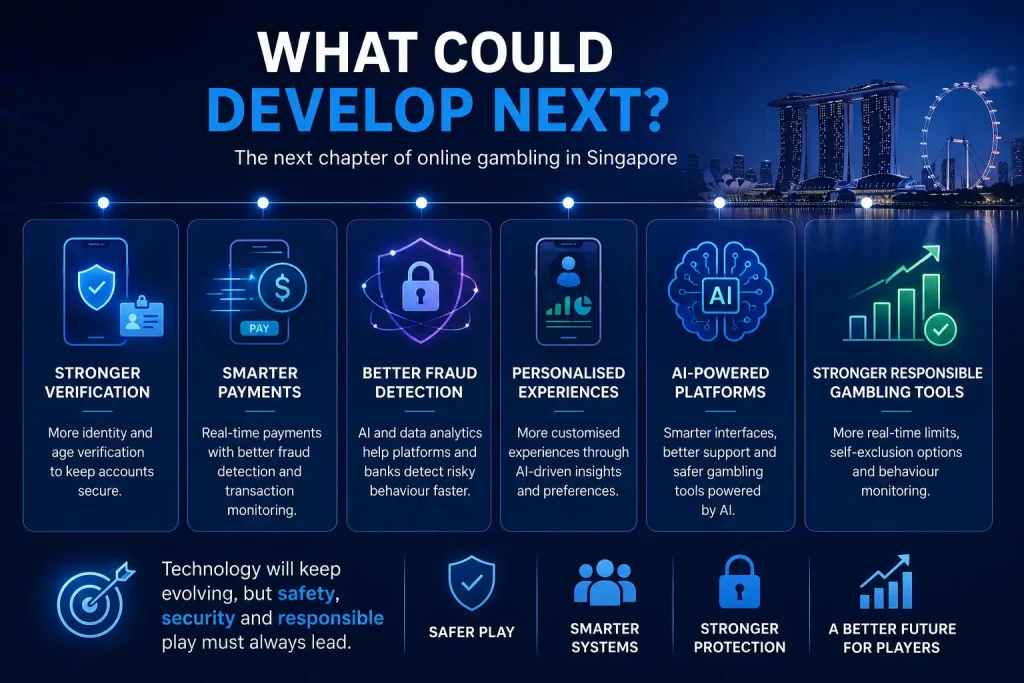
Predictions are marked as predictions. None of the following is established fact.
Stronger payment monitoring
Given that payment blocking is already producing measurable results, further integration between enforcement bodies, banks and payment network operators seems likely to continue.
More identity and account verification
The pattern of account misuse cases points toward more rigorous checks on account ownership and unusual transfer activity.
Continued mobile optimisation
Mobile-first is already the baseline. Refinement is more likely than reinvention.
Better fraud detection
Automated anomaly detection is a natural extension of what banks already do elsewhere.
More AI-powered platform features
This remains an emerging area locally, with more announced than demonstrated.
Stronger responsible gambling tools
Deposit limits, self-exclusion and cooling-off periods could become more automated and harder to bypass.
Avoid the language of inevitability. Cryptocurrency and VR may develop, could become more common, or may remain niche. There is not yet enough Singapore-specific evidence to say.
What These Trends Mean for People in Singapore
Two things are happening at once, and they pull in opposite directions.
Access to online gambling has never been technologically easier. At the same time, Singapore has tightened controls around unlicensed operators, advertising, payments and the bank accounts used to move money.
If you take one practical thing from this article, make it a short set of questions worth asking about any online gambling service:
- Who operates it, and where? An overseas licence does not authorise service to people in Singapore.
- Is it permitted here? The GRA states that Singapore Pools is the only operator it has licensed for remote gambling. Participating in unlicensed remote gambling is an offence, carrying a fine of up to $10,000, imprisonment of up to six months, or both.
- How are payments processed? Unusual routing, third-party accounts or requests to transfer to an individual are serious warning signs.
- What information is requested, and why? Legitimate verification has a stated purpose. Requests for your credentials, or for use of your account, do not.
- Are there limits available? Deposit limits, time limits and self-exclusion tools exist to be used.
Anyone concerned about their own gambling, or someone else’s, can contact the National Council on Problem Gambling, which operates a helpline and web chat service and administers exclusion orders. Building responsible gambling practices early is considerably easier than unwinding a problem later.
For the full foundation, return to our guide to Online Gambling Singapore.
Frequently Asked Questions
What are the biggest online gambling trends in Singapore?
The best-evidenced trends are falling overall gambling participation, a small rise in reported illegal online gambling since 2020, and significantly stronger enforcement covering websites, apps, advertising, payments and bank accounts. Mobile-first access and instant payment expectations are shaping how services are built, though these are global patterns rather than measured Singapore behaviours.
Is online gambling increasing in Singapore?
The answer is genuinely two-sided. Overall gambling participation fell to 40% in the 2023 NCPG survey, down from 44% in 2020 and 52% in 2017. Over the same period, respondents reporting illegal online gambling rose from 0.3% to about 1%. Fewer people gamble overall, while a small share of those who do report shifting to unlawful online channels. Because the figure is self-reported, it likely understates actual activity.
Why is mobile gambling becoming more important?
Because mobile is the default access layer for nearly all digital services, and mobile removes the friction that physical access naturally imposed: opening hours, travel and cash handling. Be sceptical of specific Singapore mobile gambling usage percentages, as no reliable public dataset supports them.
How are digital payments changing online gambling?
Mainly by resetting expectations. Users accustomed to instant transfers and real-time confirmation expect the same speed everywhere. In parallel, faster payments have driven more monitoring, which is why verification requests, transaction holds and payment blocking have become more common.
Are cryptocurrency casinos popular in Singapore?
There is limited reliable public data on cryptocurrency gambling adoption among Singapore residents. It is also worth noting that accepting cryptocurrency does not change a platform’s legal position: what matters is whether it is licensed to provide remote gambling to people in Singapore.
Will AI change online gambling?
Probably, in areas like fraud detection, identity verification, support and responsible gambling monitoring. Current deployment should be separated from prediction. There is limited public evidence about how widely specific AI features are used by online gambling services reaching Singapore users today.