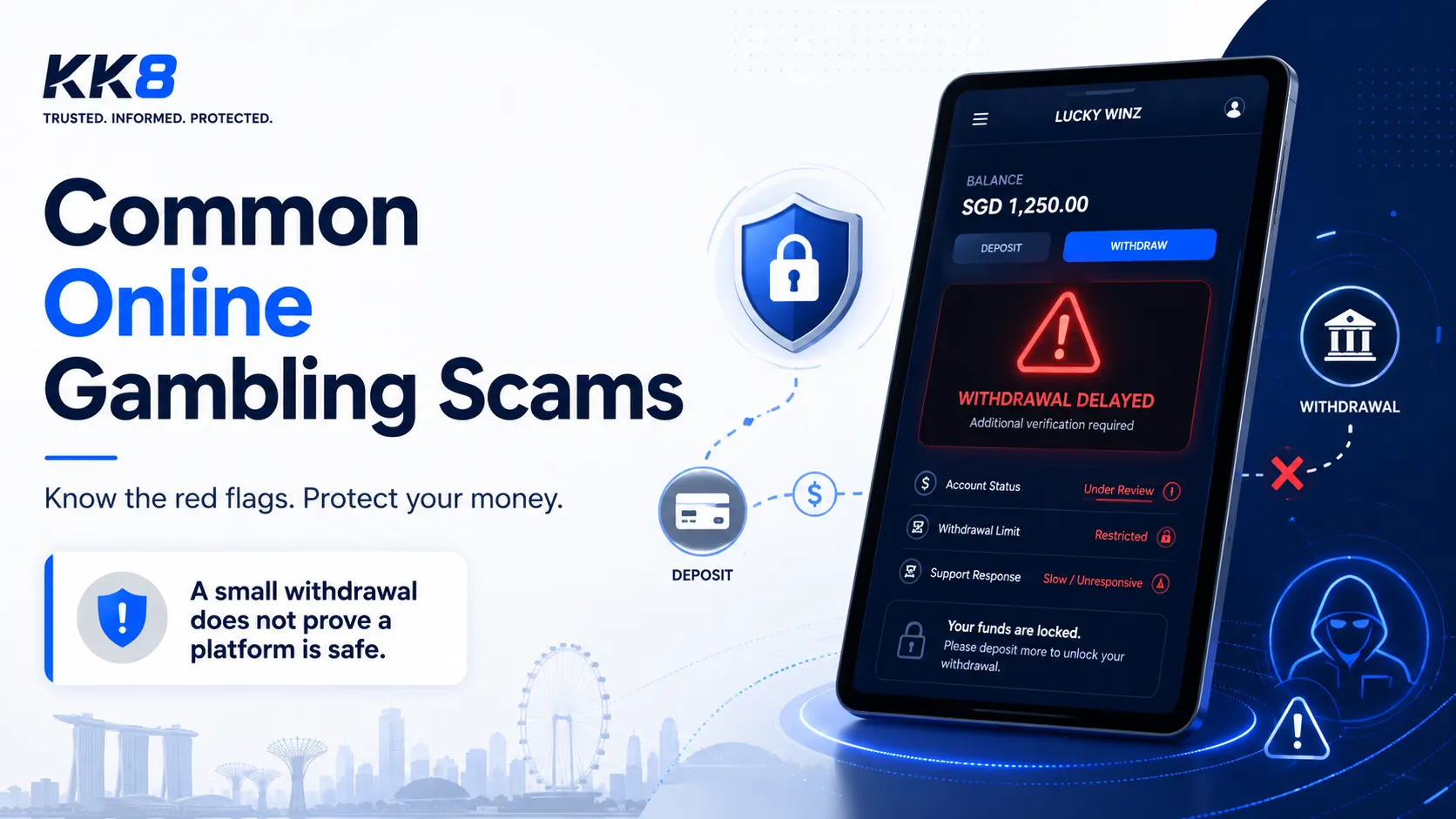
Online gambling scams are not always easy to recognise. Some use poorly made websites and unrealistic promises, but others can look professional, offer responsive customer support and even allow a small withdrawal before problems begin.
The real warning signs often appear when money starts moving. A platform may suddenly change its withdrawal conditions, ask for another deposit, direct payments to unfamiliar accounts or claim that a fee must be paid before winnings can be released.
For people in Singapore, there is another issue to consider: whether the gambling service is legally allowed to operate here. A foreign licence or professional-looking website does not by itself mean that an online gambling service is authorised in Singapore.
This guide explains the most common online gambling scams, how they work, the warning signs to watch for and what to do if you believe you have already sent money to a scam.
Educational notice: This guide is for general information and consumer safety. It is not legal or financial advice. Gambling laws can change, so check current information from official Singapore authorities.
Quick Answer: What Are Online Gambling Scams?
Online gambling scams are schemes that use gambling websites, betting platforms, apps, agents, promotions or messages to deceive people into sending money or giving away personal information.
Common examples include fake gambling websites, blocked-withdrawal schemes, fake betting agents, phishing pages, fake gambling apps and services that demand extra payments before supposedly releasing winnings.
One important point is that a delayed payment does not automatically mean a platform is a scam. Genuine payment checks, bank processing and identity verification can take time. The stronger warning sign is usually a pattern of behaviour: changing rules, repeated requests for money, unexplained account restrictions or payment instructions that do not make sense.
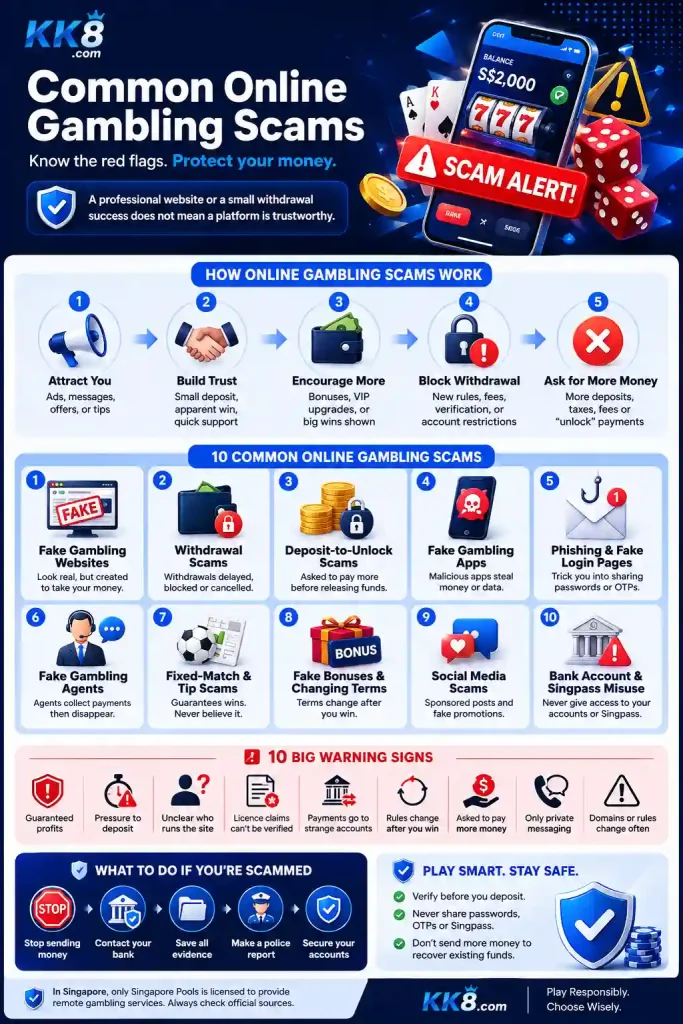
How Online Gambling Scams Usually Work
Many people imagine an online gambling scam as a fake website that simply takes a deposit and disappears. That can happen, but more organised scams may operate differently.
They may first try to establish trust. A common pattern looks like this:
Promotion → Account → Small Deposit → Apparent Win → Withdrawal → Trust → Larger Deposit → Withdrawal Problem → More Money Requested
Understanding this sequence matters because scammers do not always try to take the largest possible amount immediately.
Stage 1: Attracting the User
The first contact can come from a gambling advertisement, social media post, private message, Telegram group, WhatsApp contact, betting tip or referral. The offer may focus on unusually large bonuses, guaranteed results or easy profits.
Promises such as these should be treated carefully:
- “Guaranteed winning system”
- “100% safe profit”
- “Fixed match available”
- “Deposit today and double your money”
- “VIP account with guaranteed withdrawals”
No legitimate gambling outcome can be guaranteed.
Stage 2: Building Trust
The website or agent may behave normally at first. The account may show wins, customer support may respond quickly and the user may even receive a small withdrawal. That does not necessarily prove the platform is trustworthy.
In a 2025 Singapore Police Force case involving an unlawful remote betting operation, victims were asked to transfer money to anonymous bank accounts for gambling credits. Some were initially able to redeem winnings. Problems appeared later when they attempted to redeem more money and were told to accumulate more winnings or purchase additional credits. Several victims lost more than S$175,000.
The lesson is simple:
A successful first withdrawal does not prove that future withdrawals will be honoured.
Stage 3: Encouraging Larger Deposits
Once confidence has been created, the user may be encouraged to deposit more. This can happen through a larger bonus, a supposed VIP upgrade, a betting recommendation or an account balance showing large apparent winnings.
Stage 4: Blocking the Withdrawal
The problem often appears when the user tries to take out a larger amount.
The platform may suddenly claim that:
- turnover requirements have not been met;
- additional verification is required;
- a tax must be paid;
- the account needs to be upgraded;
- another deposit is required;
- a security fee must be paid;
- more credits must be purchased.
A genuine KYC or payment review is not automatically suspicious. The concern increases when requirements keep changing or when the platform demands new payments that were not clearly disclosed beforehand.
Stage 5: Asking for More Money
This is one of the most important warning signs.
Imagine your account shows S$2,000 and you request a withdrawal. Support then says:
“Deposit another S$300 to verify your account before the S$2,000 can be released.”
After paying S$300, another fee appears.
Then another.
At that point, the focus has changed from processing your withdrawal to convincing you to send more money.
10 Common Online Gambling Scams
Online gambling scams can target your money, identity or account information. The following are some of the most common patterns to recognise.
1. Fake Online Gambling Websites
A fake gambling website may be created mainly to collect deposits rather than provide a genuine service. Some are easy to spot. Others may copy the layout, logo or design style of an established business.
Possible warning signs include:
- unclear company ownership;
- unverifiable contact information;
- copied or vague terms and conditions;
- licence claims that cannot be checked;
- recently changing domains;
- suspicious payment instructions;
- no clear dispute process;
- withdrawal rules that appear only after a win.
A polished website is not proof that the business behind it is legitimate.
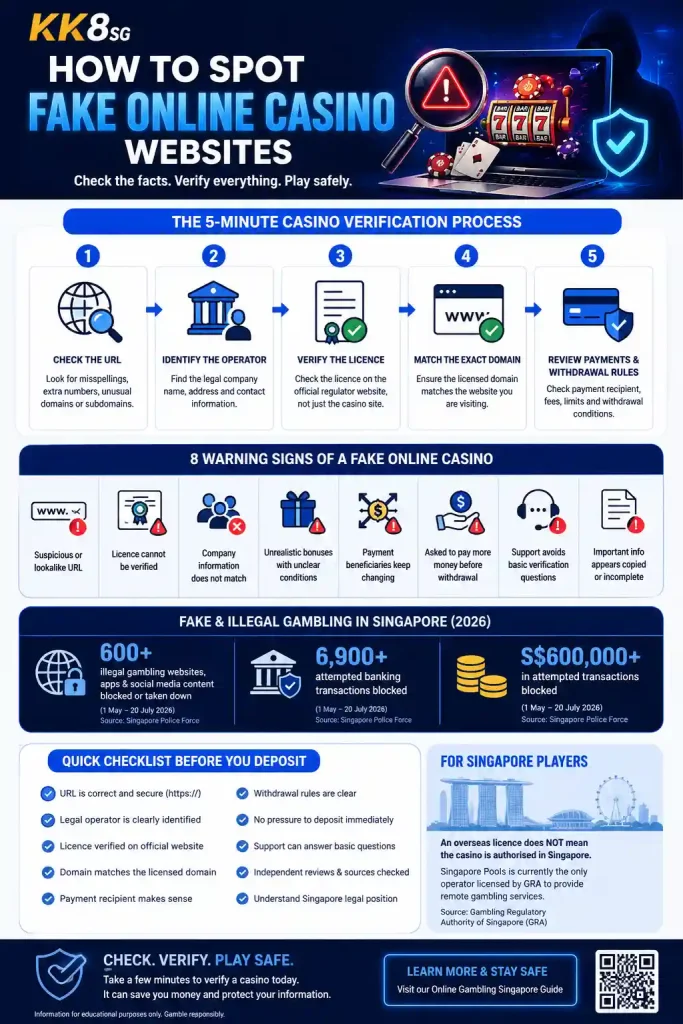
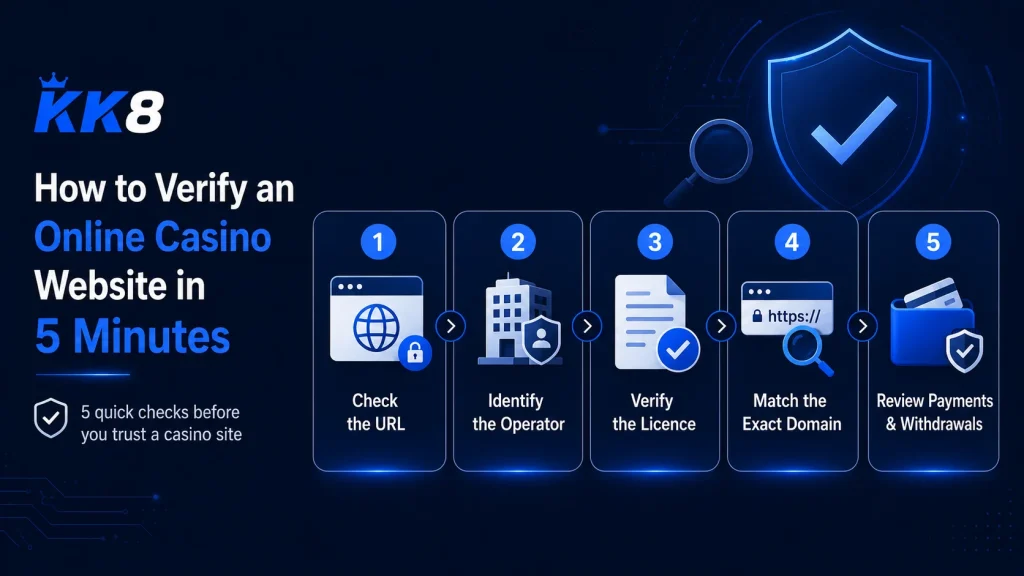
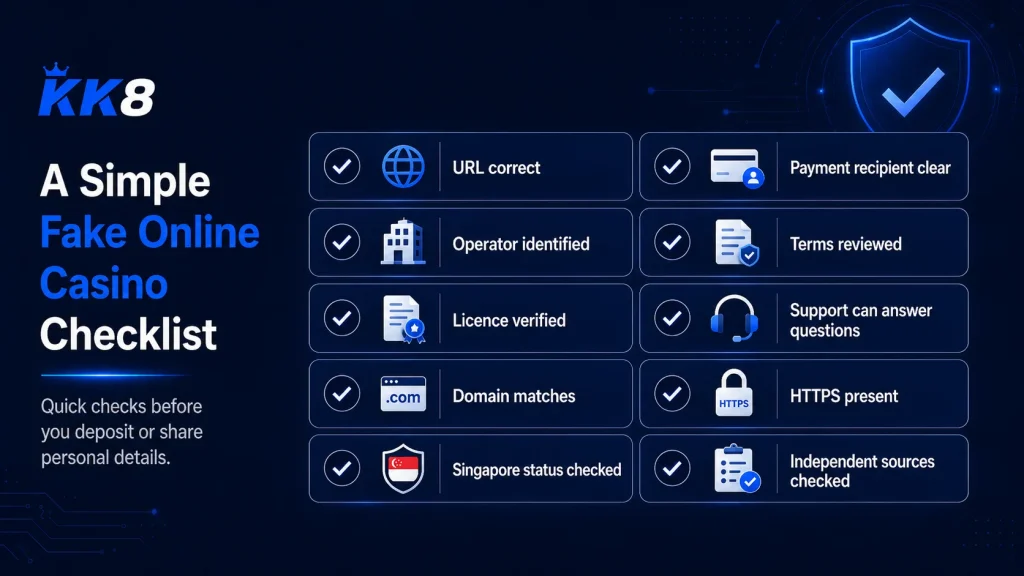
See our guide to How to Spot Fake Online Casino Websites for a deeper website-verification checklist.
2. Casino Withdrawal Scams
Withdrawal scams happen when a platform accepts deposits normally but creates unreasonable barriers when a player attempts to take money out.
Common patterns include:
- withdrawals remaining pending without explanation;
- repeated cancellation of withdrawal requests;
- new identity checks appearing each time;
- account balances being frozen;
- unexpected wagering conditions;
- support giving different explanations each time.
However, a slow withdrawal by itself is not enough to prove fraud.
Some withdrawals are delayed by banking hours, payment-provider processing, compliance reviews or incomplete verification. The key question is whether there is a reasonable, consistent explanation.
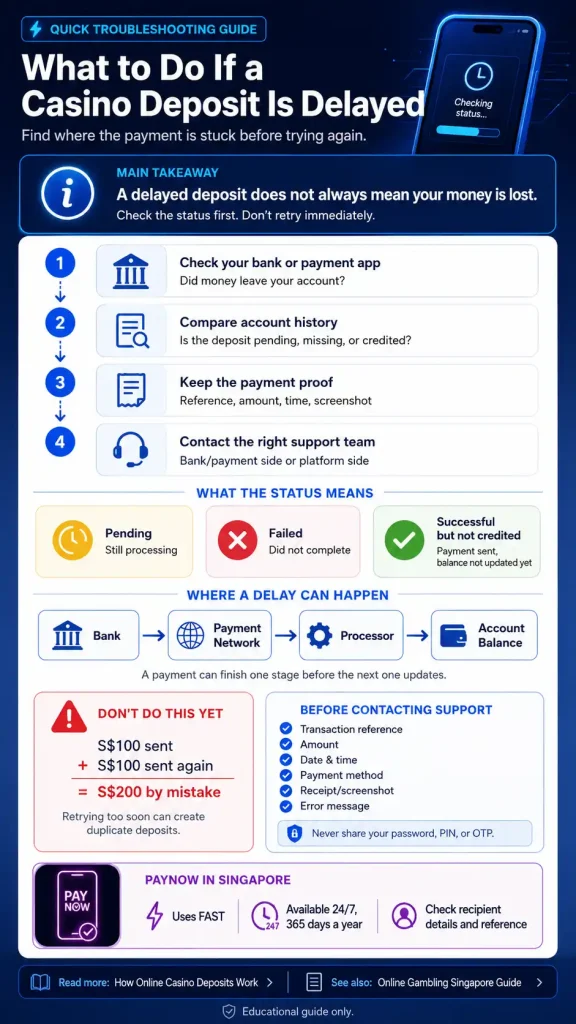
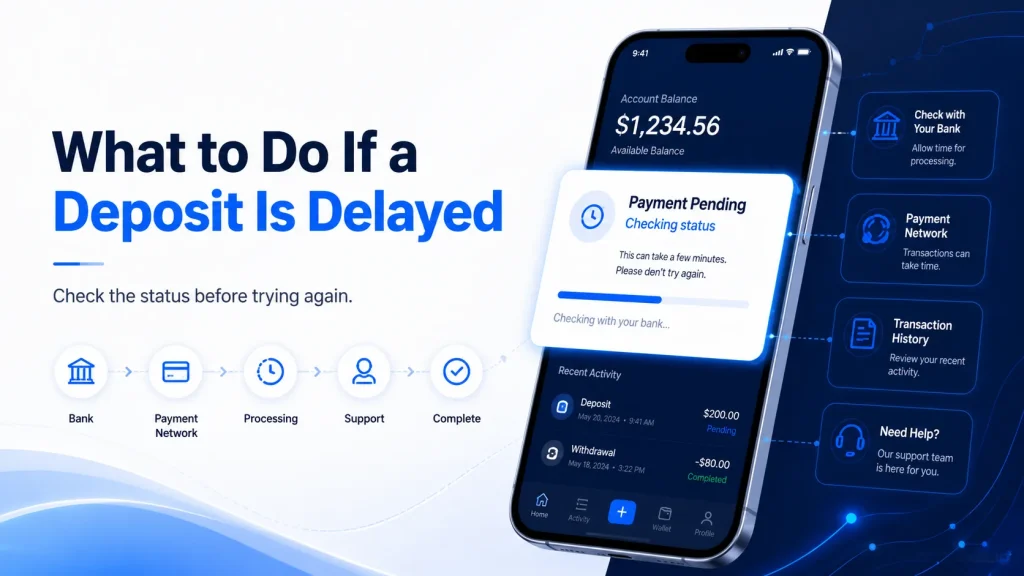
If the issue involves a payment that has not arrived, see What to Do If a Casino Deposit Is Delayed.
3. Deposit-to-Unlock Withdrawal Scams
This deserves separate attention because it can cause victims to keep sending money while trying to recover an existing balance.
For example:
| Step | What happens |
| 1 | Account shows S$2,000 |
| 2 | User requests withdrawal |
| 3 | Platform requests S$200 “verification fee” |
| 4 | User pays |
| 5 | Platform requests S$300 “tax” |
| 6 | User pays again |
| 7 | Another requirement appears |
| 8 | Withdrawal is still not released |
The names used for the payment can vary:
- verification fee
- AML fee
- account activation fee
- withdrawal tax
- security deposit
- VIP upgrade
- processing payment
The important question is not what the fee is called. It is why you are being asked to send additional money before receiving funds that supposedly already belong to you.
4. Fake Gambling Apps
Fake gambling apps can imitate real platforms or be promoted as exclusive versions that must be downloaded outside normal app stores. Some may simply take deposits. Others can be designed to steal passwords, payment information or personal data.
Be especially careful when someone asks you to install:
- an unknown APK file;
- software sent through Telegram or WhatsApp;
- an app from a shortened or unfamiliar link;
- an “updated version” from outside the official source.
Do not assume an app is trustworthy simply because its interface looks professional.
5. Phishing and Fake Login Pages
Phishing scams try to make you enter your information into a fake page.
A message might claim:
- “Your withdrawal has been suspended.”
- “Verify your account now.”
- “Your bonus expires today.”
- “Security check required.”
- “Log in to release your funds.”
The link then opens a page designed to look like a gambling website, bank or payment provider. Once a user enters a password, OTP or payment information, the scammer may be able to use it elsewhere.
MoneySense advises users not to provide banking login details or OTPs through suspicious messages and to contact their bank quickly if they believe their financial information has been compromised.
6. Fake Gambling Agents
Not every gambling scam starts on a gambling website. Some begin with an “agent” contacting users through:
- Telegram
- private chat groups
The agent may offer gambling credits, special odds, bonuses or access to a private platform. Payment instructions deserve particular attention. Be cautious when money is repeatedly sent to unrelated personal accounts, different names or newly provided bank accounts.
Singapore Police investigations have identified cases where personal bank accounts were allegedly provided to unlicensed gambling operators to conduct monetary transactions.
7. Fake Betting Tips and Fixed-Match Scams
Another common scheme involves someone claiming to know the outcome of a sporting event in advance.
The seller may advertise:
- guaranteed football tips;
- insider information;
- “100% fixed matches”;
- private VIP betting groups;
- unusually high winning rates.
Users are normally asked to pay for access to the tip. Sometimes the scam goes further. The user may be directed to a specific betting website controlled by the same people. Claims of guaranteed betting outcomes should be treated as a major warning sign.
8. Fake Bonuses and Changing Terms
Large bonuses can attract attention, but the size of a promotion alone does not prove that it is fraudulent. The important issue is whether the conditions are clear before the user deposits.
For example, there is a major difference between:
Before deposit:
“The bonus has a 20x wagering requirement.”
and:
After winning:
“You must complete an additional 50x turnover before we allow the withdrawal.”
Terms that suddenly appear or change after a withdrawal request deserve closer scrutiny.
9. Social Media Gambling Scams
A gambling scam may begin long before the user reaches the actual platform. Someone may see a sponsored post, influencer-style video or comment claiming that a particular system produces easy winnings.
The conversation is then moved to WhatsApp or Telegram, where the user receives a registration or payment link.
This creates a chain:
Social media → Private chat → Gambling platform → Deposit
Checking only the final website can therefore miss an important part of the scam. Consider where the recommendation came from, who is communicating with you and why they want the conversation moved away from a public platform.
10. Bank Account and Singpass Misuse
This is particularly important for Singapore readers. A person may be offered money for:
- opening a bank account;
- lending an existing bank account;
- receiving payments for another person;
- opening a company;
- handing over online banking access;
- providing Singpass credentials.
Do not treat this as harmless side income.
Normal Payment Problem or Possible Gambling Scam?
Not every inconvenience is fraud. The table below helps separate ordinary issues from stronger warning signs.
| Situation | Could be a normal issue | Stronger scam warning |
| Withdrawal pending | Stated processing period has not passed | Deadline keeps changing |
| KYC requested | Standard documents requested once | New documents repeatedly requested |
| Withdrawal rejected | Existing rule clearly applies | New rule appears after winning |
| Deposit pending | Bank or payment processing delay | Told to send another deposit |
| Account under review | Clear compliance review | Payment required to end review |
| Bonus restriction | Terms were shown beforehand | Conditions change after the win |
| Payment account changes | Verified company updates details | Different personal accounts used repeatedly |
| Support response | Clear and consistent explanation | Different agents give different stories |
A single warning sign may have a reasonable explanation. Several warning signs appearing together should lead to much greater caution.
10 Warning Signs of an Online Gambling Scam
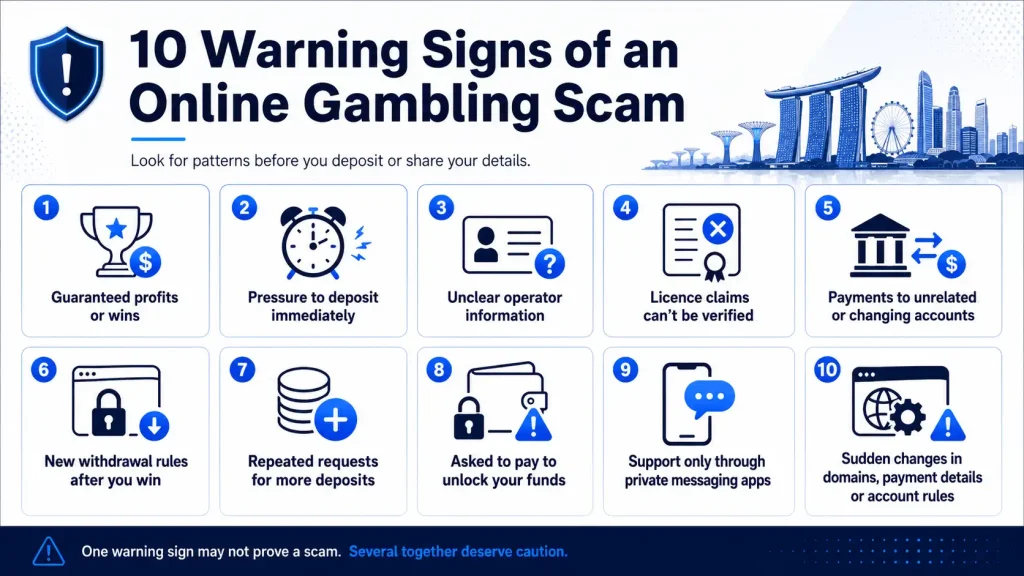
Watch for these patterns:
- Guaranteed profits or guaranteed wins.
- Pressure to deposit immediately.
- Unclear information about who runs the platform.
- Licence claims that cannot be independently checked.
- Payments going to unrelated or changing accounts.
- New withdrawal rules introduced after a win.
- Repeated requests for additional deposits.
- Requests for money to “unlock” existing funds.
- Support that communicates only through private messaging apps.
- Sudden changes in domains, payment details or account rules.
None of these should be considered a single automatic test. Look at the overall behaviour of the platform.
Does a Foreign Gambling Licence Make a Website Legal in Singapore?
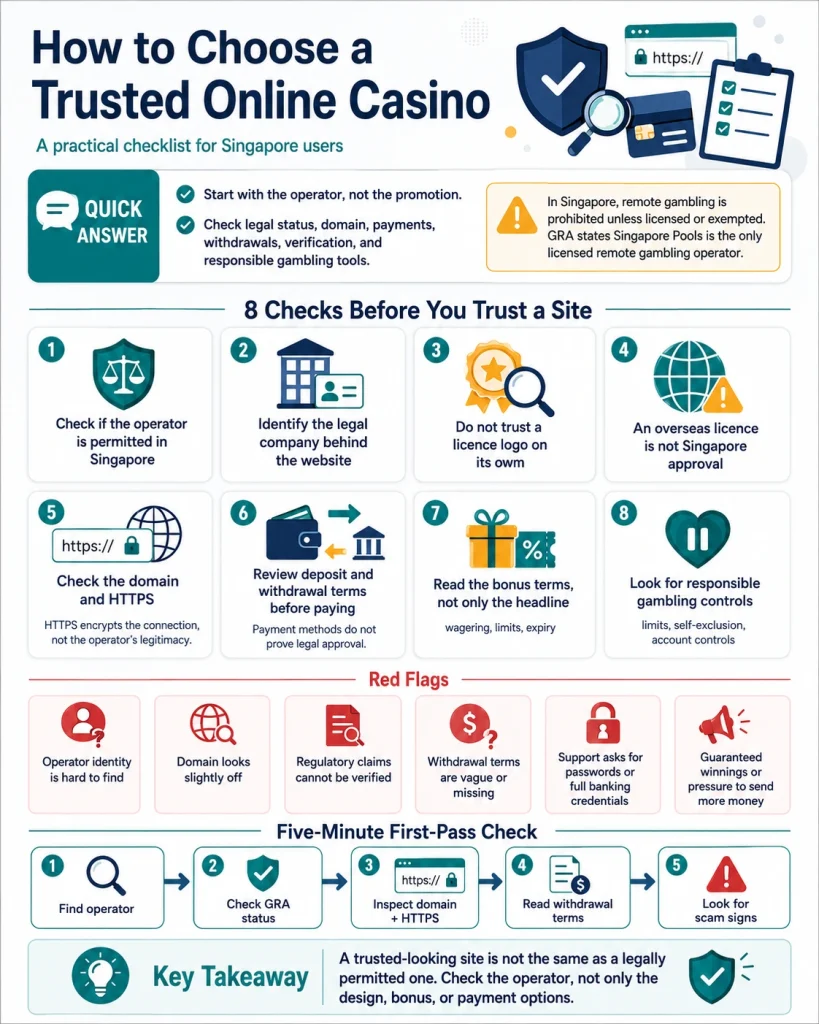
No. These are two separate questions. A gambling website may claim to hold a licence from an overseas jurisdiction. That does not automatically mean it is authorised to offer remote gambling services to people in Singapore.
A Small Withdrawal Can Be Part of the Scam
One Singapore case shows why an early successful payment should not create automatic trust. Singapore Police said victims had been encouraged to create accounts with an online gambling website and send money to anonymous bank accounts for gambling credits.
At first, they could redeem winnings. But after continuing to gamble and trying to redeem larger amounts, they were told that they needed to accumulate more winnings or purchase additional credits. Several victims eventually lost more than S$175,000.
The pattern is important:
Small deposit → apparent success → trust → more money → withdrawal obstacle
A scam does not have to fail immediately to be a scam.
Payment Red Flags Singapore Users Should Watch
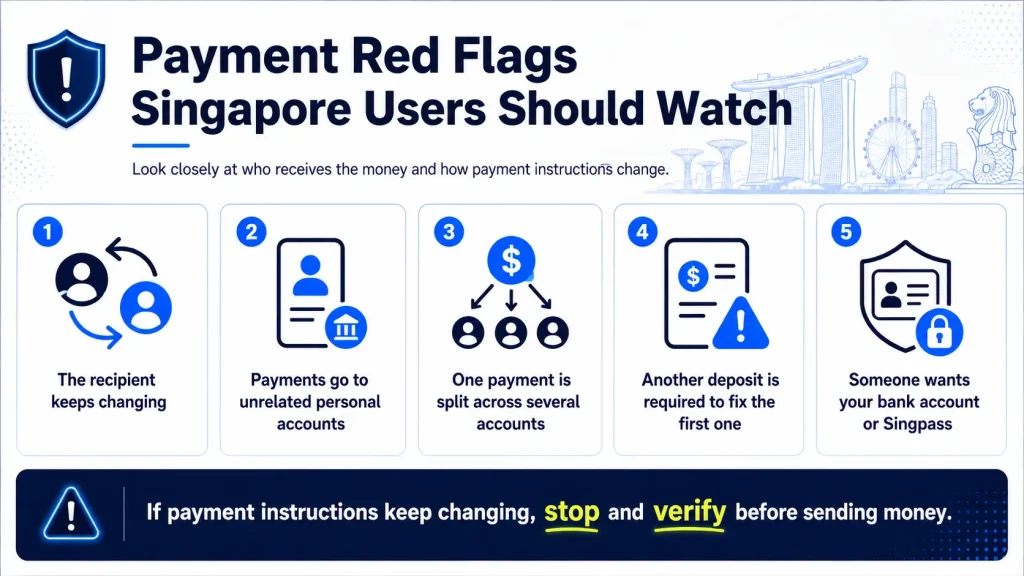
The payment method itself is only part of the picture. Who receives the money and how payment instructions change can tell you much more.
The Recipient Keeps Changing
If every deposit goes to a different account holder, ask why. A legitimate explanation may exist, but repeated unexplained changes deserve caution.
Payments Go to Unrelated Personal Accounts
Be careful when a supposed business repeatedly directs payments to individuals whose names have no clear relationship with the service.
One Payment Is Split Across Several Accounts
Being told to divide a payment among multiple unrelated recipients should trigger additional checks.
Another Deposit Is Required to Fix the First One
A request such as:
“Your deposit failed. Send another S$500 and we will return both.”
should not be accepted without independent verification.
Someone Wants Your Bank Account or Singpass
Never provide another person with control over your bank account, banking credentials or Singpass simply because they promise a commission.
Singapore Police operations in 2026 have specifically investigated alleged misuse of personal and corporate bank accounts connected with illegal online gambling.
What to Do If You Think You Have Been Scammed
If something feels wrong, the priority is to prevent further loss rather than continuing to negotiate with the suspected scammer.
1. Stop Sending Money
Do not keep paying because someone claims that one final fee will release your withdrawal. Scammers may continue asking for money after the first loss. MoneySense specifically warns that scammers can promise to release funds after additional fees are paid and advises people who suspect a scam to stop sending more money.
2. Secure Your Financial Accounts
If banking information, card details, passwords or OTPs may have been exposed, contact the relevant bank immediately. Depending on what has been compromised, this may involve freezing accounts, cancelling cards or securing an e-wallet. ScamShield and MoneySense both advise scam victims to contact their bank quickly to limit further losses.
3. Save Evidence
Keep copies of:
- website URLs;
- screenshots;
- advertisements;
- account balances;
- withdrawal messages;
- Telegram or WhatsApp conversations;
- bank account numbers;
- payment receipts;
- phone numbers;
- email addresses.
Do this before the website or account disappears.
4. Secure Compromised Online Accounts
Change passwords if you entered them on a suspicious page. If the password was reused elsewhere, change it on those accounts too. Enable multi-factor authentication where available.
5. Report the Incident
ScamShield advises affected users to contact their bank, file a police report, secure compromised accounts and report suspicious activity to relevant platforms. Use official Singapore channels rather than paying an unknown “recovery agent” who promises to recover lost funds for an upfront fee. Recovery scams can target people who have already lost money once.
How to Reduce the Risk of Online Gambling Scams
There is no single check that can guarantee a website is trustworthy. A safer approach is to use several checks before sending money or personal information.
Before registering
Check:
- who operates the platform;
- whether contact information can be verified;
- whether legal claims make sense;
- whether the domain matches the business being advertised.
Before depositing
Check:
- who will receive the payment;
- whether the recipient makes sense;
- whether deposit terms are clearly explained;
- whether withdrawal requirements are available before payment.
Before sharing personal information
Ask:
- Why is this information required?
- Where am I submitting it?
- Am I on the correct domain?
- Did I arrive through an unexpected message?
Before sending more money
Stop if someone tells you that another payment is required to access money that is already shown as yours. Verify independently before doing anything else.
Online Gambling Scam Safety Checklist
Use this checklist whenever an online gambling platform feels suspicious.
| Check | Question to ask |
| Operator | Can I identify who runs the website? |
| Legal status | Is the service authorised for Singapore users? |
| Payment | Who exactly am I paying? |
| Terms | Were withdrawal conditions clear before depositing? |
| Account | Have the rules changed after I won? |
| Withdrawal | Am I being asked to deposit again? |
| Communication | Is everything handled through Telegram or WhatsApp? |
| Security | Am I being asked for passwords, OTPs or Singpass access? |
| Pressure | Am I being told to act immediately? |
| Evidence | Can important claims be independently verified? |
The more questions you cannot answer clearly, the more cautious you should be.
Frequently Asked Questions
What are the most common online gambling scams?
Common online gambling scams include fake gambling websites, withdrawal scams, deposit-to-unlock schemes, fake gambling apps, phishing, fake betting agents, fixed-match scams, misleading bonus schemes and identity or bank-account misuse.
How can I tell if an online gambling website is fake?
Look beyond the website design. Check the operator’s identity, contact information, legal claims, payment recipients and withdrawal terms. Warning signs include changing bank accounts, guaranteed winnings, unexplained withdrawal restrictions and demands for more money before a withdrawal is released.
Is a delayed casino withdrawal always a scam?
No. Withdrawals can be delayed because of banking processing, verification, compliance reviews or payment-provider issues.
The situation becomes more concerning when explanations keep changing, new conditions appear after the withdrawal request or additional payments are required.
Is it normal for a casino to ask for another deposit before withdrawal?
A request for additional money solely to release an existing balance should be treated as a serious warning sign.
Do not keep sending money simply because support claims that one more deposit, tax or verification fee will unlock the withdrawal.
Can a scam gambling website allow me to withdraw money at first?
Yes. An early successful withdrawal does not prove that later withdrawals will work.
Singapore Police documented a case where victims initially redeemed winnings before later being told to accumulate more winnings or purchase more credits when attempting further redemptions.
Does an overseas gambling licence make an online casino legal in Singapore?
Not automatically. An overseas licence and authorisation to provide remote gambling services to people in Singapore are separate issues.
What should I do if I already sent money to a gambling scam?
Stop sending further payments, contact your bank quickly, secure affected accounts, save evidence and file a report through official channels.
ScamShield recommends acting quickly because doing so may help prevent further losses.
Should I give someone my bank account or Singpass for gambling transactions?
No. Do not give another person control of your bank account, banking credentials or Singpass.
Singapore Police have investigated cases involving personal and corporate bank accounts and Singpass access suspected of being used to facilitate illegal online gambling.
Final Takeaway
The best way to identify an online gambling scam is not to focus only on how professional the website looks.
Pay attention to behaviour.
Who receives the money? Are the rules clear before you deposit? What happens when you try to withdraw? Do the requirements suddenly change? Are you being asked to send more money to recover money already shown in your account?
Those questions often reveal more than a logo, bonus banner or licence badge.
For Singapore readers, it is also important to separate overseas licensing claims from local legal status. Check official information from the Gambling Regulatory Authority and Singapore Police Force when in doubt.
For a broader understanding of regulation, payments and player safety, explore our Online Gambling Singapore Guide.