Author: admin

  • Understanding Gambling Regulations in Singapore

    Understanding Gambling Regulations in Singapore

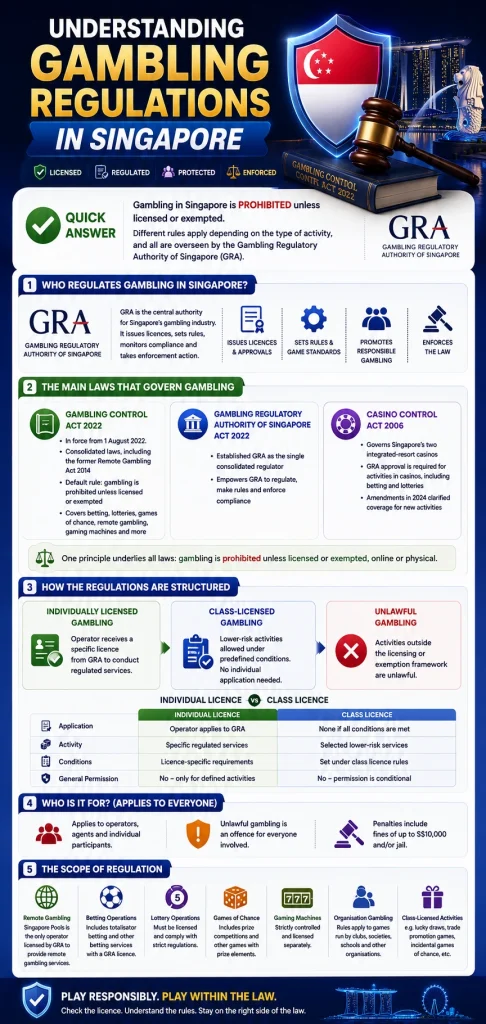
    Gambling regulations in Singapore use a controlled licensing system rather than treating every activity the same way. The Gambling Regulatory Authority of Singapore (GRA) oversees the framework under the Gambling Regulatory Authority Act 2022, the Gambling Control Act 2022 and the Casino Control Act 2006.

    The main principle is simple: gambling is prohibited unless licensed or exempted, online or physical. Different rules then apply depending on whether the activity involves casinos, betting, lotteries, remote gambling, gaming machines, or lower-risk activities under class licences.

    Worth separating early: laws and regulations are not the same thing. Laws are the Acts passed by Parliament, regulations are the detailed requirements GRA makes within that framework, and licence conditions apply directly to individual operators. A service can be legal in principle and still breach its license conditions.

    For a broader overview of the legal framework itself, read Singapore Gambling Laws Explained.
    gambling regulations Singapore

    Quick Answer

    Singapore’s gambling regulations rest on four things: licensing, approval, enforcement, and harm-minimisation controls. The Gambling Control Act 2022 provides most of the framework for betting, lotteries, games of chance and remote gambling outside the casino regime.

    Lower-risk activities such as qualifying lucky draws may operate under class licences when all conditions are met. Remote gambling is far more restricted, and GRA states that Singapore Pools is the only operator licensed to provide remote gambling services here.

    Who Regulates Gambling in Singapore?

    GRA is the central authority for Singapore’s gambling industry, consolidating what was previously a fragmented arrangement across multiple bodies, and it can also make regulations for the industry.

    Regulation involves far more than issuing licences. GRA handles approvals, operator compliance, game rules, social safeguards and enforcement, all continuing for as long as an operator holds a licence.

    For readers starting with the broader topic, see the Online Gambling Singapore Guide.

    What Does the Gambling Control Act Cover?

    The Gambling Control Act 2022 came into effect on 1 August 2022, consolidating earlier legislation including the former Remote Gambling Act 2014.

    Its default rule is that gambling is prohibited unless licensed or exempted, and the government stated during its passage that unlawful gambling offences apply to everyone involved, including operators, agents and individual participants.

    The Act covers betting operations, lotteries, games of chance, remote gambling, gaming machine operations, gambling by organisations, and class-licensed activities. Requirements differ by service, which is why “how is this specific activity regulated” is the more useful question.

    How the Regulations Are Structured

    Regulatory Category How It Works
    Individually licensed gambling Operator receives a specific licence from GRA
    Class-licensed gambling Proceeds under predefined conditions, no individual application
    Unlawful gambling Falls outside the permitted framework

    Betting and lottery services generally need a GRA license, while qualifying lower-risk activities such as certain lucky draws may fall under a class license instead.

    Individual Licences

    GRA states that anyone wishing to conduct betting operations, including totalisator betting, or lottery operations must be licensed. The licence may cover accepting or settling bets, facilitating betting arrangements, games of chance involving prizes, and lotteries.

    Approval extends to the details. Under Section 69 of the Gambling Control Act, a licensee must obtain GRA approval for the contents of the rules governing its licensed betting, games of chance and lotteries. Permission covers defined activities, not authority to offer every gambling product.

    Class Licences

    Class licences cover selected lower-risk services: qualifying lucky draws, trade promotion games and lotteries, incidental games of chance, and certain remote games of chance. An organisation covered by one does not need to submit an individual application, provided all conditions are met.

    Area Individual Licence Class Licence
    Application Operator applies to GRA None if all conditions are met
    Activity Specific regulated service Selected lower-risk services
    Conditions Licence-specific Set under class licence rules
    General permission No No

    Note the last row. Neither route grants general permission, and a class licence is never an exemption covering online casinos, sportsbooks or unrelated services.

    How Is Remote Gambling Regulated?

    Remote gambling is the most tightly controlled part of the framework. GRA states that it is unlawful to provide unlicensed remote gambling services in Singapore, from Singapore, or from outside Singapore to persons situated in Singapore. Singapore Pools is the only operator currently licensed to provide them.

    The delivery method changes the regulatory problems without changing the principle. Physical regulation focuses on venues, entry controls and equipment. Remote regulation adds online access, overseas operators, website blocking, digital advertising, remote payments and account-based controls.

    An overseas operator does not escape these rules because its company, servers or facilities sit elsewhere. GRA states the definition covers facilities located outside Singapore, partly or fully, and none of the following establishes approval: overseas registration, a foreign licence, acceptance of Singapore users, SGD support, PayNow availability, or the site being reachable.

    Payment method is the most persuasive false signal of the lot. A platform accepting PayNow, cards or local bank transfers has established nothing about its licensing.

    For a dedicated explanation, read Remote Gambling in Singapore Explained.

    Advertising and Enforcement

    Promotion is regulated separately from accepting bets. GRA states that advertising unlawful gambling in Singapore, from Singapore, or from outside Singapore into Singapore is an offence. An advertisement on a website or social platform is therefore not evidence the service is lawful.

    GRA acknowledges that operators based outside Singapore present practical enforcement difficulties, which is why website blocking is used against unlawful services reachable by Singapore users.

    Participation carries real exposure. GRA confirms that taking part in unlicensed remote gambling is an offence for a person in Singapore, with a maximum penalty of a fine up to SGD10,000, imprisonment up to six months, or both.

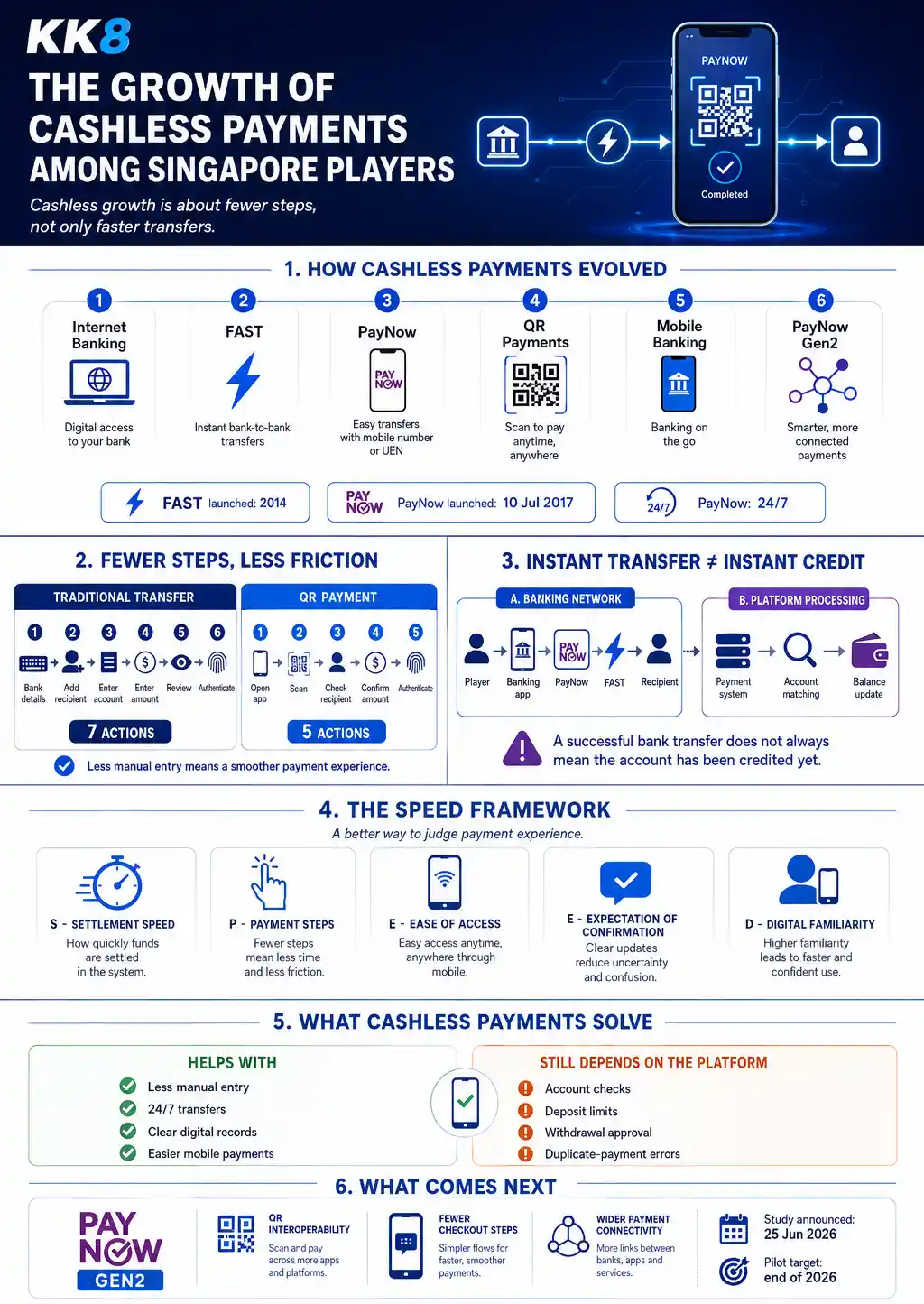
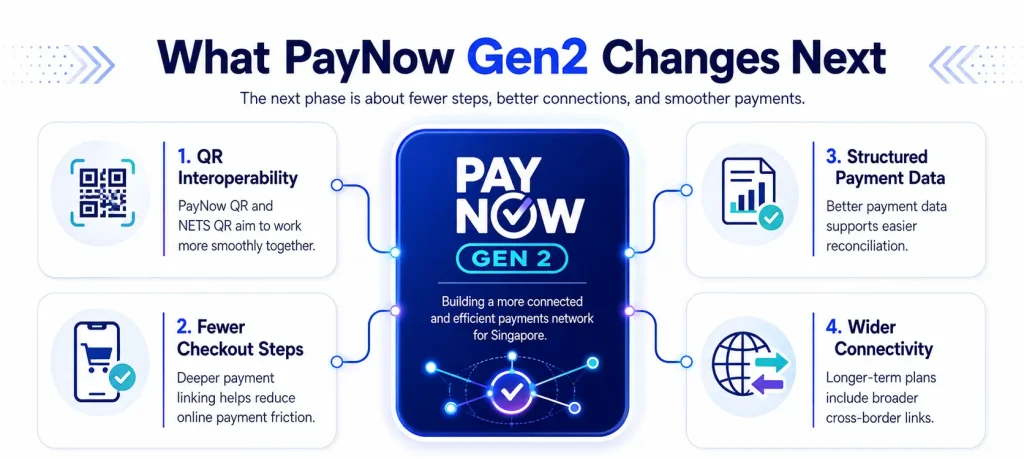
    PayNow often appeals to users who already rely on Singapore mobile banking and prefer direct account-to-account payments.

    For a broader payment comparison, read Which Payment Method Is Fastest for Singapore Players?

    How Are Licensed Operators Monitored After Approval?

    Licensed operators must keep complying with licence conditions, and GRA publishes enforcement actions against operators and approved venues. In May 2026, GRA listed a SGD100,000 financial penalty against Singapore Pools for failing to verify customers’ exclusion status.

    That example is instructive because it involves the licensed operator rather than an illegal site. Regulation is a continuing obligation, not a one-time approval, and it covers harm-minimisation duties as much as commercial ones.

    Social Safeguards and Self-Exclusion

    Harm reduction is built into the framework rather than sitting alongside it. The National Council on Problem Gambling (NCPG) manages exclusion and visit-limit programmes, with individual self-exclusion covering Marina Bay Sands, Resorts World Sentosa, jackpot machine rooms at private clubs, and Singapore Pools online betting.

    Anyone applying must remain excluded for at least one year before applying for revocation. That minimum is deliberate, making exclusion a durable barrier rather than something reversible on impulse.

    These protections exist because the activity is regulated, and no equivalent applies on an unlicensed offshore site.

    For a dedicated guide, read Responsible Gambling Singapore.

    Casinos, Gaming Machines and Community Gambling

    Casino gambling has its own structure under the Casino Control Act 2006, with GRA regulating operators, activities, equipment and approvals. Technical compliance reaches down to the hardware: GRA-approved laboratories testing casino gaming equipment must maintain ISO/IEC 17025 accreditation.

    Gaming machine rooms fall under the Gambling Control Act, with GRA licensing eligible operators against suitability criteria. Approved venues remain subject to conditions, and GRA’s enforcement records include action against venues that failed to conduct required social safeguard checks.

    Community gambling is also covered. GRA licenses eligible community organisations conducting gambling for social purposes at approved venues. A private or social setting does not automatically sit outside regulation. What matters is whether the activity meets the definition of gambling and whether a permitted framework applies.

    Across all of these, Singapore uses different regulatory tools depending on the activity rather than one identical rule for every product.

    Common Misunderstandings

    “All gambling is illegal in Singapore.”

    Incorrect. The framework permits gambling that is licensed or exempted.

    “An overseas gambling licence is enough.”

    Incorrect. The rules apply to unlicensed services provided from overseas to people located in Singapore.

    “All legal gambling uses the same licence.”

    Incorrect. Singapore uses individual licences, casino-specific regulation and class licences depending on the activity.

    “If a gambling website is accessible, it is approved.”

    Incorrect. Accessibility establishes nothing. GRA uses website blocking as one enforcement measure, so a reachable site may simply not have been blocked yet.

    “Regulation ends once an operator gets a licence.”

    Incorrect. GRA monitors compliance and publishes enforcement actions against licensed entities that breach requirements.

    Regulation Checklist for Singapore Users

    Check Question to Ask
    Operator Who is the legal entity behind the brand?
    Activity What type of gambling is involved?
    GRA status Does the operator hold the required approval?
    Remote access Is the activity conducted online?
    Overseas operation Is an overseas operator serving Singapore users?
    Class licence Does a qualifying class licence apply?
    Advertising Is unlawful gambling being promoted?
    Compliance Is the operator subject to current regulatory action?

    Start with GRA’s own information rather than the operator’s website, and identify the legal entity first, since a brand name and the company behind it are frequently different. Check current enforcement records too, not just whether a licence exists.

    For website-level checks, read How to Verify an Online Casino.

    Frequently Asked Questions

    Who regulates gambling in Singapore?

    The Gambling Regulatory Authority of Singapore, exercising powers under the Gambling Regulatory Authority Act 2022, the Gambling Control Act 2022 and the Casino Control Act 2006.

    What is the main gambling regulation in Singapore?

    The Gambling Control Act 2022, which came into effect on 1 August 2022 and covers gambling outside the casino-specific regime.

    Does every gambling activity require an individual licence?

    No. Certain lower-risk activities operate under class licences when all prescribed conditions are met.

    How is online gambling regulated in Singapore?

    Within the remote gambling framework. GRA states that Singapore Pools is the only operator licensed to provide remote gambling services, and both providing and participating in unlicensed remote gambling are offences.

    Are licensed operators still monitored after approval?

    Yes. They remain subject to license conditions and regulatory requirements, and GRA publishes enforcement actions when operators or approved venues breach those obligations.
  • Remote Gambling in Singapore Explained

    Remote Gambling in Singapore Explained

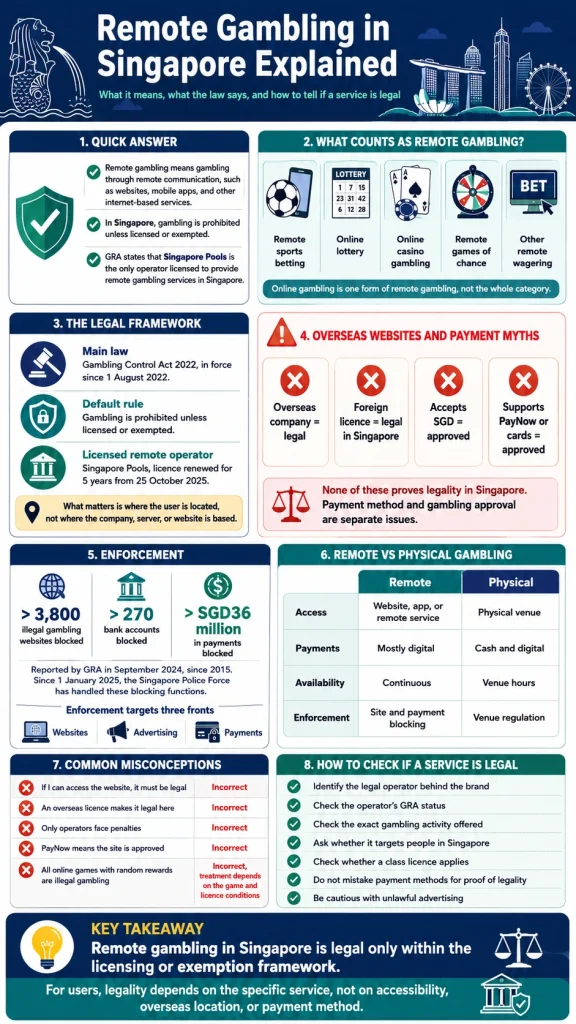
    Remote gambling in Singapore means gambling conducted through remote communication rather than requiring participants to be physically present at the same venue. In practice, that covers websites, mobile apps and other internet-based services.

    Singapore regulates it under the Gambling Control Act 2022, where the default rule is that gambling is prohibited unless licensed or exempted. The Gambling Regulatory Authority (GRA) states that Singapore Pools is the only operator licensed by GRA to provide remote gambling services in Singapore.

    The reach of that rule is what catches most people out. It is unlawful to provide unlicensed remote gambling services in Singapore, from Singapore, or from overseas to people located in Singapore. What determines whether Singapore’s law applies is where the user sits, not where the company, licence or server sits.

    For the wider topic, read our Online Gambling Singapore Guide.

    remote gambling singapore

    Quick Answer

    Remote gambling is not open to any operator that wants to offer it. An activity must fall within Singapore’s licensing or exemption framework, and GRA identifies Singapore Pools as the only licensed remote gambling operator.

    An overseas website does not become legal for Singapore users because it operates from another country. The framework explicitly covers gambling facilities sitting outside, or partly outside, Singapore.

    What Is Remote Gambling?

    Remote gambling describes gambling carried out without everyone involved being physically present in the same place: websites, mobile apps, remote sports betting, online lottery participation, and other internet-based wagering.

    Online gambling is therefore one form of remote gambling, not a synonym for it. The regulatory term is broader because it focuses on how the activity is provided rather than on whether a conventional website is involved. That breadth is deliberate, since a definition tied to “websites” would age badly as technology changes while one tied to remote communication does not.

    If you want the basic definition first, read What Is Online Gambling?

    Which Law Covers Remote Gambling in Singapore?

    Remote gambling sits within the Gambling Control Act 2022 framework, in force since 1 August 2022. GRA exercises its powers under that Act alongside the Gambling Regulatory Authority Act 2022 and the Casino Control Act 2006.

    Singapore previously regulated this area through the separate Remote Gambling Act 2014. The Gambling Control Act consolidated it into a single structure covering physical and remote gambling together, and the government confirmed during its passage that the new framework would continue to cover unlawful remote gambling, including cases where facilities sit outside or partly outside Singapore.

    Nothing was loosened in that reorganization. Remote gambling is not a carve-out from the wider framework, and repealing the older Act did not create a gap.

    For the broader legal structure, read Singapore Gambling Laws Explained.

    Is Remote Gambling Legal in Singapore?

    Remote gambling is permitted only where the activity falls within the licensing or exemption framework, and Singapore Pools is the only licensed operator. GRA renewed its licence to conduct betting operations, gaming and lotteries for five years from 25 October 2025.

    This reframes the question worth asking. “Is remote gambling legal?” has no useful answer. “Is this specific service licensed or exempted for use in Singapore?” does.

    For the dedicated legality guide, read Is Online Gambling Legal in Singapore?

    Are Overseas Websites and Foreign Licences Legal Here?

    No, and both fail for the same reason: neither says anything about Singapore permission.

    GRA states that it is unlawful to provide unlicensed remote gambling services from outside Singapore to people situated in Singapore. A foreign licence shows an operator is regulated under another jurisdiction’s rules, which is a fact about that jurisdiction, not this one.

    None of the following establishes legality:

    The company is registered overseas. The website holds an overseas licence. The servers are outside Singapore. The site accepts Singapore users. The site accepts SGD. The site supports a familiar payment method.

    Payment familiarity is the most persuasive false signal of the lot. A platform might accept PayNow, bank transfers, cards or e-wallets without any of it establishing approval. There is a practical risk the other way too: payment services connected to illegal gambling are an active enforcement target, so a route working today is no guarantee it works tomorrow.

    For a payment-specific comparison, read PayNow vs Other Payment Methods.

    Can Players Break the Law by Using Unlicensed Services?

    Yes. Singapore’s framework does not apply only to operators.

    When introducing the Gambling Control Act, the government stated that unlawful gambling offences apply across the chain, covering operators, agents and individual punters. Assuming only the website faces consequences is the most consequential misreading of this framework.

    How Are Unlawful Remote Gambling Services Controlled?

    Enforcement targets three fronts at once: the websites, the advertising, and the money.

    GRA reported in September 2024 that more than 3,800 illegal gambling websites, over 270 bank accounts and more than SGD36 million in payments linked to illegal remote gambling had been blocked since 2015. Since 1 January 2025, the Singapore Police Force has handled these blocking functions.

    Advertising is covered too. GRA states that advertising unlawful gambling in Singapore, from Singapore, or from outside Singapore into Singapore is an offence. A social media advertisement is therefore not evidence the advertised service is lawful, and aggressive marketing into Singapore is a signal worth treating with suspicion rather than reassurance.

    What Types of Gambling Count as Remote Gambling?

    Remote Gambling Type Typical Format
    Remote sports betting Wagering on sporting events through an online service
    Online lottery Entering lottery products remotely
    Online casino gambling Casino-style games through an online platform
    Remote games of chance Chance-based games offered through digital systems
    Remote wagering Other bets placed through remote communication

    Legal treatment differs by activity. GRA operates a separate class licensing framework for certain remote games with chance-based elements where users might win money, money equivalents or other items of value, with loot boxes given as an example.

    That structure is not general approval for online casino gambling. Different products sit under different arrangements, and permission granted for one does not extend to another.

    For a breakdown of gambling categories, read Types of Online Gambling Explained.

    How Remote Gambling Differs From Physical Gambling

    Area Remote Gambling Physical Gambling
    Access Website, app or remote service Physical venue
    Location User and operator need not be together User visits venue
    Payments Mostly digital Cash and digital methods
    Availability Continuous Depends on venue hours
    Regulatory concern Cross-border access, websites, payments Venue licensing and entry controls
    Enforcement Includes site and payment blocking Includes venue regulation

    Availability is the difference that matters most in practice. A venue closes and requires a journey to reach, while a remote service does neither. That is why account-level controls such as spending limits and exclusion programmes carry more weight here than any physical restriction can.

    The National Council on Problem Gambling provides self-exclusion and gambling harm services, including exclusion options covering Singapore Pools online betting. These protections exist because the activity is regulated, and they have no equivalent on an unlicensed offshore site.

    For the dedicated guide, read Responsible Gambling Singapore.

    Common Misconceptions

    “If I can access the website, it must be legal.”

    Incorrect. Accessibility is a technical fact, never a regulatory one.

    “An overseas licence makes remote gambling legal in Singapore.”

    Incorrect. The framework applies to unlicensed services supplied from overseas to people located here.

    “Only operators face penalties.”

    Incorrect. Unlawful gambling offences also apply to individual participants.

    “PayNow means the website is approved.”

    Incorrect. Payment availability and gambling licensing are entirely separate matters.

    “All online games with random rewards are illegal gambling.”

    Incorrect. Some remote games of chance operate under class licence conditions, and treatment depends on the game and whether those conditions are met.

    How to Check Whether a Service Is Legal

    Check Question to Ask
    Operator Who is the legal entity behind the brand name?
    GRA status Is that operator licensed?
    Gambling type Which specific activity is being offered?
    Overseas operation Is it targeting people in Singapore?
    Class licence Does a specific class licence apply?
    Payment Is a payment method being mistaken for proof of legality?
    Advertising Is the service being promoted unlawfully?

    Work through these in order, starting with GRA’s own information rather than the operator’s website. Identifying the operator comes first because a brand name and the legal entity behind it are frequently different, and a licence may cover only certain activities rather than everything the site offers.

    For more website checks, read How to Verify an Online Casino.

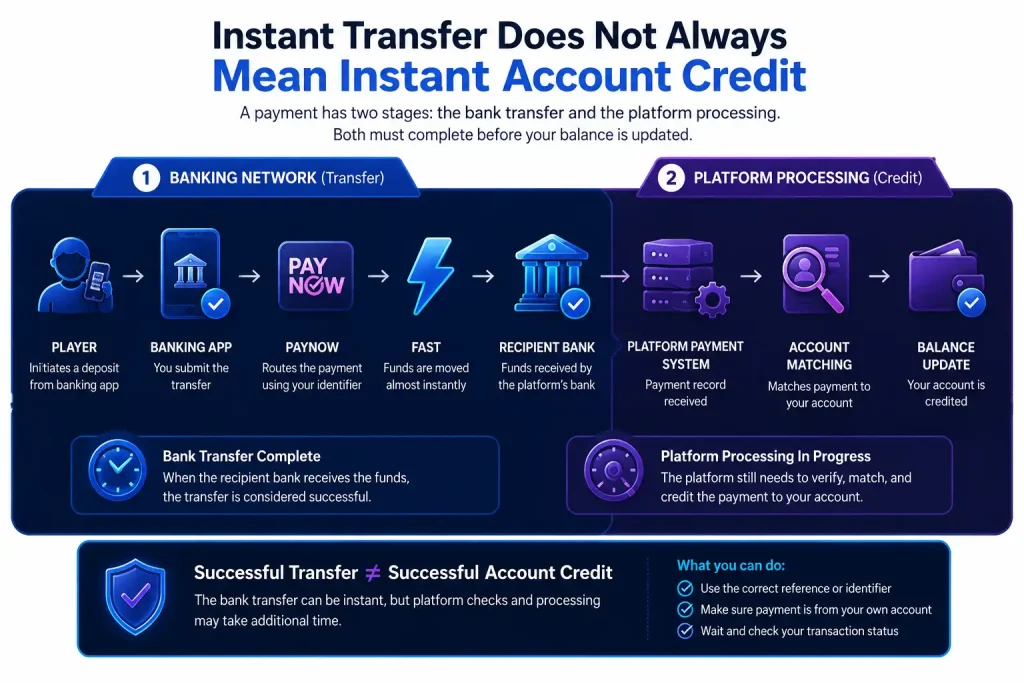
    Why a PayNow Payment May Not Show Up

    Sometimes the bank shows a completed PayNow transaction while the merchant account still shows no payment.

    This often means the delay is happening on the receiving side rather than inside PayNow itself.

    Possible reasons include:

    • Manual payment matching
    • Missing transaction reference
    • Incorrect amount
    • Account verification
    • Payment processing queues
    • Platform maintenance

    Keep the transaction reference and payment confirmation. These details help the receiving platform trace the transfer.

    Read Why Is My PayNow Deposit Not Showing? for a detailed troubleshooting guide.


    Using PayNow for Online Casino Payments

    Some online gaming platforms offer PayNow for deposits because it provides a direct local payment option for Singapore users.

    The basic process is similar to other PayNow online payments:

    1. Select PayNow.
    2. Enter the deposit amount.
    3. Scan the PayNow QR or use the payment information.
    4. Confirm the recipient.
    5. Approve the payment.
    6. Wait for the platform to credit the balance.

    The platform’s processing system determines how quickly the deposit appears after the bank transfer is completed.

    Read How to Deposit Using PayNow at an Online Casino for the full process.

    Frequently Asked Questions

    What is remote gambling?

    Remote gambling is gambling conducted through remote communication rather than requiring physical presence at the venue. Online gambling is one common form of it.

    Is remote gambling legal in Singapore?

    Only within the licensing or exemption framework. GRA states that Singapore Pools is the only operator licensed by GRA to provide remote gambling services in Singapore.

    Are overseas online gambling websites legal in Singapore?

    No. GRA states that providing unlicensed remote gambling services from outside Singapore to people situated in Singapore is unlawful, regardless of where the operator is based.

    What law regulates remote gambling in Singapore?

    The Gambling Control Act 2022, which consolidated the earlier Remote Gambling Act 2014. GRA also exercises powers under the Gambling Regulatory Authority Act 2022 and the Casino Control Act 2006.

    Does an overseas gambling licence make a website legal in Singapore?

    No. Singapore applies its own requirements to remote gambling services supplied to people located here, and a foreign license does not substitute for Singapore approval.

  • What Is Live Baccarat? How Live Dealer Baccarat Works

    What Is Live Baccarat? How Live Dealer Baccarat Works

    Live baccarat is baccarat played at a physical gaming table with a real dealer while the action is shown through a live video feed. Instead of receiving your own hand, you place a wager on one of two hands, called Player and Banker, or on the two hands finishing with the same score, called a Tie.

    The main objective is simple. The hand with a score closest to nine wins. You choose your wager and stake, while fixed baccarat rules determine how the cards are dealt and whether either hand receives a third card. You do not make hit-or-stand decisions as you would in blackjack. Standard baccarat rules use Player and Banker as names for the two hands, not descriptions of you and the casino dealer.

    Explore: Online Casino Singapore

    What Is Live Baccarat?

    Live baccarat combines a physical baccarat game with a digital betting interface. A dealer handles real cards at a studio or casino table, while players watch the round through a video stream and place wagers through an on-screen interface.

    A typical screen includes the live video, betting areas for Player, Banker and Tie, a countdown timer, chip values, previous results and, on many tables, baccarat roadmaps.

    The important distinction is the method of delivery. The dealer and cards are physical, while your wager is recorded through the digital interface. The underlying baccarat rules still determine the outcome.

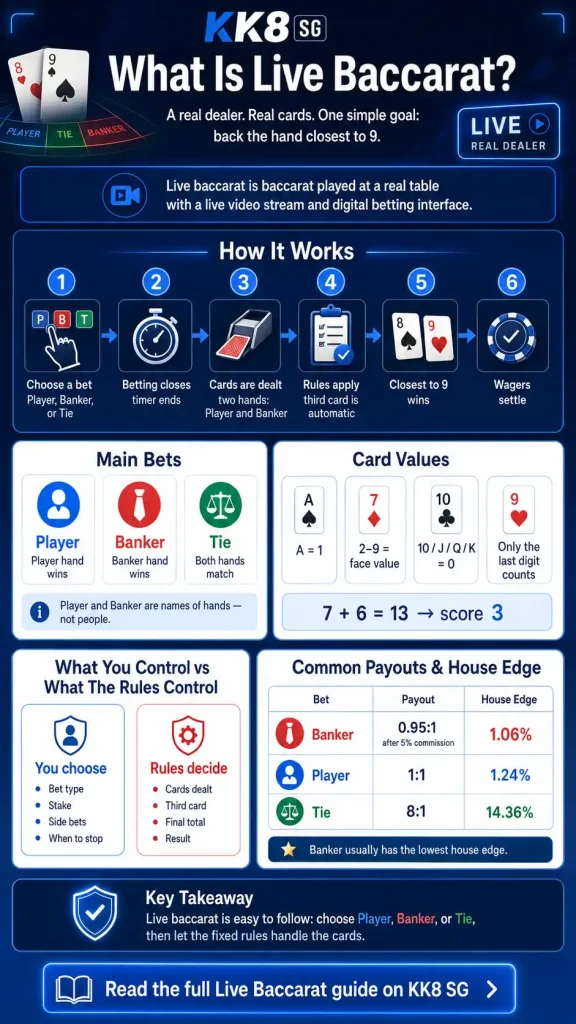
    A simple guide to how live baccarat works, including the main bets, card values, drawing rules, payouts and house edge

    How Does Live Baccarat Work?

    1. Choose Your Bet

    Before cards are dealt, you select where to place your wager. The three core options are:

    Bet What You Are Betting On
    Player The Player hand finishes closer to 9
    Banker The Banker hand finishes closer to 9
    Tie Both hands finish with the same total

    Some tables also offer side bets, such as Player Pair or Banker Pair. Side-bet rules and payouts vary by table.

    2. The Betting Window Closes

    Live baccarat tables use a betting period before each round. Once the timer ends, the interface stops accepting wagers for the current round. The dealer then starts dealing.

    3. Player and Banker Receive Two Cards

    Two cards are dealt to the Player hand and two to the Banker hand. Standard baccarat commonly uses multiple decks, with eight-deck analysis frequently used when comparing baccarat probabilities.

    You do not receive a personal hand. Player and Banker are simply the names given to the two hands on the table.

    4. Baccarat Drawing Rules Apply

    A third card is sometimes dealt, but you do not choose whether either hand takes another card.

    If either hand has a natural 8 or 9 from its first two cards, both hands stand. Otherwise, the Player hand draws on totals of 0 to 5 and stands on 6 or 7. The Banker rules depend on its own total and, in some situations, the Player’s third card.

    This sounds more complicated than the player’s role actually is. The dealer and game system apply the drawing rules for you.

    5. The Winning Hand Is Determined

    The hand finishing closest to nine wins.
    If Player and Banker finish with the same total, the round is a Tie. Standard Player and Banker wagers push when this happens, while a successful Tie wager receives its stated payout.

    6. The Wager Is Settled

    Once the result is confirmed, the interface settles the wagers and prepares for the next betting window.

    What Do Player, Banker and Tie Mean in Baccarat?

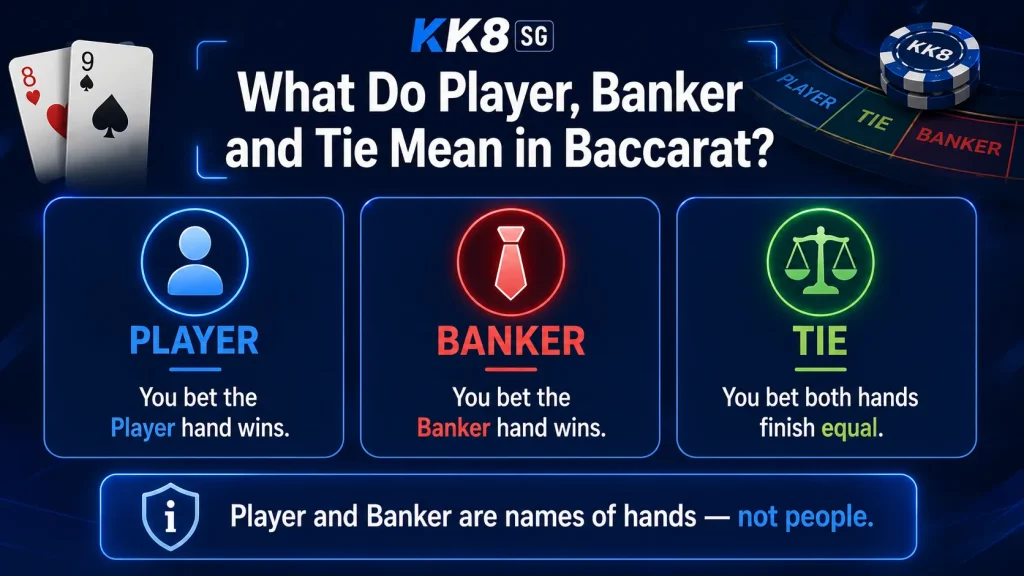
    What Player, Banker and Tie mean in baccarat, showing the three main baccarat betting options and what each bet represents

    These terms cause more confusion than the rules themselves. Player does not mean you. Banker does not mean the dealer or casino.

    They are two separate hands used to determine the result of each baccarat round. Standard baccarat rules refer to Player and Banker as both hands and betting options.

    Think of the decision as predicting an outcome rather than playing a hand yourself. For example, suppose you place S$20 on Player.

    Player finishes with 8.
    Banker finishes with 6.

    Player wins, so your Player wager wins.

    You did not own the Player cards. You simply backed the Player hand to finish with the higher baccarat score.

    How Are Baccarat Cards Scored?

    Baccarat uses an unusual scoring system, but it takes little time to learn.

    Card Baccarat Value
    Ace 1
    2 to 9 Face value
    10 0
    Jack 0
    Queen 0
    King 0

    Standard baccarat gives Ace a value of one, cards 2 through 9 their printed value, and tens and face cards a value of zero. Only the final digit of the total matters.

    Example 1:

    7 + 6 = 13

    Baccarat score = 3

    Example 2:

    9 + 8 = 17

    Baccarat score = 7

    Example 3:

    King + 8 = 8

    Baccarat score = 8

    There is no score above nine.

    What Is a Natural in Baccarat?

    A natural occurs when the first two cards give Player or Banker a total of eight or nine. If either hand has a natural, the normal baccarat rules stop both hands from drawing another card.

    For example:

    Player: 4 + 4 = 8
    Banker: 3 + 2 = 5

    Player has a natural 8. No third card is dealt, and Player wins.

    Who Decides Whether a Third Card Is Drawn?

    The baccarat rules decide. This is an important difference between baccarat and games such as blackjack. You do not choose to hit, stand or request another card.

    The Player rule is straightforward. Outside a natural:

    Player Total Action
    0 to 5 Draw
    6 to 7 Stand
    8 to 9 Natural, both hands stand

    If Player stands on 6 or 7, Banker draws on 0 to 5 and stands on 6 or 7. If Player receives a third card, the Banker drawing rule also considers the value of that card.

    A beginner does not need to memorise the full Banker matrix to play a standard baccarat round. The dealer follows it automatically.

    A useful way to think about baccarat is to separate your decisions from the game’s decisions.

    You Control Baccarat Rules Control
    Where you wager Cards dealt
    Your stake Third-card decisions
    Whether you choose a side bet Hand totals
    Whether you continue playing Round result

    What Are the Payouts and House Edge in Live Baccarat?

    Payouts depend on the table rules, so check the paytable before treating any figures as universal.

    For a common eight-deck baccarat structure with a 5% Banker commission and an 8:1 Tie payout, the mathematical house edges are approximately 1.06% for Banker, 1.24% for Player and 14.36% for Tie.

    Bet Common Payout Structure Approx. House Edge
    Banker 0.95:1 after 5% commission 1.06%
    Player 1:1 1.24%
    Tie 8:1 14.36%

    These percentages describe long-run mathematical expectation, not what will happen during one round or one session.

    To make the difference easier to understand, consider S$100 of theoretical wagering.

    Bet House Edge Theoretical Average Loss per S$100 Wagered
    Banker 1.06% About S$1.06
    Player 1.24% About S$1.24
    Tie 14.36% About S$14.36

    This does not mean a S$100 Banker wager loses S$1.06 each time. Individual rounds result in wins, losses or pushes. House edge describes the mathematical average across a large number of wagers.

    For a deeper explanation of this concept, see our RTP and casino mathematics guide.

    Why Does the Banker Bet Charge Commission?

    The Banker hand has a small structural advantage because its drawing rules act after more information about the Player hand is available. Standard baccarat offsets this advantage by paying a winning Banker bet at 19:20, equivalent to even money minus a 5% commission.

    Here is a simple example.

    You wager S$100 on Player and Player wins.

    Profit: S$100.

    You wager S$100 on Banker under a standard 5% commission table and Banker wins.

    Profit before commission: S$100.
    Commission: S$5.
    Net profit: S$95.

    This commission structure helps explain why Banker still has a slightly lower house edge than Player despite its reduced winning payout.

    What Is No Commission Baccarat?

    No Commission Baccarat removes the standard 5% commission from winning Banker wagers, but the name does not mean every Banker result pays full even money.

    Instead, the paytable usually modifies one or more outcomes.

    One widely analysed version pays most Banker wins at 1:1 but reduces a Banker win with a total of six to 1:2. Under an eight-deck model, this version gives the Banker bet a house edge of about 1.46%.

    For a S$100 Banker wager:

    Normal Banker win:
    S$100 profit.

    Banker wins with 6:
    S$50 profit under this specific version.

    Compare this with a standard commission game:

    Feature Standard Baccarat Example No Commission Version
    Banker commission Usually 5% None
    Most Banker wins 0.95:1 1:1
    Banker win with 6 Standard Banker payout 0.5:1
    Banker house edge About 1.06% About 1.46%

    Different no-commission formats use different rules. Read the table paytable before comparing two games based only on their names.

    Singapore’s Gambling Regulatory Authority also lists Baccarat and No Commission Baccarat among approved Marina Bay Sands baccarat game rules.

    What Are Baccarat Roadmaps?

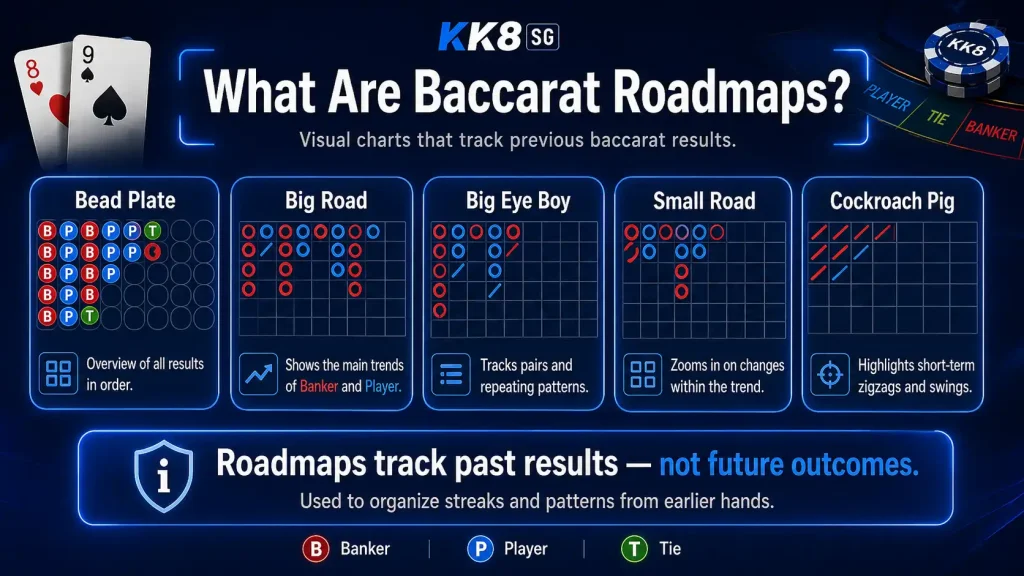
    Live baccarat screens often display previous Player, Banker and Tie outcomes in visual charts known as roadmaps.

    Common names include:

    • Bead Plate
    • Big Road
    • Big Eye Boy
    • Small Road
    • Cockroach Pig

    These displays organise previous results into different visual patterns.

    Their main value is record keeping. A sequence of previous Banker or Player results does not alter the mathematics of the next standard baccarat round. Past results should not be treated as a guaranteed prediction system. Baccarat analysis shows the underlying house edge comes from the rules and payouts rather than whether a recent scoreboard appears to form a streak.

    A useful rule for beginners is simple:

    Use the roadmap to read what happened, not as proof of what happens next.

    Live Baccarat vs RNG Baccarat

    Live baccarat and RNG baccarat often use similar core game rules, but they present the game differently.

    Feature Live Baccarat RNG Baccarat
    Dealer Real dealer Automated software
    Cards Physical cards Digital game outcome
    Presentation Live video stream Digital graphics
    Betting window Timed around dealer action Usually faster
    Interaction Live-table environment Automated
    Roadmaps Common Depends on game
    Core objective Closest hand to 9 Closest hand to 9

    Choosing between them does not change what Player, Banker or Tie mean. The main difference is the way the game is delivered.

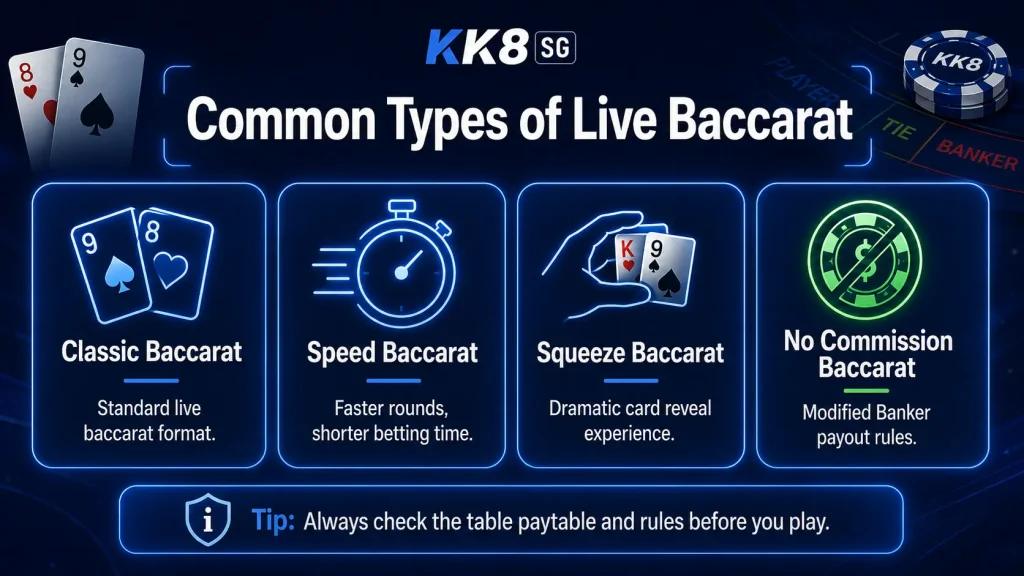
    Common Types of Live Baccarat

    Common types of live baccarat including Classic Baccarat, Speed Baccarat, Squeeze Baccarat and No Commission Baccarat

    Live baccarat tables come in several formats. These formats vary by speed, presentation, and rules.

    • Classic Baccarat: This follows the familiar Player, Banker and Tie structure with standard drawing rules.
    • Speed Baccarat: Speed versions shorten pauses between rounds and use shorter betting windows.
    • Squeeze Baccarat: Squeeze tables place more emphasis on the reveal of the cards. The core baccarat result still comes from the cards and drawing rules.
    • No Commission Baccarat: These tables replace the standard Banker commission with an alternative payout structure. The exact modified result differs by version.

    The table name alone does not tell you the full mathematics. The payout rules matter.

    A Simple Live Baccarat Round Example

    Consider this round:

    Player receives 4 and 3.

    Player total = 7.

    Banker receives 2 and 4.

    Banker total = 6.

    Player stands on 7. Banker also stands on 6. Player wins 7 to 6 under standard drawing rules.

    Suppose three different people each wagered S$20.

    Wager Result
    S$20 on Player Wins
    S$20 on Banker Loses
    S$20 on Tie Loses

    The Player bettor did not make any card decisions. Their only decision was to back Player before the betting window closed.

    This is why baccarat often feels simpler once you separate betting decisions from dealing rules.

    What Should You Check Before Joining a Live Baccarat Table?

    Do not assume every baccarat table uses identical payouts.

    Check:

    • Banker payout.
    • Banker commission.
    • Rules for Banker winning with six or another modified result.
    • Player payout.
    • Tie payout.
    • Side-bet payouts.
    • Minimum stake.
    • Maximum stake.
    • Table speed.
    • Game-specific rules.

    Two games using the word “Baccarat” might produce different expected returns if their payout structures differ. No Commission Baccarat is a clear example, since changing how specific Banker wins pay changes the house edge.

    If you are learning broader terminology at the same time, our Online Casino Terms guide explains common terms used across casino interfaces.

    Live Baccarat and Singapore Gambling Rules

    It is important to separate physical casino baccarat rules from online gambling access.

    Singapore’s Gambling Regulatory Authority publishes approved baccarat rules for regulated casino operations. Its Marina Bay Sands listings include Baccarat and No Commission Baccarat, along with several baccarat-related game formats.

    Remote gambling follows a different legal framework. The Ministry of Home Affairs stated on 9 June 2026 that gambling in Singapore is illegal unless authorised, licensed or exempted under the Gambling Control Act. It also states Singapore Pools is the only operator licensed to provide remote gambling services in Singapore, and other gambling operators, including online operators, are illegal.

    An overseas licence therefore should not be treated as equivalent to authorisation under Singapore law.

    For broader educational information about online casino games and related topics, see our Online Casino Singapore guide.

    Frequently Asked Questions

    What is live baccarat?

    Live baccarat is baccarat played with a real dealer and physical cards while the game is shown through a live video interface. Players place wagers digitally on Player, Banker, Tie or available side bets.

    What do Player and Banker mean in baccarat?

    Player and Banker are names for the two hands. Player does not represent your personal cards, and Banker does not mean the dealer’s personal hand. Standard baccarat rules treat them as the two competing hands and main betting options.

    Who decides whether a third card is drawn?

    Fixed baccarat drawing rules determine whether Player or Banker receives another card. The bettor does not make this decision.

    Why does Banker pay a commission?

    The Banker hand has a small mathematical advantage under standard drawing rules. A common baccarat structure charges 5% commission on winning Banker wagers, producing a 0.95:1 payout.

    What is the house edge in live baccarat?

    Under a common eight-deck game with standard payouts, the house edge is about 1.06% on Banker, 1.24% on Player and 14.36% on an 8:1 Tie wager. Different payout rules change these figures.

    What happens if Player and Banker tie?

    Standard Player and Banker wagers push when the two hands finish with the same score. A Tie wager wins according to the table’s stated payout.

    Do baccarat roadmaps predict the next result?

    No reliable mathematical basis shows a roadmap predicting the next independent baccarat outcome. Roadmaps record and organise previous results. They do not remove the game’s built-in house edge.

    What is the difference between live baccarat and RNG baccarat?

    Live baccarat presents a physical table, real cards and a live dealer through video. RNG baccarat generates and presents the game through software. Both formats still centre on comparing Player and Banker totals against nine.

  • Is Online Gambling Legal in Singapore?

    Is Online Gambling Legal in Singapore?

    Online gambling in Singapore is legal only when the activity is licensed or exempted. The Gambling Regulatory Authority (GRA) states that gambling is prohibited unless licensed or exempted, whether online or at a physical venue.

    For remote gambling, Singapore Pools is the only operator licensed by GRA to provide remote gambling services in Singapore. Its licence was renewed for five years from 25 October 2025 under Section 54 of the Gambling Control Act 2022.

    The practical consequence is worth stating plainly: a gambling website being accessible from Singapore tells you nothing about whether it is legal to use. Accessibility is a technical fact, not a regulatory one.

    For a broader introduction to the topic, read our Online Gambling Singapore Guide.

    Is Online Gambling Legal in Singapore

    Quick Answer

    Is online gambling legal in Singapore? Yes, but only within a tightly controlled framework.

    Singapore Pools holds the licence covering approved betting operations, gaming and lotteries. Any other remote gambling service supplied to people in Singapore without the required licence falls outside that framework.

    Singapore law also reaches overseas operators, covering gambling facilities located fully or partly outside Singapore when services are offered to people here. What matters legally is where the user is, not where the server is.

    What Law Regulates Online Gambling in Singapore?

    The main legislation is the Gambling Control Act 2022, effective 1 August 2022, which consolidated earlier laws including the former Remote Gambling Act 2014 into a single framework covering physical and remote gambling.

    The approach rests on one default rule: gambling is prohibited unless licensed or exempted. That is the opposite of a permissive framework, and it puts the burden on the operator to show permission rather than on the regulator to prohibit each new service.

    GRA oversees regulated gambling products and licensing, including casinos, lotteries, betting, gaming machine rooms, and certain class-licensed activities.

    For the wider legal framework, read Singapore Gambling Laws Explained.


    What Counts as Remote Gambling?

    Remote gambling means gambling conducted through remote communication rather than requiring physical presence at the same location, and online gambling sits inside this category.

    The framework was deliberately drafted to cover gambling facilities located outside Singapore, or only partly within it, so an overseas location alone does not put an operator outside Singapore’s rules.

    For a dedicated explanation, read Remote Gambling in Singapore Explained.

    Is Singapore Pools Legal for Online Gambling?

    Yes. Singapore Pools is the licensed remote gambling operator, with its licence renewed by GRA for five years from 25 October 2025 covering betting operations, gaming and lotteries.

    Licensed services also carry obligations that unlicensed offshore sites do not, including responsible gambling requirements such as expenditure and funding limits. The difference is not only permission to operate but the safeguards attached to it.

    Are Overseas Online Casinos Legal in Singapore?

    No, not by virtue of being overseas. An operator does not become legal because its servers, company, or facilities sit outside the country, since Singapore’s framework explicitly covers cross-border situations.

    The only test that matters is whether the operator has legal authority to provide gambling services to people in Singapore. That makes the following claims unreliable:

    “Licensed overseas, so legal in Singapore.” “Accepts SGD, so legal.” “Accepts PayNow, so approved in Singapore.” “Accessible without a VPN, so legal.”

    None of these substitutes for Singapore licensing. An overseas licence shows a regulatory relationship with another jurisdiction, nothing more.

    Does Accepting PayNow Make an Online Casino Legal?

    No. Payment method has no bearing on regulatory status.

    A site might support bank transfers, cards, or e-wallets without any of that establishing whether the service is licensed here. Payment familiarity creates a false impression of legitimacy, which is why the two questions are worth separating.

    There is a practical point in the other direction too. Financial institutions can be directed to block payment transactions linked to unlawful gambling operators, so a payment route working today is no guarantee it will work tomorrow.

    For payment comparisons, read PayNow vs Other Payment Methods.


    Can Singapore Residents Gamble on Unlicensed Websites?

    No, and this is the point most often misunderstood. Singapore’s framework does not treat unlawful gambling as an operator-only issue.

    When the Gambling Control framework was introduced, the government stated that unlawful gambling would be an offence for everyone involved, including operators, agents, and individual punters. Enforcement is active rather than theoretical: since 1 January 2025, the Singapore Police Force has handled the blocking of unlawful remote gambling websites, advertising, and payment transactions.

    If you are unsure whether a site falls within the permitted framework, GRA’s licensing information is far more reliable than an operator’s marketing claims.

    Are Online Casino Games and Sports Betting Legal?

    Both follow the same licensing principle, and neither is a legal category in itself.

    “Online casino” is a commercial term, not a regulatory one. Whether slots, roulette, or baccarat are permitted depends on whether the specific service is licensed, not on the games offered. Sports betting works identically: Singapore Pools holds the licence covering betting operations, and an offshore sportsbook gains no legal status by accepting Singapore users.

    Esports betting is the clearest exception worth knowing. The National Council on Problem Gambling (NCPG) states that esports betting is illegal in Singapore. International sites routinely group esports with traditional sports markets, which makes it easy to assume the legal treatment is the same. It is not.

    For a structural comparison between the two categories, read Online Casino vs Sports Betting.

    What About Loot Boxes and Chance-Based Prizes?

    Not every online game with chance-based features is regulated like a conventional online casino.

    GRA operates a class licensing framework covering certain remote games of chance, referring to games with chance-based elements where players might win money, money equivalents, or other things of value, with loot boxes given as an example.

    These rules sit separately from the framework for betting and lottery operators, so a game with random rewards is not automatically online casino gambling. Equally, a class licence for a lower-risk activity is not permission to run a casino.

    Licensed vs Unlicensed Online Gambling

    Area Licensed or Permitted Activity Unlicensed Activity
    Operator status Licensed or exempted under Singapore framework No required Singapore permission
    Regulatory oversight Subject to applicable Singapore rules Outside approved framework
    User participation Depends on permitted service Participation is an offence
    Payment method Does not determine legality Familiar payment methods do not make it legal
    Overseas location Not decisive Overseas location does not bypass Singapore law
    Safeguards Responsible gambling controls required No enforceable protections

    Singapore’s approach focuses on whether gambling is licensed or exempted, not on whether a website looks professional or operates abroad.

    How to Check Whether an Operator Is Legal

    Start with official regulatory information, not the operator’s own claims.

    Question Why It Matters
    Who operates the website? Identifies the actual gambling provider
    Is the operator licensed in Singapore? Determines regulatory status
    What activities does the licence cover? A licence may apply only to specific services
    Is remote gambling included? Physical and remote permissions differ
    Is the licence current? Licensing status changes
    Is the site relying only on an overseas licence? Overseas licensing does not replace Singapore approval
    Does the site make unclear legal claims? Marketing is not regulatory evidence

    A logo, footer statement, or foreign licence number is not verification. The only reliable source is GRA.

    For a broader website checking process, read How to Verify an Online Casino.

    Why Singapore Regulates Remote Gambling

    Singapore’s approach balances controlled access against harm reduction, permitting selected regulated activities while restricting the rest.

    NCPG provides responsible gambling information, exclusion programmes, and support services. Its self-exclusion system covers Singapore Pools online betting alongside casinos and jackpot machine rooms at private clubs, so an individual can bar their own access to the licensed channel.

    That safeguard exists only because the activity is regulated. Self-exclusion, spending limits, and account controls have no equivalent on an unlicensed offshore site, which is a practical reason the distinction matters beyond legality alone.

    For more information, read Responsible Gambling Singapore.

    Common Misconceptions

    “If the website accepts Singapore players, it must be legal.”

    Incorrect. A site’s willingness to accept users says nothing about its licence status.

    “If it accepts SGD or PayNow, it is approved.”

    Incorrect. Payment options and gambling licensing are entirely separate issues.

    “An overseas licence makes the casino legal in Singapore.”

    Incorrect. Singapore applies its own requirements to services supplied to people located here.

    “Only the operator breaks the law.”

    Incorrect. Participation in unlawful gambling is also an offence.

    The site is still accessible, so it must be permitted.”

    Incorrect. Accessibility is never a legal test. A site reachable today may be blocked tomorrow, and blocking status is not a licensing indicator either way.

    Frequently Asked Questions

    Is online gambling legal in Singapore?

    Online gambling is permitted only within Singapore’s licensed or exempted framework. Singapore Pools is currently the operator licensed by GRA to provide approved remote gambling services.

    Are online casinos legal in Singapore?

    A casino website is not legal simply because it is accessible. The specific service must fall within Singapore’s licensing or exemption framework.

    Is overseas online gambling legal for Singapore players?

    No. A foreign licence or overseas location does not make a service legal here. Singapore’s framework covers remote gambling supplied from overseas to people located in Singapore.

    Is Singapore Pools legal for online betting?

    Yes. GRA renewed Singapore Pools’ licence for five years from 25 October 2025, covering approved betting operations, gaming and lotteries.

    Is esports betting legal in Singapore?

    No. NCPG states that esports betting is illegal in Singapore.

  • Types of Online Gambling Explained

    Types of Online Gambling Explained

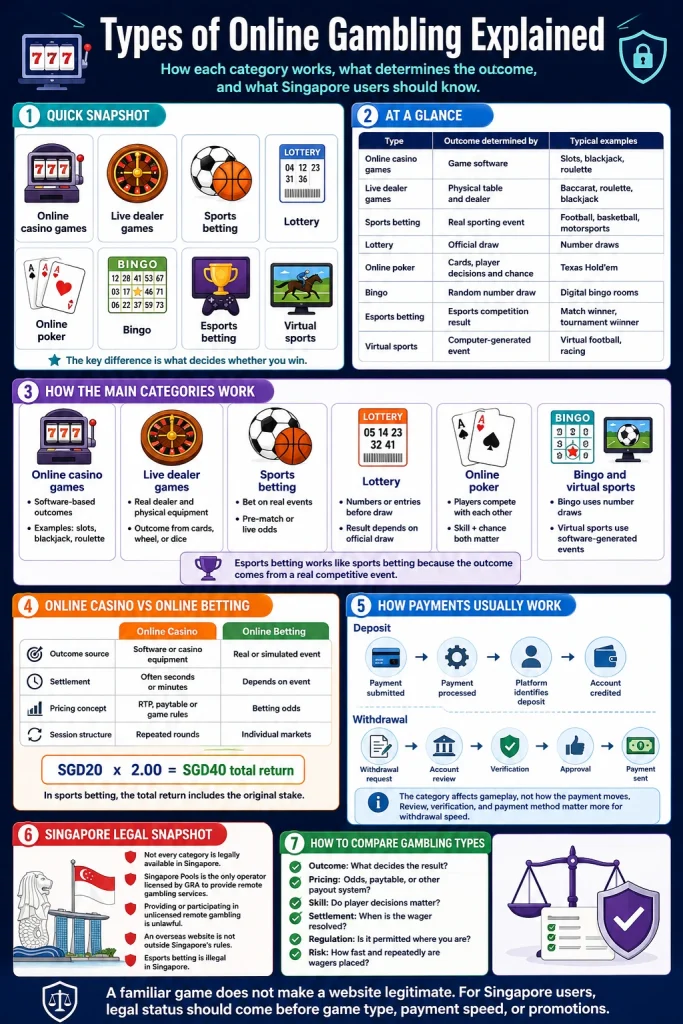
    The main types of online gambling include online casino games, live dealer games, sports betting, lotteries, poker, bingo, esports betting, and virtual sports. Some rely on game software, some use real dealers, and others depend on real-world events.

    The most useful way to tell these categories apart is to ask what decides whether you win. Settlement speed, how payouts are priced, and how much player decisions matter all follow from that answer.

    For Singapore users, legal status matters as much as mechanics. The Gambling Regulatory Authority (GRA) states that Singapore Pools is the only operator licensed by GRA to provide remote gambling services in Singapore. Providing or participating in unlicensed remote gambling is unlawful, so a format existing online is not evidence it is permitted here.

    For the broader topic, read our Online Gambling Singapore Guide.

    types of online gambling

    This article describes how different online gambling formats work and is provided for general information only. It is not legal advice, and it is not an encouragement to gamble or a recommendation of any operator. The formats described here exist internationally, and their inclusion does not mean they are lawful or available in Singapore. The Gambling Regulatory Authority states that Singapore Pools is the only operator licensed to provide remote gambling services in Singapore, and participating in unlicensed remote gambling is an offence. Verify the current position with GRA before acting on anything described here.

    Gambling can be addictive. If you or someone you know needs support, the National Council on Problem Gambling helpline is 1800-6-668-668, available 24 hours.

    Main Types of Online Gambling at a Glance

    Online Gambling Type How the Outcome Is Determined Typical Examples
    Online casino games Game software Slots, blackjack, roulette
    Live dealer games Physical table and dealer Baccarat, roulette, blackjack
    Sports betting Real sporting event Football, basketball, motorsports
    Lottery Official draw Number draws
    Online poker Cards, player decisions and chance Texas Hold’em
    Bingo Random number draw Digital bingo rooms
    Esports betting Esports competition result Match winner, tournament winner
    Virtual sports Computer-generated event Virtual football, racing

    These categories describe how the products work internationally, not what is legally available to Singapore users.

    If you are starting with the basic definition, read What Is Online Gambling?

    1. Online Casino Games

    Common types of online casino games include slots, blackjack, roulette, baccarat, video poker, and dice-based games. The outcome comes from the game itself rather than any external event, with software applying the rules and mathematical design of the title to each wager, commonly using random number generator technology.

    For slots, the concepts worth knowing are paylines, RTP, volatility, bonus features, and stake limits. RTP describes a theoretical long-term return across a very large number of rounds. It does not predict a single session, and no game is ever “due” for a payout.

    Digital blackjack and roulette work the same way, and the interface can look almost identical to a live table.


    2. Live Dealer Casino Games

    A real dealer runs the game in a studio while cameras stream the action, and players submit wagers through the interface. Live baccarat, blackjack, roulette, and game-show formats are typical.

    A live round runs as follows:

    Player enters table > Bet placed > Betting closes > Dealer runs the game > Outcome confirmed > Wagers settled

    The outcome comes from the physical cards, wheel, or dice used during the session, which is what separates live games from RNG-based ones. Live games also run at the dealer’s pace with fixed betting windows, while software-based games run as fast as the player clicks.

    For a direct comparison, read Live Casino vs RNG Games.

    3. Sports Betting

    Sports betting means wagering on a real sporting event or a specific occurrence within a match. Common markets include match winner, handicap, total goals, correct score, and tournament winner.

    Unlike casino games, sports bets stay unsettled until the event finishes, and funds tied up in an open bet are generally not withdrawable. Account balance and withdrawable balance are not always the same number.

    Pre-match betting happens before an event starts, with odds published in advance. Live or in-play betting happens during the event, with odds moving after goals, red cards, and injuries. That faster pace is a difference in risk, not just convenience.

    For a full comparison between these two major categories, read Online Casino vs Sports Betting.

    4. Lottery and Number-Based Gambling

    Lottery gambling involves selecting numbers or buying an entry before an official draw, with the result depending entirely on that draw.

    The structural difference from casino games is pacing. Players wait for a scheduled result rather than completing repeated rounds, which gives lottery products a very different risk profile from fast, repeatable formats.

    5. Online Poker

    Online poker differs from most casino games because players compete against each other rather than the house. Texas Hold’em, Omaha, tournament poker, and cash games are the common formats.

    Poker combines random card distribution with player decisions. Position, bet sizing, stack size, and opponent behavior shape how a hand develops, which makes poker structurally different from slots or roulette even though chance remains central. Payouts also differ, since prize money comes from pots built by players rather than a paytable.

    6. Online Bingo and Virtual Sports

    Online bingo uses digitally distributed cards and random number draws, checking each card for the required pattern. Rooms vary by card size and prize structure, but the mechanism is always randomly drawn numbers.

    Virtual sports use computer-generated events rather than real matches, including virtual football, horse racing, and simulated motorsports. The presentation mimics a competition, but the result comes from the underlying software, so virtual sports sit closer to RNG casino games than to genuine sports betting.

    7. Esports Betting

    Esports betting means wagering on competitive video game events, with markets such as match winner, map winner, and tournament winner. Mechanically it resembles traditional sports betting, since the outcome comes from a real competitive event.

    The legal position deserves attention here. NCPG states that esports betting is illegal in Singapore, a clear example of why a category existing internationally says nothing about whether it is permitted locally.

    Online Casino Games vs Online Betting

    Casino gaming and betting are the two broadest forms of online gambling.

    Feature Online Casino Online Betting
    Outcome source Software or casino equipment Real or simulated event
    Settlement Often seconds or minutes Depends on event
    Pricing concept RTP, paytable or game rules Betting odds
    Session structure Repeated rounds Individual markets

    Pricing is what most often confuses newcomers. Sports betting uses odds, so decimal odds of 2.00 on a SGD20 winning wager return SGD40 in total:

    SGD20 x 2.00 = SGD40 total return

    That total includes the original stake, so the profit is SGD20. Casino games work differently. Slots use paytables, roulette pays by bet type, poker pays from pots built by players, and lottery payouts follow the draw’s prize structure. RTP and odds are not interchangeable, and RTP is not normally applied to sports betting at all.

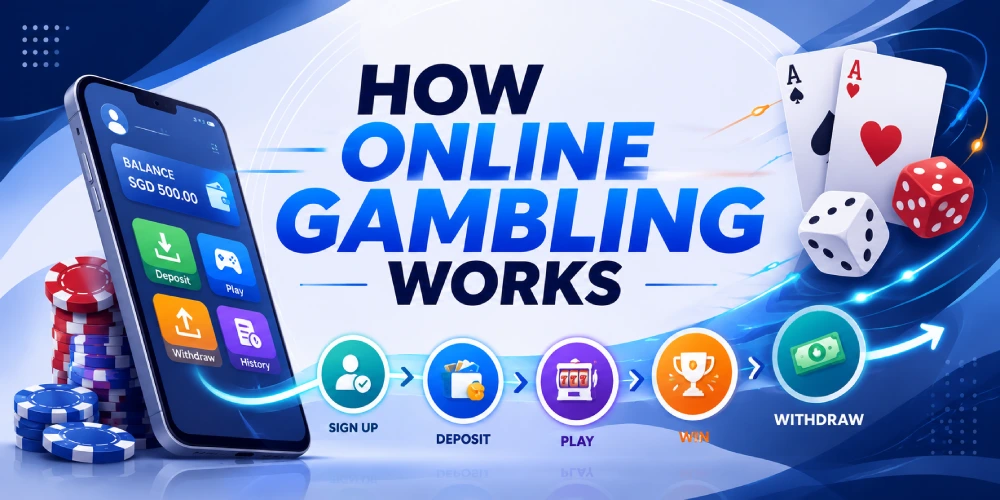
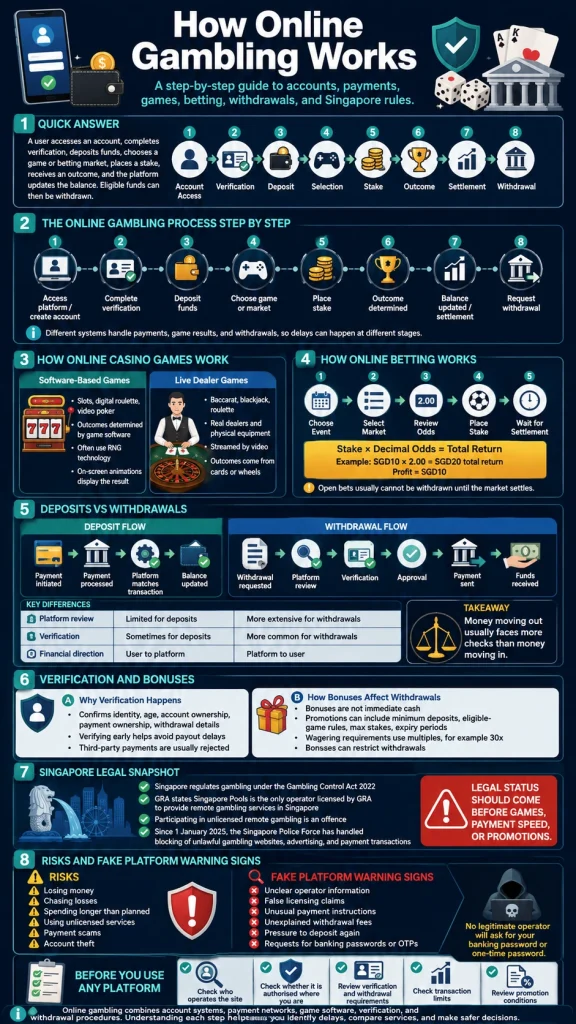
    For more detail about the full process, read How Online Gambling Works.

    How Payments Work Across Gambling Types

    Gambling categories usually share the same payment system, so a casino player and a sports bettor might deposit through the same bank transfer.

    Deposit: Payment submitted > Payment processed > Platform identifies deposit > Account credited

    Withdrawal: Withdrawal request > Account review > Verification > Approval > Payment sent

    The category affects how money is wagered after crediting, not how the payment moves. The game that produced a balance also does not determine withdrawal speed. Platform review, verification, and the payment method matter far more.

    For the payment guides, read How Online Casino Deposits Work and How Online Casino Withdrawals Work.

    Are All Forms of Online Gambling Legal in Singapore?

    No. The existence of a category does not mean Singapore users may participate in it.

    GRA states that it is unlawful to provide unlicensed remote gambling services in or from Singapore, or from overseas to people situated in Singapore. Singapore Pools is the only operator licensed by GRA to provide remote gambling services.

    Remote gambling covers gambling through remote communication rather than physical presence at a venue. What matters legally is where the user is located, not where the website is hosted, so an overseas platform is not outside Singapore’s rules.

    The Gambling Control Act also provides class licensing for certain lower-risk services, such as qualifying lucky draws. These are not permission for general online casino gambling.

    For the full legal topic, read Is Online Gambling Legal in Singapore? and Remote Gambling in Singapore Explained.

    How to Compare Different Types of Online Gambling

    When comparing categories, look past the game name.

    Factor What to Check
    Outcome What determines whether you win or lose?
    Pricing Odds, a paytable, or another payout system?
    Skill Do player decisions influence gameplay?
    Settlement When is the wager settled?
    Regulation Is the activity permitted in your location?
    Risk How quickly and repeatedly are wagers placed?

    Speed of repetition is the most overlooked factor. A slot session, a poker tournament, a football bet, and a lottery entry sit under the same heading but expose a user to a very different number of decisions per hour.

    Why the Operator Matters More Than the Game Category

    A familiar game does not make a website legitimate. A platform can offer recognisable blackjack, slots, or football markets while having no permission to serve users in Singapore, and unlicensed sites add risks around payment disputes, account access, and misleading claims on top of the normal risk of losing money.

    Before using any platform, check who operates it, its licensing status, verification requirements, payment instructions, and withdrawal terms. NCPG provides responsible gambling information, exclusion tools, and support services.

    Frequently Asked Questions

    What are the main types of online gambling?

    The main types include online casino games, live dealer games, sports betting, lotteries, online poker, bingo, esports betting, and virtual sports. Legal availability differs by jurisdiction.

    What are the most common types of online casino games?

    Common types of online casino games include slots, blackjack, baccarat, roulette, video poker, and live dealer versions of traditional table games.

    What is the difference between online casino gambling and sports betting?

    Casino gambling produces outcomes through software or casino equipment and settles quickly. Sports betting depends on a real event and settles only once that event reaches a result.

    Is online poker considered gambling?

    Yes. Real-money poker involves staking money on uncertain card-game outcomes. Strategic decisions matter, but chance remains part of the game.

    Are all types of online gambling legal in Singapore?

    No. GRA states that Singapore Pools is the only operator licensed by GRA to provide remote gambling services in Singapore, and participating in unlicensed remote gambling is unlawful.

  • What Is A Live Dealer Casino?

    What Is A Live Dealer Casino?

    A live dealer casino is an online casino format where you join a table through a real-time video stream while a human dealer runs the game. Instead of watching computer-generated cards or roulette animations, you see physical cards, roulette wheels, tables, and dealers on screen.

    You still place bets through your phone or computer. The difference is what happens after you place the bet. In a standard digital casino game, software usually determines and displays the result. In a live dealer game, the dealer performs the game action in front of cameras, and the system records the outcome. Live baccarat, blackjack, and roulette are among the most common live dealer games.

    If you are new to online casinos, understanding live dealer games also helps you see how they differ from slots, RNG table games, and other formats found on an online casino Singapore platform.

    Explore Guide: Online Casino Singapore

    What Does Live Dealer Casino Mean?

    The term has two main parts.

    “Live” means the game takes place in real time and is streamed to you through video.

    “Dealer” refers to the person running the table. Depending on the game, this person might deal cards, spin a roulette wheel, announce results, or manage each betting round.

    A live dealer casino therefore combines a physical casino table with an online betting interface. You do not sit at the table physically. Instead, you watch the dealer through a live stream and make your selections using buttons on your screen.

    For example, during a live baccarat game, you might see a dealer draw cards from a physical shoe. You select Player, Banker, or Tie through the betting interface before the betting period closes.

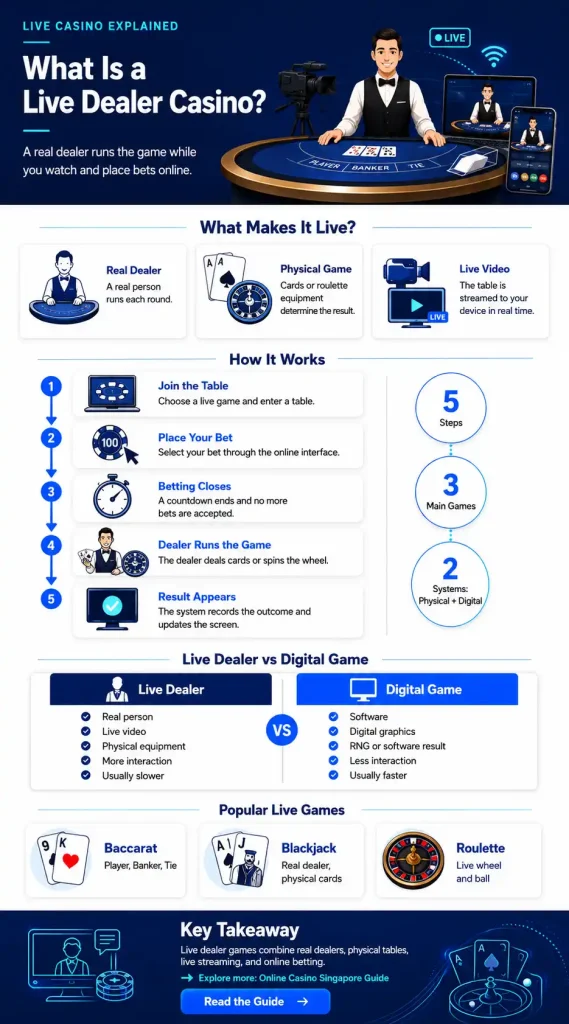
    How a live dealer casino works, including real dealers, live video streaming, betting steps, and popular games such as baccarat, blackjack, and roulette

    How Does a Live Dealer Casino Work?

    Most live dealer games follow a simple process.

    Stage What Happens
    1. Join the table You select a live game and enter an available table
    2. Place your bet You choose a betting option through the online interface
    3. Betting closes The game stops accepting bets for the current round
    4. Dealer runs the game The dealer deals cards, spins a wheel, or performs another game action
    5. Result is recorded The system displays the result and settles the round

    Step 1: Join a Live Casino Table

    You start by selecting a live game. Some platforms offer several tables for the same game. Tables might differ by betting limits, game speed, language, or rule variation.

    After entering the table, you usually see the dealer in the centre of the screen and the betting controls underneath or around the video.

    Step 2: Place Your Bet

    You make your selection through the digital betting interface. For example, a live roulette screen might show the roulette betting layout below the live video. You select numbers, colours, or other available betting options on the screen.

    You are not handing chips directly to the dealer. The software records your bet while the physical game continues at the studio.

    Step 3: The Betting Window Closes

    Live games usually include a countdown timer. The timer tells you how long you have to place or change your bet. Once it reaches zero, the system closes betting for the round. The dealer then continues with the game.

    Step 4: The Dealer Runs the Game

    The dealer performs the physical action required by the game. For baccarat, the dealer deals cards. For blackjack, the dealer deals cards to the relevant positions and follows the table rules. For roulette, the dealer spins the wheel and releases the ball.

    This physical process is one of the main differences between live dealer games and fully digital casino games.

    Step 5: The Result Appears on Your Screen

    Camera systems and gaming software track the result. Once the round finishes, the interface displays the outcome and updates the player’s balance according to the result. The next betting round then begins.

    Are Live Casino Dealers Real People?

    Yes. In a standard live casino game, a real person manages the table in real time. The dealer usually works in a dedicated studio designed for live casino streaming. Some live games also operate from physical casino floors.

    Studios often contain multiple tables, cameras, lighting systems, microphones, monitors, and gaming equipment. The dealer’s job goes beyond dealing cards. Depending on the game, the dealer might also:

    • Open and close betting rounds
    • Announce game results
    • Manage physical gaming equipment
    • Explain basic table actions
    • Communicate with players through the live interface

    Players sometimes confuse live casino games with computer-generated games designed to look realistic. The distinction is simple.

    A live casino game shows a real dealer performing the game action through a live video stream. A digital casino game generates and presents the game through software.

    Are Live Casino Games Pre-Recorded?

    Standard live casino games are designed to run in real time. The dealer performs each round while players watch and place bets through the interface.

    Pre-recorded video would defeat one of the main functions of a live dealer system, which is to connect online betting activity with a game taking place at the same time.

    A short streaming delay might still exist because video must travel from the studio to your device. This does not mean the game is pre-recorded.

    What Games Are Available at Live Dealer Casinos?

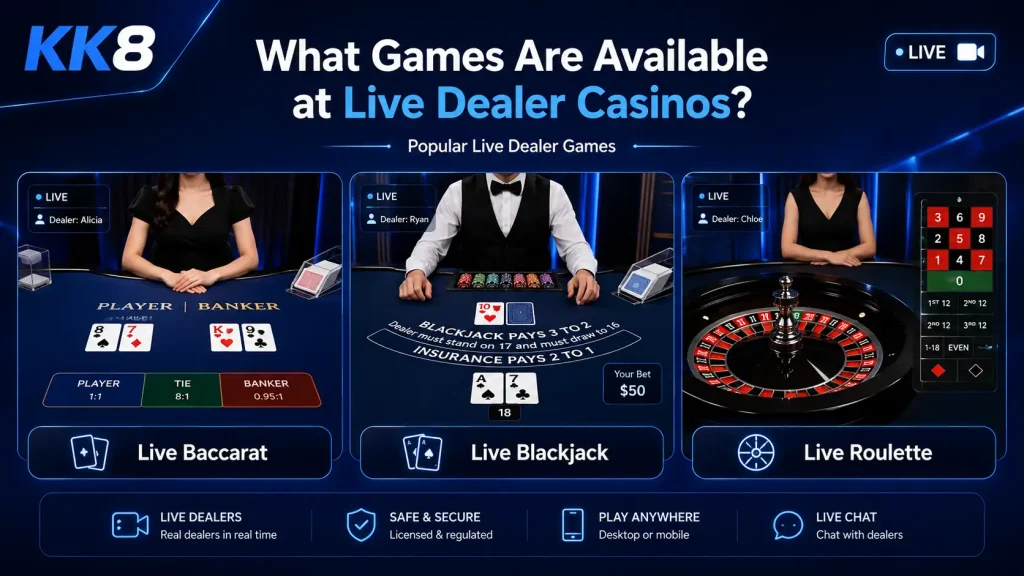
    Live dealer casino games including baccarat, blackjack, and roulette

    Live dealer casinos focus mainly on games that work well with physical tables and repetitive rounds.

    Live Baccarat

    Baccarat is one of the most common live casino games. You generally choose between Player, Banker, and Tie before the dealer deals the cards. The dealer then completes the round according to fixed baccarat drawing rules.

    If you want to understand the game in more detail, read our guide to What Is Live Baccarat?.

    Live Blackjack

    Live blackjack uses a real dealer and physical cards. Players make decisions such as hit or stand through the online interface. The dealer then performs the corresponding actions at the table. The exact rules, available side bets, and betting limits depend on the table.

    Live Roulette

    Live roulette follows the same basic principle as physical roulette. You place your bets digitally while watching the dealer operate a physical roulette wheel. The ball lands in a numbered pocket, and the system records the result.

    For more background on the game itself, see our guide to What Is Online Roulette?.

    Other Live Casino Games

    Some live casino sections also include:

    • Sic Bo
    • Dragon Tiger
    • Poker-style table games
    • Game-show formats
    • Speed versions of traditional table games

    Availability differs between platforms and game providers.

    Do Live Dealer Casinos Use RNG?

    Traditional live dealer games differ from standard RNG casino games because the main game result usually comes from physical gaming equipment.

    RNG means random number generator. In a digital slot or virtual roulette game, software uses an RNG to generate game outcomes. In a traditional live roulette game, the outcome comes from the physical wheel and ball. In live baccarat or blackjack, physical cards determine the result.

    This does not mean software has no role in a live dealer casino. Software still handles areas such as:

    • Bet submission
    • Video streaming
    • Game information
    • Bet limits
    • Timers
    • Player balances
    • Result display
    • Game history

    Some hybrid live games also include digital components beyond the main physical table. The important distinction is where the core result comes from.

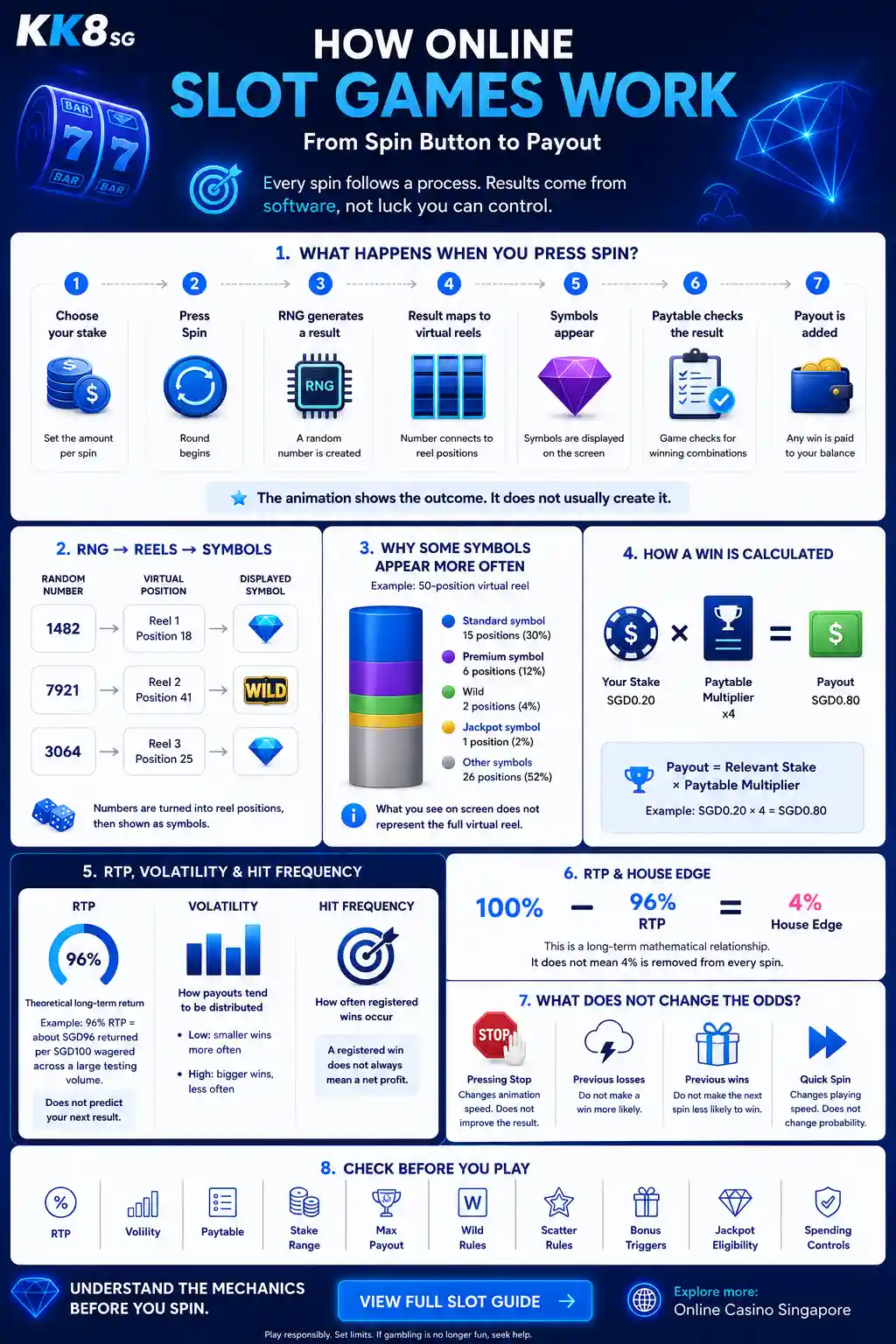
    If you want to understand RNG-based games in more detail, our guide to How Online Slot Games Work explains how digital game outcomes differ from live dealer formats.

    Live Casino Games vs Regular Online Casino Games

    Live dealer games and standard digital games both work online, but the user experience is different.

    Feature Live Dealer Game Digital Casino Game
    Dealer Real person Software
    Presentation Live video Digital graphics
    Main result source Physical cards or equipment RNG or game software
    Game speed Often slower Often faster
    Player interaction Higher Usually lower
    Internet usage Higher due to video Usually lower
    Common examples Baccarat, blackjack, roulette Slots, video poker, digital roulette
    Physical equipment Usually yes No

    Neither format is automatically better. The right format depends on what you want from the game. Someone who prefers faster rounds might prefer online casino games. Someone who wants to watch a real dealer and physical table might prefer live casino games.

    Live Dealer Casino vs Traditional Casino

    A live dealer game tries to reproduce parts of a physical table-game experience online, but the two formats are not identical.

    Feature Live Dealer Casino Traditional Casino
    Location Online Physical venue
    Dealer Real person Real person
    Cards and equipment Physical Physical
    Player interaction Through software Face to face
    Betting Digital interface Physical or electronic chips
    Travel required No Yes
    Video stream Yes No

    The main difference is location. With a live dealer casino, the dealer and player are in different places. Video streaming and betting software connect them.

    Are Live Dealer Casino Games Fair?

    You should separate two questions. The first is whether live dealer technology supports transparent game procedures. The second is whether a specific casino operator is trustworthy.

    Live casino games use visible physical equipment, which lets players watch much of the game process. In regulated environments, live dealer studios might also be subject to technical standards, testing requirements, record keeping, and auditing.

    This does not mean every website offering live dealer games is legitimate. Before using any online gambling platform, check factors such as:

    • Who operates the website
    • Which regulator oversees the operator
    • Whether licence information is verifiable
    • Whether the website uses secure connections
    • Whether payment terms are clearly stated
    • Whether game providers are identified
    • Whether withdrawal rules are transparent

    You can learn more in our guides to Online Casino Security Features Explained and How to Verify an Online Casino Website.

    What Technology Does a Live Casino Use?

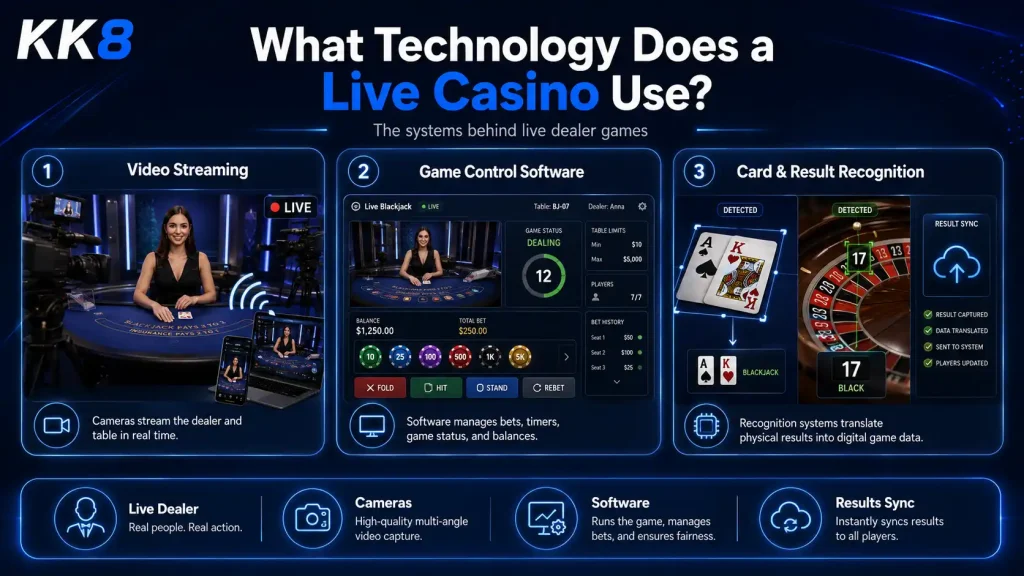
    Live casino technology, including video streaming, game control software, and card and result recognition

    A live casino game looks simple from the player’s screen, but several systems work together behind the scenes.

    Video Streaming

    Cameras capture the dealer and gaming table. The video is then streamed through the internet to players using desktop computers, tablets, or smartphones.
    Multiple camera angles might be used to show the dealer, cards, roulette wheel, or other important areas of the game.

    Game Control Software

    The gaming interface connects player actions with the live table. It manages:

    • Bets
    • Timers
    • Game status
    • Results
    • Account balances
    • Table limits

    Card and Result Recognition

    Live gaming studios often use systems that help translate physical game actions into digital information. For example, card recognition technology might identify cards dealt during a baccarat round and display them on the player’s interface.

    Roulette systems similarly record the winning number after the ball stops. These systems allow the physical game and digital betting interface to stay synchronised.

    What Do You Need to Play a Live Casino Game?

    Live casino games generally require more internet bandwidth than standard online casino games because they stream video continuously.

    You usually need:

    • A stable internet connection
    • A supported web browser or app
    • A desktop computer, smartphone, or tablet
    • Video playback support
    • An account with the relevant platform where participation is permitted

    A weak connection might lead to buffering, delayed video, or interruptions. Your bet is usually processed by the platform’s gaming system rather than by the video itself. Even so, connection quality plays an important role in the overall experience.

    For more information about playing from a phone, see our Mobile Casino Gaming Guide.

    Advantages and Limitations of Live Dealer Games

    Live dealer gaming has both strengths and limitations.

    Advantages Limitations
    Real dealer Requires video streaming
    Physical gaming equipment Uses more internet data
    Visible game process Rounds might take longer
    More interaction Table limits vary
    Traditional table-game format Fewer games than a large slot library
    Real-time gameplay Performance depends on connection quality

    The slower pace is worth noting. A digital roulette or blackjack game might start another round almost immediately. A live dealer needs time to manage physical equipment, complete the game, clear the table, and prepare the next round.

    What Should Singapore Players Know?

    Live streaming technology does not change the legal status of an online gambling service.

    Singapore regulates remote gambling, and players should not assume a website is permitted simply because it offers professional-looking live dealer tables or holds a licence issued in another jurisdiction.

    When researching gambling services in Singapore, refer to information published by the Gambling Regulatory Authority of Singapore and Singapore legislation rather than relying only on claims made by an operator.

    This distinction is important when reading international casino content because rules that apply in another country do not automatically apply in Singapore.

    Key Takeaways

    A live casino streams table games run by real dealers. Players place bets through a digital interface while watching the game through live video.

    Traditional live baccarat, blackjack, and roulette use physical cards or gaming equipment to determine the main result.

    Live casino games differ from fully digital casino games, where software and RNG systems usually generate outcomes. The technology behind a live game includes video streaming, betting software, result tracking, and account systems.

    A professional-looking live stream is not proof that a casino operator is licensed, trustworthy, or legally available in your location.

    Frequently Asked Questions

    What is a live casino?

    A live casino is an online gaming format where a real dealer runs a physical table game while players watch through a live video stream. Players place bets through an online interface rather than sitting at the table.

    How does a live casino work?

    You join a table, place a bet through the online interface, and wait for betting to close. A real dealer then deals cards, spins a roulette wheel, or performs another game action. The system records the result and updates the game interface.

    Are live casino dealers real?

    Yes. Standard live casino games use real people who operate casino tables in real time. They usually work from dedicated live gaming studios or physical casino locations.

    Are live casino games pre-recorded?

    Standard live casino games run in real time. There might be a short streaming delay between the studio and your device, but the game itself is designed to take place while players are participating.

    Do live dealer casinos use RNG?

    Traditional live dealer games generally use physical cards, roulette wheels, or other equipment to produce the main game result. Software still manages bets, video, timers, balances, and other digital functions.

    What games are available in a live casino?

    Common live casino games include baccarat, blackjack, and roulette. Some platforms also offer Sic Bo, Dragon Tiger, poker-style games, and game-show formats.

    What is the difference between a live casino and an online casino?

    An online casino is a broad category containing digital games and live games. A live casino specifically refers to games streamed from tables operated by real dealers.

    Are live dealer casino games fair?

    Live dealer systems allow players to watch physical game actions in real time, but fairness also depends on the operator, provider, technical controls, and regulatory oversight. Always verify the platform rather than relying only on the live video presentation.

  • How Online Gambling Works

    How Online Gambling Works

    Online gambling works by moving traditional gambling activities onto websites and mobile apps. Users create an account, choose a gambling product, place a stake, receive an outcome, and have any winnings or losses reflected in their account balance.

    The most useful thing to understand upfront is that these stages run on separate systems. A payment can succeed while an account balance stays unchanged, and a withdrawal can be approved while the money is still in transit. Most confusion about how online gambling works comes from assuming these steps happen as a single event.

    For Singapore users, understanding the process also means understanding local rules. The Gambling Regulatory Authority (GRA) states that Singapore Pools is the only operator licensed by GRA to provide remote gambling services in Singapore. Participating in unlicensed remote gambling is an offence.

    If you are starting with the broader topic, read What Is Online Gambling? first.

    How online gambling work

    This article explains how online gambling systems operate and is provided for general information only. It is not legal advice and is not an encouragement to gamble. Gambling laws differ by jurisdiction. In Singapore, the Gambling Regulatory Authority states that Singapore Pools is the only operator licensed to provide remote gambling services, and participating in unlicensed remote gambling is an offence. Verify the current position with GRA before acting on anything described here.

    Gambling can be addictive. If you or someone you know needs support, the National Council on Problem Gambling helpline is 1800-6-668-668, available 24 hours.

    Quick Answer

    How does online gambling work? A user funds an account, chooses a game or betting market, selects a stake, and receives an outcome. The platform records the result and adjusts the balance.

    The online gambling process looks like this:

    Account access > Verification > Deposit > Game or bet selection > Stake > Outcome > Settlement > Withdrawal

    Casino games, live dealer games, sports betting, and lottery products each determine outcomes differently, so the middle of that sequence varies.

    For a broader overview of the topic cluster, see the Online Gambling Singapore Guide.

    The Online Gambling Process Step by Step

    Step 1: Accessing a Platform and Creating an Account

    Registration typically asks for name, date of birth, contact details, login credentials, and payment information. The account then acts as the central record for deposits, wagers, results, withdrawals, and verification status.

    Website access alone does not prove an operator is authorised in Singapore. GRA states that providing unlicensed remote gambling services to people in Singapore is unlawful, whether the service originates locally or overseas.

    Step 2: Completing Verification

    Verification confirms the account belongs to the person using it, covering identity, age, account ownership, payment ownership, and withdrawal details.

    Some platforms verify at registration, others defer it. Where deferred, it almost always resurfaces at the withdrawal stage, which is why an account can feel fully functional until the first payout request. Verifying early is the best way to avoid withdrawal delays.

    For a detailed explanation, read How to Verify an Online Casino.

    Step 3: Depositing Funds

    Common payment categories include bank transfers, real-time payments, cards, and e-wallets.

    A deposit involves two processes: the payment provider processes the payment, then the platform identifies the transaction and credits the account. This is why a bank can show a successful payment before the balance updates. The bank has finished its job, but the platform has not yet matched the payment to your account.

    For the full process, read How Online Casino Deposits Work.

    How Online Casino Games Work

    Understanding how online casinos work means separating two categories.

    Software-Based Casino Games

    Games such as online slots, digital roulette, and video poker run through software that applies predefined rules to each wager, commonly using random number generator technology.

    The graphics on screen represent a result the system has already determined. Spinning reels and flipping cards are animations of that result, so no button-press timing influences the outcome.

    Live Dealer Casino Games

    Live baccarat, blackjack, and roulette use real dealers and physical equipment streamed by video, with players submitting wagers through the interface.

    The key difference is the source of the outcome. RNG games use software, while live outcomes come from physical cards or wheels, and live games run at the dealer’s speed with fixed betting windows.

    Read Live Casino vs RNG Games for a direct comparison.

    How Online Betting Works

    Online betting means wagering on real events: choose an event, select a market, review the odds, place a stake, and wait for settlement.

    Decimal odds of 2.00 on a SGD10 successful wager return SGD20 in total:

    Stake x Decimal Odds = Total Return

    That total includes your stake, so the profit is SGD10, not SGD20. Odds are also not a guarantee of an event’s real chance, since the price includes the operator’s margin.

    Funds committed to an open bet are usually unavailable for withdrawal until the market settles, so account balance and withdrawable balance are not always the same.

    For more detail, read Online Casino vs Sports Betting.

    How Results Are Settled and What RTP Means

    Settlement is where the platform decides whether a wager won or lost and updates the balance. Slots settle immediately, live games settle once the physical outcome is confirmed, and sports bets stay open until the market reaches a result. Bets may be voided under operator rules, such as an abandoned match, in which case the stake is returned.

    RTP, or return to player, is a theoretical percentage describing how much a game is designed to return across a large number of wagers, often calculated across millions of rounds. A 96% RTP does not mean a player receives SGD96 after wagering SGD100 once. Individual sessions land far above or below it, and no game is ever “due” for a payout.

    What Happens When You Request a Withdrawal?

    Withdrawals involve more steps than deposits:

    Withdrawal request > Platform review > Verification > Approval > Payment sent > Funds received

    Review checks might include account verification, payment ownership, withdrawal limits, and transaction history. Once approved, the payout runs at the speed of the payment network, so total wait time combines review and banking time.

    Stage Deposit Withdrawal
    Platform review Usually limited Often more extensive
    Account verification Sometimes More common
    Financial transfer User to platform Platform to user
    Balance update After crediting After approval and payment

    Money moving in faces fewer checks than money moving out. That asymmetry is a feature of the review process, not a sign something has gone wrong.

    For a full explanation, read How Online Casino Withdrawals Work.

    Why Payment Verification Happens

    Payment verification is separate from payment processing. A bank transfer can succeed while the platform still needs to verify it. The most common trigger is a name mismatch between the payment account and the gambling account, which is why third-party payments are usually rejected.

    Read Payment Verification Issues Explained for troubleshooting.

    How Bonuses Affect the Process

    A bonus is not cash available for immediate withdrawal. Promotions carry conditions such as minimum deposits, eligible-game restrictions, maximum stakes, and expiry periods. Wagering requirements are expressed as a multiple, so a 30x requirement means wagering thirty times the relevant amount before withdrawal is possible. Accepting a bonus can also restrict withdrawals on funds that were previously unrestricted.

    Is Online Gambling Legal in Singapore?

    Singapore regulates gambling under the Gambling Control Act 2022, administered by GRA. The Act took effect on 1 August 2022, consolidating earlier legislation including the former Remote Gambling Act 2014.

    GRA states that Singapore Pools is the only operator licensed by GRA to provide remote gambling services in Singapore. Providing unlicensed remote gambling services to people in Singapore is unlawful, and participating in unlicensed remote gambling is also an offence.

    Enforcement is active. Since 1 January 2025, the Singapore Police Force has handled the blocking of unlawful gambling websites, advertising, and payment transactions. What matters legally is where the user is located, not where the server is, so an overseas website is not outside Singapore’s rules.

    For more detail, read Is Online Gambling Legal in Singapore?

    Risks and How to Spot a Fake Platform

    Common risks include losing money, chasing losses, spending longer than intended, using unlicensed services, payment scams, and account theft. Mobile access removes the physical boundary of leaving a venue, which makes session length and spending easier to lose track of.

    A fake platform can display games, balances, promotions, and withdrawal buttons that look entirely normal, but a displayed balance is just a number with no funds behind it. This is why problems surface at the withdrawal stage rather than during gameplay.

    Warning signs include unclear operator information, false licensing claims, unusual payment instructions, unexplained withdrawal fees, pressure to deposit again, and requests for banking passwords or OTPs. No legitimate operator will ever ask for a banking password or a one-time password.

    Singapore’s National Council on Problem Gambling provides responsible gambling information, exclusion tools, and support services.

    Before You Use Any Platform

    Online gambling is not one technical process. Account systems, payment networks, gaming software, verification, and withdrawal procedures all work together, and a delay at any one stage looks identical to a delay at another from the user’s side.

    Before depositing anywhere, check who operates the site, whether it is authorized where you are, the verification and withdrawal requirements, transaction limits, and promotion conditions. For Singapore users, legal status should come before games, payment speed, or promotions.

    Frequently Asked Questions

    How do online casinos work?

    Software-based games use game systems and RNG technology to determine outcomes, while live dealer games use physical tables streamed to players online.

    Why does my deposit show as paid but not appear in my balance?

    The bank and the platform run separate processes. A bank can confirm a payment has left your account while the platform is still matching that transaction, so the balance updates only after matching completes.

    Why do withdrawals take longer than deposits?

    Withdrawals add a platform review and verification stage before payment is released, then run at the speed of the chosen payment network.

    Is online gambling legal in Singapore?

    GRA states that Singapore Pools is currently the only operator licensed by GRA to provide remote gambling services in Singapore. Participating in unlicensed remote gambling is an offence.

    What should I do if my PayNow payment is missing?

    First check whether the bank shows the transfer as completed. Save the transaction reference and contact the receiving platform if the payment has not been credited after its stated processing time.

  • How Online Slot Games Work

    How Online Slot Games Work

    Online slot games look simple. You choose a stake, press Spin, and wait for the reels to stop. Behind this short sequence, the game uses software, probability rules, virtual reels, and a paytable to produce and evaluate the result.

    Understanding these mechanics helps you interpret features such as Return to Player, volatility, paylines, and bonus rounds. It also helps separate mathematical facts from common slot myths.

    This guide explains what happens during each spin, how payouts are calculated, and what you should check before playing.

    Explore more: Online Casino Singapore

    How online slot games work, including RNG, virtual reels, payouts, RTP, volatility, hit frequency, and house edge

    The Main Parts of an Online Slot Game

    Before looking at the software behind a spin, it helps to understand the parts shown on the screen.

    Element What it does
    Reels Vertical columns containing symbols
    Rows Horizontal positions where symbols appear
    Symbols Images used to form combinations
    Paylines Patterns used to assess matching symbols
    Paytable Lists winning combinations and payout values
    Stake control Sets the amount wagered per spin
    Spin button Starts the game round
    Balance Shows the funds available
    Win display Shows the return from the latest spin
    Feature controls Provide access to settings, autoplay, rules, or bonus information

    A traditional online slot might use five reels and three rows. Newer games often use larger grids, cascading symbols, cluster systems, or changing reel layouts.

    Read more: Online Casino Terms Explained

    What Happens When You Press Spin?

    A standard online slot follows a process similar to this:

    1. You select your stake.
    2. You press the Spin button.
    3. The RNG produces or selects a numerical result.
    4. The game maps the result to positions on its virtual reels.
    5. The corresponding symbols appear on the screen.
    6. The game checks the displayed result against its rules and paytable.
    7. Any qualifying payout is added to your balance.

    The reel animation does not usually create the result. It presents a result already determined by the game system.

    This distinction matters because pressing Stop or tapping the screen usually changes only the animation speed. It does not improve the result.

    What Is a Random Number Generator?

    A Random Number Generator is software used to produce unpredictable values. Online slots use these values to determine reel positions or game events.
    The RNG operates continuously or generates values when a round begins, depending on the game design. The selected numbers connect to positions within the game’s mathematical model.
    A simplified example might work like this:

    Generated value Virtual reel position Displayed symbol
    1482 Reel 1, position 18 Blue gem
    7921 Reel 2, position 41 Wild
    3064 Reel 3, position 25 Blue gem

    Real slot systems are more complex. The example shows the basic relationship between numerical results and displayed symbols.

    Is Every Spin Independent?

    In a standard RNG slot, each spin is a separate event. Suppose a slot fails to produce a major payout across 100 spins. This does not mean the 101st spin is more likely to produce one. The game does not need to compensate for the previous results within your session.

    The same principle applies after a large win. A recent payout does not automatically reduce or increase the probability of the next individual result.

    This is similar to repeatedly tossing a fair coin. Five heads in a row do not make tails guaranteed on the sixth toss. The next toss still follows its own probability.

    Some games include persistent features, collected symbols, or linked bonus progress. In those cases, the feature state might carry between spins. The underlying random event still follows the rules published for the game.

    How Virtual Reels Work

    The symbols visible on your screen do not always represent the full reel structure. A physical slot uses mechanical reels with a limited number of stopping positions. An online slot uses virtual reels, which support far more positions and different symbol weightings.
    Consider a simplified virtual reel with 50 positions:

    Symbol Number of positions Approximate chance of appearing
    Standard symbol 15 30%
    Premium symbol 6 12%
    Wild symbol 2 4%
    Jackpot symbol 1 2%
    Other symbols 26 52%

    A symbol shown once in the visible artwork might occupy several positions on the virtual reel. Another symbol might appear less often in the virtual structure.
    This weighting lets game designers control how frequently different combinations occur.
    The exact reel strips and symbol weightings are rarely visible from the main game screen. The paytable and help section should still explain the winning combinations, features, and relevant payout rules.
     

    How Paylines Work

    A payline is a pattern used to evaluate matching symbols. Older slots often use one horizontal line across the centre. Modern games might use 10, 20, 50, or more fixed paylines.

    A five-reel game might pay when matching symbols appear:

    • From left to right
    • On adjacent reels
    • Along an active payline
    • Starting from the first reel

    Not every game follows these rules. Some pay from either direction, while scatter symbols often pay regardless of their exact reel positions.

    More paylines do not automatically produce a higher mathematical return. The stake, symbol probabilities, paytable, and overall game model all affect the result.

    Example of a Payline Win

    Assume a game has a straight payline across the middle row. The middle row shows:

    Cherry | Cherry | Cherry | Star | Bell

    The paytable awards 4 times the relevant line stake for three cherries.

    If the line stake is SGD0.20:

    SGD0.20 × 4 = SGD0.80 payout

    The total amount wagered might be higher when the game covers several paylines. Check whether the displayed multiplier applies to the line stake, total stake, or another value defined in the rules.

    What Does “Ways to Win” Mean?

    How Ways to Win works in online slot games using matching symbols across adjacent reels

    Ways-to-win slots do not rely on traditional line patterns. A common format pays for matching symbols appearing on adjacent reels, beginning from the leftmost reel. Their exact row positions do not need to match.

    For example, a three-symbol combination might qualify when the same symbol appears:

    • On reel one, row one
    • On reel two, row three
    • On reel three, row two

    The symbols sit on different rows, but they appear on consecutive reels.

    A game with three rows and five reels might advertise 243 ways to win. Larger or changing reel grids might advertise thousands of possible ways. The number of ways describes possible symbol arrangements. It does not describe the chance of making a profit.

    Explore: Popular Online Slot Games Singapore

    Other Common Payout Systems

    Online slots use several systems beyond traditional paylines.

    System How wins are assessed
    Fixed paylines Symbols must follow defined line patterns
    Ways to win Matching symbols appear on adjacent reels
    Cluster pays Groups of matching symbols touch each other
    Cascading reels Winning symbols disappear and new ones fall into place
    All pays Matching symbols qualify across broad position rules
    Megaways-style reels Symbol counts and possible combinations change each spin

    Cascading games might produce several evaluations from one paid spin. After a winning group disappears, replacement symbols enter the grid. The process continues until no new qualifying combination appears.
    Read the game rules before assuming every cascade increases a multiplier or produces another payout. Feature behaviour differs between games.

    How Slot Payouts Are Calculated

    The paytable defines how much each qualifying combination returns.

    A basic calculation looks like this:

    Payout = Relevant stake × Paytable multiplier

    Suppose you place a total stake of SGD1 and receive a combination valued at 5 times the total stake.

    SGD1 × 5 = SGD5

    The game returns SGD5, including any amount defined as part of the payout under its rules.

    Some games calculate winnings using the stake assigned to each payline. Others use the total stake or a fixed coin value. Jackpot and bonus prizes might follow separate calculations.

    Always check these details:

    Paytable detail Why it matters
    Payment direction Shows where combinations must begin
    Minimum matching symbols Shows how many symbols form a win
    Multiplier basis Identifies whether the multiplier uses line or total stake
    Maximum payout Shows the game’s stated payout limit
    Wild rules Explains which symbols the wild replaces
    Scatter rules Explains position-independent payouts
    Bonus conditions Shows how special features start

    What Is RTP?

    Return to Player, or RTP, is the theoretical percentage of total stakes a game is designed to return over a large number of rounds.

    Suppose a slot has a theoretical RTP of 96%. Its mathematical model is designed to return about SGD96 for every SGD100 wagered across a large testing sample.

    It does not mean:

    • You will receive SGD96 after staking SGD100
    • Every group of 100 spins returns the same percentage
    • A loss must soon be followed by a win
    • You receive 96% of each individual stake

    Your short-term result might sit far above or below the published percentage.

    RTP Example

    Consider three players using a 96% RTP game:

    Player Total wagered Total returned Session return
    Player A SGD100 SGD35 35%
    Player B SGD100 SGD112 112%
    Player C SGD100 SGD87 87%

    None of these short sessions needs to match 96%. The theoretical percentage applies to the game model across a far larger volume of play, not to each person or session.

    Learn more: Understanding RTP in Online Casino Games

    RTP and House Edge

    House edge represents the theoretical share of stakes not returned to players over the long term.

    The basic relationship is:

    House edge = 100% − RTP

    For a game with 96% RTP:

    100% − 96% = 4% theoretical house edge

    This does not mean the operator takes 4% from each spin. It describes a long-term mathematical expectation across many rounds.

    Some game providers offer more than one approved RTP version of the same title. Two platforms might therefore display the same game name but use different settings. Check the information screen for the specific version available.

    What Is Slot Volatility?

    Volatility describes how a game’s payouts tend to be distributed. It focuses on the pattern of returns, not only the long-term percentage.

    Volatility level Typical payout pattern
    Low Smaller payouts tend to occur more often
    Medium Mix of smaller and larger payouts
    High Payouts tend to be less frequent and more uneven

    Two games might both have 96% RTP while producing different playing experiences.

    A low-volatility game might distribute more of its theoretical return through frequent small results. A high-volatility game might concentrate more of its return in less frequent bonus rounds or large combinations.

    Neither format removes the house edge.

    Learn more: What Is Volatility in Slot Games?

    RTP, Volatility and Hit Frequency

    These terms describe different parts of the game.

    Metric What it measures What it does not tell you
    RTP Theoretical long-term return Your next result
    Volatility Distribution and variation of payouts Exact win timing
    Hit frequency How often registered wins occur Whether those wins exceed the stake
    House edge Theoretical operator advantage Your guaranteed session loss

    A game might have a high hit frequency while still producing a negative session result. For example, you stake SGD1 and receive SGD0.30. The game might count this as a registered win because it returned something, even though your balance fell by SGD0.70.

    This is why win animations alone do not show whether a spin produced a net gain.

    How Wild Symbols Work

    A wild usually replaces selected standard symbols to help complete combinations. Suppose the payline displays:

    Seven | Seven | Wild

    When the wild substitutes for the third seven, the game might treat the result as three matching symbols.

    Wild rules differ. A wild might:

    • Replace most standard symbols
    • Exclude scatters or bonus symbols
    • Carry a multiplier
    • Expand across a reel
    • Move between reels
    • Remain in place during free spins

    Check the paytable instead of assuming all wilds behave the same way.

    How Scatter Symbols Work

    Scatter symbols often trigger payouts or bonus features without following a standard payline. For example, three scatter symbols anywhere on a five-reel grid might award 10 free spins.

    A game might also pay a scatter prize based on the total stake:

    Scatter count Example award
    3 2× total stake
    4 10× total stake
    5 50× total stake

    These figures are illustrative. Each title uses its own rules.

    How Free Spins and Bonus Rounds Work

    Free spins are additional rounds awarded after a qualifying trigger.

    Common triggers include:

    • Landing a set number of scatter symbols
    • Filling a collection meter
    • Completing a random feature
    • Reaching a specific symbol combination

    The bonus might include modified reels, extra wilds, multipliers, or new symbols. The game’s mathematical model includes the expected value of these features.

    A bonus round does not remove randomness. Its outcomes still follow the rules and probabilities built into the game.

    Are Bonus Choices Skill-Based?

    Some bonus rounds ask you to choose a box, card, or object. The result might be determined in one of two ways:

    1. Your chosen object corresponds to a randomly assigned prize.
    2. The system determines the award before the selection, and your choice reveals it.

    Unless the rules state otherwise, visual choice elements should not be treated as a skill contest.

    How Progressive Jackpots Work

    A progressive jackpot increases as eligible wagers enter the connected system.

    The jackpot might link:

    • One slot machine
    • Several games on one platform
    • The same game across several platforms
    • A wider provider network

    A small portion of qualifying stakes often contributes to the prize pool. The jackpot continues growing until an eligible result triggers it.

    Progressive games tend to produce wider short-term variation because a significant part of the expected return might depend on a rare jackpot event.

    Check whether the published RTP includes the jackpot contribution. Also review the stake requirements, eligibility rules, maximum prize terms, and whether the displayed amount uses your selected currency.

    Are Online Slot Games Fair?

    Online slot fairness depends on tested RNG systems, transparent game rules, published paytables, and independent verification

    Fairness depends on the game, operator, software provider, regulatory framework, and testing process.

    A properly regulated game should follow its approved mathematical model. Its random outcomes should remain unpredictable, and its displayed rules should match the implemented payout system.

    UK Gambling Commission technical standards require licensed remote gambling software to meet testing and random-outcome requirements. These standards cover RNG behaviour, result determination, published rules, and technical controls.

    A licence logo on a website is not enough by itself. Licence claims should be checked against the regulator’s own records.

    Fairness Checklist

    Before trusting a platform or game, check:

    Check What to look for
    Operator identity Clear legal business name and contact details
    Regulatory status Verifiable record on the regulator’s website
    Game provider Recognised software company with clear ownership
    Paytable Accessible payout rules inside the game
    RTP information Percentage shown in the rules or help section
    Testing details Named testing laboratory or certification information
    Transaction history Clear records of stakes, returns, and withdrawals
    Complaint process Written steps for raising disputes
    Security HTTPS, account controls, and payment protection
    Responsible-play tools Deposit, spending, time, or exclusion controls

    Do Autoplay and Quick Spin Change the Odds?

    Autoplay repeats spins based on selected settings. Quick Spin shortens the reel animation. These controls normally affect pace rather than probability. The same game model evaluates each round.

    Faster play still increases the number of wagers placed within a given period. For example:

    Playing speed Spins per minute Spins in 30 minutes Total staked at SGD1 per spin
    Standard pace 6 180 SGD180
    Faster pace 12 360 SGD360
    Rapid pace 20 600 SGD600

    The example assumes continuous play with no pauses or returns reused. It shows how speed affects total exposure, even when the stake per round stays unchanged.

    What to Check Before Playing a Slot

    A game with attractive graphics might still have rules or volatility unsuitable for your intended budget. Open the game’s information or help section before placing a stake. 

    Review:

    • Published RTP
    • Volatility rating
    • Paytable
    • Payment direction
    • Stake range
    • Maximum payout
    • Wild and scatter rules
    • Bonus triggers
    • Jackpot eligibility
    • Feature purchase terms
    • Session and spending controls

    Key Takeaways

    Online slots rely on an RNG, virtual reel positions, and a paytable. The RNG determines each independent result. The game maps the result to symbols and evaluates the displayed combination according to its rules.

    RTP describes theoretical return across a large volume of play. Volatility describes how payouts tend to be distributed. Hit frequency describes how often registered wins occur.

    None of these figures predicts your next spin. No timing method or betting pattern changes the underlying mathematics of a standard RNG slot.

    Before using a game, read its paytable, review its RTP and volatility, verify the operator, and check the laws applying to your location.

    Continue Exploring: Online Casino Singapore

    Frequently Asked Questions

    How do online slot games work?

    Online slots use a Random Number Generator to produce or select each result. The game maps the numerical outcome to virtual reel positions, displays the corresponding symbols, and checks the result against its paytable.

    Are online slot results decided before the reels stop?

    In standard online slots, the result is usually determined when the spin begins. The reel movement displays the selected outcome.

    Does an online slot remember previous spins?

    A standard RNG slot treats each spin as an independent event. Previous wins or losses do not make a future result due.

    What does 96% RTP mean?

    A 96% RTP means the game is mathematically designed to return about 96% of total stakes across a large volume of play. It does not promise a 96% return for one player or session.

    What is the difference between RTP and volatility?

    RTP describes the game’s theoretical long-term return. Volatility describes how frequently and unevenly payouts tend to occur.

    Do more paylines increase RTP?

    Not necessarily. The number of paylines, stake structure, symbol probabilities, and paytable all form part of the game’s mathematical model.

    Does stopping the reels affect the result?

    The Stop control usually changes how quickly the animation finishes. It does not alter a result already selected by the system.

    Are free spins free of risk?

    Free spins do not require a separate stake at the moment they are played, but they usually come from a paid trigger, promotional condition, or bonus feature. Their outcomes still follow the game’s rules.

    How do I check whether an online slot is fair?

    Review the operator’s regulatory status, the game provider, the paytable, published RTP, testing information, account records, and dispute process. Confirm licence claims through the regulator’s official website.

    Are online slots legal in Singapore?

    Singapore prohibits gambling unless it is licensed or exempted. GRA identifies Singapore Pools as the only operator licensed by it to provide remote gambling services. Check current GRA guidance before participating.

  • What Is Online Gambling?

    What Is Online Gambling?

    Online gambling refers to gambling activities carried out through websites, mobile apps, or other internet-connected services. Instead of visiting a physical casino, betting shop, or gaming venue, users access gambling products digitally and place wagers through an online account.

    Common types of online gambling include casino games, sports betting, lotteries, and other wagering products. The exact services available depend on the operator, payment system, technology, and local regulations.

    For Singapore users, there is an important legal distinction between licensed and unlicensed remote gambling. The Gambling Regulatory Authority (GRA), a statutory board under the Ministry of Home Affairs formed on 1 August 2022, states that Singapore Pools is the only operator licensed by GRA to provide remote gambling services in Singapore. Participating in unlicensed remote gambling is also an offence.

    This matters more than it might first appear. NCPG’s 2023 survey found that 92% of Singapore residents who gambled used a legal channel such as Singapore Pools, while about 1% reported taking part in illegal online gambling, up from 0.3% in 2020. Understanding what counts as licensed activity is the first practical step for any Singapore user looking into online gambling.

    For a broader overview of the topic, visit our Online Gambling Singapore Guide.

    what is online gambling

    This article is for general information only and is not legal advice. Gambling laws differ by jurisdiction. In Singapore, the Gambling Regulatory Authority states that Singapore Pools is the only operator licensed to provide remote gambling services, and participating in unlicensed remote gambling is an offence. Readers should verify the current legal position with GRA before acting on anything here. Gambling can be addictive. If you or someone you know needs support, the National Council on Problem Gambling helpline is 1800-6-668-668.

    Quick Answer

    The simplest online gambling meaning is gambling conducted through the internet. A player accesses an online service, selects a gambling product, places a stake, and receives an outcome according to the rules of the game or event.

    Different forms work in different ways. Online slots and some casino games use software to determine outcomes, live casino games use streamed tables with human dealers, while sports betting depends on the outcome of real sporting events.

    In Singapore, online gambling also falls within the country’s remote gambling framework. GRA regulates gambling under the Gambling Regulatory Authority Act 2022, the Gambling Control Act 2022, and the Casino Control Act 2006. The Gambling Control Act 2022 consolidated earlier legislation, including the former Remote Gambling Act 2014, into a single modern framework covering both land-based and remote gambling.

    How Does Online Gambling Work?

    Most online gambling platforms follow a similar basic process. The exact details differ by operator and gambling product.

    A typical journey looks like this:

    A user creates or accesses an account. The user selects a game or betting product. Funds are deposited or otherwise made available for wagering. The user selects a stake. The game or event determines the result. Winnings, if any, are added to the account balance. Eligible funds are withdrawn according to the operator’s rules.

    Several systems work behind the scenes, including account management, payments, game software, security controls, transaction records, and withdrawal processing.

    For a more detailed breakdown, read How Online Gambling Works.


    What Are the Main Types of Online Gambling?

    The term online gambling covers several different activities rather than one single product.

    Type How It Works Typical Outcome Source
    Online casino games Players wager on digital casino games Game rules or software
    Live casino games Real dealers run games through video streams Physical table outcome
    Sports betting Players wager on sporting events Real event result
    Lottery products Players select numbers or entries Official draw
    Fixed-odds betting A price is offered before the wager Event result

    Some remote games also include chance-based elements where players might win items or prizes of value. GRA separately addresses remote games of chance under its class licensing framework.

    Among Singapore’s legal gambling options, lottery-style products remain the most widely used. NCPG’s 2023 survey found 4D was the most common activity among gamblers, reported by 30% of respondents, followed closely by TOTO at 29%.

    For a full explanation of each category, see Types of Online Gambling Explained.

    Online Casino Games

    Online casino games reproduce or adapt traditional casino formats for digital use.

    Common examples include:

    Slots Blackjack Baccarat Roulette Table games Live dealer games

    Some games are generated entirely through software. Others use live video streams from physical tables.

    The way an outcome is generated depends on the game type. This is why understanding the difference between RNG-based games and live casino games matters.

    Read Live Casino vs RNG Games for a direct comparison.

    Sports Betting

    Sports betting involves placing a wager on the result or occurrence of an event within a sporting competition.

    Examples include:

    Match winner Total goals Correct score Handicap markets Tournament winner

    Unlike casino games, the outcome comes from a real-world sporting event rather than a game program or casino table.

    This difference is one reason users often compare online casinos and sportsbooks separately.

    Read Online Casino vs Sports Betting for more detail.

    How Online Gambling Accounts Work

    Online gambling generally requires some form of user account.

    An account keeps track of information such as:

    Account balance Deposits Withdrawals Bets Game activity Bonuses Verification status Account limits

    Account requirements differ between operators.

    Some regulated services also require age checks, identity verification, payment verification, or responsible gambling controls.

    In Singapore, Singapore Pools’ licensed remote gambling service is required to implement responsible gambling measures including monthly expenditure and funding limits, usage information, and alerts as users approach expenditure limits.

    How Online Gambling Payments Work

    Payments connect the player’s bank, card, wallet, or other supported payment method with the online gambling account.

    A deposit generally follows this sequence:

    Payment initiated > Payment processed > Platform identifies transaction > Account balance updated

    A withdrawal follows a different path:

    Withdrawal requested > Platform reviews request > Withdrawal approved > Payment sent > User receives funds

    This explains why deposit and withdrawal speeds often differ even when the same payment method is involved.

    Read How Online Casino Deposits Work for the deposit process.

    What Payment Methods Are Used for Online Gambling?

    Online platforms might support different payment methods depending on the market and operator.

    Common digital payment categories include:

    Bank transfers Real-time payments Cards E-wallets Mobile payments

    For Singapore users, PayNow is a familiar real-time payment service used for SGD transfers through participating financial institutions.

    Payment availability does not determine whether a gambling service is lawful. A platform accepting a familiar Singapore payment method should not be treated as proof of licensing. In fact, GRA can direct financial institutions to block payment transactions linked to unlawful gambling operators, so a payment method being available on a site is not a signal of legitimacy either way.

    If you are comparing payment methods, read PayNow vs Other Payment Methods.

    What Is Remote Gambling?

    Remote gambling is a broader regulatory term used for gambling conducted through remote communication.

    Online gambling is one common form because users participate through websites, mobile devices, or online services rather than being physically present at the gambling venue.

    For Singapore users, the distinction matters because GRA specifically regulates remote gambling. GRA states that providing unlicensed remote gambling services in Singapore, from Singapore, or from overseas to people located in Singapore is unlawful.

    You can explore this topic further in Remote Gambling in Singapore Explained.

    Is Online Gambling Legal in Singapore?

    Online gambling Singapore rules are more restrictive than simply asking whether a website is accessible.

    GRA states that Singapore Pools is the only operator licensed to provide remote gambling services in Singapore. It is unlawful for another operator to provide unlicensed remote gambling services to people situated in Singapore. It is also an offence for a person in Singapore to participate in unlicensed remote gambling.

    Since 1 January 2025, the Singapore Police Force has taken over functions involving the blocking of unlawful remote gambling websites, advertising, and payment transactions. In 2023, police arrested more than 450 individuals for illegal gambling, roughly a third of whom were involved with online platforms, underlining that enforcement against unlicensed remote gambling is an active, ongoing effort rather than a rule that exists only on paper.

    For the detailed legal framework, read Is Online Gambling Legal in Singapore?

    How Online Gambling Differs From Physical Gambling

    The gambling principle is similar, but the user experience differs.

    Area Online Gambling Physical Gambling
    Access Website or app Physical venue
    Payments Digital payments Cash and electronic methods
    Games Software or streamed games Physical tables or machines
    Account Usually account-based Depends on venue
    Availability Depends on service access Depends on venue hours
    Transaction records Often stored digitally Varies
    Verification Digital account checks Physical or account checks

    Online access removes the need to travel to a venue, but it also changes how users manage time, money, account access, and transaction records.

    How RNG Online Gambling Works

    Many digital casino games rely on a random number generator, often called an RNG.

    An RNG generates values used by the game software to determine outcomes according to the game’s rules.

    For example, an online slot uses its underlying game system to determine the symbols shown after a spin. The visual animation displays the result but does not necessarily create the randomness itself.

    RNG-based games differ from live dealer games, where outcomes come from physical cards, wheels, or other equipment used during a streamed game.

    Our Live Casino vs RNG Games guide covers the differences in more detail.

    What Is RTP?

    RTP stands for return to player.

    It is a mathematical percentage describing how much a game is designed to return to players collectively over a long period of play.

    For example, a theoretical RTP of 96% does not mean a player who wagers SGD100 receives SGD96 back. It describes a long-run statistical model across many rounds.

    Individual sessions vary because outcomes occur separately.

    RTP should therefore not be treated as a prediction of your personal result.

    Why Verification Matters in Online Gambling

    Verification helps an operator confirm information related to an account.

    Depending on the service, verification might include:

    Identity Age Account ownership Payment ownership Withdrawal details

    Verification also plays a role in online gambling security. Users should know which operator they are dealing with, how their account information is handled, and whether the service is licensed where required.

    For practical checks, see How to Verify an Online Casino.

    What Are the Main Risks of Online Gambling?

    Online gambling involves financial risk because outcomes are uncertain and losses are possible.

    Other risks include:

    Spending more than planned Chasing losses Spending long periods gambling Using unlicensed gambling websites Payment disputes Fake casino websites Account scams Sharing banking or login information

    The scale of this risk in Singapore is measurable. NCPG’s 2023 survey, based on interviews with 3,007 residents aged 18 and above, found that while overall gambling participation has fallen to 40%, its lowest level since the survey began in 2005, median monthly gambling expenditure among those who do gamble rose to $25, up from $15 in 2020. The probable pathological and problem gambling rate has stayed low and stable at 1.1% across recent survey years, but the council notes this does not make individual harm any less serious for those affected.

    Singapore’s National Council on Problem Gambling describes responsible gambling as managing gambling behavior through self-control, balancing gambling with other activities, setting time limits, and setting a gambling budget.

    For online safety issues, read Common Online Gambling Scams.

    How to Recognise a Fake Online Gambling Website

    A professional-looking website does not prove a gambling operator is trustworthy or licensed.

    Common warning signs include:

    Unclear operator information False regulatory claims Unusual payment requests Requests for passwords or banking credentials Missing withdrawal rules Inconsistent website information Pressure to deposit quickly Unclear customer support

    In Singapore, the key regulatory check is whether remote gambling activity is licensed under the applicable framework. GRA identifies Singapore Pools as the only licensed remote gambling operator.

    See How to Spot Fake Online Casino Websites for a detailed checklist.

    Online Gambling Explained in One Process

    The basic online gambling process is easier to understand when separated into stages.

    Stage What Happens
    Access User enters website or app
    Account User signs in or registers
    Funding Funds become available for gambling
    Selection User chooses a game or wager
    Stake User chooses the amount
    Outcome Game or event determines result
    Settlement Winnings or losses update the balance
    Withdrawal Eligible funds are requested for payout

    This process applies broadly, though individual products and operators differ.

    Online Gambling Checklist for Singapore Users

    Before using any online gambling service, review:

    Who operates the service Whether remote gambling is permitted in your location Whether the operator holds the required licence How deposits and withdrawals work Account verification requirements Gambling rules and payout terms Payment security Spending limits Time limits Support options

    Legal status should come before convenience, bonuses, game selection, or payment speed.

    Frequently Asked Questions

    What is online gambling?

    Online gambling means participating in gambling activities through internet-based services such as websites or mobile applications. Products might include casino games, sports betting, lotteries, and other forms of remote wagering.

    How does online gambling work?

    Users generally access an account, fund it, select a game or wager, choose a stake, receive an outcome, and have winnings or losses reflected in the account balance. Withdrawals follow a separate approval and payment process.

    What are the main types of online gambling?

    Common types include online casino games, live casino games, sports betting, lottery products, and other remote wagering formats.

    Is online gambling legal in Singapore?

    Licensed remote gambling is tightly restricted. GRA states that Singapore Pools is the only operator licensed to provide remote gambling services in Singapore, and participating in unlicensed remote gambling is an offence.

    What is the difference between online gambling and remote gambling?

    Online gambling refers specifically to gambling through internet-based services. Remote gambling is a wider regulatory concept covering gambling conducted through remote communication rather than physical presence.

  • The Growth of Cashless Payments Among Singapore Players

    The Growth of Cashless Payments Among Singapore Players

    Singapore’s shift toward cashless payments did not start with online gaming. It grew through everyday activities such as paying merchants, transferring money to friends, shopping online and managing bills from mobile banking apps.

    Systems such as FAST, PayNow and SGQR reduced many of the steps once associated with electronic transfers. Instead of entering full bank details, users now complete many payments through a mobile number, an identifier or a QR code.

    PayNow, launched for participating banks on 10 July 2017, lets users transfer Singapore dollars through FAST without knowing the recipient’s bank account number. The service operates around the clock.

    These experiences have also influenced what Singapore players expect from payment systems. Speed matters, but the bigger change involves fewer steps, easier mobile access and clearer transaction status.

    Explore More: PayNow Casino Singapore

    Quick Answer

    Cashless payments have become more relevant to Singapore players because they match payment habits already established outside gaming. Mobile banking, PayNow and QR payments make it easier to initiate transfers, confirm recipient details and check transaction records without handling cash or manually entering long account numbers.

    The important distinction is between payment-network speed and platform-processing speed. A bank transfer might complete almost instantly while the receiving platform still needs to identify, verify and credit the transaction. Understanding both stages gives players a more accurate view of what a “fast payment” means.

    The growth of cashless payments among Singapore players, including FAST, PayNow, QR payments, payment steps, transaction processing, and PayNow Gen2

    How Singapore Moved Toward Cashless Payments

    Singapore’s cashless transition developed over several stages. Each stage reduced a different form of payment friction.

    Payment development What changed for users
    Internet banking Transfers moved from branches and ATMs to online banking
    FAST Singapore-dollar bank transfers became almost immediate
    PayNow Users no longer needed full account details for many transfers
    PayNow QR and SGQR Scanning replaced more manual payment entry
    Mobile banking Payments, records and authentication moved onto one device
    PayNow Gen2 Planned enhancements target fewer checkout steps and wider interoperability

    FAST, or Fast And Secure Transfers, launched in March 2014. It allows customers at participating financial institutions to transfer Singapore-dollar funds between accounts almost instantly. PayNow later built a simpler addressing layer on top of FAST.

    That distinction matters. FAST is the transfer infrastructure. PayNow provides a simpler way to identify who receives the money.

    PayNow Reduced the Need for Account Details

    Traditional transfers often require the recipient’s bank name and account number. PayNow changes the process. 

    Eligible users transfer funds through identifiers such as a mobile number, NRIC/FIN or Virtual Payment Address. Businesses also receive payments through PayNow Corporate using their UEN. For users, this reduces input rather than merely reducing processing time.

    Read more: How PayNow Transfers Work in Singapore

    QR Payments Reduced Payment Steps Further

    QR payments change the payment journey again. A simplified traditional transfer might involve:

    Find bank details → Add recipient → Enter account information → Enter amount → Review → Authenticate → Confirm

    A QR-based journey might look more like:

    Open banking app → Scan → Check recipient → Confirm amount → Authenticate

    The exact steps vary between banks and services, but the direction is clear. Payment design has shifted toward reducing manual entry. This helps explain why cashless payment growth should not be measured through transaction speed alone.

    Why Cashless Payments Appeal to Singapore Players

    Players experience the same payment friction as other online consumers. They need to choose a payment method, complete a transaction and confirm whether it succeeded.

    Several features make modern cashless systems more practical.

    Fewer Manual Steps

    Every extra field creates another opportunity for a typing error. QR payments and registered PayNow identifiers reduce the amount of information users need to enter manually.

    Fewer steps also make mobile transactions easier because users spend less time switching between pages or copying banking details.

    24/7 Payment Access

    PayNow is available 24 hours a day, 365 days a year. This has changed the meaning of a bank transfer for many Singapore users. A bank payment no longer automatically means waiting for a branch, banking day or manual processing window before the underlying transfer begins.

    Clearer Transaction Status

    Modern banking apps normally display transaction status after a transfer.

    This gives users a record showing:

    • Amount
    • Recipient
    • Date and time
    • Transaction reference
    • Transfer status

    These records help when a receiving platform does not update an account immediately.

    Mobile-First Payment Management

    The same phone often handles payment initiation, authentication, confirmation and transaction history. This consolidation matters because convenience comes from the full payment journey, not one technical feature.

    Payment Speed Is No Longer the Only Measure

    Articles comparing payment methods often focus on one question:

    Which method is fastest?

    A better question is:

    How much effort does the user need to complete and verify the payment?

    Consider two methods taking roughly the same amount of time.

    Method A requires eight manual actions.

    Method B requires four.

    Users often perceive Method B as the smoother payment experience even if the final settlement difference is small.

    This introduces a useful concept: payment friction.

    The SPEED Framework for Cashless Payments

    A payment experience can be assessed through five factors, which together help evaluate how smooth and efficient a transaction feels. These factors provide a structured way to compare different payment methods beyond just speed. 

    Factor What to examine
    Settlement Speed How quickly funds move through the payment network
    Payment Steps How many actions the user completes
    Ease of Access Whether the method works easily through familiar devices and apps
    Expectation of Confirmation How clearly the transaction status appears
    Digital Familiarity How familiar users already are with the payment method

    This SPEED framework is an editorial model for comparing user experience. It is not an official banking-industry measurement. Its value lies in looking beyond a simple “instant versus slow” comparison.

    A payment method might settle quickly but still create friction through complicated forms, unclear instructions or additional manual verification.

    Read more: What Makes Fast Casino Payments Important Today?

    Instant Transfer Does Not Always Mean Instant Account Credit

    This is one of the most important distinctions for players. A typical PayNow-related deposit journey looks like this:

    Player → Banking app → PayNow → FAST → Recipient → Platform payment system → Account matching → Balance update

    The bank transfer and the receiving platform are different parts of the process.

    A successful PayNow transfer means the banking stage reached the recipient. It does not automatically prove the receiving platform has completed its own processing.

    Singapore Pools provides a useful regulated local example. Its PayNow deposit guidance states a deposit might remain pending or be rejected due to an account-status check, deposit-limit issue, duplicate QR transaction or use of an unsupported third-party, joint or corporate account.

    This shows why users should avoid treating “money left my bank” and “my account has been credited” as the same event.

    Read more: Why Is My PayNow Deposit Not Showing?

    How Cashless Payments Changed the Online Casino Deposit Experience

    Cashless systems have reduced several pain points associated with older transfer processes.

    Users increasingly expect:

    • Mobile payment initiation
    • Fewer manual fields
    • Recipient verification before confirmation
    • Immediate bank-side transaction status
    • 24/7 availability
    • Searchable digital transaction records

    Singapore Pools offers a local example of a QR-based deposit flow. Its official process involves generating a PayNow QR code, scanning it through a participating banking app and completing the transaction within the QR validity period.

    The important lesson is not the specific online gaming platform. It is how familiar consumer payment behaviour has entered account-funding journeys. 

    Related guides:

    How to Deposit Using PayNow at an Online Casino

    Instant PayNow Deposits vs Manual Transfers

    Cashless Payments Also Changed Withdrawal Expectations

    Deposit speed is only half of the payment experience. When users become familiar with near-real-time transfers, they start paying closer attention to how quickly money moves in the opposite direction.

    A withdrawal usually has more stages:

    Withdrawal request → Platform checks → Approval → Payment instruction → Banking network → Recipient account

    This explains why a platform supporting a fast payment rail might still have a slower withdrawal process. The delay might occur before the payment network receives the instruction.

    This distinction is important when comparing withdrawal claims. “PayNow withdrawal” describes the payment route, not necessarily the full processing time.

    Related guides:

    How to Withdraw Casino Winnings with PayNow

    Why Is My PayNow Withdrawal Delayed?

    What Cashless Payments Solve, and What They Do Not

    Cashless payments improve several parts of the transaction experience, but they do not remove every source of delay or error.

    Issue Does cashless payment help? Explanation
    Manual bank-account entry Yes QR codes and registered identifiers reduce manual input
    24/7 transfer initiation Yes PayNow operates around the clock
    Transaction records Yes Banking apps provide digital payment histories
    Wrong-recipient risk Not completely Users still need to verify recipient details
    Platform account checks No Receiving platforms set their own checks
    Deposit limits No Limits still apply
    Withdrawal approval No The platform normally handles approval before payout
    Account verification No Identity and account checks remain separate processes
    Duplicate payment errors No Users still need to follow the correct payment process

    The Association of Banks in Singapore advises users to check the recipient’s displayed name before confirming a PayNow transfer.

    What PayNow Gen2 Says About the Next Stage of Cashless Payments

    PayNow Gen2 in Singapore, including QR interoperability, fewer checkout steps, structured payment data, and wider payment connectivity

    Singapore’s payment system continues to develop, with ongoing improvements to speed, interoperability and user experience across services like PayNow, FAST and QR-based payments.

    On 25 June 2026, the Monetary Authority of Singapore and the Association of Banks in Singapore announced a PayNow Generation 2 study focused on four areas of enhancement.

    One proposal involves interoperability between PayNow QR and NETS QR. This would let consumers scan and pay merchants across the two payment schemes more easily. A pilot is targeted for the end of 2026.

    Another area focuses on improving online checkout through deeper linking within PayNow QR flows. The stated goal includes reducing payment steps. Longer-term areas include request-to-pay functions, structured payment data for automated reconciliation and broader cross-border connectivity.

    These developments support a wider trend: the next phase of digital payments is not only about moving money faster. It is also about reducing friction around the transfer.

    Related guides:

    How Digital Payments Changed Online Gambling in Singapore

    A Better Way to Measure Cashless Payment Progress

    The growth of cashless payments should not be judged through transaction volume alone. For users, progress also appears through practical changes:

    • More manual entry → Less manual entry
    • Account numbers → Registered identifiers and QR codes
    • Banking-hour thinking → 24/7 transfers
    • Transfer completed → Clear digital status
    • Separate banking tasks → Mobile-first payment management
    • Long checkout journeys → Fewer payment steps

    For Singapore online casino players, these wider changes matter because payment expectations do not develop inside gaming platforms alone. They come from everyday experiences with banks, shops, online services and person-to-person transfers.

    A player accustomed to scanning a QR code and seeing a payment status within seconds is likely to notice unnecessary payment friction elsewhere. That is the larger story behind cashless payment growth.

    Frequently Asked Questions

    Why are cashless payments growing in Singapore?

    Cashless payments reduce the need for physical cash and manual banking information. Systems such as FAST, PayNow and QR payments also support mobile and round-the-clock transactions. PayNow itself operates 24/7 and sends funds through FAST.

    Is PayNow a cashless payment method?

    Yes. PayNow is an electronic funds-transfer service. It lets participating users send and receive Singapore dollars through FAST using registered identifiers rather than relying solely on bank account numbers.

    What is the difference between FAST and PayNow?

    FAST is Singapore’s electronic funds-transfer infrastructure for near-immediate Singapore-dollar transfers between participating institutions. PayNow runs through FAST and makes transfers easier by letting users identify recipients through registered proxies such as mobile numbers or NRIC/FIN.

    Does an instant PayNow transfer mean an instant deposit?

    Not always. The banking transfer and the receiving platform’s account-crediting process are separate stages. A recipient platform might still perform account matching, limit checks or other processing after funds arrive. Singapore Pools documents several cases where a PayNow deposit might remain pending or be rejected despite the payment process being initiated.

    What is PayNow Gen2?

    PayNow Gen2 is a 2026 MAS and ABS initiative examining improvements to Singapore’s instant-payment infrastructure. Areas under study include PayNow-NETS QR interoperability, fewer online checkout steps and longer-term improvements such as automated reconciliation and wider cross-border payment functions.

    Sources

    Association of Banks in Singapore, PayNow Singapore and PayNow Fact Sheet.

    Monetary Authority of Singapore and Association of Banks in Singapore, PayNow Generation 2 study, 25 June 2026.

    Singapore Pools, Singapore Pools Account Deposit Through PayNow Guide.

    Gambling Regulatory Authority of Singapore, Licences for Gambling Operators