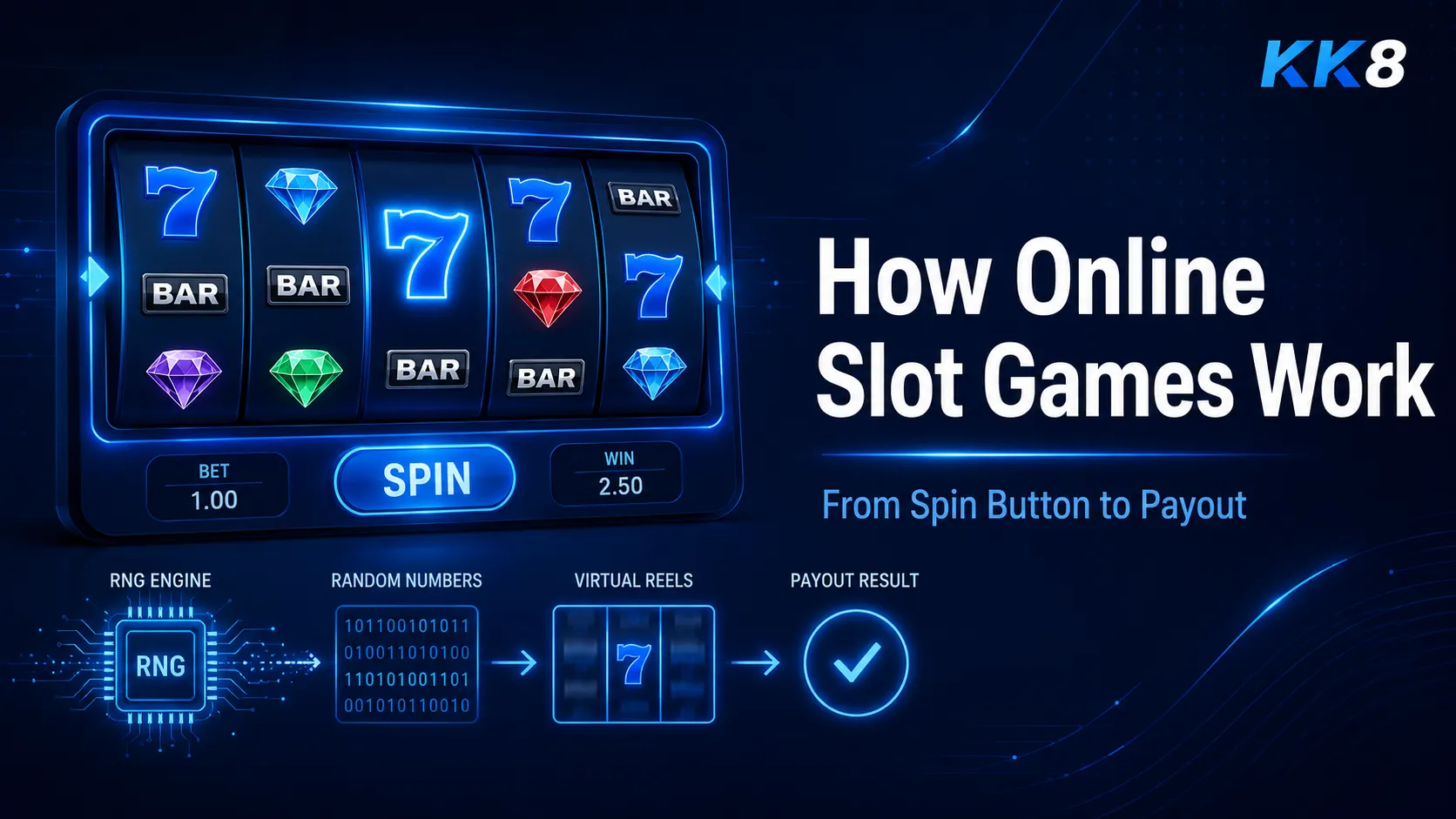
Online slot games look simple. You choose a stake, press Spin, and wait for the reels to stop. Behind this short sequence, the game uses software, probability rules, virtual reels, and a paytable to produce and evaluate the result.
Understanding these mechanics helps you interpret features such as Return to Player, volatility, paylines, and bonus rounds. It also helps separate mathematical facts from common slot myths.
This guide explains what happens during each spin, how payouts are calculated, and what you should check before playing.
Explore more: Online Casino Singapore
The Main Parts of an Online Slot Game
Before looking at the software behind a spin, it helps to understand the parts shown on the screen.
| Element | What it does |
| Reels | Vertical columns containing symbols |
| Rows | Horizontal positions where symbols appear |
| Symbols | Images used to form combinations |
| Paylines | Patterns used to assess matching symbols |
| Paytable | Lists winning combinations and payout values |
| Stake control | Sets the amount wagered per spin |
| Spin button | Starts the game round |
| Balance | Shows the funds available |
| Win display | Shows the return from the latest spin |
| Feature controls | Provide access to settings, autoplay, rules, or bonus information |
A traditional online slot might use five reels and three rows. Newer games often use larger grids, cascading symbols, cluster systems, or changing reel layouts.
Read more: Online Casino Terms Explained
What Happens When You Press Spin?
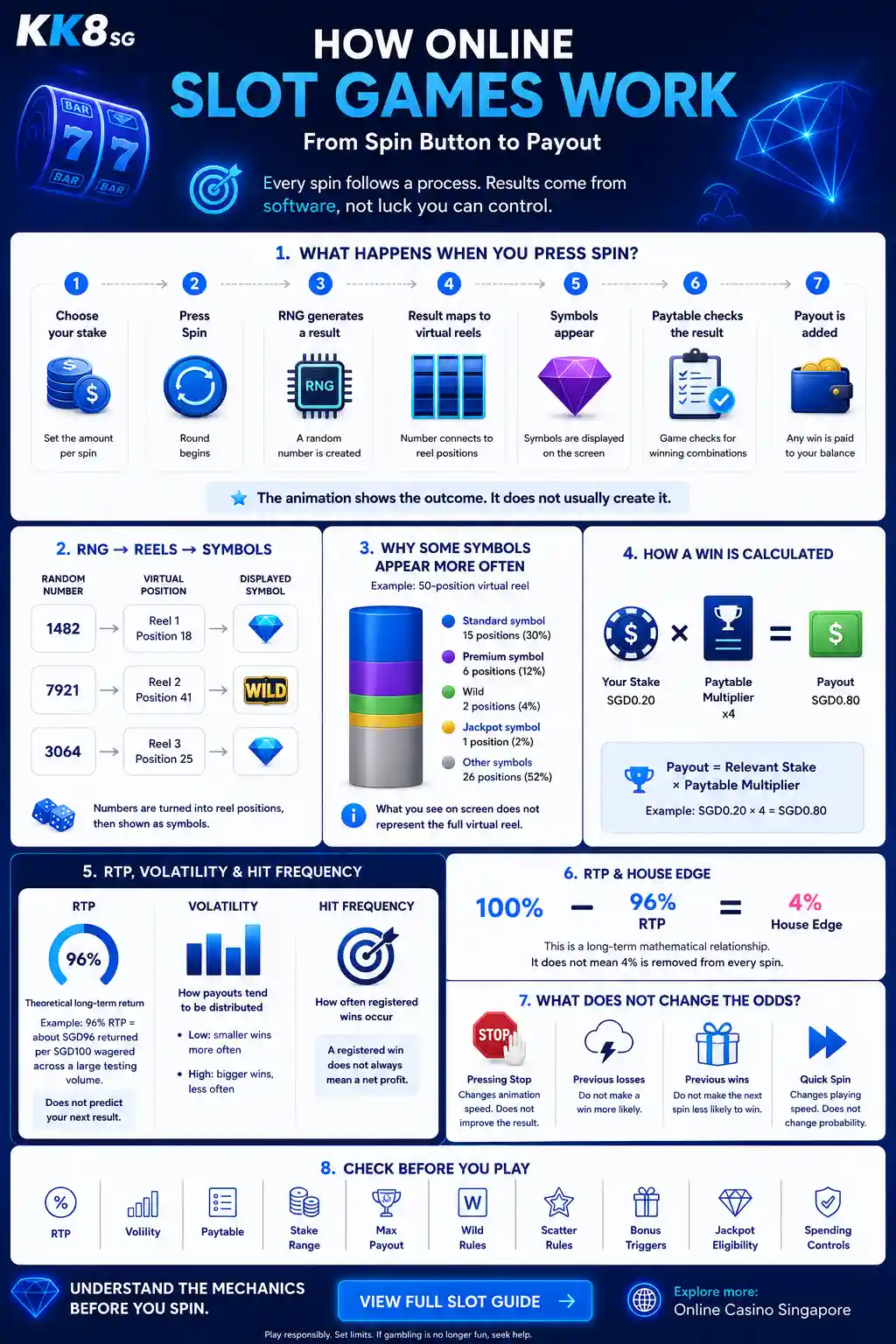
A standard online slot follows a process similar to this:
- You select your stake.
- You press the Spin button.
- The RNG produces or selects a numerical result.
- The game maps the result to positions on its virtual reels.
- The corresponding symbols appear on the screen.
- The game checks the displayed result against its rules and paytable.
- Any qualifying payout is added to your balance.
The reel animation does not usually create the result. It presents a result already determined by the game system.
This distinction matters because pressing Stop or tapping the screen usually changes only the animation speed. It does not improve the result.
What Is a Random Number Generator?
A Random Number Generator is software used to produce unpredictable values. Online slots use these values to determine reel positions or game events.
The RNG operates continuously or generates values when a round begins, depending on the game design. The selected numbers connect to positions within the game’s mathematical model.
A simplified example might work like this:
| Generated value | Virtual reel position | Displayed symbol |
| 1482 | Reel 1, position 18 | Blue gem |
| 7921 | Reel 2, position 41 | Wild |
| 3064 | Reel 3, position 25 | Blue gem |
Real slot systems are more complex. The example shows the basic relationship between numerical results and displayed symbols.
Is Every Spin Independent?
In a standard RNG slot, each spin is a separate event. Suppose a slot fails to produce a major payout across 100 spins. This does not mean the 101st spin is more likely to produce one. The game does not need to compensate for the previous results within your session.
The same principle applies after a large win. A recent payout does not automatically reduce or increase the probability of the next individual result.
This is similar to repeatedly tossing a fair coin. Five heads in a row do not make tails guaranteed on the sixth toss. The next toss still follows its own probability.
Some games include persistent features, collected symbols, or linked bonus progress. In those cases, the feature state might carry between spins. The underlying random event still follows the rules published for the game.
How Virtual Reels Work
The symbols visible on your screen do not always represent the full reel structure. A physical slot uses mechanical reels with a limited number of stopping positions. An online slot uses virtual reels, which support far more positions and different symbol weightings.
Consider a simplified virtual reel with 50 positions:
| Symbol | Number of positions | Approximate chance of appearing |
| Standard symbol | 15 | 30% |
| Premium symbol | 6 | 12% |
| Wild symbol | 2 | 4% |
| Jackpot symbol | 1 | 2% |
| Other symbols | 26 | 52% |
A symbol shown once in the visible artwork might occupy several positions on the virtual reel. Another symbol might appear less often in the virtual structure.
This weighting lets game designers control how frequently different combinations occur.
The exact reel strips and symbol weightings are rarely visible from the main game screen. The paytable and help section should still explain the winning combinations, features, and relevant payout rules.
How Paylines Work
A payline is a pattern used to evaluate matching symbols. Older slots often use one horizontal line across the centre. Modern games might use 10, 20, 50, or more fixed paylines.
A five-reel game might pay when matching symbols appear:
- From left to right
- On adjacent reels
- Along an active payline
- Starting from the first reel
Not every game follows these rules. Some pay from either direction, while scatter symbols often pay regardless of their exact reel positions.
More paylines do not automatically produce a higher mathematical return. The stake, symbol probabilities, paytable, and overall game model all affect the result.
Example of a Payline Win
Assume a game has a straight payline across the middle row. The middle row shows:
Cherry | Cherry | Cherry | Star | Bell
The paytable awards 4 times the relevant line stake for three cherries.
If the line stake is SGD0.20:
SGD0.20 × 4 = SGD0.80 payout
The total amount wagered might be higher when the game covers several paylines. Check whether the displayed multiplier applies to the line stake, total stake, or another value defined in the rules.
What Does “Ways to Win” Mean?
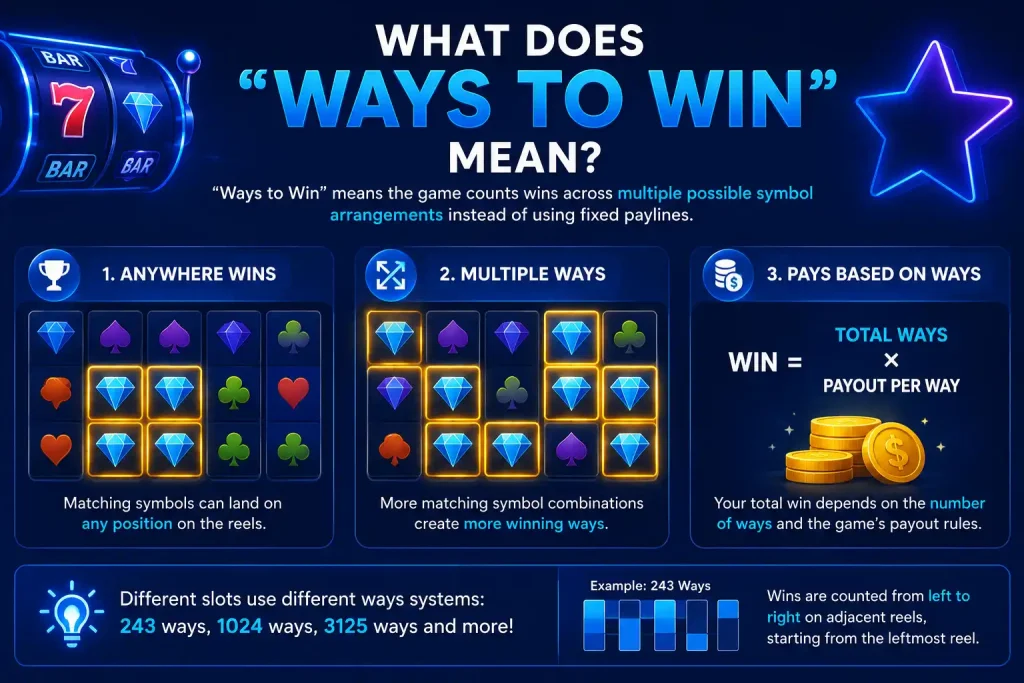
Ways-to-win slots do not rely on traditional line patterns. A common format pays for matching symbols appearing on adjacent reels, beginning from the leftmost reel. Their exact row positions do not need to match.
For example, a three-symbol combination might qualify when the same symbol appears:
- On reel one, row one
- On reel two, row three
- On reel three, row two
The symbols sit on different rows, but they appear on consecutive reels.
A game with three rows and five reels might advertise 243 ways to win. Larger or changing reel grids might advertise thousands of possible ways. The number of ways describes possible symbol arrangements. It does not describe the chance of making a profit.
Explore: Popular Online Slot Games Singapore
Other Common Payout Systems
Online slots use several systems beyond traditional paylines.
| System | How wins are assessed |
| Fixed paylines | Symbols must follow defined line patterns |
| Ways to win | Matching symbols appear on adjacent reels |
| Cluster pays | Groups of matching symbols touch each other |
| Cascading reels | Winning symbols disappear and new ones fall into place |
| All pays | Matching symbols qualify across broad position rules |
| Megaways-style reels | Symbol counts and possible combinations change each spin |
Cascading games might produce several evaluations from one paid spin. After a winning group disappears, replacement symbols enter the grid. The process continues until no new qualifying combination appears.
Read the game rules before assuming every cascade increases a multiplier or produces another payout. Feature behaviour differs between games.
How Slot Payouts Are Calculated
The paytable defines how much each qualifying combination returns.
A basic calculation looks like this:
Payout = Relevant stake × Paytable multiplier
Suppose you place a total stake of SGD1 and receive a combination valued at 5 times the total stake.
SGD1 × 5 = SGD5
The game returns SGD5, including any amount defined as part of the payout under its rules.
Some games calculate winnings using the stake assigned to each payline. Others use the total stake or a fixed coin value. Jackpot and bonus prizes might follow separate calculations.
Always check these details:
| Paytable detail | Why it matters |
| Payment direction | Shows where combinations must begin |
| Minimum matching symbols | Shows how many symbols form a win |
| Multiplier basis | Identifies whether the multiplier uses line or total stake |
| Maximum payout | Shows the game’s stated payout limit |
| Wild rules | Explains which symbols the wild replaces |
| Scatter rules | Explains position-independent payouts |
| Bonus conditions | Shows how special features start |
What Is RTP?
Return to Player, or RTP, is the theoretical percentage of total stakes a game is designed to return over a large number of rounds.
Suppose a slot has a theoretical RTP of 96%. Its mathematical model is designed to return about SGD96 for every SGD100 wagered across a large testing sample.
It does not mean:
- You will receive SGD96 after staking SGD100
- Every group of 100 spins returns the same percentage
- A loss must soon be followed by a win
- You receive 96% of each individual stake
Your short-term result might sit far above or below the published percentage.
RTP Example
Consider three players using a 96% RTP game:
| Player | Total wagered | Total returned | Session return |
| Player A | SGD100 | SGD35 | 35% |
| Player B | SGD100 | SGD112 | 112% |
| Player C | SGD100 | SGD87 | 87% |
None of these short sessions needs to match 96%. The theoretical percentage applies to the game model across a far larger volume of play, not to each person or session.
Learn more: Understanding RTP in Online Casino Games
RTP and House Edge
House edge represents the theoretical share of stakes not returned to players over the long term.
The basic relationship is:
House edge = 100% − RTP
For a game with 96% RTP:
100% − 96% = 4% theoretical house edge
This does not mean the operator takes 4% from each spin. It describes a long-term mathematical expectation across many rounds.
Some game providers offer more than one approved RTP version of the same title. Two platforms might therefore display the same game name but use different settings. Check the information screen for the specific version available.
What Is Slot Volatility?
Volatility describes how a game’s payouts tend to be distributed. It focuses on the pattern of returns, not only the long-term percentage.
| Volatility level | Typical payout pattern |
| Low | Smaller payouts tend to occur more often |
| Medium | Mix of smaller and larger payouts |
| High | Payouts tend to be less frequent and more uneven |
Two games might both have 96% RTP while producing different playing experiences.
A low-volatility game might distribute more of its theoretical return through frequent small results. A high-volatility game might concentrate more of its return in less frequent bonus rounds or large combinations.
Neither format removes the house edge.
Learn more: What Is Volatility in Slot Games?
RTP, Volatility and Hit Frequency
These terms describe different parts of the game.
| Metric | What it measures | What it does not tell you |
| RTP | Theoretical long-term return | Your next result |
| Volatility | Distribution and variation of payouts | Exact win timing |
| Hit frequency | How often registered wins occur | Whether those wins exceed the stake |
| House edge | Theoretical operator advantage | Your guaranteed session loss |
A game might have a high hit frequency while still producing a negative session result. For example, you stake SGD1 and receive SGD0.30. The game might count this as a registered win because it returned something, even though your balance fell by SGD0.70.
This is why win animations alone do not show whether a spin produced a net gain.
How Wild Symbols Work
A wild usually replaces selected standard symbols to help complete combinations. Suppose the payline displays:
Seven | Seven | Wild
When the wild substitutes for the third seven, the game might treat the result as three matching symbols.
Wild rules differ. A wild might:
- Replace most standard symbols
- Exclude scatters or bonus symbols
- Carry a multiplier
- Expand across a reel
- Move between reels
- Remain in place during free spins
Check the paytable instead of assuming all wilds behave the same way.
How Scatter Symbols Work
Scatter symbols often trigger payouts or bonus features without following a standard payline. For example, three scatter symbols anywhere on a five-reel grid might award 10 free spins.
A game might also pay a scatter prize based on the total stake:
| Scatter count | Example award |
| 3 | 2× total stake |
| 4 | 10× total stake |
| 5 | 50× total stake |
These figures are illustrative. Each title uses its own rules.
How Free Spins and Bonus Rounds Work
Free spins are additional rounds awarded after a qualifying trigger.
Common triggers include:
- Landing a set number of scatter symbols
- Filling a collection meter
- Completing a random feature
- Reaching a specific symbol combination
The bonus might include modified reels, extra wilds, multipliers, or new symbols. The game’s mathematical model includes the expected value of these features.
A bonus round does not remove randomness. Its outcomes still follow the rules and probabilities built into the game.
Are Bonus Choices Skill-Based?
Some bonus rounds ask you to choose a box, card, or object. The result might be determined in one of two ways:
- Your chosen object corresponds to a randomly assigned prize.
- The system determines the award before the selection, and your choice reveals it.
Unless the rules state otherwise, visual choice elements should not be treated as a skill contest.
How Progressive Jackpots Work
A progressive jackpot increases as eligible wagers enter the connected system.
The jackpot might link:
- One slot machine
- Several games on one platform
- The same game across several platforms
- A wider provider network
A small portion of qualifying stakes often contributes to the prize pool. The jackpot continues growing until an eligible result triggers it.
Progressive games tend to produce wider short-term variation because a significant part of the expected return might depend on a rare jackpot event.
Check whether the published RTP includes the jackpot contribution. Also review the stake requirements, eligibility rules, maximum prize terms, and whether the displayed amount uses your selected currency.
Are Online Slot Games Fair?

Fairness depends on the game, operator, software provider, regulatory framework, and testing process.
A properly regulated game should follow its approved mathematical model. Its random outcomes should remain unpredictable, and its displayed rules should match the implemented payout system.
UK Gambling Commission technical standards require licensed remote gambling software to meet testing and random-outcome requirements. These standards cover RNG behaviour, result determination, published rules, and technical controls.
A licence logo on a website is not enough by itself. Licence claims should be checked against the regulator’s own records.
Fairness Checklist
Before trusting a platform or game, check:
| Check | What to look for |
| Operator identity | Clear legal business name and contact details |
| Regulatory status | Verifiable record on the regulator’s website |
| Game provider | Recognised software company with clear ownership |
| Paytable | Accessible payout rules inside the game |
| RTP information | Percentage shown in the rules or help section |
| Testing details | Named testing laboratory or certification information |
| Transaction history | Clear records of stakes, returns, and withdrawals |
| Complaint process | Written steps for raising disputes |
| Security | HTTPS, account controls, and payment protection |
| Responsible-play tools | Deposit, spending, time, or exclusion controls |
Do Autoplay and Quick Spin Change the Odds?
Autoplay repeats spins based on selected settings. Quick Spin shortens the reel animation. These controls normally affect pace rather than probability. The same game model evaluates each round.
Faster play still increases the number of wagers placed within a given period. For example:
| Playing speed | Spins per minute | Spins in 30 minutes | Total staked at SGD1 per spin |
| Standard pace | 6 | 180 | SGD180 |
| Faster pace | 12 | 360 | SGD360 |
| Rapid pace | 20 | 600 | SGD600 |
The example assumes continuous play with no pauses or returns reused. It shows how speed affects total exposure, even when the stake per round stays unchanged.
What to Check Before Playing a Slot
A game with attractive graphics might still have rules or volatility unsuitable for your intended budget. Open the game’s information or help section before placing a stake.
Review:
- Published RTP
- Volatility rating
- Paytable
- Payment direction
- Stake range
- Maximum payout
- Wild and scatter rules
- Bonus triggers
- Jackpot eligibility
- Feature purchase terms
- Session and spending controls
Key Takeaways
Online slots rely on an RNG, virtual reel positions, and a paytable. The RNG determines each independent result. The game maps the result to symbols and evaluates the displayed combination according to its rules.
RTP describes theoretical return across a large volume of play. Volatility describes how payouts tend to be distributed. Hit frequency describes how often registered wins occur.
None of these figures predicts your next spin. No timing method or betting pattern changes the underlying mathematics of a standard RNG slot.
Before using a game, read its paytable, review its RTP and volatility, verify the operator, and check the laws applying to your location.
Continue Exploring: Online Casino Singapore
Frequently Asked Questions
How do online slot games work?
Online slots use a Random Number Generator to produce or select each result. The game maps the numerical outcome to virtual reel positions, displays the corresponding symbols, and checks the result against its paytable.
Are online slot results decided before the reels stop?
In standard online slots, the result is usually determined when the spin begins. The reel movement displays the selected outcome.
Does an online slot remember previous spins?
A standard RNG slot treats each spin as an independent event. Previous wins or losses do not make a future result due.
What does 96% RTP mean?
A 96% RTP means the game is mathematically designed to return about 96% of total stakes across a large volume of play. It does not promise a 96% return for one player or session.
What is the difference between RTP and volatility?
RTP describes the game’s theoretical long-term return. Volatility describes how frequently and unevenly payouts tend to occur.
Do more paylines increase RTP?
Not necessarily. The number of paylines, stake structure, symbol probabilities, and paytable all form part of the game’s mathematical model.
Does stopping the reels affect the result?
The Stop control usually changes how quickly the animation finishes. It does not alter a result already selected by the system.
Are free spins free of risk?
Free spins do not require a separate stake at the moment they are played, but they usually come from a paid trigger, promotional condition, or bonus feature. Their outcomes still follow the game’s rules.
How do I check whether an online slot is fair?
Review the operator’s regulatory status, the game provider, the paytable, published RTP, testing information, account records, and dispute process. Confirm licence claims through the regulator’s official website.
Are online slots legal in Singapore?
Singapore prohibits gambling unless it is licensed or exempted. GRA identifies Singapore Pools as the only operator licensed by it to provide remote gambling services. Check current GRA guidance before participating.