Skip to content

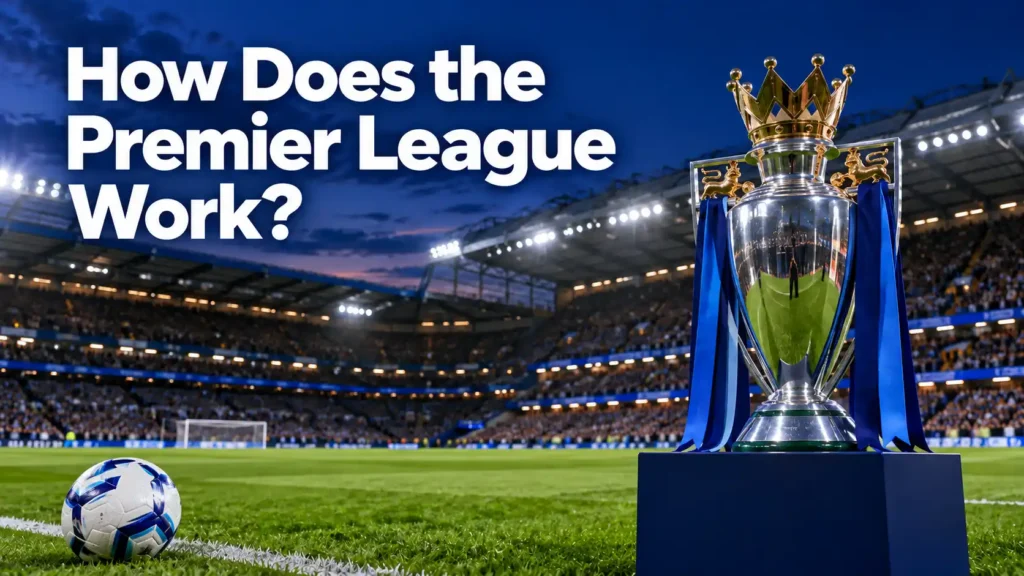
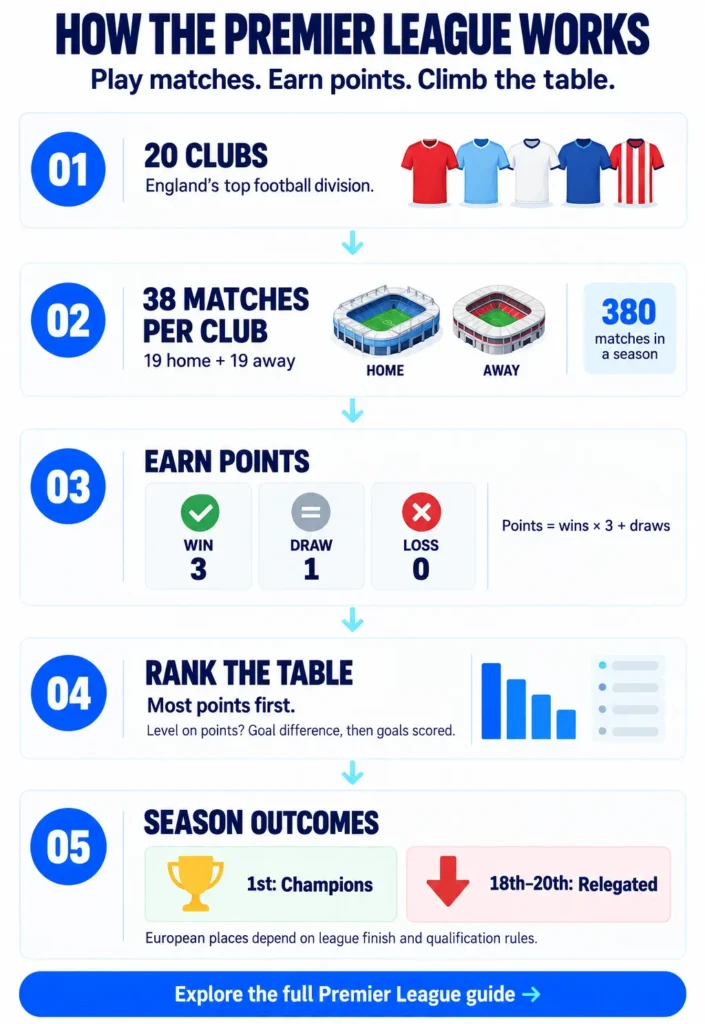
The Premier League is the top division of English football. 20 clubs play each other twice, once at home and once away, so every club plays 38 league matches a season. A win earns three points, a draw earns one and a defeat earns none. There is no final and no play-off for the title: the club with the most points after 38 matches is champion. The bottom three clubs are relegated to the Championship, and the clubs near the top qualify for European competitions.
The rest of this article explains each part in order: fixtures, points, the table, Matchweeks, the title, relegation, promotion and Europe.
What Is the Premier League?

The Premier League is the highest level of men’s professional football in England. It launched in 1992 and has had 20 clubs since the 1995/96 season. A season normally runs from August to May. The 2026/27 season began in late August 2026 and ends on Sunday 30 May 2027.
You will also see it called the EPL, short for English Premier League. That name is common in Singapore and across Asia. It is the same competition.
The most important thing to understand is that the Premier League is a league, not a knockout tournament. A club that loses a match is not eliminated. All 20 clubs play all 38 of their matches, and every result feeds into a single table.
The league sits at the top of the English football pyramid. Directly below it is the English Football League (EFL), whose top division is called the Championship. Clubs move between the two every season through promotion and relegation, which we cover further down.
How Many Teams and Matches Are in the Premier League?
There are 20 teams, and each one plays 38 league matches per season.
Why Does Each Team Play 38 Matches?
Every club has 19 opponents and plays each of them twice. One match is at its own stadium (the home match) and one is at the opponent’s stadium (the away match).
19 opponents x 2 matches = 38 matches per club, split into 19 home and 19 away.
For example, Arsenal hosted Chelsea once at the Emirates Stadium and travelled to Stamford Bridge once. The same applies to Arsenal’s other 18 opponents.
This format is called a double round-robin. It is considered the fairest way to rank clubs because everyone faces the same opponents the same number of times, with home advantage shared equally.
Why Are There 380 Matches in Total?
If 20 clubs each play 38 matches, that looks like 760 matches. But every match involves two clubs, so each one has been counted twice.
20 clubs x 38 matches / 2 = 380 matches per season.
| Season in numbers | Total |
| Clubs | 20 |
| Opponents per club | 19 |
| Matches per club | 38 (19 home, 19 away) |
| Matches in one full round | 10 |
| Matches in a season | 380 |
How Does the Premier League Points System Work?
Clubs earn points from each match based on the result. Goals only decide who wins the match. They are not added to the points total.
| Result | Points |
| Win | 3 |
| Draw | 1 |
| Loss | 0 |
Example: a club has played 10 matches, with 6 wins, 2 draws and 2 losses.
- 6 wins x 3 points = 18
- 2 draws x 1 point = 2
- 2 losses x 0 points = 0
That club has 20 points.
The gap between a win and a draw is deliberate. One win and one loss (3 points) is worth more than two draws (2 points), which rewards clubs for trying to win instead of settling for a draw.
The maximum possible total is 114 points, which would mean winning all 38 matches. No club has ever done it.
How Does the Premier League Table Work?
The league table ranks all 20 clubs by points, from most to fewest. It updates after every match. Here is a simplified example after 10 matches, using made-up clubs.
| Pos | Club | P | W | D | L | GF | GA | GD | Pts |
| 1 | Club A | 10 | 7 | 2 | 1 | 20 | 8 | +12 | 23 |
| 2 | Club B | 10 | 7 | 2 | 1 | 18 | 9 | +9 | 23 |
| 3 | Club C | 10 | 5 | 4 | 1 | 14 | 9 | +5 | 19 |
| 4 | Club D | 10 | 6 | 1 | 3 | 15 | 12 | +3 | 19 |
Each column has a fixed meaning.
| Column | Stands for | Meaning |
| P | Played | Matches played so far |
| W | Won | Matches won |
| D | Drawn | Matches drawn |
| L | Lost | Matches lost |
| GF | Goals For | Goals the club has scored |
| GA | Goals Against | Goals the club has conceded |
| GD | Goal Difference | GF minus GA |
| Pts | Points | Wins x 3, plus draws x 1 |
Two details in the example are worth a second look. Club A and Club B have the same wins, draws and losses, but Club A is first because of a better goal difference. Club D has won more matches than Club C, yet sits below it for the same reason.
What Does Goal Difference Mean?
Goal difference is the number of goals a club has scored minus the number it has conceded. Club A has scored 20 and conceded 8, so its goal difference is +12. A club that concedes more than it scores has a negative goal difference.
It matters because it is the first tiebreaker when clubs have the same points.
What Happens When Teams Finish Level on Points?
The Premier League separates clubs on equal points in this order:
- Goal difference
- Goals scored
- Points won in the matches between the tied clubs (head-to-head)
- Away goals scored in those head-to-head matches
If two clubs are still level, and the position decides the title, relegation or a European place, the rules allow for a one-off play-off at a neutral venue. That has never been needed.
Goal difference has decided the title once. In 2011/12, Manchester City and Manchester United both finished on 89 points, and City won the league on goal difference.
The Table Is Four Races at Once
New fans often watch only the top of the table. In practice, clubs in different parts of it are competing for different things.
| Part of the table | What clubs are playing for |
| 1st | The title |
| The places just below | Qualification for European competitions |
| Mid-table | A higher finish, which brings a larger share of the league’s merit payments |
| 18th to 20th | Avoiding relegation |
This is why a late-season match between two clubs in 16th and 18th can matter as much to those clubs as a match between the top two.
What Is a Premier League Matchweek?

A Matchweek is one round of fixtures in which every club plays once. With 20 clubs, a full Matchweek has 10 matches, and a season has 38 Matchweeks.
The name is slightly misleading, because a Matchweek is not always a single weekend:
- Matches are usually spread from Friday night to Monday night so more of them can be shown live.
- Some rounds are played in midweek. The 2026/27 calendar has 33 weekend rounds and 5 midweek rounds.
- A match can be postponed, often because one club has a cup tie. It is then played later but still belongs to its original Matchweek.
That last point explains the phrase “a game in hand”. If a club has played 20 matches while its rivals have played 21, it has one game in hand, and the table is not a like-for-like comparison until that match is played.
The final Matchweek is the exception to the spread-out schedule. All 10 matches kick off at the same time, so no club can benefit from already knowing a rival’s result.
How Is the Premier League Champion Decided?
The club in first place after all 38 matches is the champion. There is no final, no knockout round and no end-of-season play-off for the title.
A club can win the league before the last day. Once its lead is larger than the points its nearest rival can still earn, the title is settled mathematically.
There is no fixed points target, but history gives a rough guide:
| Title-race figure | Points |
| Maximum possible | 114 |
| Average for champions, per Premier League figures published in April 2026 | 87.7 |
| Lowest winning total (Manchester United, 1996/97) | 75 |
| Highest total that did not win (Liverpool, 2018/19) | 97 |
The last two rows show why a target is unreliable. What matters is finishing above everyone else in that particular season. Arsenal are the current champions after winning the 2025/26 title.
How Does Relegation Work?
The clubs that finish 18th, 19th and 20th are relegated. They drop to the Championship for the following season and are replaced by three clubs coming up.
In 2025/26, Burnley, West Ham United and Wolverhampton Wanderers went down. Coventry City, Hull City and Ipswich Town took their places for 2026/27.
Relegation is a major setback for a club. It means lower broadcast income, the likely loss of key players and no guarantee of a quick return. That pressure is why the bottom of the table often produces some of the most intense matches of the season.
Is 40 Points Enough to Avoid Relegation?
Usually, but it is a rule of thumb and not an official threshold. No points total guarantees safety. A club is safe only when it cannot finish in the bottom three.
| Relegation figure | Points |
| Average for the 18th-placed club since the league moved to 20 clubs | 35.2 |
| Most points for a relegated club (West Ham United, 2002/03) | 42 |
| Fewest points for a club that stayed up (Nottingham Forest, 2023/24) | 32 |
What this means: on average, 36 points has been enough to stay up. But one club has survived with 32 and another has gone down with 42, so the “40-point mark” is best read as a comfortable margin, not a finish line.
How Does Promotion to the Premier League Work?

Three clubs are promoted from the Championship each season:
- The club that finishes 1st is promoted automatically.
- The club that finishes 2nd is promoted automatically.
- The third place goes to the winner of the Championship play-offs.
From the 2026/27 season, the play-offs involve six clubs, those finishing 3rd to 8th, instead of the previous four.
Promoted clubs often find the step up difficult, and it is common for at least one to go straight back down. It is not a given, though. Two of the three clubs promoted for 2025/26 stayed up, and one of them, Sunderland, finished 7th.
How Do Premier League Clubs Qualify for Europe?
Finishing near the top of the Premier League earns a place in one of UEFA’s three club competitions the following season. This is the main reason the places just below first still matter so much.
| Competition | Usual route for English clubs |
| UEFA Champions League | Top four in the Premier League |
| UEFA Europa League | The next-highest league finisher, plus the FA Cup winner |
| UEFA Conference League | The EFL Cup winner |
Three things can change who qualifies:
- An extra Champions League place. UEFA gives a bonus place to the two countries whose clubs performed best in Europe that season. If England earns it, fifth place also goes to the Champions League.
- Cup winners who have already qualified. If the FA Cup or EFL Cup winner has qualified through its league position, that European place passes down the table. This is how clubs finishing 6th, 7th or occasionally 8th can reach Europe.
- European trophy winners. A club that wins the Champions League or Europa League qualifies for the next Champions League, whatever its league position.
UEFA can adjust these rules between seasons, so treat the table above as the standard pattern, not a permanent guarantee.
Premier League vs Champions League: What's the Difference?
They are separate competitions run by different organisations. The Premier League decides the champion of England. The Champions League decides the champion of Europe.
| Point of comparison | Premier League | Champions League |
| Type | English domestic league | European club competition |
| Organiser | The Premier League | UEFA |
| Who plays | 20 English clubs | Top clubs from leagues across Europe |
| Format | 38-match league, no knockout stage | League phase, then knockout rounds and a final |
| How to enter | Stay in or get promoted to the top division | Qualify through your domestic league or by winning a UEFA trophy |
The two run side by side. An English club that qualifies plays Premier League matches at the weekend and Champions League matches in midweek during the same season.
For a fuller comparison, read our guide to the Premier League vs Champions League.
How to Follow the Premier League From Singapore
Matches are scheduled in UK time, so most of them fall in the evening or late at night in Singapore. Singapore is 7 hours ahead of the UK during British Summer Time and 8 hours ahead for the rest of the year.
| Common UK kick-off | Singapore time, late March to late October | Singapore time, late October to late March |
| Saturday 12:30pm | Saturday 7:30pm | Saturday 8:30pm |
| Saturday 3:00pm | Saturday 10:00pm | Saturday 11:00pm |
| Saturday 5:30pm | Sunday 12:30am | Sunday 1:30am |
| Sunday 2:00pm | Sunday 9:00pm | Sunday 10:00pm |
| Sunday 4:30pm | Sunday 11:30pm | Monday 12:30am |
| Midweek 8:00pm | 3:00am the next day | 4:00am the next day |
The UK moves its clocks back on the last Sunday of October and forward on the last Sunday of March. Singapore does not change its clocks, so every kick-off shifts an hour later for Singapore viewers over the winter months. This season the changes fall on 25 October 2026 and 28 March 2027.
For live coverage, StarHub holds the Premier League broadcast rights in Singapore under a deal that runs through the 2027/28 season. From 2026/27, the Premier League also offers its own streaming service in Singapore, Premier League+, developed with StarHub and carrying all 380 matches live. Packages and prices change, so check the details in our guide on how to watch the Premier League in Singapore.
Does Understanding the League Help With Football Betting?
It gives you context, which is useful, but context is not a prediction.
Knowing how the league works helps you read a fixture properly. A club fighting relegation in May is in a different position from a mid-table club with little left to play for. A club with a European match in midweek may rotate its squad at the weekend. A club with a game in hand is closer to its rivals than the table suggests.
None of that tells you who will win. Football has a high share of draws and upsets, and the factors above are already known to everyone setting and reading the odds.
If you are new to the terminology, start with our beginner’s guide to football betting in Singapore. For markets, odds and match factors specific to this competition, see our KK8 Premier League page. Betting carries a real risk of loss, so only stake what you can afford to lose.
Frequently Asked Questions
How many teams are in the Premier League?
Twenty clubs compete in the Premier League each season. Three are relegated at the end of the season and replaced by three clubs promoted from the Championship, so the number stays at 20.
How many games does each Premier League team play?
Each club plays 38 league matches: 19 at home and 19 away. That comes from playing each of the other 19 clubs twice.
How many points do you get for a win in the Premier League?
A win is worth three points, a draw is worth one point and a defeat is worth none. The most a club can earn in a season is 114 points.
How many teams are relegated from the Premier League?
Three. The clubs that finish 18th, 19th and 20th drop to the Championship for the following season.
What happens if Premier League teams finish on the same points?
Goal difference is the first tiebreaker, followed by goals scored. If clubs are still level, the league looks at points and then away goals in the matches between them. A play-off at a neutral venue is the last resort and has never been needed.