Skip to content

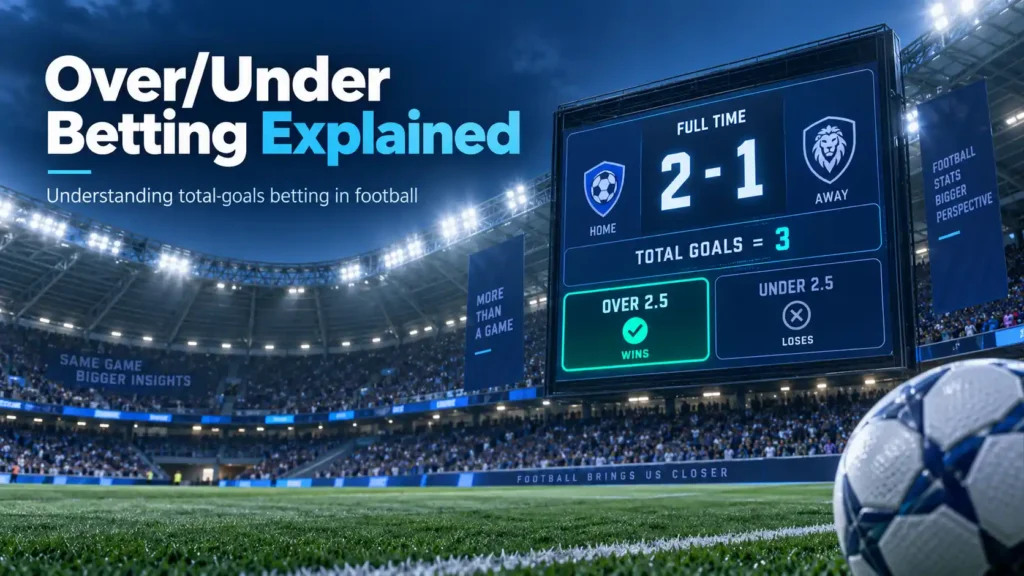
Over/under betting is a football market based on the combined number of goals both teams score. The operator sets a line, such as 2.5, and the selection is either over or under that number. Over 2.5 wins if the match produces three or more goals. Under 2.5 wins if it produces two or fewer. A 2-1 result has three goals, so Over 2.5 wins. Unless the market states otherwise, only goals scored in the 90 minutes plus stoppage time count.
What Is Over/Under Betting?
Over/under betting, also called total goals betting, asks one question: how many goals will the match produce in total? It does not matter who scores them or which team wins.
“Over” means the total finishes above the line. “Under” means it finishes below. The line is simply the number the operator chooses as the dividing point, and in football that number is most often 2.5.
Goals from both teams are added together. A match that ends 2-1 has three total goals. So does a 3-0 home win, and so does a 0-3 away win. For this market, all three results are identical.
That is the main difference from a match-winner market, often written as 1X2, where you choose a home win, a draw or an away win. In a totals market you can be completely wrong about the winner and still be on the right side of the line. The reverse is also true. Over/under is just one of several football betting markets, alongside match-winner and handicap markets.
How Does Over/Under Betting Work in Football?
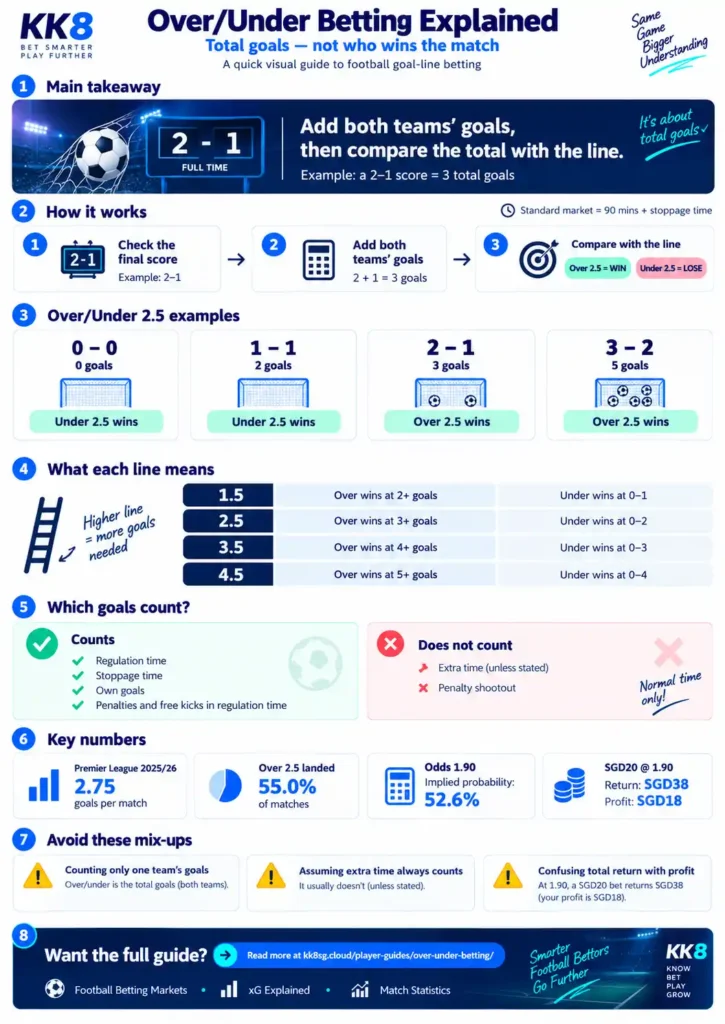
Settling an over/under football betting market takes three steps:
- Take the final score for the period the market covers, which is usually regulation time.
- Add the two teams’ goals together.
- Compare that total with the line.
These steps are the same in every competition, from the Singapore Premier League to the English top flight covered on our Premier League football betting page.
How Are Total Goals Counted?
The scores below are illustrative, not real results. Each one is checked against a 2.5 line.
| Final score | Total goals | Over 2.5 | Under 2.5 |
| 0-0 | 0 | Loses | Wins |
| 1-1 | 2 | Loses | Wins |
| 2-1 | 3 | Wins | Loses |
| 3-2 | 5 | Wins | Loses |
Own goals count as well. An own goal is added to the opposing team’s score, so it raises the total by one like any other goal.
Why Do Betting Lines Use Decimal Numbers?
No football match can finish with 2.5 goals, and that is exactly why the number is used. The total is always a whole number, so it must land on one side of a half-goal line. There are only two possible results, a win or a loss, with no tie to resolve.
Whole-number lines such as 2.0 behave differently because the total can land exactly on the line. Those are covered further down.
Over 1.5 vs Over 2.5 vs Over 3.5 Goals
The number changes, but the rule does not. Round the line up to find what Over needs, and round it down to find the most Under can allow.
| Goal line | Over wins at | Under wins at |
| 1.5 | 2+ goals | 0-1 goals |
| 2.5 | 3+ goals | 0-2 goals |
| 3.5 | 4+ goals | 0-3 goals |
| 4.5 | 5+ goals | 0-4 goals |
In plain terms, Over 1.5 means two or more goals, Over 2.5 means three or more, and Over 3.5 means four or more. Under 2.5 is the mirror image of Over 2.5: two goals or fewer.
Each step up the ladder asks for one more goal before Over wins. That makes Over less likely and Under more likely, and the odds move to reflect it. A higher line with bigger odds is not a better or worse selection. It is a less likely outcome with a larger potential return, priced according to the operator’s estimate of the chances.
One Score, Seven Lines
To see how the line changes the outcome, take a single hypothetical result: a match that finishes 2-1, giving three total goals.
| Line | Line type | Over | Under |
| 1.5 | Half | Wins | Loses |
| 2.5 | Half | Wins | Loses |
| 2.75 | Quarter | Half win, half refund | Half loss, half refund |
| 3.0 | Whole | Stake refunded | Stake refunded |
| 3.25 | Quarter | Half loss, half refund | Half win, half refund |
| 3.5 | Half | Loses | Wins |
| 4.5 | Half | Loses | Wins |
The half-goal rows match the illustration in the Singapore Pools football betting rules: at a full-time score of 2-1, “Over 2.5” is the winning selection on a 2.5 line and “Under 3.5” is the winning selection on a 3.5 line. The whole and quarter rows follow the general Asian total goals convention explained below.
How Are Over/Under Betting Odds Calculated?
Understanding Decimal Odds
Decimal odds show the total amount returned for every dollar staked, including the stake itself. Odds of 1.90 mean a successful SGD1 stake returns SGD1.90: the original dollar plus 90 cents.
Over/under betting odds also carry an implied probability, which is the chance of the outcome that the price suggests. To find it, divide 1 by the odds. For 1.90, that is 1 ÷ 1.90 = 0.526, or about 52.6%.
Calculating Returns in SGD
Two formulas cover every half-goal market:
- Total return = Stake × Decimal odds
- Net profit = Total return − Stake
Take a hypothetical $20 stake on Over 2.5 at odds of 1.90. If the match produces three or more goals, the total return is $20 × 1.90 = $38, and the net profit is $38 − $20 = $18. If it produces two or fewer, the $20 stake is lost.
The same sums work at any price. The odds below are examples only.
| Stake | Decimal odds | Implied probability | Total return | Net profit |
| $20 | 1.70 | 58.8% | $34 | $14 |
| $20 | 1.90 | 52.6% | $38 | $18 |
| $20 | 2.10 | 47.6% | $42 | $22 |
Why Lower Odds Do Not Guarantee a Win
Lower odds signal a more likely outcome, not a certain one. Odds of 1.25 imply an 80% chance, which still leaves one failure in every five.
The odds also include the operator’s margin. Suppose Over 2.5 and Under 2.5 are both priced at 1.90. Each implies 52.6%, which adds up to 105.3% for two outcomes whose true chances can only total 100%. The extra 5.3 percentage points are the margin, and it is one reason total goals betting is not a dependable way to make money over time.
What Are Whole and Quarter Goal Lines?
Half-goal lines are the standard format. Some operators also offer Asian total goals lines, which use whole and quarter numbers and add outcomes that sit between a full win and a full loss. Not every operator offers them and settlement terms vary, so read the rules for the specific market.
Whole Goal Lines: 2.0 and 3.0
With a whole-number line, the total can land exactly on the line. Over 3.0 wins with four or more goals and loses with two or fewer. Exactly three goals is a “push”: the bet is treated as void and the stake is returned, where the market’s rules provide for it.
Quarter Goal Lines: 2.25 and 2.75
A quarter line splits the stake equally across the two nearest lines. Over 2.25 is half on Over 2.0 and half on Over 2.5. Over 2.75 is half on Over 2.5 and half on Over 3.0.
Here is a hypothetical $20 stake on Over 2.75 at odds of 1.90. $10 goes on Over 2.5 and $10 goes on Over 3.0.
| Total goals | Over 2.5 half (SGD10) | Over 3.0 half (SGD10) | Total return | Net result |
| 2 or fewer | Loses | Loses | $0 | Loss of $20 |
| Exactly 3 | Wins, returns $19 | Push, $10 refunded | $29 | Profit of $9 |
| 4 or more | Wins, returns $19 | Wins, returns $19 | $38 | Profit of $18 |
The middle row is the “half win”. Over 2.25 produces the opposite case. With exactly two goals, the Over 2.0 half is refunded and the Over 2.5 half loses, so $10 comes back from a $20 stake. That is a “half loss”.
Which Goals Count in Over/Under Betting?
Regulation Time and Stoppage Time
Under IFAB Law 7, a match lasts two halves of 45 minutes. The referee then adds time at the end of each half for stoppages such as substitutions, injuries, VAR reviews and goal celebrations.
That added time is part of the half, not a separate period. A goal in the sixth minute of stoppage time counts exactly like a goal in the sixth minute of the match.
Extra Time and Penalty Shootouts
Extra time is different. It is a separate period played only when a knockout tie, such as a UEFA Champions League knockout match, is level after 90 minutes. A standard full-time total goals market is settled on the score at the end of regulation time, so extra-time goals do not count unless the market explicitly says it includes extra time.
Shootout kicks are not part of the match score at all. They decide which team advances.
| Period | Counts in a standard full-time total goals market? |
| First half, including stoppage time | Yes |
| Second half, including stoppage time | Yes |
| Extra time | No, unless the market states otherwise |
| Penalty shootout | No |

Abandoned and Postponed Matches
An abandoned match may be replayed under the competition’s rules, but bets are settled under the operator’s published rules, so those are what matter.
The Singapore Pools rules show a common approach. Total Goals Over/Under bets are void and refunded if a match is called off before the end of regulation time, unless the result was already decided. In their example, a match is abandoned in the 65th minute at 2-1. Over 2.5 has already won, because a third goal cannot be taken back. The 3.5 market is void and refunded, because a fourth goal was still possible.
Over/Under Betting in Singapore
In Singapore, the official name for this market is “Total Goals Over/Under”. You will also see it shortened to O/U, and in casual conversation some fans say “big” and “small” over and under.
The Singapore Pools football betting rules, dated 29 May 2026, define the market precisely:
- It is based on the total number of “Valid Goals” scored by both teams during regulation time.
- Regulation time means the first and second halves, including stoppage time. Extra time and penalty shootouts are excluded.
- Penalties, free kicks and own goals scored in regulation time all count.
- A separate market, Halftime Total Goals Over/Under, covers the first half only.
Suppose a Singapore Premier League match between Lion City Sailors and FC Jurong, the club previously known as Albirex Niigata (S), ends 3-1. That is four total goals, so Over 2.5 and Over 3.5 both win, and Over 4.5 loses. This is a hypothetical scoreline, not a real result. Actual fixtures and results are published by the league and the Football Association of Singapore (FAS).
Can Football Statistics Help Explain Goal Totals?
Statistics can tell you how often a total has occurred. They cannot tell you what the next match will produce.
Goals Per Match
A league’s average is its total goals divided by its matches played. The 2025/26 Premier League season had 1,045 goals in 380 matches, which is 2.75 goals per match.
The table below shows how often each line was cleared across the last three completed Premier League seasons.
| Season | Matches | Goals | Goals per match | Over 1.5 | Over 2.5 | Over 3.5 |
| 2023/24 | 380 | 1,246 | 3.28 | 86.1% | 64.7% | 43.7% |
| 2024/25 | 380 | 1,115 | 2.93 | 81.3% | 56.6% | 34.2% |
| 2025/26 | 380 | 1,045 | 2.75 | 78.9% | 55.0% | 28.4% |
Method: our own count from the full-time score of every match, using the public-domain openfootball England dataset. Each percentage is the number of matches with a total above the line, divided by 380. Season totals can be checked against Premier League statistics.
The same league produced very different numbers within three seasons. Over 2.5 was cleared in 246 matches in 2023/24 and 209 in 2025/26.
An average also hides the spread. The 2025/26 average of 2.75 sits above the 2.5 line, yet 45% of matches finished with two goals or fewer, including 27 goalless draws.
For a closer look at goals, shots and possession figures, see our guide to reading football match statistics.

Expected Goals (xG)
Expected goals, or xG, measures the quality of scoring chances. Each shot is given a value between 0 and 1, based on how often similar shots have been scored in the past. A close-range tap-in might be rated 0.6, and a speculative long shot 0.03.
Adding up a team’s shots gives its xG for the match. An xG of 1.8 means the chances were typically worth about 1.8 goals, yet the team might still score none, or four. xG describes chance quality. It is not a forecast of the final score.
To understand why xG differs from actual goals scored, explore our guide to what xG means in football.
Why Historical Results Cannot Guarantee Future Results
- Sample size. A team’s last five matches is a very small sample. One 5-0 win changes the average sharply.
- Randomness. A deflection, an early red card or a penalty can turn a quiet match into a high-scoring one.
- Change. Injuries, new managers, transfers and tactics all shift how a team plays. The table above shows that whole leagues shift too.
Common Over/Under Betting Mistakes
- Counting one team’s goals instead of both. A 2-1 win is three total goals, not two. A line on a single team’s goals is a different market.
- Assuming extra-time goals always count. A cup tie that is 1-1 after 90 minutes and ends 2-1 after extra time has two goals for a standard market, not three.
- Mixing up full-match and first-half markets. A match that is 0-0 at half-time and ends 3-1 clears a full-match 2.5 line, but a first-half Over 0.5 loses.
- Misreading whole and quarter lines. Exactly three goals on Over 3.0 is a refund, not a win. On Over 2.75 it is a half win.
- Treating past statistics as a guarantee. Over 2.5 was cleared in 64.7% of Premier League matches in 2023/24 and 55.0% two seasons later.
- Confusing total return with net profit. $20 at odds of 1.90 returns $38, but $20 of that is your own stake. The profit is $18.
Conclusion
Over/under betting comes down to one sum: add both teams’ goals and compare the total with the line. The parts that catch people out are the details around it, such as which periods count, how whole and quarter lines settle, and the difference between a return and a profit.
Knowing how a market settles does not make its outcome predictable. If you want to see how totals compare with other markets, Explore More Football Betting Markets.
This article is for educational purposes only and is intended for readers aged 21 and above. It is not betting advice. All match results, stakes and odds used as examples are hypothetical unless a source is given, and no outcome is guaranteed.
Sources
- Singapore Pools: Football Betting Game Rules, dated 29 May 2026. Appendix A10 (Total Goals Over/Under X), Appendix A21 (Halftime Total Goals Over/Under X) and the definitions of Regulation Time and Valid Goal.
- IFAB: Law 7, The Duration of the Match, 2026/27 Laws of the Game.
- openfootball England dataset, Premier League 2023/24, 2024/25 and 2025/26 results.
- Premier League: Statistics.
- Singapore Premier League: 2026/27 SPL season returns on 11 September.
Frequently Asked Questions
What does Over 2.5 mean in football betting?
Over 2.5 means the two teams must score three or more goals between them in the period the market covers. If the match finishes with two goals or fewer, Over 2.5 loses and Under 2.5 wins.
What is the difference between Over 1.5 and Over 2.5?
One goal. Over 1.5 needs at least two goals and Over 2.5 needs at least three. A 1-1 draw wins on Over 1.5 and loses on Over 2.5. Because Over 1.5 is the more likely outcome, it carries lower odds.
Do both teams' goals count in over/under betting?
Yes. The market is based on the combined total, so a 2-0 and a 1-1 are both two goals. Own goals are included, because they are added to the opposing team’s score.
Does extra time count in over/under betting?
Normally not. A standard total goals market is settled on the score at the end of regulation time, which includes stoppage time but not extra time or a penalty shootout. Check the market description, as some markets state that extra time is included.
What happens if the total goals equal the betting line?
This cannot happen on a half-goal line such as 2.5. On a whole-number line such as 3.0, a match with exactly three goals is usually treated as a push and the stake is refunded, subject to the operator’s rules.