Tag: Online Casino Singapore

  • How to Choose a Trusted Online Casino

    How to Choose a Trusted Online Casino

    Knowing how to choose a trusted online casino takes more than glancing at bonuses, game selection or a polished website design. A more reliable approach starts by working out who actually operates the platform, whether that operator is legally permitted to serve your location, how the site protects your account information, how deposits and withdrawals are actually processed, and whether the terms are written clearly enough to trust.

    For Singapore users, regulatory status should be the very first thing you check, before bonuses or game libraries even enter the picture. The Gambling Regulatory Authority of Singapore (GRA) states plainly that gambling in Singapore is prohibited unless it is licensed or exempted, and that Singapore Pools is currently the only operator licensed by GRA to provide remote gambling services in the country. A website being accessible from Singapore, or accepting SGD, PayNow or other familiar local payment methods, says nothing about whether it actually holds that approval. For the broader legal framework, see our Online Gambling Singapore Guide.
    choose trusted online casino

    Quick Answer

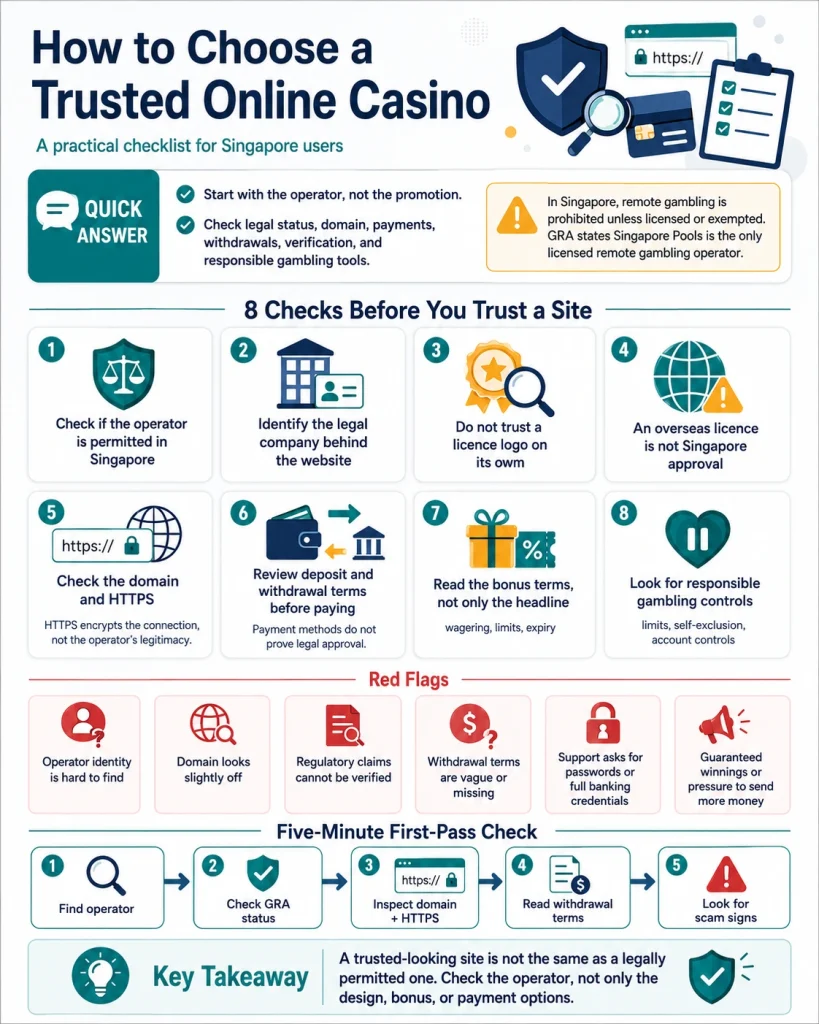
    To choose a trusted online casino, start with the operator rather than the promotion. Identify the company behind the brand, verify its regulatory status, examine the domain carefully, confirm the site runs on HTTPS, review the deposit and withdrawal terms, check what identity verification is required, and look for clear responsible gambling controls. Singapore users also need to separate technical trust from legal status: a site can look secure and professional while still lacking approval to offer remote gambling to people in Singapore, since GRA states that providing unlicensed remote gambling services, whether from inside or outside Singapore, to persons situated in Singapore is unlawful. For a dedicated step-by-step process, read How to Verify an Online Casino.

    Step 1: Check Whether the Operator Is Permitted in Singapore

    This has to come before games or bonuses. GRA regulates Singapore’s gambling industry and lists the higher-risk licensed activities it permits, including the casinos run by Resorts World Sentosa and Marina Bay Sands, and the lottery and betting services offered by Singapore Pools. For remote gambling specifically, GRA is clear that Singapore Pools is the only licensed operator. That means a platform shouldn’t be treated as a “trusted online casino Singapore” simply because it accepts Singapore users, supports SGD or PayNow, runs Singapore-themed promotions, holds a licence from somewhere else, or ranks well in search results. None of that establishes Singapore regulatory approval. For the full legal picture, read Is Online Gambling Legal in Singapore?

    Step 2: Identify the Company Behind the Website, Not Just the Brand

    A trustworthy platform usually makes it fairly easy to find out which legal business actually operates the service, including its registered company name, contact details, terms and conditions, privacy policy and applicable regulatory information. If a site repeatedly promotes a brand name but never identifies the company handling user accounts and payments, that’s worth investigating further, since licences are generally issued to legal entities, not to marketing names.

    Step 3: Don’t Trust a Licence Logo on Its Own

    Anyone can place a regulatory-looking logo in a website footer, so the logo itself proves nothing. What matters is identifying which regulator supposedly issued the licence, which company holds it, what activities it actually covers, and whether that approval can be independently verified as applying to your jurisdiction. GRA requires operators to hold the appropriate licence for betting or lottery operations, and a licence covering one activity shouldn’t be read as blanket permission for every gambling service the site offers.

    Step 4: Understand That an Overseas Licence Isn’t Singapore Approval

    An overseas gambling licence may place an operator under another jurisdiction’s rules, but it does not make the service legal in Singapore. GRA states directly that providing unlicensed remote gambling services from outside Singapore to people located in Singapore is unlawful, so an overseas licence, a foreign company registration and an international-looking website are all, on their own, unrelated to Singapore approval. For more detail, see Remote Gambling in Singapore Explained.

    Step 5: Check the Domain, and Make Sure the Site Uses HTTPS

    Fake gambling websites frequently use domains that closely resemble legitimate brands, sometimes changing a single letter to create something that looks convincing at a glance. Before entering any personal or banking details, check the spelling of the address, watch for extra words, unusual subdomains or strange redirects, and be wary of links arriving through unsolicited messages. ScamShield specifically flags spoofed website addresses and unsolicited links as phishing warning signs. Separately, the Cyber Security Agency of Singapore explains that HTTPS encrypts the data passing between your browser and the website, which matters when you’re entering login credentials or sensitive information. Just remember that HTTPS only confirms the connection is encrypted, not that the operator behind it is honest or legally permitted. A scam site can hold an HTTPS certificate just as easily as a legitimate one. For a deeper look at spotting fakes, read How to Spot Fake Online Casino Websites.

    PayNow often appeals to users who already rely on Singapore mobile banking and prefer direct account-to-account payments.

    For a broader payment comparison, read Which Payment Method Is Fastest for Singapore Players?

    Step 6: Review Deposit and Withdrawal Terms Before You Send Money

    Payment behaviour reveals a lot about how seriously a platform takes its operations. Before depositing, check the supported payment methods, minimum and maximum limits, processing times, fees and any account-name or reference requirements, and don’t assume that accepting PayNow or a Singapore bank transfer says anything about regulatory approval, since payment technology and gambling licensing are entirely separate issues. It’s just as important to check withdrawal terms before you deposit rather than after, since a deposit might be credited automatically while a withdrawal typically has to move through submission, account review, verification and approval before payment is sent. A platform that explains deposits in detail but stays vague about withdrawals deserves closer scrutiny. See How Online Casino Deposits Work and How Online Casino Withdrawals Work for the full process.

    Step 7: Read the Bonus Terms, Not Just the Headline Number

    A large promotional figure like “100% bonus up to SGD200” doesn’t tell you whether the offer is actually usable. The practical value depends on the wagering requirement, which games count toward it, the maximum bet allowed while it’s active, expiry dates and any withdrawal restrictions attached to bonus funds. Treat the headline as a starting point, not the full offer, and don’t let it substitute for the operator and legal checks that should come first.

    Step 8: Look for Responsible Gambling Controls

    A trustworthy platform shouldn’t be built solely around keeping people playing. Look for spending and time limits, self-exclusion options, account restrictions and clear information about gambling risk. Singapore’s regulatory approach pairs operator licensing with harm-minimisation measures, since GRA frames its role as allowing certain gambling activities within a controlled environment rather than treating licensing as the only requirement. For more on personal safeguards, read Responsible Gambling Singapore.

    Red Flags Worth Watching For

    Be cautious if the operator’s identity is hard to find, the domain looks slightly off, regulatory claims can’t be independently verified, withdrawal terms are missing or vague, support asks for passwords or full banking credentials, unexpected fees appear during withdrawal, or the platform promises guaranteed winnings or a “secret system” that always wins. Gambling outcomes are inherently uncertain, and any site presenting them as a guaranteed income stream deserves immediate scrutiny. ScamShield also warns against pressure to send additional money before funds are released, describing scams broadly as attempts to trick people into surrendering money or personal data through false information or unusually attractive offers. For more on these patterns, read Common Online Gambling Scams.

    A Five-Minute First-Pass Check

    If you only have a few minutes, work through this sequence: identify the legal company behind the brand rather than stopping at the brand name; check official GRA information for Singapore regulatory status rather than relying on the operator’s own claims; inspect the domain for correct spelling, HTTPS and unusual redirects; read the withdrawal terms for processing times, verification requirements and fees; and search for scam reports or contradictory terms. If several of these can’t be confirmed, don’t rely on the site’s promotional claims alone. Dig further before depositing anything.

    Frequently Asked Questions

    How do I choose a trusted online casino?

    Start by identifying the operator and checking its regulatory status, then review the domain, HTTPS, payment methods, withdrawal rules, verification requirements, account security and responsible gambling controls, rather than relying on bonuses or appearance alone.

    How can I verify an online casino in Singapore?

    Check official GRA information directly. GRA currently identifies Singapore Pools as the only operator licensed to provide remote gambling services in Singapore.

    Does HTTPS mean an online casino is safe?

    HTTPS encrypts the data exchanged between your browser and the site, which matters for logins and sensitive information, but it doesn’t prove the operator is legitimate or legally permitted to operate.

    Is an overseas gambling licence enough for Singapore players?

    No. GRA states that providing unlicensed remote gambling services from overseas to people situated in Singapore is unlawful, regardless of what licence the operator holds elsewhere.

    What are the biggest online casino red flags?

    Unverifiable operator details, misspelled or spoofed domains, unclear withdrawal terms, requests for banking credentials through unofficial channels, pressure to send more money, and unrealistic guaranteed-winnings claims.

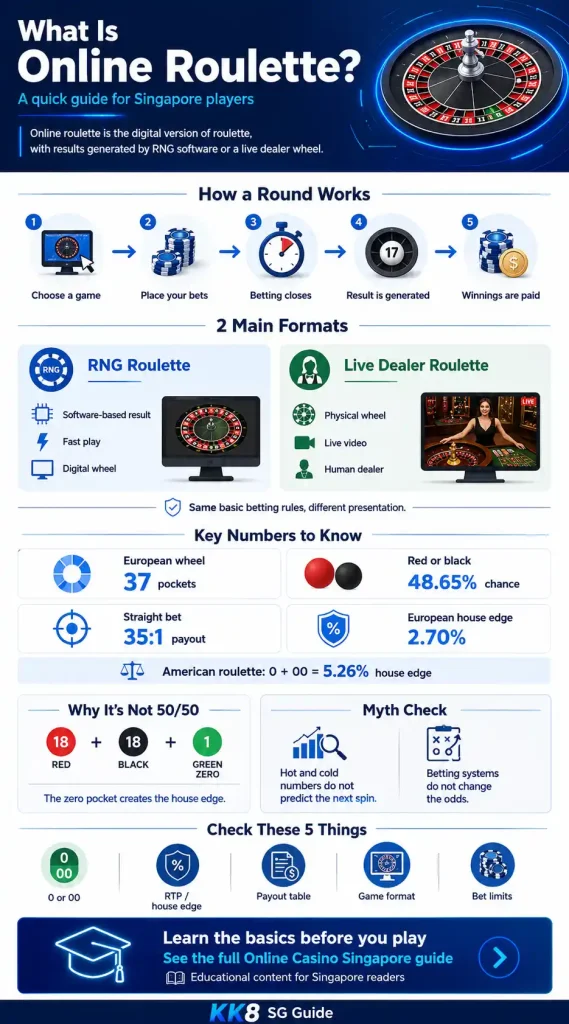
  • What Is Online Roulette? How the Game Works

    What Is Online Roulette? How the Game Works

    Online roulette is the online version of the traditional casino table game. You place bets on numbers, colours, groups of numbers, or other outcomes before the roulette wheel produces a winning number.

    The main difference is how the result is produced. RNG roulette uses software to generate outcomes, while live dealer roulette uses a physical wheel streamed through video. The basic betting rules stay similar.

    Understanding the type of roulette, the number of zero pockets, payouts, and house edge matters more than following betting systems or recent-result patterns.

    For a broader introduction to online casino games, see our Online Casino Singapore guide.

    How Does Online Roulette Work?

    A standard online roulette round follows a simple process:

    1. Choose a roulette game.
    2. Select a chip value.
    3. Place one or more bets on the betting table.
    4. Wait for betting to close.
    5. The game produces a winning number.
    6. Winning bets receive the listed payout.

    Suppose you place $5 on red in European roulette. There are 18 red numbers, 18 black numbers, and one green zero.

    If the result is red 23, your $5 bet wins at 1:1. You receive S$5 in winnings plus your original $5 stake, for a total return of $10.

    If the result is black or zero, the bet loses.

    The presence of zero explains why red versus black is not a true 50/50 wager.

    Online roulette explained, including how a round works, RNG vs live dealer roulette, key probabilities and house edge

    RNG Roulette vs Live Dealer Roulette

    Online roulette generally falls into two formats.

    Feature RNG Roulette Live Dealer Roulette
    Result source Software-based RNG Physical roulette wheel
    Dealer No Yes
    Presentation Digital graphics Live video
    Game speed Usually faster Usually slower
    Physical wheel No Yes
    Betting interface Digital Digital
    Previous-result display Common Common

    How RNG Roulette Works

    RNG stands for Random Number Generator. In RNG roulette, software determines the game outcome.

    The animated wheel gives the player a visual representation of the game. In an RNG game, the animation should not be confused with a physical roulette ball determining the result.

    This distinction is important because RNG roulette is software-based from start to finish.

    How Live Roulette Works

    Live roulette combines an online betting interface with a physical roulette table.

    Players watch the dealer and wheel through a live video stream while placing bets through their phone or computer.

    If you want to understand this format in more detail, read our guide to What Is a Live Dealer Casino?

    What Does an Online Roulette Table Show?

    An online roulette interface usually contains more information than a physical betting layout.

    Common elements include:

    Feature Purpose
    Betting grid Where you select numbers and bet types
    Chip selector Sets your stake
    Balance Shows available account funds
    Betting timer Shows how long remains before bets close
    Previous results Lists recent winning numbers
    Hot numbers Shows numbers appearing frequently in a recent sample
    Cold numbers Shows numbers appearing less frequently
    Repeat bet Repeats the previous wager
    Double bet Increases an existing wager
    Bet history Records previous bets and outcomes

    Previous-result statistics need careful interpretation.

    A number appearing several times recently does not become more or less likely solely because of its recent history. Likewise, a long run of red results does not mean black is due next.

    These panels describe past results. They do not change the mathematical structure of the next independent spin.

    What Bets Are Available in Online Roulette?

    Roulette bets fall into two main groups: inside bets and outside bets. Inside bets focus on specific numbers or small number combinations, while outside bets cover broader categories such as colours, odd or even, and number ranges.

    Inside Bets

    Inside bets cover individual numbers or small groups of numbers.

    Bet Numbers covered Standard payout
    Straight 1 35:1
    Split 2 17:1
    Street 3 11:1
    Corner 4 8:1
    Six line 6 5:1

    A straight bet offers the largest standard payout because it covers only one number.
     

    Outside Bets

    Outside bets cover larger groups of numbers.

    Bet Numbers covered Standard payout
    Red or black 18 1:1
    Odd or even 18 1:1
    1–18 or 19–36 18 1:1
    Dozen 12 2:1
    Column 12 2:1

    Outside bets win more frequently than single-number bets, but their payouts are smaller.

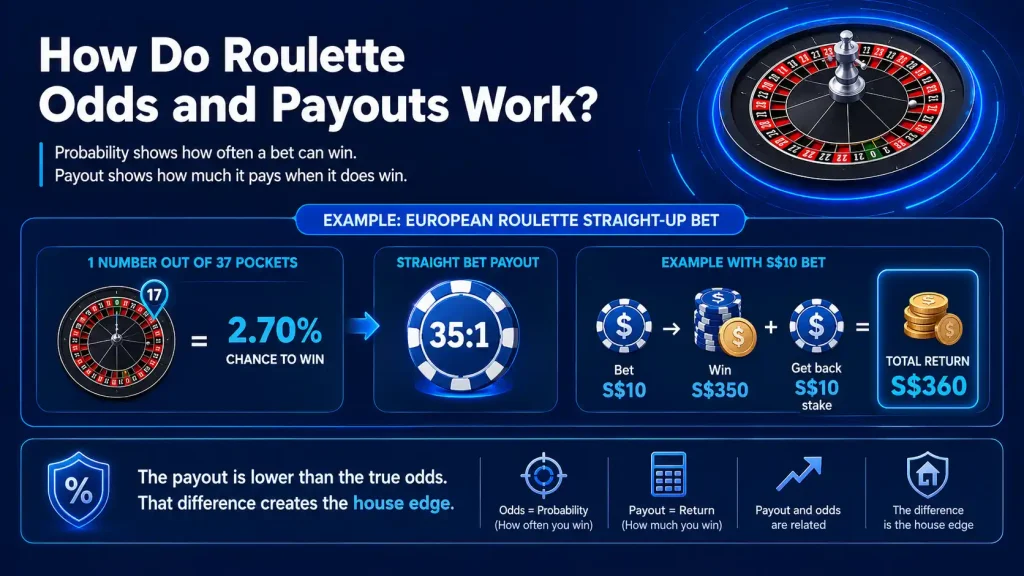
    How Do Roulette Odds and Payouts Work?

    How Roulette Odds and Payouts Work

    Probability and payout are related, but they are not the same thing. Take a European roulette straight-up bet. There are 37 possible pockets, and your selected number covers one of them.

    Probability of winning:

    1 ÷ 37 = about 2.70%

    The casino pays a winning straight-up bet at 35:1.

    For an $10 bet:

    • Winnings = $350
    • Original stake returned = $10
    • Total return = $360

    The payout is lower than the true mathematical odds required for a zero-house-edge game. This difference produces the casino’s advantage.

    Does Choosing a Safer Roulette Bet Reduce the House Edge?

    Not necessarily. Consider European roulette.

    A red bet covers 18 numbers and wins about 48.65% of the time.

    A straight-up number covers one number and wins about 2.70% of the time.

    Their winning frequencies differ, yet both normally face the same standard 2.70% house edge.

    What changes is the payout pattern.

    Bet Approx. win probability Payout Standard European house edge
    Red 48.65% 1:1 2.70%
    Dozen 32.43% 2:1 2.70%
    Straight 2.70% 35:1 2.70%

    A bet that wins more often is not automatically a better-value bet. It usually produces smaller, more frequent wins rather than rare large payouts.

    Why Is Red or Black Not 50/50?

    A European roulette wheel has:

    • 18 red numbers
    • 18 black numbers
    • 1 green zero

    Therefore:

    • Probability of red = 18 ÷ 37 = about 48.65%
    • Probability of black = 18 ÷ 37 = about 48.65%
    • Probability of zero = 1 ÷ 37 = about 2.70%

    Zero is what prevents either colour from reaching a 50% probability.

    American roulette adds 00, reducing the probability of red or black further:

    18 ÷ 38 = about 47.37%.

    Do Previous Roulette Results Matter?

    A roulette interface might show:

    Red, red, red, red, red.

    It is tempting to think black should appear next. That reasoning is known as the gambler’s fallacy.

    In a game where spins are independent, previous outcomes do not force the next result to compensate for a streak.

    A run of red does not make black “due.”

    The same principle applies to hot and cold numbers. These statistics describe what happened in a selected sample. They do not prove what will happen next.

    This distinction matters when reading the statistics panels found in many online roulette games.

    Do Roulette Betting Systems Work?

    Betting systems such as Martingale change how much you wager after wins or losses. They do not change the probabilities built into the roulette wheel.

    For example, Martingale usually involves increasing an even-money bet after a loss.

    The system changes:

    • Stake size
    • Bankroll exposure
    • Size of individual wins and losses
    • How quickly betting limits become relevant

    It does not change:

    • Number of roulette pockets
    • Probability of zero appearing
    • Probability of red or black
    • House edge

    No staking sequence changes a 37-pocket European wheel into a game without a house advantage.

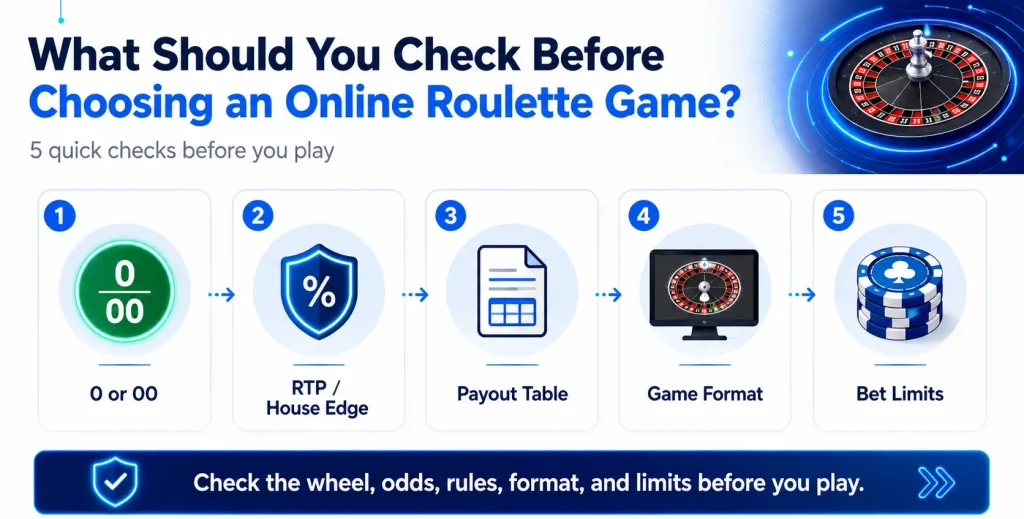
    What Should You Check Before Choosing an Online Roulette Game?

    Five things Singapore players should check before choosing an online roulette game

    Instead of choosing a roulette table based on appearance alone, check five things.

    1. Number of Zero Pockets

    Look for 0 or 0 plus 00.

    A single-zero European wheel has a lower standard house edge than a double-zero American wheel.

    2. RTP and House Edge

    Check the published game information.

    For standard European roulette:

    RTP: about 97.30%
    House edge: about 2.70%

    For standard American roulette:

    RTP: about 94.74%
    House edge: about 5.26%

    3. Payout Table

    Check whether standard payouts apply.

    A straight bet, for example, traditionally pays 35:1.

    4. Game Format

    Identify whether the game uses:

    • RNG software
    • A live dealer and physical wheel
    • Another electronic roulette format

    The format affects how the game is presented and how the outcome is produced.

    5. Bet Limits

    Check the minimum and maximum allowed stakes before placing a bet.

    Limits matter even more when someone follows a progressive staking system, since increasing stakes eventually runs into either bankroll or table limits.

    Is Online Roulette Legal in Singapore?

    Singapore regulates remote gambling under the Gambling Control Act framework.

    The Gambling Regulatory Authority states that providing unlicensed remote gambling services in or from Singapore, or from outside Singapore to people situated in Singapore, is unlawful. GRA also states that Singapore Pools is the only operator it licenses to provide remote gambling services.

    Accepting SGD, displaying Singapore-focused promotions, or allowing registration from Singapore should not be treated as proof that an offshore website holds a Singapore gambling licence. This follows from GRA’s licensing position.

    Singapore also regulates roulette played in licensed land-based casinos. GRA publishes approved game rules for roulette games operated at Marina Bay Sands, which shows the distinction between regulated casino roulette and remote gambling services.

    For more detail, read our Singapore Gambling Laws Explained guide.

    Example of an Online Roulette Round

    Suppose you start with $50. You choose European roulette and place $5 on red. Your balance after placing the bet temporarily shows $45.

    The result is red 23.

    Red pays 1:1.

    You receive:

    • $5 winnings
    • $5 original stake

    Total returned: $10

    Your balance becomes $55.

    Now consider the same bet where the result is zero. Zero is neither red nor black, so the $5 red bet loses. Your balance becomes $45.

    This simple example shows why even-money bets have a house edge despite appearing close to 50/50.

    Key Online Roulette Terms

    Term Meaning
    RNG Software used to produce random game outcomes
    RTP Theoretical percentage of wagers returned over extensive play
    House edge Mathematical advantage built into the game
    Inside bet Bet covering one or a small group of numbers
    Outside bet Bet covering a larger group of outcomes
    Straight Bet on one number
    Split Bet covering two adjacent numbers
    Zero Green pocket found on European and American wheels
    Double zero Additional green pocket on American roulette
    La Partage Rule returning half an even-money stake when zero wins
    Live roulette Online roulette using a physical wheel shown through video

    For other terminology, see our Online Casino Terms guide.

    Frequently Asked Questions

    What is online roulette?

    Online roulette is a digital version of roulette where players place wagers through an online interface. Results come from either RNG software or a physical roulette wheel streamed by a live dealer.

    How does online roulette work?

    You select a bet before betting closes. The game then determines a winning number. Bets matching the result receive the listed payout, while other bets lose.

    Is online roulette random?

    RNG roulette relies on software-generated outcomes, while live roulette uses a physical wheel and ball. The exact game rules and technical implementation depend on the game provider and format.

    What is the difference between RNG roulette and live roulette?

    RNG roulette produces outcomes through software and displays them through a digital interface. Live roulette streams a physical wheel and dealer while players place their bets online.

    Are red and black bets 50/50?

    No. European roulette has 18 red numbers, 18 black numbers, and one green zero. Red and black each therefore have a winning probability of about 48.65%.

    Do hot numbers predict the next roulette result?

    Hot-number displays describe recent results. In an independent roulette game, previous results do not make a particular number more likely solely because it appeared frequently in the past.

    Does Martingale improve roulette odds?

    No. Martingale changes stake sizes after losses. It does not change the number of pockets, probability of each result, or house edge.

    Is online roulette legal in Singapore?

    Singapore restricts unlicensed remote gambling. GRA states that providing unlicensed remote gambling services to people situated in Singapore is unlawful and that Singapore Pools is the only operator licensed by GRA to provide remote gambling services.

  • What Is Live Baccarat? How Live Dealer Baccarat Works

    What Is Live Baccarat? How Live Dealer Baccarat Works

    Live baccarat is baccarat played at a physical gaming table with a real dealer while the action is shown through a live video feed. Instead of receiving your own hand, you place a wager on one of two hands, called Player and Banker, or on the two hands finishing with the same score, called a Tie.

    The main objective is simple. The hand with a score closest to nine wins. You choose your wager and stake, while fixed baccarat rules determine how the cards are dealt and whether either hand receives a third card. You do not make hit-or-stand decisions as you would in blackjack. Standard baccarat rules use Player and Banker as names for the two hands, not descriptions of you and the casino dealer.

    Explore: Online Casino Singapore

    What Is Live Baccarat?

    Live baccarat combines a physical baccarat game with a digital betting interface. A dealer handles real cards at a studio or casino table, while players watch the round through a video stream and place wagers through an on-screen interface.

    A typical screen includes the live video, betting areas for Player, Banker and Tie, a countdown timer, chip values, previous results and, on many tables, baccarat roadmaps.

    The important distinction is the method of delivery. The dealer and cards are physical, while your wager is recorded through the digital interface. The underlying baccarat rules still determine the outcome.

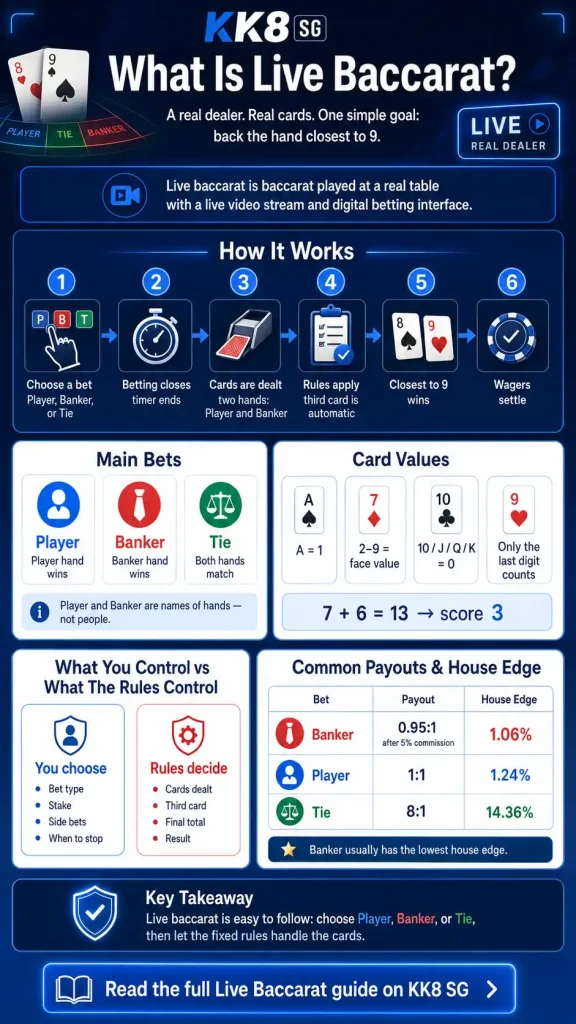
    A simple guide to how live baccarat works, including the main bets, card values, drawing rules, payouts and house edge

    How Does Live Baccarat Work?

    1. Choose Your Bet

    Before cards are dealt, you select where to place your wager. The three core options are:

    Bet What You Are Betting On
    Player The Player hand finishes closer to 9
    Banker The Banker hand finishes closer to 9
    Tie Both hands finish with the same total

    Some tables also offer side bets, such as Player Pair or Banker Pair. Side-bet rules and payouts vary by table.

    2. The Betting Window Closes

    Live baccarat tables use a betting period before each round. Once the timer ends, the interface stops accepting wagers for the current round. The dealer then starts dealing.

    3. Player and Banker Receive Two Cards

    Two cards are dealt to the Player hand and two to the Banker hand. Standard baccarat commonly uses multiple decks, with eight-deck analysis frequently used when comparing baccarat probabilities.

    You do not receive a personal hand. Player and Banker are simply the names given to the two hands on the table.

    4. Baccarat Drawing Rules Apply

    A third card is sometimes dealt, but you do not choose whether either hand takes another card.

    If either hand has a natural 8 or 9 from its first two cards, both hands stand. Otherwise, the Player hand draws on totals of 0 to 5 and stands on 6 or 7. The Banker rules depend on its own total and, in some situations, the Player’s third card.

    This sounds more complicated than the player’s role actually is. The dealer and game system apply the drawing rules for you.

    5. The Winning Hand Is Determined

    The hand finishing closest to nine wins.
    If Player and Banker finish with the same total, the round is a Tie. Standard Player and Banker wagers push when this happens, while a successful Tie wager receives its stated payout.

    6. The Wager Is Settled

    Once the result is confirmed, the interface settles the wagers and prepares for the next betting window.

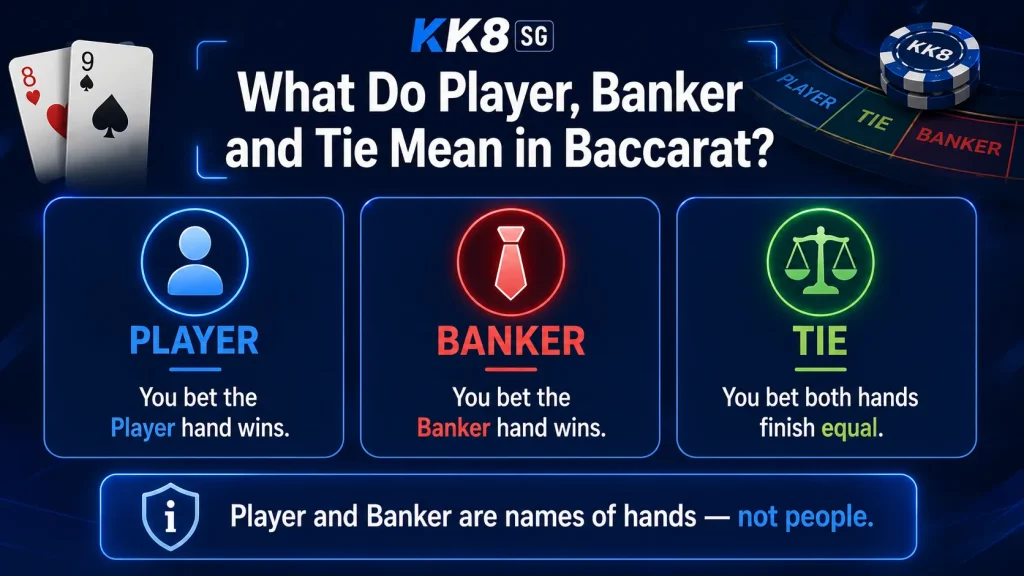
    What Do Player, Banker and Tie Mean in Baccarat?

    What Player, Banker and Tie mean in baccarat, showing the three main baccarat betting options and what each bet represents

    These terms cause more confusion than the rules themselves. Player does not mean you. Banker does not mean the dealer or casino.

    They are two separate hands used to determine the result of each baccarat round. Standard baccarat rules refer to Player and Banker as both hands and betting options.

    Think of the decision as predicting an outcome rather than playing a hand yourself. For example, suppose you place S$20 on Player.

    Player finishes with 8.
    Banker finishes with 6.

    Player wins, so your Player wager wins.

    You did not own the Player cards. You simply backed the Player hand to finish with the higher baccarat score.

    How Are Baccarat Cards Scored?

    Baccarat uses an unusual scoring system, but it takes little time to learn.

    Card Baccarat Value
    Ace 1
    2 to 9 Face value
    10 0
    Jack 0
    Queen 0
    King 0

    Standard baccarat gives Ace a value of one, cards 2 through 9 their printed value, and tens and face cards a value of zero. Only the final digit of the total matters.

    Example 1:

    7 + 6 = 13

    Baccarat score = 3

    Example 2:

    9 + 8 = 17

    Baccarat score = 7

    Example 3:

    King + 8 = 8

    Baccarat score = 8

    There is no score above nine.

    What Is a Natural in Baccarat?

    A natural occurs when the first two cards give Player or Banker a total of eight or nine. If either hand has a natural, the normal baccarat rules stop both hands from drawing another card.

    For example:

    Player: 4 + 4 = 8
    Banker: 3 + 2 = 5

    Player has a natural 8. No third card is dealt, and Player wins.

    Who Decides Whether a Third Card Is Drawn?

    The baccarat rules decide. This is an important difference between baccarat and games such as blackjack. You do not choose to hit, stand or request another card.

    The Player rule is straightforward. Outside a natural:

    Player Total Action
    0 to 5 Draw
    6 to 7 Stand
    8 to 9 Natural, both hands stand

    If Player stands on 6 or 7, Banker draws on 0 to 5 and stands on 6 or 7. If Player receives a third card, the Banker drawing rule also considers the value of that card.

    A beginner does not need to memorise the full Banker matrix to play a standard baccarat round. The dealer follows it automatically.

    A useful way to think about baccarat is to separate your decisions from the game’s decisions.

    You Control Baccarat Rules Control
    Where you wager Cards dealt
    Your stake Third-card decisions
    Whether you choose a side bet Hand totals
    Whether you continue playing Round result

    What Are the Payouts and House Edge in Live Baccarat?

    Payouts depend on the table rules, so check the paytable before treating any figures as universal.

    For a common eight-deck baccarat structure with a 5% Banker commission and an 8:1 Tie payout, the mathematical house edges are approximately 1.06% for Banker, 1.24% for Player and 14.36% for Tie.

    Bet Common Payout Structure Approx. House Edge
    Banker 0.95:1 after 5% commission 1.06%
    Player 1:1 1.24%
    Tie 8:1 14.36%

    These percentages describe long-run mathematical expectation, not what will happen during one round or one session.

    To make the difference easier to understand, consider S$100 of theoretical wagering.

    Bet House Edge Theoretical Average Loss per S$100 Wagered
    Banker 1.06% About S$1.06
    Player 1.24% About S$1.24
    Tie 14.36% About S$14.36

    This does not mean a S$100 Banker wager loses S$1.06 each time. Individual rounds result in wins, losses or pushes. House edge describes the mathematical average across a large number of wagers.

    For a deeper explanation of this concept, see our RTP and casino mathematics guide.

    Why Does the Banker Bet Charge Commission?

    The Banker hand has a small structural advantage because its drawing rules act after more information about the Player hand is available. Standard baccarat offsets this advantage by paying a winning Banker bet at 19:20, equivalent to even money minus a 5% commission.

    Here is a simple example.

    You wager S$100 on Player and Player wins.

    Profit: S$100.

    You wager S$100 on Banker under a standard 5% commission table and Banker wins.

    Profit before commission: S$100.
    Commission: S$5.
    Net profit: S$95.

    This commission structure helps explain why Banker still has a slightly lower house edge than Player despite its reduced winning payout.

    What Is No Commission Baccarat?

    No Commission Baccarat removes the standard 5% commission from winning Banker wagers, but the name does not mean every Banker result pays full even money.

    Instead, the paytable usually modifies one or more outcomes.

    One widely analysed version pays most Banker wins at 1:1 but reduces a Banker win with a total of six to 1:2. Under an eight-deck model, this version gives the Banker bet a house edge of about 1.46%.

    For a S$100 Banker wager:

    Normal Banker win:
    S$100 profit.

    Banker wins with 6:
    S$50 profit under this specific version.

    Compare this with a standard commission game:

    Feature Standard Baccarat Example No Commission Version
    Banker commission Usually 5% None
    Most Banker wins 0.95:1 1:1
    Banker win with 6 Standard Banker payout 0.5:1
    Banker house edge About 1.06% About 1.46%

    Different no-commission formats use different rules. Read the table paytable before comparing two games based only on their names.

    Singapore’s Gambling Regulatory Authority also lists Baccarat and No Commission Baccarat among approved Marina Bay Sands baccarat game rules.

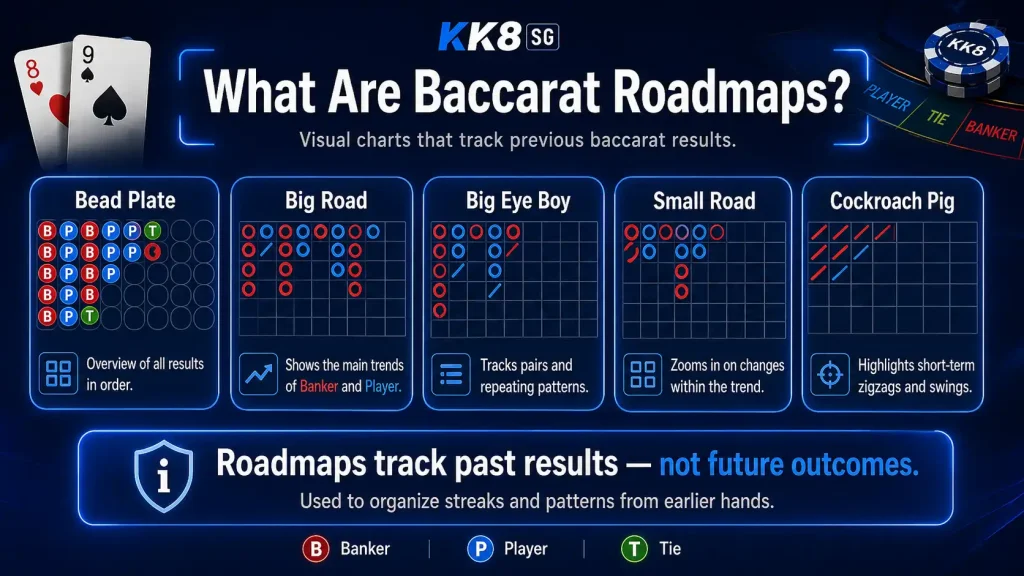
    What Are Baccarat Roadmaps?

    Live baccarat screens often display previous Player, Banker and Tie outcomes in visual charts known as roadmaps.

    Common names include:

    • Bead Plate
    • Big Road
    • Big Eye Boy
    • Small Road
    • Cockroach Pig

    These displays organise previous results into different visual patterns.

    Their main value is record keeping. A sequence of previous Banker or Player results does not alter the mathematics of the next standard baccarat round. Past results should not be treated as a guaranteed prediction system. Baccarat analysis shows the underlying house edge comes from the rules and payouts rather than whether a recent scoreboard appears to form a streak.

    A useful rule for beginners is simple:

    Use the roadmap to read what happened, not as proof of what happens next.

    Live Baccarat vs RNG Baccarat

    Live baccarat and RNG baccarat often use similar core game rules, but they present the game differently.

    Feature Live Baccarat RNG Baccarat
    Dealer Real dealer Automated software
    Cards Physical cards Digital game outcome
    Presentation Live video stream Digital graphics
    Betting window Timed around dealer action Usually faster
    Interaction Live-table environment Automated
    Roadmaps Common Depends on game
    Core objective Closest hand to 9 Closest hand to 9

    Choosing between them does not change what Player, Banker or Tie mean. The main difference is the way the game is delivered.

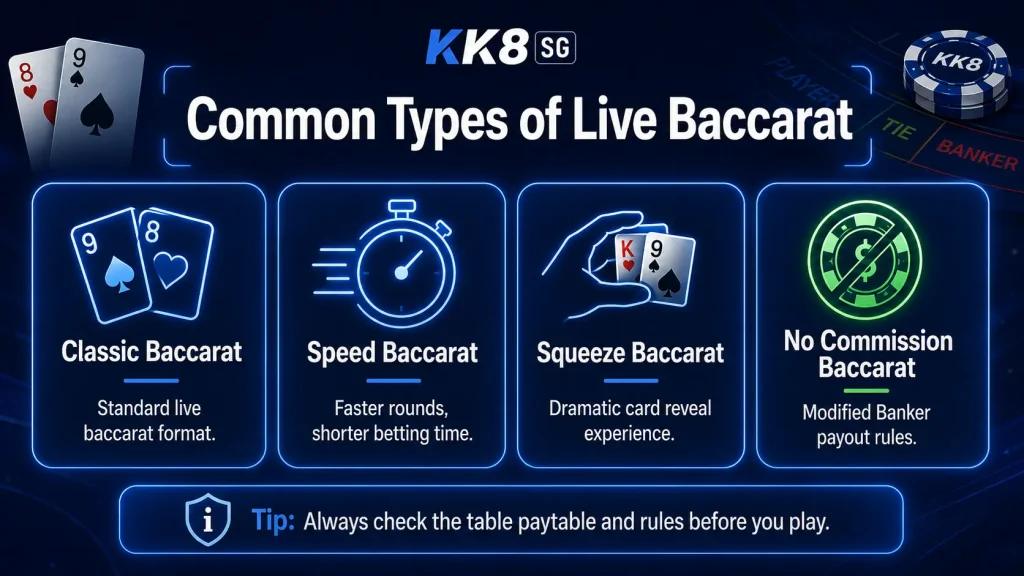
    Common Types of Live Baccarat

    Common types of live baccarat including Classic Baccarat, Speed Baccarat, Squeeze Baccarat and No Commission Baccarat

    Live baccarat tables come in several formats. These formats vary by speed, presentation, and rules.

    • Classic Baccarat: This follows the familiar Player, Banker and Tie structure with standard drawing rules.
    • Speed Baccarat: Speed versions shorten pauses between rounds and use shorter betting windows.
    • Squeeze Baccarat: Squeeze tables place more emphasis on the reveal of the cards. The core baccarat result still comes from the cards and drawing rules.
    • No Commission Baccarat: These tables replace the standard Banker commission with an alternative payout structure. The exact modified result differs by version.

    The table name alone does not tell you the full mathematics. The payout rules matter.

    A Simple Live Baccarat Round Example

    Consider this round:

    Player receives 4 and 3.

    Player total = 7.

    Banker receives 2 and 4.

    Banker total = 6.

    Player stands on 7. Banker also stands on 6. Player wins 7 to 6 under standard drawing rules.

    Suppose three different people each wagered S$20.

    Wager Result
    S$20 on Player Wins
    S$20 on Banker Loses
    S$20 on Tie Loses

    The Player bettor did not make any card decisions. Their only decision was to back Player before the betting window closed.

    This is why baccarat often feels simpler once you separate betting decisions from dealing rules.

    What Should You Check Before Joining a Live Baccarat Table?

    Do not assume every baccarat table uses identical payouts.

    Check:

    • Banker payout.
    • Banker commission.
    • Rules for Banker winning with six or another modified result.
    • Player payout.
    • Tie payout.
    • Side-bet payouts.
    • Minimum stake.
    • Maximum stake.
    • Table speed.
    • Game-specific rules.

    Two games using the word “Baccarat” might produce different expected returns if their payout structures differ. No Commission Baccarat is a clear example, since changing how specific Banker wins pay changes the house edge.

    If you are learning broader terminology at the same time, our Online Casino Terms guide explains common terms used across casino interfaces.

    Live Baccarat and Singapore Gambling Rules

    It is important to separate physical casino baccarat rules from online gambling access.

    Singapore’s Gambling Regulatory Authority publishes approved baccarat rules for regulated casino operations. Its Marina Bay Sands listings include Baccarat and No Commission Baccarat, along with several baccarat-related game formats.

    Remote gambling follows a different legal framework. The Ministry of Home Affairs stated on 9 June 2026 that gambling in Singapore is illegal unless authorised, licensed or exempted under the Gambling Control Act. It also states Singapore Pools is the only operator licensed to provide remote gambling services in Singapore, and other gambling operators, including online operators, are illegal.

    An overseas licence therefore should not be treated as equivalent to authorisation under Singapore law.

    For broader educational information about online casino games and related topics, see our Online Casino Singapore guide.

    Frequently Asked Questions

    What is live baccarat?

    Live baccarat is baccarat played with a real dealer and physical cards while the game is shown through a live video interface. Players place wagers digitally on Player, Banker, Tie or available side bets.

    What do Player and Banker mean in baccarat?

    Player and Banker are names for the two hands. Player does not represent your personal cards, and Banker does not mean the dealer’s personal hand. Standard baccarat rules treat them as the two competing hands and main betting options.

    Who decides whether a third card is drawn?

    Fixed baccarat drawing rules determine whether Player or Banker receives another card. The bettor does not make this decision.

    Why does Banker pay a commission?

    The Banker hand has a small mathematical advantage under standard drawing rules. A common baccarat structure charges 5% commission on winning Banker wagers, producing a 0.95:1 payout.

    What is the house edge in live baccarat?

    Under a common eight-deck game with standard payouts, the house edge is about 1.06% on Banker, 1.24% on Player and 14.36% on an 8:1 Tie wager. Different payout rules change these figures.

    What happens if Player and Banker tie?

    Standard Player and Banker wagers push when the two hands finish with the same score. A Tie wager wins according to the table’s stated payout.

    Do baccarat roadmaps predict the next result?

    No reliable mathematical basis shows a roadmap predicting the next independent baccarat outcome. Roadmaps record and organise previous results. They do not remove the game’s built-in house edge.

    What is the difference between live baccarat and RNG baccarat?

    Live baccarat presents a physical table, real cards and a live dealer through video. RNG baccarat generates and presents the game through software. Both formats still centre on comparing Player and Banker totals against nine.

  • What Is A Live Dealer Casino?

    What Is A Live Dealer Casino?

    A live dealer casino is an online casino format where you join a table through a real-time video stream while a human dealer runs the game. Instead of watching computer-generated cards or roulette animations, you see physical cards, roulette wheels, tables, and dealers on screen.

    You still place bets through your phone or computer. The difference is what happens after you place the bet. In a standard digital casino game, software usually determines and displays the result. In a live dealer game, the dealer performs the game action in front of cameras, and the system records the outcome. Live baccarat, blackjack, and roulette are among the most common live dealer games.

    If you are new to online casinos, understanding live dealer games also helps you see how they differ from slots, RNG table games, and other formats found on an online casino Singapore platform.

    Explore Guide: Online Casino Singapore

    What Does Live Dealer Casino Mean?

    The term has two main parts.

    “Live” means the game takes place in real time and is streamed to you through video.

    “Dealer” refers to the person running the table. Depending on the game, this person might deal cards, spin a roulette wheel, announce results, or manage each betting round.

    A live dealer casino therefore combines a physical casino table with an online betting interface. You do not sit at the table physically. Instead, you watch the dealer through a live stream and make your selections using buttons on your screen.

    For example, during a live baccarat game, you might see a dealer draw cards from a physical shoe. You select Player, Banker, or Tie through the betting interface before the betting period closes.

    How a live dealer casino works, including real dealers, live video streaming, betting steps, and popular games such as baccarat, blackjack, and roulette

    How Does a Live Dealer Casino Work?

    Most live dealer games follow a simple process.

    Stage What Happens
    1. Join the table You select a live game and enter an available table
    2. Place your bet You choose a betting option through the online interface
    3. Betting closes The game stops accepting bets for the current round
    4. Dealer runs the game The dealer deals cards, spins a wheel, or performs another game action
    5. Result is recorded The system displays the result and settles the round

    Step 1: Join a Live Casino Table

    You start by selecting a live game. Some platforms offer several tables for the same game. Tables might differ by betting limits, game speed, language, or rule variation.

    After entering the table, you usually see the dealer in the centre of the screen and the betting controls underneath or around the video.

    Step 2: Place Your Bet

    You make your selection through the digital betting interface. For example, a live roulette screen might show the roulette betting layout below the live video. You select numbers, colours, or other available betting options on the screen.

    You are not handing chips directly to the dealer. The software records your bet while the physical game continues at the studio.

    Step 3: The Betting Window Closes

    Live games usually include a countdown timer. The timer tells you how long you have to place or change your bet. Once it reaches zero, the system closes betting for the round. The dealer then continues with the game.

    Step 4: The Dealer Runs the Game

    The dealer performs the physical action required by the game. For baccarat, the dealer deals cards. For blackjack, the dealer deals cards to the relevant positions and follows the table rules. For roulette, the dealer spins the wheel and releases the ball.

    This physical process is one of the main differences between live dealer games and fully digital casino games.

    Step 5: The Result Appears on Your Screen

    Camera systems and gaming software track the result. Once the round finishes, the interface displays the outcome and updates the player’s balance according to the result. The next betting round then begins.

    Are Live Casino Dealers Real People?

    Yes. In a standard live casino game, a real person manages the table in real time. The dealer usually works in a dedicated studio designed for live casino streaming. Some live games also operate from physical casino floors.

    Studios often contain multiple tables, cameras, lighting systems, microphones, monitors, and gaming equipment. The dealer’s job goes beyond dealing cards. Depending on the game, the dealer might also:

    • Open and close betting rounds
    • Announce game results
    • Manage physical gaming equipment
    • Explain basic table actions
    • Communicate with players through the live interface

    Players sometimes confuse live casino games with computer-generated games designed to look realistic. The distinction is simple.

    A live casino game shows a real dealer performing the game action through a live video stream. A digital casino game generates and presents the game through software.

    Are Live Casino Games Pre-Recorded?

    Standard live casino games are designed to run in real time. The dealer performs each round while players watch and place bets through the interface.

    Pre-recorded video would defeat one of the main functions of a live dealer system, which is to connect online betting activity with a game taking place at the same time.

    A short streaming delay might still exist because video must travel from the studio to your device. This does not mean the game is pre-recorded.

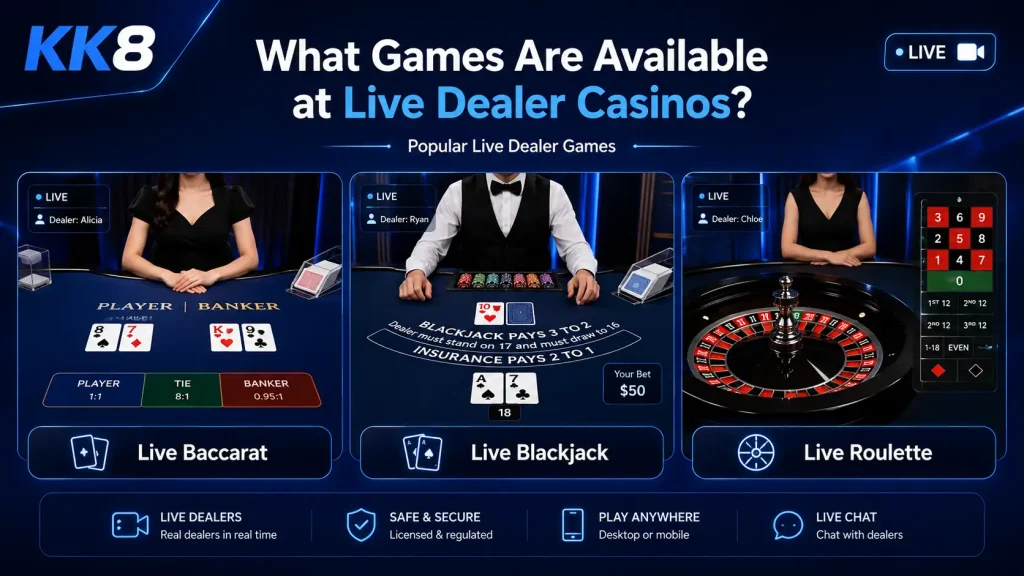
    What Games Are Available at Live Dealer Casinos?

    Live dealer casino games including baccarat, blackjack, and roulette

    Live dealer casinos focus mainly on games that work well with physical tables and repetitive rounds.

    Live Baccarat

    Baccarat is one of the most common live casino games. You generally choose between Player, Banker, and Tie before the dealer deals the cards. The dealer then completes the round according to fixed baccarat drawing rules.

    If you want to understand the game in more detail, read our guide to What Is Live Baccarat?.

    Live Blackjack

    Live blackjack uses a real dealer and physical cards. Players make decisions such as hit or stand through the online interface. The dealer then performs the corresponding actions at the table. The exact rules, available side bets, and betting limits depend on the table.

    Live Roulette

    Live roulette follows the same basic principle as physical roulette. You place your bets digitally while watching the dealer operate a physical roulette wheel. The ball lands in a numbered pocket, and the system records the result.

    For more background on the game itself, see our guide to What Is Online Roulette?.

    Other Live Casino Games

    Some live casino sections also include:

    • Sic Bo
    • Dragon Tiger
    • Poker-style table games
    • Game-show formats
    • Speed versions of traditional table games

    Availability differs between platforms and game providers.

    Do Live Dealer Casinos Use RNG?

    Traditional live dealer games differ from standard RNG casino games because the main game result usually comes from physical gaming equipment.

    RNG means random number generator. In a digital slot or virtual roulette game, software uses an RNG to generate game outcomes. In a traditional live roulette game, the outcome comes from the physical wheel and ball. In live baccarat or blackjack, physical cards determine the result.

    This does not mean software has no role in a live dealer casino. Software still handles areas such as:

    • Bet submission
    • Video streaming
    • Game information
    • Bet limits
    • Timers
    • Player balances
    • Result display
    • Game history

    Some hybrid live games also include digital components beyond the main physical table. The important distinction is where the core result comes from.

    If you want to understand RNG-based games in more detail, our guide to How Online Slot Games Work explains how digital game outcomes differ from live dealer formats.

    Live Casino Games vs Regular Online Casino Games

    Live dealer games and standard digital games both work online, but the user experience is different.

    Feature Live Dealer Game Digital Casino Game
    Dealer Real person Software
    Presentation Live video Digital graphics
    Main result source Physical cards or equipment RNG or game software
    Game speed Often slower Often faster
    Player interaction Higher Usually lower
    Internet usage Higher due to video Usually lower
    Common examples Baccarat, blackjack, roulette Slots, video poker, digital roulette
    Physical equipment Usually yes No

    Neither format is automatically better. The right format depends on what you want from the game. Someone who prefers faster rounds might prefer online casino games. Someone who wants to watch a real dealer and physical table might prefer live casino games.

    Live Dealer Casino vs Traditional Casino

    A live dealer game tries to reproduce parts of a physical table-game experience online, but the two formats are not identical.

    Feature Live Dealer Casino Traditional Casino
    Location Online Physical venue
    Dealer Real person Real person
    Cards and equipment Physical Physical
    Player interaction Through software Face to face
    Betting Digital interface Physical or electronic chips
    Travel required No Yes
    Video stream Yes No

    The main difference is location. With a live dealer casino, the dealer and player are in different places. Video streaming and betting software connect them.

    Are Live Dealer Casino Games Fair?

    You should separate two questions. The first is whether live dealer technology supports transparent game procedures. The second is whether a specific casino operator is trustworthy.

    Live casino games use visible physical equipment, which lets players watch much of the game process. In regulated environments, live dealer studios might also be subject to technical standards, testing requirements, record keeping, and auditing.

    This does not mean every website offering live dealer games is legitimate. Before using any online gambling platform, check factors such as:

    • Who operates the website
    • Which regulator oversees the operator
    • Whether licence information is verifiable
    • Whether the website uses secure connections
    • Whether payment terms are clearly stated
    • Whether game providers are identified
    • Whether withdrawal rules are transparent

    You can learn more in our guides to Online Casino Security Features Explained and How to Verify an Online Casino Website.

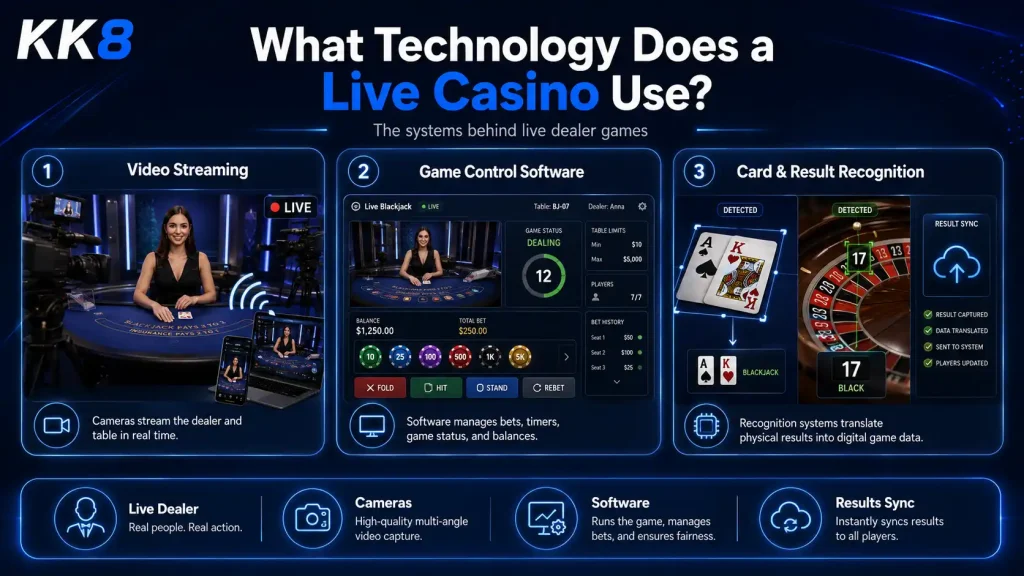
    What Technology Does a Live Casino Use?

    Live casino technology, including video streaming, game control software, and card and result recognition

    A live casino game looks simple from the player’s screen, but several systems work together behind the scenes.

    Video Streaming

    Cameras capture the dealer and gaming table. The video is then streamed through the internet to players using desktop computers, tablets, or smartphones.
    Multiple camera angles might be used to show the dealer, cards, roulette wheel, or other important areas of the game.

    Game Control Software

    The gaming interface connects player actions with the live table. It manages:

    • Bets
    • Timers
    • Game status
    • Results
    • Account balances
    • Table limits

    Card and Result Recognition

    Live gaming studios often use systems that help translate physical game actions into digital information. For example, card recognition technology might identify cards dealt during a baccarat round and display them on the player’s interface.

    Roulette systems similarly record the winning number after the ball stops. These systems allow the physical game and digital betting interface to stay synchronised.

    What Do You Need to Play a Live Casino Game?

    Live casino games generally require more internet bandwidth than standard online casino games because they stream video continuously.

    You usually need:

    • A stable internet connection
    • A supported web browser or app
    • A desktop computer, smartphone, or tablet
    • Video playback support
    • An account with the relevant platform where participation is permitted

    A weak connection might lead to buffering, delayed video, or interruptions. Your bet is usually processed by the platform’s gaming system rather than by the video itself. Even so, connection quality plays an important role in the overall experience.

    For more information about playing from a phone, see our Mobile Casino Gaming Guide.

    Advantages and Limitations of Live Dealer Games

    Live dealer gaming has both strengths and limitations.

    Advantages Limitations
    Real dealer Requires video streaming
    Physical gaming equipment Uses more internet data
    Visible game process Rounds might take longer
    More interaction Table limits vary
    Traditional table-game format Fewer games than a large slot library
    Real-time gameplay Performance depends on connection quality

    The slower pace is worth noting. A digital roulette or blackjack game might start another round almost immediately. A live dealer needs time to manage physical equipment, complete the game, clear the table, and prepare the next round.

    What Should Singapore Players Know?

    Live streaming technology does not change the legal status of an online gambling service.

    Singapore regulates remote gambling, and players should not assume a website is permitted simply because it offers professional-looking live dealer tables or holds a licence issued in another jurisdiction.

    When researching gambling services in Singapore, refer to information published by the Gambling Regulatory Authority of Singapore and Singapore legislation rather than relying only on claims made by an operator.

    This distinction is important when reading international casino content because rules that apply in another country do not automatically apply in Singapore.

    Key Takeaways

    A live casino streams table games run by real dealers. Players place bets through a digital interface while watching the game through live video.

    Traditional live baccarat, blackjack, and roulette use physical cards or gaming equipment to determine the main result.

    Live casino games differ from fully digital casino games, where software and RNG systems usually generate outcomes. The technology behind a live game includes video streaming, betting software, result tracking, and account systems.

    A professional-looking live stream is not proof that a casino operator is licensed, trustworthy, or legally available in your location.

    Frequently Asked Questions

    What is a live casino?

    A live casino is an online gaming format where a real dealer runs a physical table game while players watch through a live video stream. Players place bets through an online interface rather than sitting at the table.

    How does a live casino work?

    You join a table, place a bet through the online interface, and wait for betting to close. A real dealer then deals cards, spins a roulette wheel, or performs another game action. The system records the result and updates the game interface.

    Are live casino dealers real?

    Yes. Standard live casino games use real people who operate casino tables in real time. They usually work from dedicated live gaming studios or physical casino locations.

    Are live casino games pre-recorded?

    Standard live casino games run in real time. There might be a short streaming delay between the studio and your device, but the game itself is designed to take place while players are participating.

    Do live dealer casinos use RNG?

    Traditional live dealer games generally use physical cards, roulette wheels, or other equipment to produce the main game result. Software still manages bets, video, timers, balances, and other digital functions.

    What games are available in a live casino?

    Common live casino games include baccarat, blackjack, and roulette. Some platforms also offer Sic Bo, Dragon Tiger, poker-style games, and game-show formats.

    What is the difference between a live casino and an online casino?

    An online casino is a broad category containing digital games and live games. A live casino specifically refers to games streamed from tables operated by real dealers.

    Are live dealer casino games fair?

    Live dealer systems allow players to watch physical game actions in real time, but fairness also depends on the operator, provider, technical controls, and regulatory oversight. Always verify the platform rather than relying only on the live video presentation.

  • How Online Slot Games Work

    How Online Slot Games Work

    Online slot games look simple. You choose a stake, press Spin, and wait for the reels to stop. Behind this short sequence, the game uses software, probability rules, virtual reels, and a paytable to produce and evaluate the result.

    Understanding these mechanics helps you interpret features such as Return to Player, volatility, paylines, and bonus rounds. It also helps separate mathematical facts from common slot myths.

    This guide explains what happens during each spin, how payouts are calculated, and what you should check before playing.

    Explore more: Online Casino Singapore

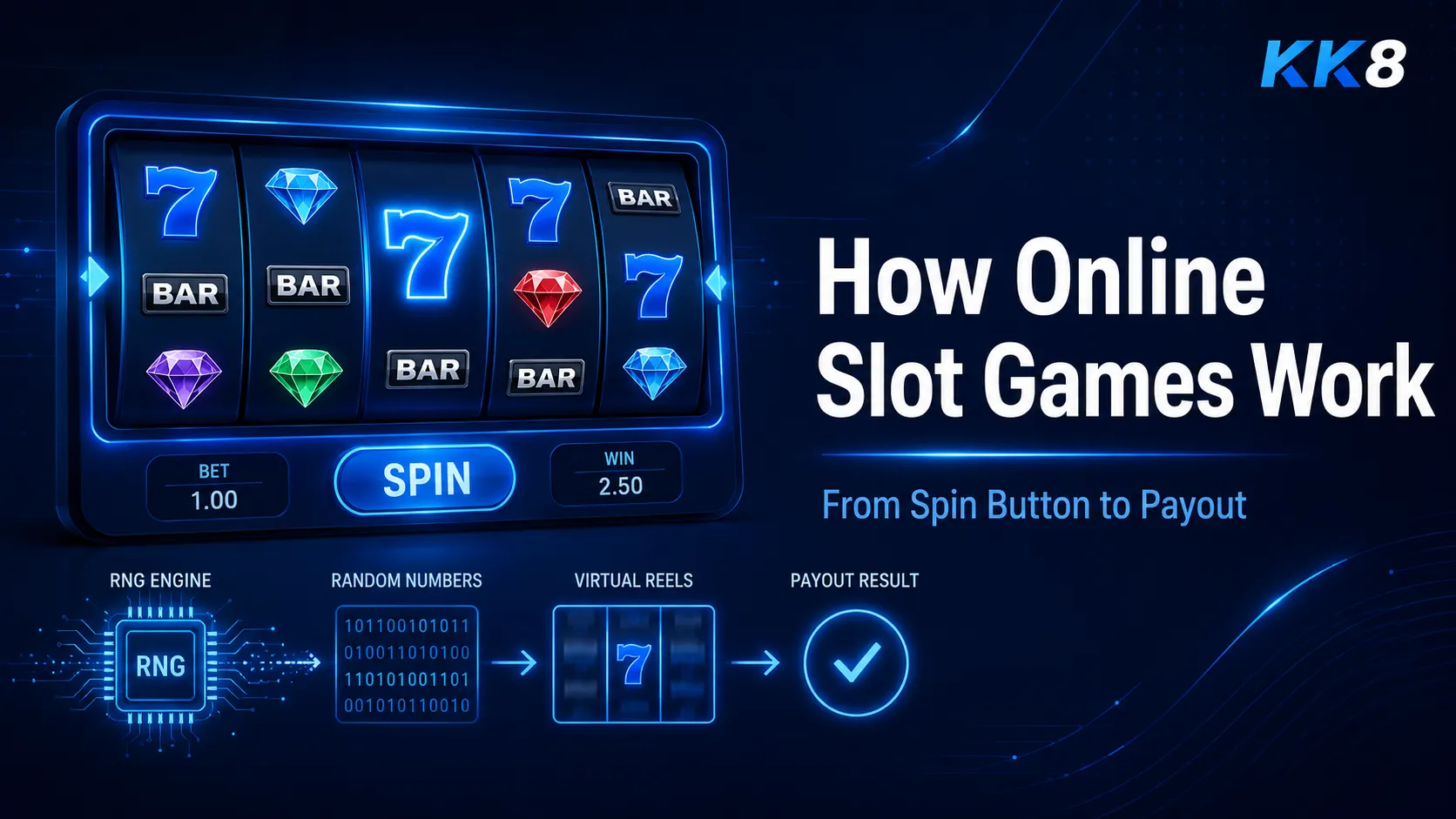
    How online slot games work, including RNG, virtual reels, payouts, RTP, volatility, hit frequency, and house edge

    The Main Parts of an Online Slot Game

    Before looking at the software behind a spin, it helps to understand the parts shown on the screen.

    Element What it does
    Reels Vertical columns containing symbols
    Rows Horizontal positions where symbols appear
    Symbols Images used to form combinations
    Paylines Patterns used to assess matching symbols
    Paytable Lists winning combinations and payout values
    Stake control Sets the amount wagered per spin
    Spin button Starts the game round
    Balance Shows the funds available
    Win display Shows the return from the latest spin
    Feature controls Provide access to settings, autoplay, rules, or bonus information

    A traditional online slot might use five reels and three rows. Newer games often use larger grids, cascading symbols, cluster systems, or changing reel layouts.

    Read more: Online Casino Terms Explained

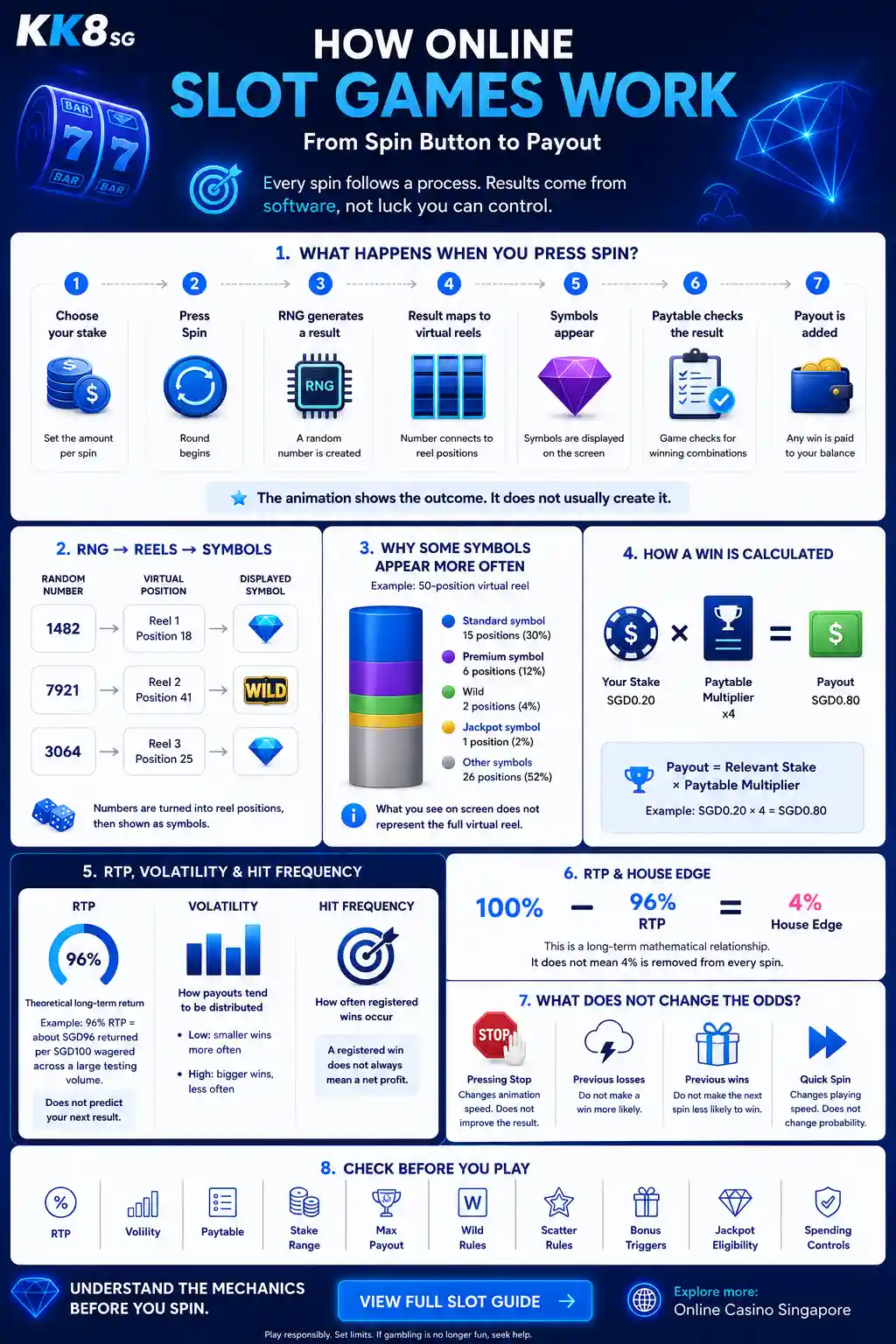
    What Happens When You Press Spin?

    A standard online slot follows a process similar to this:

    1. You select your stake.
    2. You press the Spin button.
    3. The RNG produces or selects a numerical result.
    4. The game maps the result to positions on its virtual reels.
    5. The corresponding symbols appear on the screen.
    6. The game checks the displayed result against its rules and paytable.
    7. Any qualifying payout is added to your balance.

    The reel animation does not usually create the result. It presents a result already determined by the game system.

    This distinction matters because pressing Stop or tapping the screen usually changes only the animation speed. It does not improve the result.

    What Is a Random Number Generator?

    A Random Number Generator is software used to produce unpredictable values. Online slots use these values to determine reel positions or game events.
    The RNG operates continuously or generates values when a round begins, depending on the game design. The selected numbers connect to positions within the game’s mathematical model.
    A simplified example might work like this:

    Generated value Virtual reel position Displayed symbol
    1482 Reel 1, position 18 Blue gem
    7921 Reel 2, position 41 Wild
    3064 Reel 3, position 25 Blue gem

    Real slot systems are more complex. The example shows the basic relationship between numerical results and displayed symbols.

    Is Every Spin Independent?

    In a standard RNG slot, each spin is a separate event. Suppose a slot fails to produce a major payout across 100 spins. This does not mean the 101st spin is more likely to produce one. The game does not need to compensate for the previous results within your session.

    The same principle applies after a large win. A recent payout does not automatically reduce or increase the probability of the next individual result.

    This is similar to repeatedly tossing a fair coin. Five heads in a row do not make tails guaranteed on the sixth toss. The next toss still follows its own probability.

    Some games include persistent features, collected symbols, or linked bonus progress. In those cases, the feature state might carry between spins. The underlying random event still follows the rules published for the game.

    How Virtual Reels Work

    The symbols visible on your screen do not always represent the full reel structure. A physical slot uses mechanical reels with a limited number of stopping positions. An online slot uses virtual reels, which support far more positions and different symbol weightings.
    Consider a simplified virtual reel with 50 positions:

    Symbol Number of positions Approximate chance of appearing
    Standard symbol 15 30%
    Premium symbol 6 12%
    Wild symbol 2 4%
    Jackpot symbol 1 2%
    Other symbols 26 52%

    A symbol shown once in the visible artwork might occupy several positions on the virtual reel. Another symbol might appear less often in the virtual structure.
    This weighting lets game designers control how frequently different combinations occur.
    The exact reel strips and symbol weightings are rarely visible from the main game screen. The paytable and help section should still explain the winning combinations, features, and relevant payout rules.
     

    How Paylines Work

    A payline is a pattern used to evaluate matching symbols. Older slots often use one horizontal line across the centre. Modern games might use 10, 20, 50, or more fixed paylines.

    A five-reel game might pay when matching symbols appear:

    • From left to right
    • On adjacent reels
    • Along an active payline
    • Starting from the first reel

    Not every game follows these rules. Some pay from either direction, while scatter symbols often pay regardless of their exact reel positions.

    More paylines do not automatically produce a higher mathematical return. The stake, symbol probabilities, paytable, and overall game model all affect the result.

    Example of a Payline Win

    Assume a game has a straight payline across the middle row. The middle row shows:

    Cherry | Cherry | Cherry | Star | Bell

    The paytable awards 4 times the relevant line stake for three cherries.

    If the line stake is SGD0.20:

    SGD0.20 × 4 = SGD0.80 payout

    The total amount wagered might be higher when the game covers several paylines. Check whether the displayed multiplier applies to the line stake, total stake, or another value defined in the rules.

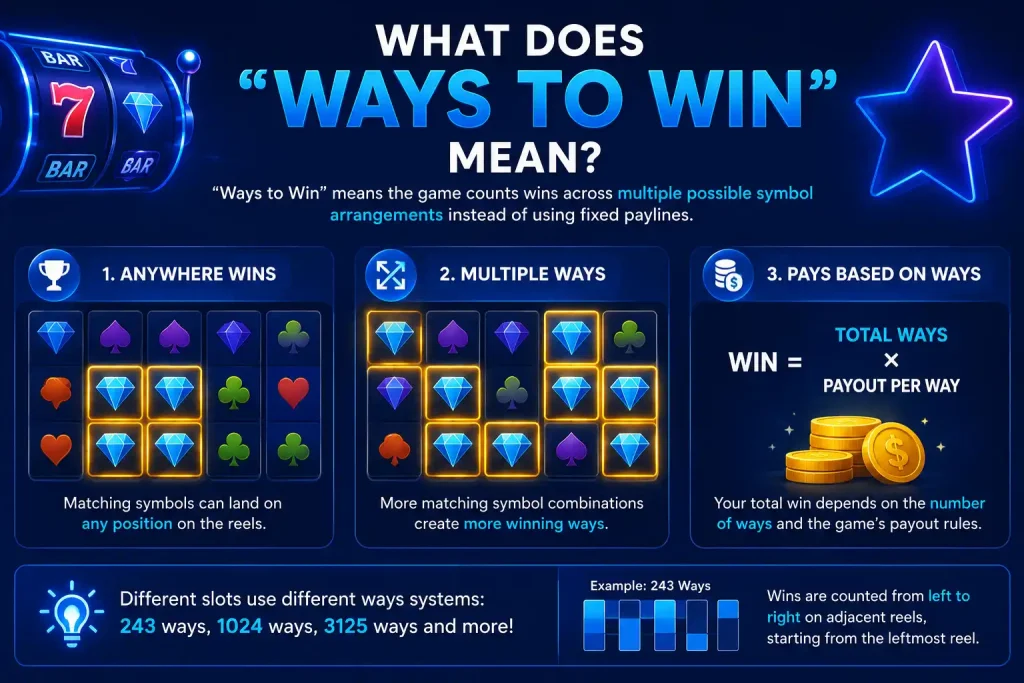
    What Does “Ways to Win” Mean?

    How Ways to Win works in online slot games using matching symbols across adjacent reels

    Ways-to-win slots do not rely on traditional line patterns. A common format pays for matching symbols appearing on adjacent reels, beginning from the leftmost reel. Their exact row positions do not need to match.

    For example, a three-symbol combination might qualify when the same symbol appears:

    • On reel one, row one
    • On reel two, row three
    • On reel three, row two

    The symbols sit on different rows, but they appear on consecutive reels.

    A game with three rows and five reels might advertise 243 ways to win. Larger or changing reel grids might advertise thousands of possible ways. The number of ways describes possible symbol arrangements. It does not describe the chance of making a profit.

    Explore: Popular Online Slot Games Singapore

    Other Common Payout Systems

    Online slots use several systems beyond traditional paylines.

    System How wins are assessed
    Fixed paylines Symbols must follow defined line patterns
    Ways to win Matching symbols appear on adjacent reels
    Cluster pays Groups of matching symbols touch each other
    Cascading reels Winning symbols disappear and new ones fall into place
    All pays Matching symbols qualify across broad position rules
    Megaways-style reels Symbol counts and possible combinations change each spin

    Cascading games might produce several evaluations from one paid spin. After a winning group disappears, replacement symbols enter the grid. The process continues until no new qualifying combination appears.
    Read the game rules before assuming every cascade increases a multiplier or produces another payout. Feature behaviour differs between games.

    How Slot Payouts Are Calculated

    The paytable defines how much each qualifying combination returns.

    A basic calculation looks like this:

    Payout = Relevant stake × Paytable multiplier

    Suppose you place a total stake of SGD1 and receive a combination valued at 5 times the total stake.

    SGD1 × 5 = SGD5

    The game returns SGD5, including any amount defined as part of the payout under its rules.

    Some games calculate winnings using the stake assigned to each payline. Others use the total stake or a fixed coin value. Jackpot and bonus prizes might follow separate calculations.

    Always check these details:

    Paytable detail Why it matters
    Payment direction Shows where combinations must begin
    Minimum matching symbols Shows how many symbols form a win
    Multiplier basis Identifies whether the multiplier uses line or total stake
    Maximum payout Shows the game’s stated payout limit
    Wild rules Explains which symbols the wild replaces
    Scatter rules Explains position-independent payouts
    Bonus conditions Shows how special features start

    What Is RTP?

    Return to Player, or RTP, is the theoretical percentage of total stakes a game is designed to return over a large number of rounds.

    Suppose a slot has a theoretical RTP of 96%. Its mathematical model is designed to return about SGD96 for every SGD100 wagered across a large testing sample.

    It does not mean:

    • You will receive SGD96 after staking SGD100
    • Every group of 100 spins returns the same percentage
    • A loss must soon be followed by a win
    • You receive 96% of each individual stake

    Your short-term result might sit far above or below the published percentage.

    RTP Example

    Consider three players using a 96% RTP game:

    Player Total wagered Total returned Session return
    Player A SGD100 SGD35 35%
    Player B SGD100 SGD112 112%
    Player C SGD100 SGD87 87%

    None of these short sessions needs to match 96%. The theoretical percentage applies to the game model across a far larger volume of play, not to each person or session.

    Learn more: Understanding RTP in Online Casino Games

    RTP and House Edge

    House edge represents the theoretical share of stakes not returned to players over the long term.

    The basic relationship is:

    House edge = 100% − RTP

    For a game with 96% RTP:

    100% − 96% = 4% theoretical house edge

    This does not mean the operator takes 4% from each spin. It describes a long-term mathematical expectation across many rounds.

    Some game providers offer more than one approved RTP version of the same title. Two platforms might therefore display the same game name but use different settings. Check the information screen for the specific version available.

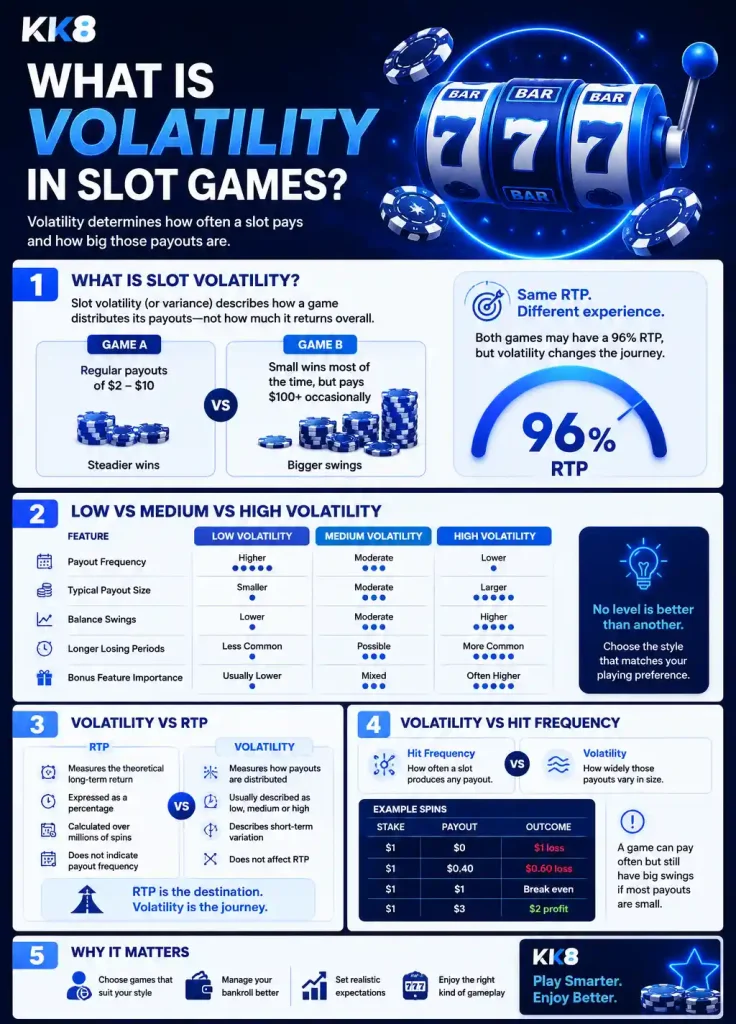
    What Is Slot Volatility?

    Volatility describes how a game’s payouts tend to be distributed. It focuses on the pattern of returns, not only the long-term percentage.

    Volatility level Typical payout pattern
    Low Smaller payouts tend to occur more often
    Medium Mix of smaller and larger payouts
    High Payouts tend to be less frequent and more uneven

    Two games might both have 96% RTP while producing different playing experiences.

    A low-volatility game might distribute more of its theoretical return through frequent small results. A high-volatility game might concentrate more of its return in less frequent bonus rounds or large combinations.

    Neither format removes the house edge.

    Learn more: What Is Volatility in Slot Games?

    RTP, Volatility and Hit Frequency

    These terms describe different parts of the game.

    Metric What it measures What it does not tell you
    RTP Theoretical long-term return Your next result
    Volatility Distribution and variation of payouts Exact win timing
    Hit frequency How often registered wins occur Whether those wins exceed the stake
    House edge Theoretical operator advantage Your guaranteed session loss

    A game might have a high hit frequency while still producing a negative session result. For example, you stake SGD1 and receive SGD0.30. The game might count this as a registered win because it returned something, even though your balance fell by SGD0.70.

    This is why win animations alone do not show whether a spin produced a net gain.

    How Wild Symbols Work

    A wild usually replaces selected standard symbols to help complete combinations. Suppose the payline displays:

    Seven | Seven | Wild

    When the wild substitutes for the third seven, the game might treat the result as three matching symbols.

    Wild rules differ. A wild might:

    • Replace most standard symbols
    • Exclude scatters or bonus symbols
    • Carry a multiplier
    • Expand across a reel
    • Move between reels
    • Remain in place during free spins

    Check the paytable instead of assuming all wilds behave the same way.

    How Scatter Symbols Work

    Scatter symbols often trigger payouts or bonus features without following a standard payline. For example, three scatter symbols anywhere on a five-reel grid might award 10 free spins.

    A game might also pay a scatter prize based on the total stake:

    Scatter count Example award
    3 2× total stake
    4 10× total stake
    5 50× total stake

    These figures are illustrative. Each title uses its own rules.

    How Free Spins and Bonus Rounds Work

    Free spins are additional rounds awarded after a qualifying trigger.

    Common triggers include:

    • Landing a set number of scatter symbols
    • Filling a collection meter
    • Completing a random feature
    • Reaching a specific symbol combination

    The bonus might include modified reels, extra wilds, multipliers, or new symbols. The game’s mathematical model includes the expected value of these features.

    A bonus round does not remove randomness. Its outcomes still follow the rules and probabilities built into the game.

    Are Bonus Choices Skill-Based?

    Some bonus rounds ask you to choose a box, card, or object. The result might be determined in one of two ways:

    1. Your chosen object corresponds to a randomly assigned prize.
    2. The system determines the award before the selection, and your choice reveals it.

    Unless the rules state otherwise, visual choice elements should not be treated as a skill contest.

    How Progressive Jackpots Work

    A progressive jackpot increases as eligible wagers enter the connected system.

    The jackpot might link:

    • One slot machine
    • Several games on one platform
    • The same game across several platforms
    • A wider provider network

    A small portion of qualifying stakes often contributes to the prize pool. The jackpot continues growing until an eligible result triggers it.

    Progressive games tend to produce wider short-term variation because a significant part of the expected return might depend on a rare jackpot event.

    Check whether the published RTP includes the jackpot contribution. Also review the stake requirements, eligibility rules, maximum prize terms, and whether the displayed amount uses your selected currency.

    Are Online Slot Games Fair?

    Online slot fairness depends on tested RNG systems, transparent game rules, published paytables, and independent verification

    Fairness depends on the game, operator, software provider, regulatory framework, and testing process.

    A properly regulated game should follow its approved mathematical model. Its random outcomes should remain unpredictable, and its displayed rules should match the implemented payout system.

    UK Gambling Commission technical standards require licensed remote gambling software to meet testing and random-outcome requirements. These standards cover RNG behaviour, result determination, published rules, and technical controls.

    A licence logo on a website is not enough by itself. Licence claims should be checked against the regulator’s own records.

    Fairness Checklist

    Before trusting a platform or game, check:

    Check What to look for
    Operator identity Clear legal business name and contact details
    Regulatory status Verifiable record on the regulator’s website
    Game provider Recognised software company with clear ownership
    Paytable Accessible payout rules inside the game
    RTP information Percentage shown in the rules or help section
    Testing details Named testing laboratory or certification information
    Transaction history Clear records of stakes, returns, and withdrawals
    Complaint process Written steps for raising disputes
    Security HTTPS, account controls, and payment protection
    Responsible-play tools Deposit, spending, time, or exclusion controls

    Do Autoplay and Quick Spin Change the Odds?

    Autoplay repeats spins based on selected settings. Quick Spin shortens the reel animation. These controls normally affect pace rather than probability. The same game model evaluates each round.

    Faster play still increases the number of wagers placed within a given period. For example:

    Playing speed Spins per minute Spins in 30 minutes Total staked at SGD1 per spin
    Standard pace 6 180 SGD180
    Faster pace 12 360 SGD360
    Rapid pace 20 600 SGD600

    The example assumes continuous play with no pauses or returns reused. It shows how speed affects total exposure, even when the stake per round stays unchanged.

    What to Check Before Playing a Slot

    A game with attractive graphics might still have rules or volatility unsuitable for your intended budget. Open the game’s information or help section before placing a stake. 

    Review:

    • Published RTP
    • Volatility rating
    • Paytable
    • Payment direction
    • Stake range
    • Maximum payout
    • Wild and scatter rules
    • Bonus triggers
    • Jackpot eligibility
    • Feature purchase terms
    • Session and spending controls

    Key Takeaways

    Online slots rely on an RNG, virtual reel positions, and a paytable. The RNG determines each independent result. The game maps the result to symbols and evaluates the displayed combination according to its rules.

    RTP describes theoretical return across a large volume of play. Volatility describes how payouts tend to be distributed. Hit frequency describes how often registered wins occur.

    None of these figures predicts your next spin. No timing method or betting pattern changes the underlying mathematics of a standard RNG slot.

    Before using a game, read its paytable, review its RTP and volatility, verify the operator, and check the laws applying to your location.

    Continue Exploring: Online Casino Singapore

    Frequently Asked Questions

    How do online slot games work?

    Online slots use a Random Number Generator to produce or select each result. The game maps the numerical outcome to virtual reel positions, displays the corresponding symbols, and checks the result against its paytable.

    Are online slot results decided before the reels stop?

    In standard online slots, the result is usually determined when the spin begins. The reel movement displays the selected outcome.

    Does an online slot remember previous spins?

    A standard RNG slot treats each spin as an independent event. Previous wins or losses do not make a future result due.

    What does 96% RTP mean?

    A 96% RTP means the game is mathematically designed to return about 96% of total stakes across a large volume of play. It does not promise a 96% return for one player or session.

    What is the difference between RTP and volatility?

    RTP describes the game’s theoretical long-term return. Volatility describes how frequently and unevenly payouts tend to occur.

    Do more paylines increase RTP?

    Not necessarily. The number of paylines, stake structure, symbol probabilities, and paytable all form part of the game’s mathematical model.

    Does stopping the reels affect the result?

    The Stop control usually changes how quickly the animation finishes. It does not alter a result already selected by the system.

    Are free spins free of risk?

    Free spins do not require a separate stake at the moment they are played, but they usually come from a paid trigger, promotional condition, or bonus feature. Their outcomes still follow the game’s rules.

    How do I check whether an online slot is fair?

    Review the operator’s regulatory status, the game provider, the paytable, published RTP, testing information, account records, and dispute process. Confirm licence claims through the regulator’s official website.

    Are online slots legal in Singapore?

    Singapore prohibits gambling unless it is licensed or exempted. GRA identifies Singapore Pools as the only operator licensed by it to provide remote gambling services. Check current GRA guidance before participating.

  • What Is Volatility In Slot Games?

    What Is Volatility In Slot Games?

    When comparing slot games, RTP isn’t the only statistic worth checking. Another important factor is volatility, which affects how often a game pays and how large those payouts tend to be.

    Understanding slot volatility helps you compare games more accurately, set realistic expectations and choose titles that suit your preferred playing style. This guide explains how volatility works, how it differs from RTP, and why both matter when evaluating online slot games.

    If you’re new to online gaming, our Online Casino Singapore guide provides a comprehensive overview of casino games, bonuses, payment methods and responsible gaming.

    What Is Slot Volatility?

    Slot volatility, sometimes referred to as slot variance, describes how a slot game distributes its payouts. Rather than measuring how much a game returns overall, volatility focuses on when payouts occur and how large they are likely to be.

    Imagine two fictional slot games with an RTP of 96%.

    Game A regularly awards payouts between $2 and $10.

    Game B pays very little during most spins but occasionally awards $100 or more.

    Although both games have the same theoretical RTP, the playing experience feels completely different. Game A offers steadier results, while Game B creates larger swings in your balance. This is why volatility is one of the most useful statistics to understand alongside RTP.

    Why Volatility Matters

    Understanding volatility helps you compare games more accurately instead of relying only on headline RTP figures. Volatility shapes your experience every time you play. It influences:

    • How often winning combinations appear.
    • The typical size of payouts.
    • How quickly your balance changes.
    • How common longer losing sequences are.
    • Whether a large portion of a game’s payout potential sits inside bonus features.

    Many new players mistakenly assume that a higher-volatility game offers better odds of winning. In reality, volatility doesn’t change a game’s theoretical return. It simply changes how that return is distributed.

    Low vs Medium vs High Volatility

    Most slot games are broadly classified into three categories.

    Feature Low Volatility Medium Volatility High Volatility
    Payout frequency Higher Moderate Lower
    Typical payout size Smaller Moderate Larger
    Balance swings Lower Moderate Higher
    Longer losing periods Less common Possible More common
    Bonus feature importance Usually lower Mixed Often higher

    No volatility level is objectively better than another. Each creates a different style of gameplay. Some players enjoy regular smaller wins, while others prefer games that reserve much of their payout potential for less frequent but larger prizes.

    Slot Volatility vs RTP

    Volatility and RTP are often confused because both describe aspects of a slot game’s mathematics. In reality, they measure completely different things.

    RTP Volatility
    Measures the theoretical long-term return Measures how payouts are distributed
    Expressed as a percentage Usually described as low, medium or high
    Calculated over millions of spins Describes short-term variation
    Does not indicate payout frequency Does not affect RTP

    Think of RTP as the destination and volatility as the journey. Two games might both have an RTP of 96%, but one could provide regular small payouts while the other produces longer dry spells followed by occasional larger wins. Neither game is mathematically better simply because it has a different volatility level.

    Read More: Understanding RTP in Online Casino Games

    Volatility vs Hit Frequency

    Another concept that is frequently confused with volatility is hit frequency.

    Hit frequency measures how often a slot produces any payout. Volatility measures how widely those payouts vary in size. These are related, but they are not the same thing.

    A game could award payouts on 30% of spins while still feeling highly volatile if many of those payouts are smaller than the original stake and most of the game’s RTP is concentrated in rare bonus features.

    For example:

    Stake Payout Outcome
    $1 $0 $1 loss
    $1 $0.40 $0.60 loss
    $1 $1 Break even
    $1 $3 $2 profit

    Although three of these examples technically produce a payout, only one generates a net profit. This explains why a game with a relatively high hit frequency can still produce noticeable balance swings.

    How Slot Volatility Works

    Every slot game is built around a mathematical model that determines how prizes are distributed across thousands, or even millions, of possible outcomes.

    This model controls factors such as:

    • Symbol combinations.
    • Bonus feature frequency.
    • Prize sizes.
    • Jackpot probability.
    • Overall RTP.

    Lower-volatility games usually spread their theoretical return across more frequent, smaller payouts. Higher-volatility games often concentrate a greater share of their RTP in larger prizes that occur less frequently.

    Many modern slots also allocate a significant portion of their payout potential to free spins, multiplier features or bonus rounds. As a result, players may experience long stretches of smaller payouts before triggering a feature that accounts for much of the game’s overall return.

    To better understand the mathematics behind slot games, read our guide on How Online Slot Games Work.

    Why Two Slots With the Same RTP Feel Different

    Consider these fictional examples. Both games have a theoretical RTP of 96%.

    Game A

    • Frequent $2 to $8 payouts
    • Bonus rounds trigger regularly
    • Few very large wins

    Game B

    • Longer periods without meaningful payouts
    • Larger bonus prizes
    • Rare high-value wins

    Over thousands of spins, both games might return the same theoretical percentage. Over 100 spins, the results could look completely different. This illustrates why RTP and volatility should always be considered together.

    How Slot Providers Measure Volatility

    There is no universal industry standard for measuring slot volatility.

    Different software providers use their own internal mathematical models and rating systems. Some simply classify games as low, medium or high volatility, while others use star ratings or numerical scales.

    Because these systems aren’t standardised, a four-star volatility rating from one provider isn’t necessarily equivalent to a four-star rating from another.

    When researching a slot game, it’s helpful to consider several pieces of information together instead of relying on a single rating.

    These include:

    • RTP
    • Volatility rating
    • Maximum advertised win
    • Bonus feature design
    • Independent game reviews

    Using multiple sources gives you a more complete picture of how a slot is designed to behave.

    How to Identify a Slot’s Volatility

    Although volatility isn’t always displayed in the game lobby, there are several ways to estimate a slot’s characteristics before playing.

    Checklist:

    • Review the game’s information screen.
    • Check the provider’s website.
    • Look for the published RTP.
    • See whether the volatility rating is available.
    • Read the paytable.
    • Review how bonus features work.
    • Compare independent reviews.
    • Try demo mode if available.

    Avoid estimating volatility after only a few spins. Short sessions rarely reflect a game’s long-term design.

    If you’d like to compare games with different mechanics and volatility levels, explore our guide to Popular Online Slot Games Singapore.

    What Volatility Cannot Tell You

    What slot volatility cannot tell you, including winning chances, bonus timing, payout amounts and short-term slot game results

    Volatility helps explain how payouts are distributed. It does not tell you:

    • Whether your next spin will win
    • When a bonus feature will trigger
    • How long a losing sequence will last
    • Whether a jackpot will be awarded
    • Whether one session will end in profit
    • Whether a game is fair or licensed

    Understanding these limitations helps set realistic expectations and avoids common misconceptions.

    Choosing the Right Volatility

    There isn’t a universal “best” option. Different players prefer different experiences.

    Preference Often Associated With
    Frequent smaller payouts Lower volatility
    Balance between frequency and prize size Medium volatility
    Larger but less frequent prizes Higher volatility

    Understanding your own expectations is more useful than chasing a specific volatility label.

    Key Takeaways

    Slot volatility is one of the most important concepts for understanding how slot games behave. While RTP explains a game’s theoretical long-term return, volatility describes how those returns are distributed across individual spins.

    Remember these key points:

    • Volatility affects payout frequency and prize size.
    • RTP and volatility measure different aspects of a slot game.
    • Two games with the same RTP can feel completely different.
    • Hit frequency and volatility are related but not the same.
    • High volatility doesn’t increase your chances of winning.
    • Provider volatility ratings aren’t standardised across the industry.

    Understanding volatility alongside RTP, hit frequency and bonus features gives you a more complete picture of how different slot games are designed.

    Frequently Asked Questions

    What does slot volatility mean?

    Slot volatility describes how frequently a game awards payouts and how large those payouts typically are. It explains the pattern of wins rather than the theoretical return.

    Is high volatility better than low volatility?

    Neither is inherently better. High-volatility games generally produce larger balance swings, while lower-volatility games tend to award smaller payouts more frequently.

    Can two slot games have the same RTP but different volatility?

    Yes. RTP measures the theoretical long-term return, while volatility describes how those returns are distributed across individual spins.

    Does volatility affect my chances of winning?

    Volatility affects the pattern of payouts, not the theoretical return of the game. It does not increase or decrease the probability of the next spin producing a particular outcome.

    How do I know if a slot is high volatility?

    Check the game’s information screen, provider website or published game documentation. Many developers classify their titles as low, medium or high volatility, although there is no universal rating system.

    Is volatility the same as variance?

    The terms are often used interchangeably in the casino industry. Technically, variance is the mathematical measurement, while volatility is the more commonly used consumer-facing description.

    Can slot volatility change?

    No. Volatility is built into the mathematical design of a game and remains consistent unless the game itself is redesigned.