Online casino security is not a single tool or certificate. It is a group of systems designed to protect the connection between a player and a website, secure account access, handle payment data, protect personal information and reduce the risk of unauthorised activity.
Some of these protections are easy to see. HTTPS appears in the browser, for example, while two-factor authentication may appear during login. Other controls, such as fraud monitoring, access restrictions and session management, normally operate in the background.
Understanding these layers is useful because a website can have some security features without being trustworthy, fair or legally available where you live. For Singapore users in particular, technical security and legal status should be checked separately.
Important: This guide is for general educational purposes. It does not provide legal advice. Gambling laws and regulatory requirements can change.
Quick Answer: How Does Online Casino Security Work?
Online casino security normally uses several layers of protection. HTTPS and TLS encrypt information travelling between the browser and website. Account controls such as passwords and multi-factor authentication help prevent unauthorised logins. Payment systems use separate security controls to protect financial data, while monitoring systems can flag unusual activity. Casinos may also use identity verification and independent game testing for other parts of their operations.
No individual security feature proves that a website is safe or legitimate. Security should be considered alongside the operator’s identity, regulatory status, payment practices and reputation.
For broader context, read our guide to Online Gambling Singapore Guide.
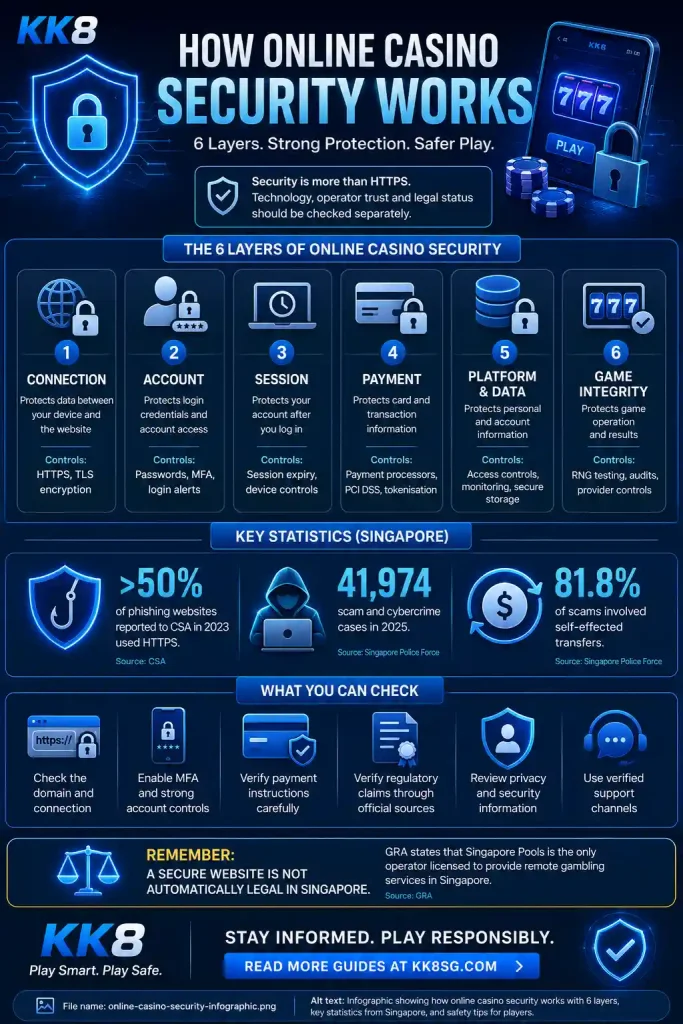
The 6 Layers of Online Casino Security
It is easier to understand online casino security by separating it into layers.
| Security layer | What it protects | Common controls |
| Connection | Information moving between your device and the website | HTTPS, TLS encryption |
| Account | Login credentials and account access | Passwords, MFA, login alerts |
| Session | Your account after you log in | Session expiry, device controls |
| Payment | Card and transaction information | Payment processors, PCI DSS controls |
| Platform and data | Personal and account information | Access controls, monitoring, secure storage |
| Game integrity | Game operation and results | RNG testing, audits, provider controls |
These layers solve different problems. HTTPS protects information while it moves across the internet, for example, but it cannot stop someone from willingly entering a password on a convincing phishing website.
That difference matters when judging whether a platform is actually secure.
Layer 1 — How HTTPS and Encryption Protect Your Connection
When you visit a website using HTTPS, the connection between your browser and the website is encrypted using TLS, or Transport Layer Security.
Encryption makes intercepted information much harder for an unauthorised third party to read. This can include login information, forms and other data sent between your browser and the server.
You may still see people use the term SSL encryption. SSL is an older technology, and modern websites generally use TLS, but “SSL” remains common in everyday marketing language.
A secure connection is important because casino accounts can involve personal and financial information. However, the padlock in your browser only answers one part of the security question.
What HTTPS Does Not Prove
HTTPS does not prove that:
- the casino operator is trustworthy;
- its licence claims are genuine;
- the website is legally available in Singapore;
- withdrawals will be processed fairly;
- its promotions are honest; or
- the website itself is not part of a phishing campaign.
This distinction is especially important because phishing websites can also use HTTPS. The Cyber Security Agency of Singapore reported that more than half of the phishing websites reported to it in 2023 were served through HTTPS. That was a major increase from 9% in 2022.
A browser padlock therefore means “your connection to this domain is encrypted”, not “this business is trustworthy.”
Layer 2 — How Casino Login Security Protects Accounts
Passwords are usually the first barrier protecting an online account. The problem is that passwords can be stolen, reused across websites or exposed through phishing.
This is why stronger account systems do not rely only on a password.
Security controls may include:
- multi-factor authentication;
- one-time passwords;
- authenticator apps;
- login notifications;
- failed-login limits;
- new-device verification; and
- checks for unusual account activity.
Multi-factor authentication, or MFA, requires another form of verification after the password. This means that knowing the password alone may not be enough to enter the account.
Why Two-Factor Authentication Helps
Imagine that a user accidentally enters their password on a fake login page. If the real account requires another authentication step, the stolen password alone may not give the attacker full access.
This does not make the account impossible to compromise. Phishing attacks can also target one-time codes, which is why users still need to check the website address and login page carefully.
A useful rule is:
Password only < password plus a second factor < phishing-resistant authentication
The exact security options depend on the platform.
Layer 3 — What Happens After You Log In
Security does not stop once the correct password has been entered.
After login, the website normally creates a session. The session allows the website to recognise that the user has already authenticated instead of asking for a password every time a new page loads.
Session security matters because an attacker who gains access to an active session may be able to act as the account holder without knowing the original password.
Security measures can include:
- automatic session expiry;
- logging out inactive users;
- ending sessions after a password change;
- allowing users to remove old devices;
- requiring verification for sensitive account changes; and
- asking for additional authentication before certain transactions.
For example, changing a profile picture should not need the same level of protection as changing a registered phone number or withdrawal method.
Why Account Recovery Is Part of Security
Password-reset systems are sometimes overlooked when people discuss online casino security.
Suppose an account has a strong password and two-factor authentication. Those controls become much less useful if another person can easily convince customer support to replace the account’s email address and reset the security settings.
A well-designed recovery process should therefore verify that the person requesting the change is really the account owner.
Sensitive actions may include:
- resetting a password;
- replacing a registered phone number;
- changing an email address;
- resetting MFA;
- changing payment details; or
- recovering a locked account.
This is one reason users should protect the email account connected to their casino account as carefully as the casino login itself.
Layer 4 — How Online Casino Payment Security Works
A deposit does not simply travel directly from a player’s bank account into a casino database.
For card transactions, the Payment Card Industry Data Security Standard, better known as PCI DSS, provides technical and operational requirements for organisations that store, process or transmit payment account data. The PCI Security Standards Council describes PCI DSS as a baseline for protecting payment account information.
Common payment-security controls can include:
- encrypted transmission;
- secure payment processors;
- access restrictions;
- transaction authentication;
- fraud monitoring; and
- tokenisation.
What Is Payment Tokenisation?
Tokenisation replaces sensitive payment information with another value that can be used by the payment system.
For example, instead of repeatedly sending or storing the full card number, a payment system may use a token that represents that card within a specific system.
If the token is exposed, it may be less useful to an attacker than the original payment details.
PCI DSS and similar security standards reduce risk, but they should not be described as a guarantee that fraud or data breaches can never happen.
For more detail on the transaction process, see How Online Casino Deposits Work.
Layer 5 — How Casinos Protect Personal and KYC Data
Online gambling accounts can contain more than a username and password.
Depending on the service and its requirements, personal information may include:
- full name;
- date of birth;
- phone number;
- email address;
- identification documents;
- proof of address;
- transaction records; and
- payment information.
Some operators use Know Your Customer, or KYC, checks to verify identity. Because identity documents contain sensitive information, users should pay attention to how documents are requested and submitted, not just why the company wants them.
A formal verification system should clearly explain what information is required and where it should be submitted.
Be cautious if someone claiming to represent a gambling website suddenly asks for identity documents, passwords or verification codes through an unrelated social-media account or private messaging service.
Before sending sensitive information, confirm that you are using the platform’s real website or verified support channel.
Layer 6 — How Online Casinos Protect Game Integrity
Game security is often discussed together with account cybersecurity, but they are not exactly the same thing.
Account security asks:
Can someone gain unauthorised access to my account or data?
Game integrity asks:
Is the game operating according to its stated rules?
For digital casino games, one important component can be the Random Number Generator, or RNG. An RNG produces the values used to determine outcomes in games where random results are required.
Independent testing organisations may examine game software or RNG systems to check whether they operate according to specified technical standards.
Other controls may involve:
- software testing;
- game-provider certification;
- version controls;
- audit records; and
- monitoring for unauthorised changes.
However, seeing an auditor’s logo on a website is not enough by itself. Where possible, users should check whether the claim can be verified through the testing organisation or relevant regulator.
How Casinos Can Detect Suspicious Activity
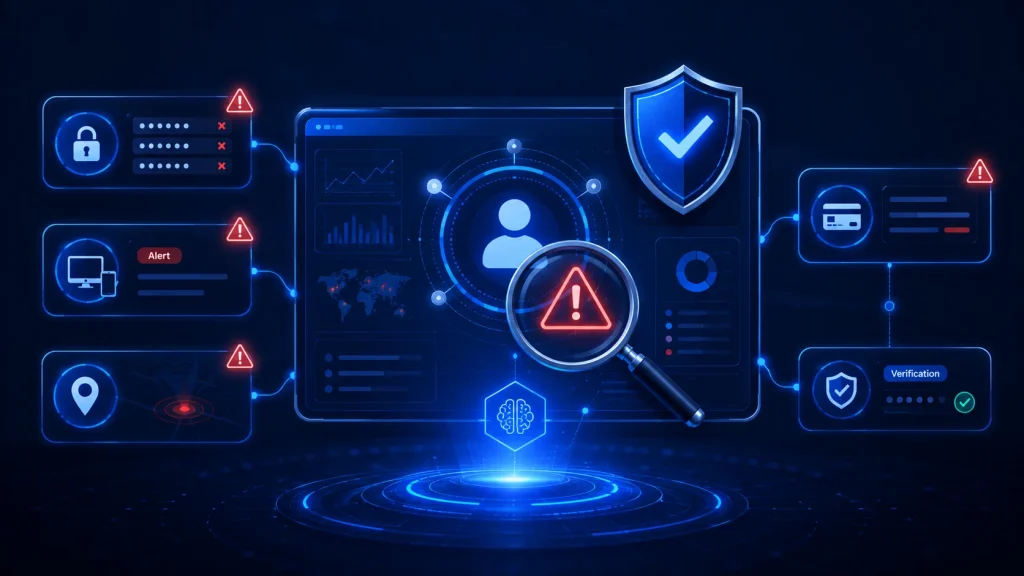
Some security controls are designed to prevent an attack. Others are designed to detect behaviour that looks unusual.
A platform may examine signals such as:
- repeated failed login attempts;
- login from a new device;
- unexpected changes in location;
- rapid changes to account details;
- password changes followed immediately by withdrawals;
- unusual transaction patterns; or
- attempts to access several accounts from the same environment.
A single unusual event does not automatically mean fraud has occurred.
For example, someone travelling overseas may naturally log in from a different location. Security systems therefore often look at several signals together before deciding whether additional verification is needed.
A suspicious transaction might result in an extra identity check rather than an immediate account block.
Online Casino Security, Safety, Fairness and Legality Are Different
These terms are often mixed together, but they answer different questions.
| Term | Main question |
| Security | Are systems, accounts and data protected? |
| Safety | What risks does the user face overall? |
| Fairness | Do games operate according to their stated rules? |
| Trustworthiness | Does the operator behave reliably and transparently? |
| Legality | Is the activity permitted under applicable law? |
A website could use HTTPS and strong login security while still having questionable business practices. Similarly, a technically secure overseas gambling platform is not automatically authorised to serve people in Singapore. That is why users should never use one security feature as proof of everything else.
What Singapore Users Need to Know
Singapore has strict rules covering remote gambling. The Gambling Regulatory Authority states that it is unlawful to provide unlicensed remote gambling services in or from Singapore, or from outside Singapore to people situated in Singapore. GRA also states that Singapore Pools is the only operator licensed by GRA to provide remote gambling services.
GRA further states that participating in unlicensed remote gambling is an offence in Singapore.
A Secure Website Is Not Automatically Legal in Singapore
This is an important distinction. A website may have:
- HTTPS;
- account authentication;
- encrypted payments;
- a polished app;
- privacy controls; and
- security certifications.
None of these technical features determine whether the gambling service is legally authorised in Singapore.
Legal status should be checked separately through official sources such as the Gambling Regulatory Authority.
Why Phishing Still Matters Even When Security Is Strong
Many account compromises do not begin with someone breaking encryption. They begin with someone convincing the user to give away information. A phishing page may look almost identical to a real login page. The domain name may differ by only one letter, and the fake site may still use HTTPS.
The victim enters a password, OTP or payment information believing they are dealing with the real service. This is why user behaviour remains part of online security.
Singapore Police reported 41,974 scam and cybercrime cases in 2025, with scam losses reaching about S$913.1 million. The Police also reported that 81.8% of scams involved self-effected transfers, where victims were deceived into carrying out the transaction themselves.
This does not mean those cases were related to online casinos. It shows a wider security lesson: strong technology cannot fully protect someone who is persuaded to send money or reveal credentials to the wrong person.
For related warning signs, see Common Online Gambling Scams.
How to Check an Online Casino’s Security Yourself
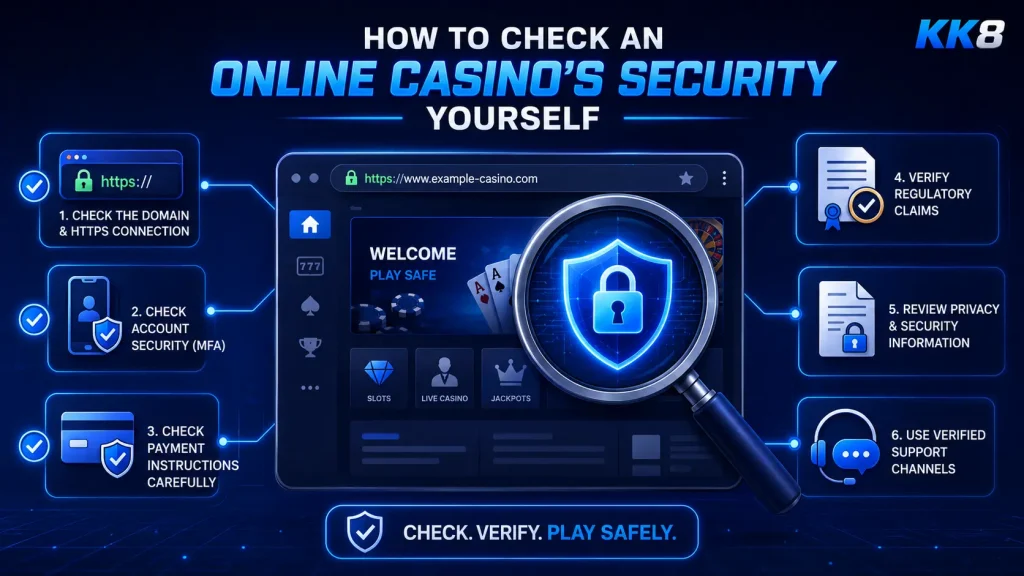
You cannot see every security system operating behind a website, but there are still checks you can make.
Check the Domain and Connection
Look at the full website address rather than only the design.
Check for:
- the correct spelling of the domain;
- HTTPS;
- no browser certificate warnings; and
- unexpected redirects to unrelated domains.
Do not treat HTTPS alone as proof that the website is genuine.
Check Account Security
Look for controls such as:
- multi-factor authentication;
- password-change options;
- login alerts;
- device management; and
- clear account-recovery procedures.
If MFA is available, consider enabling it.
Check Payment Instructions Carefully
Be cautious if payment instructions suddenly change or if you are asked to transfer money to an unrelated personal account without a clear explanation.
Before making a payment, confirm:
- the recipient;
- the amount;
- the payment channel; and
- whether the instructions match information shown through the official platform.
Verify Regulatory Claims
Do not rely only on a regulator’s logo displayed in the website footer. Check whether the regulator exists and, where possible, verify the operator directly through the regulator’s official records.
Check Security and Privacy Information
A useful privacy or security page should explain things such as:
- what information is collected;
- why it is collected;
- who may receive it;
- how users can manage their information; and
- what security measures are described.
Generic claims such as “100% secure” provide little useful detail.
For a wider website-checking process, read How to Spot Fake Online Casino Websites.
Security Claims That Deserve a Closer Look
Security language is often used in marketing. Some phrases sound impressive without explaining much.
| Claim | Why to look closer |
| “100% secure” | No online system can realistically promise zero risk |
| “Hacker-proof” | Absolute security claims should be treated carefully |
| “Military-grade encryption” | The phrase tells you little without technical context |
| “SSL certified, therefore trusted” | HTTPS does not prove operator reliability |
| “Fully anonymous” | May conflict with identity or regulatory requirements |
| “Guaranteed safe payments” | Security controls reduce risk; they do not eliminate it |
More useful security information explains what system is being protected, how it is protected and who has independently checked the claim.
What to Do If You Think Your Account Has Been Compromised
Act quickly if you notice an unfamiliar login, unexpected password reset, changed payment details or transactions you do not recognise.
A sensible response is:
- Change your password through the official website.
- Sign out of other sessions or devices if that option is available.
- Enable or reset multi-factor authentication.
- Check account and transaction history.
- Contact the platform using a verified support channel.
- Contact your bank or payment provider if financial information may be affected.
- Change the password of the connected email account if it may also be compromised.
- Report suspected phishing or scams through the appropriate official channels.
Do not use contact details contained in a suspicious message to report the problem. Go to the official website independently.
Online Casino Security Checklist
Before trusting security claims, look at the whole picture.
| Check | Better sign | Warning sign |
| Website address | Correct, expected domain | Misspelled or copycat domain |
| Connection | HTTPS with no browser warning | Certificate warning |
| Login | MFA and account controls | Password only with weak recovery process |
| Payments | Clear and consistent instructions | Sudden transfer to unrelated accounts |
| KYC | Clear verification process | Documents requested through random accounts |
| Security claims | Specific explanation | “100% secure” with no details |
| Regulation | Claim can be independently checked | Regulator logo with no verification |
| Privacy | Clear policy and data explanation | Little information about data handling |
| Support | Verified contact channels | Support only through private messaging accounts |
The important point is not whether a website passes one check. It is whether the different pieces make sense together.
Frequently Asked Questions
How does online casino security work?
Online casino security uses several layers. HTTPS and TLS protect information travelling between a browser and website, account controls help prevent unauthorised access, payment systems protect financial information, and monitoring tools can detect suspicious behaviour. Other systems may protect personal data and game integrity.
Does HTTPS mean an online casino is safe?
No. HTTPS means the connection between your browser and the website is encrypted. It does not prove that the operator is trustworthy, legally authorised or reliable. Phishing websites can also use HTTPS.
What security features should an online casino have?
Useful controls can include HTTPS, multi-factor authentication, secure payment processing, clear account-recovery procedures, privacy protections and monitoring for unusual account activity. The presence of these features should still be considered alongside operator and regulatory information.
Is two-factor authentication important for casino accounts?
Two-factor authentication adds another security step beyond a password. This can make unauthorised access harder if the password is stolen. It is still important to avoid phishing because attackers may also try to steal verification codes.
How are online casino payments protected?
Payment protection may involve encrypted connections, secure payment processors, authentication, fraud monitoring and standards such as PCI DSS for payment-card environments. The exact controls depend on the payment method and service provider.
How can I tell if an online casino website is fake?
Check the exact domain, operator identity, payment instructions, regulatory claims and contact channels. Do not rely on website design, HTTPS or regulator logos alone. Where possible, verify claims through independent official sources.
Final Takeaway
The best way to identify an online gambling scam is not to focus only on how professional the website looks.
Pay attention to behaviour.
Who receives the money? Are the rules clear before you deposit? What happens when you try to withdraw? Do the requirements suddenly change? Are you being asked to send more money to recover money already shown in your account?
Those questions often reveal more than a logo, bonus banner or licence badge.
For Singapore readers, it is also important to separate overseas licensing claims from local legal status. Check official information from the Gambling Regulatory Authority and Singapore Police Force when in doubt.
For a broader understanding of regulation, payments and player safety, explore our Online Gambling Singapore Guide.