Category: Online Gambling Singapore

  • The Future of Online Gambling: Technology, Regulation and What Comes Next

    The Future of Online Gambling: Technology, Regulation and What Comes Next

    The future of online gambling is being decided in two places at once: inside product teams building faster and more personalised platforms, and inside regulators deciding how much of that is allowed to reach players. Most trend articles only cover the first half. That is why predictions from five years ago about virtual reality casinos and crypto-first betting have aged badly, while unglamorous changes like automated identity checks and behavioural monitoring have quietly reshaped how real platforms work.

    This guide covers what is actually changing, which technologies have genuine momentum, which are still mostly marketing, and what it all means for readers in Singapore, where online gambling in Singapore sits under one of the strictest frameworks in the region.

    Quick Answer: What Will the Future of Online Gambling Look Like?

    Expect mobile-first platforms as the default, more artificial intelligence in both recommendations and harm detection, faster payments, more interactive live dealer gaming, and much heavier identity verification. Alongside that, expect stricter product rules: stake caps, spending controls, affordability checks and mandatory player protection tools.

    The important distinction is that these developments are not moving at the same speed. Mobile and live dealer gaming are already mainstream. AI and instant payments are scaling now. Virtual reality and metaverse gambling remain small, and have stayed small for years despite constant coverage.
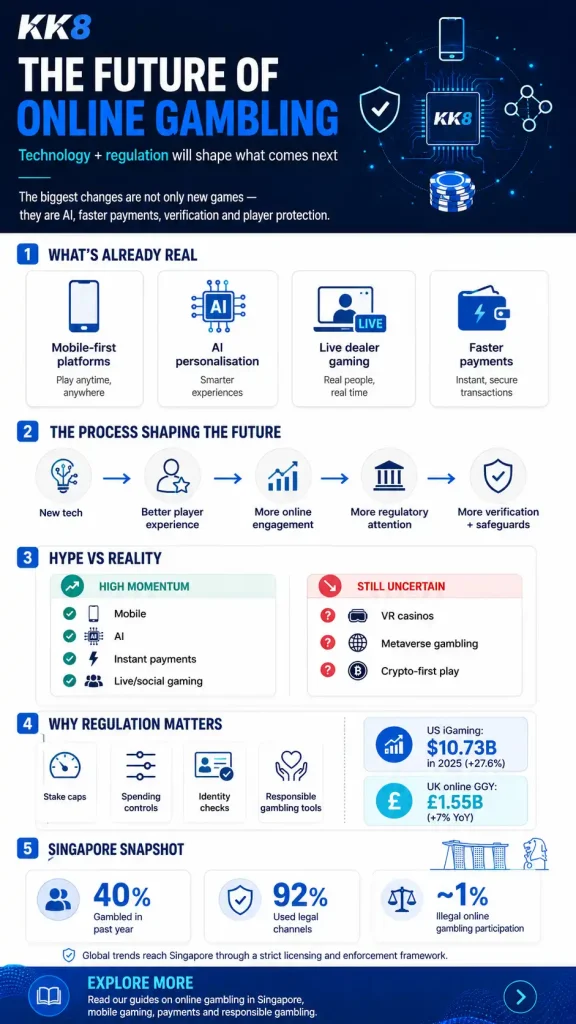
    the future of online gambling, including AI, mobile gaming, faster payments, regulation, player protection and Singapore gambling trends

    How Online Gambling Is Changing

    The direction of travel is clear in regulated markets that publish real numbers.

    In the United States, regulated iGaming revenue grew 27.6% in 2025 to a record $10.73 billion, according to the American Gaming Association. The more telling detail sits underneath that figure: in both Pennsylvania and New Jersey, online casino revenue exceeded land-based commercial casino revenue for the first time.

    In Great Britain, the Gambling Commission’s operator dataset for January to March 2026 recorded online gross gambling yield (GGY, meaning the amount operators keep after paying out winnings) of £1.55 billion, up 7% year on year. But average monthly active accounts actually fell 1% to 13.4 million.

    Together these say something more useful than a market forecast. Growth is coming from deeper engagement within existing player bases and from online taking share from physical venues, not from an endless supply of new players. That is precisely the kind of growth that attracts regulatory attention, which is why the technology story and the regulation story cannot be separated. If you are new to the mechanics, start with how online gambling works.

    7 Trends That Could Shape the Future of Online Gambling

    1. AI will change both personalisation and player protection

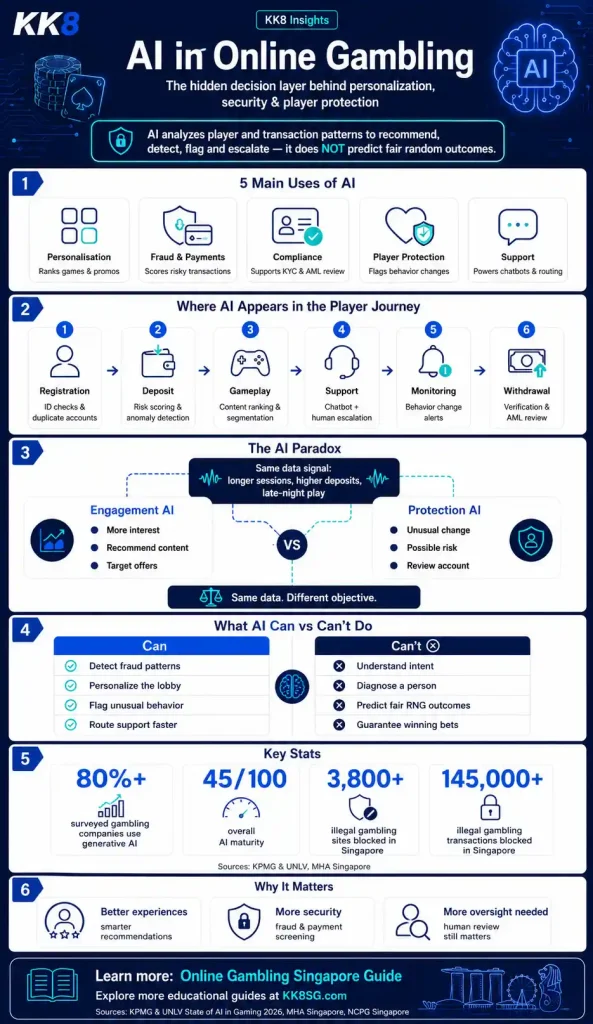
    Most coverage of AI in online gambling stops at recommendations. The dual role is what matters.

    Commercially, machine learning drives recommendations, search, dynamic lobbies, support automation and fraud detection. On the protection side, the same modelling flags unusual deposit patterns, lengthening sessions, chasing behaviour after losses and account takeover signals.

    That creates a real tension: the models that make a platform more engaging and the models that detect someone playing too much are built from the same behavioural data. Regulators are increasingly interested in whether operators use that capability in both directions.

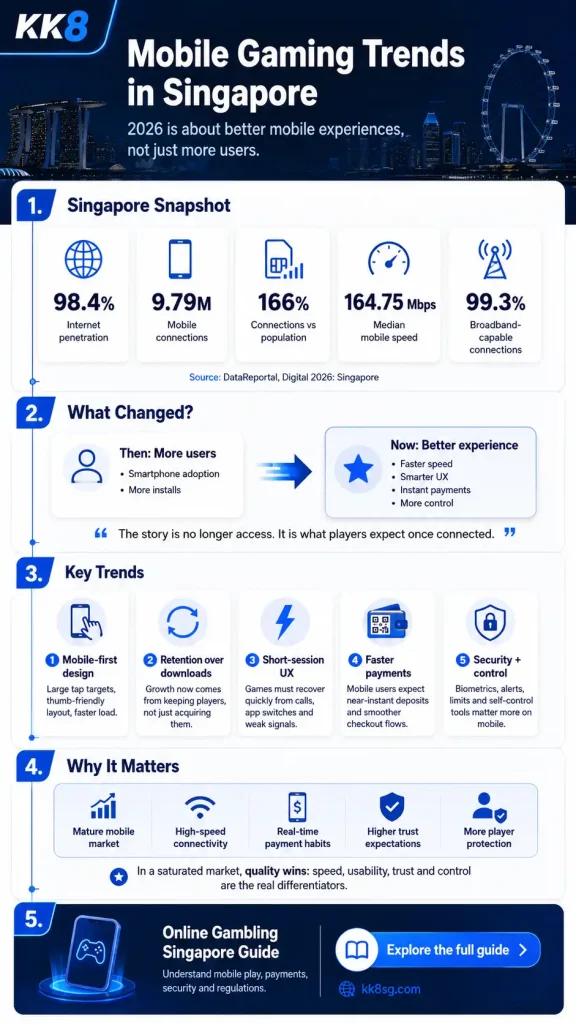
    2. Mobile-first gambling will become the default

    Mobile is not a future technology. It is the existing baseline, so the useful question is what comes next.

    Realistic development areas: app performance on mid-range devices, lighter web clients for data-constrained markets, biometric login instead of passwords, deposit flows with fewer screens, and better live video over mobile networks. Our mobile casino gaming guide covers how mobile differs from desktop play today.

    3. Live casino technology will become more interactive

    Live dealer gaming is the clearest bridge between physical and digital play, and it absorbs a lot of engineering effort: lower streaming latency, higher video quality, multiple camera angles and game-show formats built for mobile screens. The direction is toward shared, event-style experiences rather than solitary play, which targets the one thing online products have struggled to reproduce, namely atmosphere.

    4. Faster payments could become a major competitive factor

    Cash out speed is one of the most common complaints about online gambling platforms, so real-time deposits, faster payouts, instant bank transfers and digital wallets are an obvious competitive lever.

    The trade-off is rarely mentioned. Faster money movement leaves less time to catch fraud and money laundering, so instant payments arrive alongside stronger verification, transaction monitoring and source-of-funds checks. Speed at the front end means more scrutiny behind it. See online casino deposits for how this runs today.

    5. Identity and security technology will become more important

    Some of the biggest future gambling technologies will operate behind the screen rather than inside the games.

    The relevant terms are worth defining. KYC (Know Your Customer) is the process of verifying who a player actually is. AML (Anti-Money Laundering) covers the controls that stop platforms being used to move criminal funds. Geolocation confirms where a player is physically located, which matters because gambling licences are territorial.

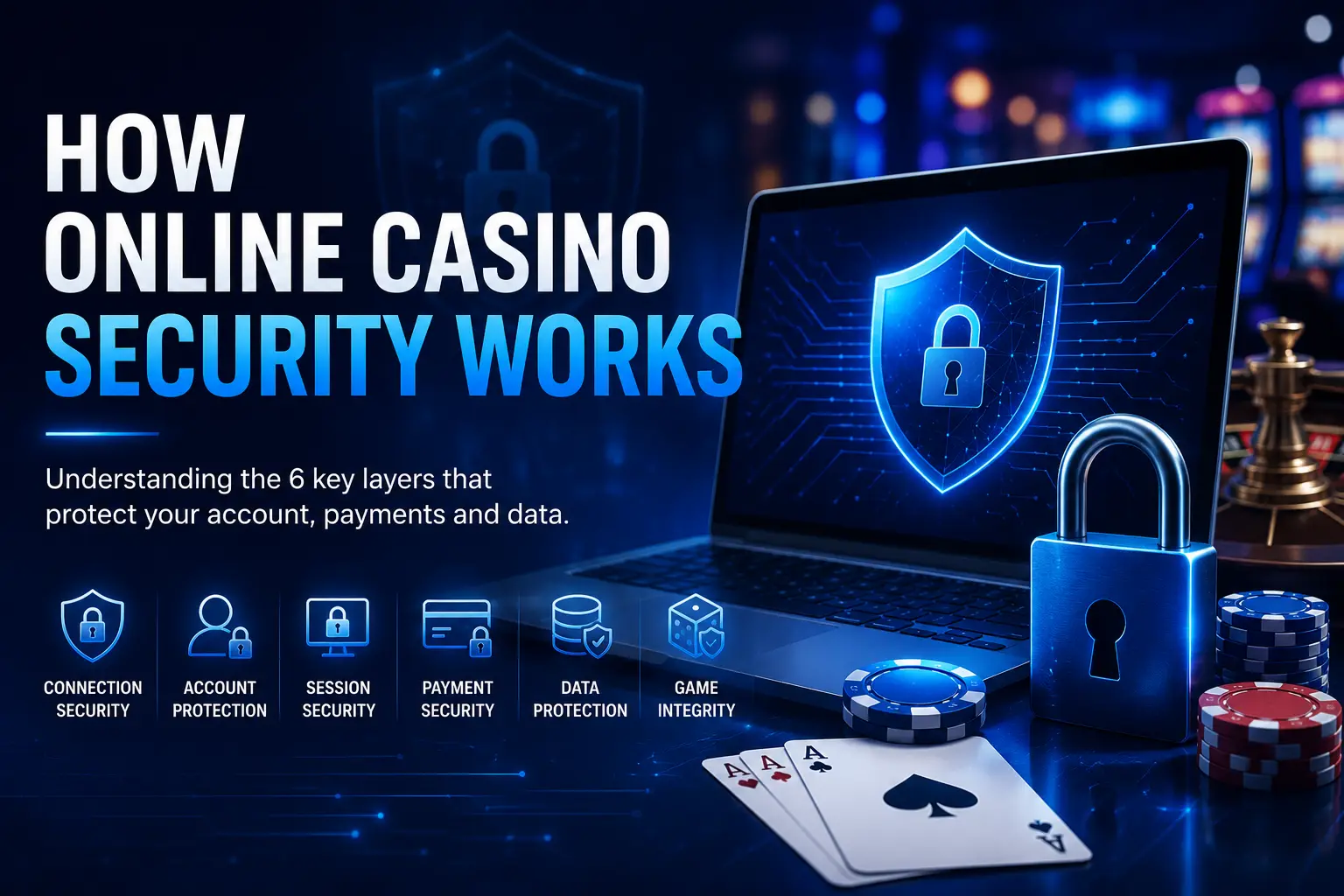
    Add biometric authentication, device fingerprinting, age assurance and cybersecurity, and this becomes the layer that determines whether a platform can legally operate at all. Our guide to online casino security features explains what players can check themselves.

    6. VR, AR and blockchain may grow more slowly than the hype suggests

    Virtual reality casinos have been called imminent for about a decade. The barriers are practical: headset ownership is low, sessions are tiring, development costs are high, and none of it is more convenient than a phone. Augmented reality has potential for overlays, but adoption is limited.

    Blockchain has narrower and more plausible uses: tamper-evident transaction records, verifiable outcome logs (often marketed as “provably fair”) and settlement between operators and suppliers. That is a very different claim from crypto becoming the default deposit method.

    7. Social gambling experiences may become more important

    Multiplayer tables, tournaments, leaderboards, live chat and shared jackpots are all attempts to rebuild the social element of a physical casino floor. This is one of the more likely growth areas because it needs no new hardware, no new payment rails and no regulatory change, only better product design.

    Which Online Gambling Technologies Are Real, and Which Are Still Hype?
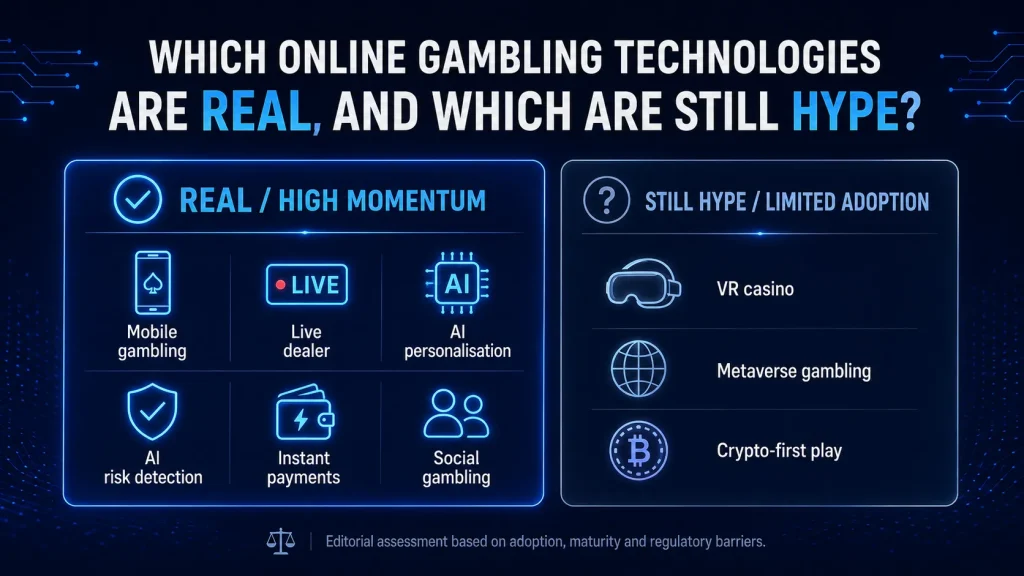
    Comparison of real online gambling technologies

    The table below is an editorial assessment based on current adoption, technology maturity and regulatory barriers. It is not a scientific ranking.

    Trend Adoption today Future potential Main barrier
    Mobile gambling High Very high Regulation
    Live dealer High High Infrastructure cost
    AI personalisation Growing Very high Privacy and data rules
    AI risk detection Growing High Accuracy and false positives
    Instant payments Growing High Compliance and fraud controls
    Social gambling Growing Medium to high Regulation
    Blockchain Limited Medium Adoption and licensing
    VR casino Limited Medium Hardware ownership
    Metaverse gambling Very limited Low User demand

    The pattern is consistent. Technologies that improve something players already do tend to scale. Technologies that ask players to change hardware or habits tend to stall.

    Regulation Could Shape the Future More Than Technology

    Technology asks what platforms can do. Regulation asks what they should be allowed to do. In the last few years, regulation has been the stronger force.

    Great Britain is the clearest worked example. Stake limits for online slots came into force in 2025: a maximum of £5 per game cycle for players aged 25 and over from 9 April 2025, and £2 for players aged 18 to 24 from 21 May 2025. This was a direct rule about product design, not a technology decision.

    The effect showed up in operator data. In the January to March 2026 quarter, the Gambling Commission recorded total sessions up 18% to 202 million while average spins per session fell from 136 to 124 and GGY per session dropped from £4.01 to £3.82. Sessions lasting more than an hour fell 12%. Players were logging in more often and spending less per visit.

    A single regulatory instrument changed session behaviour across an entire national market faster than any product innovation of the same period. Age verification, advertising rules, affordability checks and deposit controls all work the same way. For the local position, see Singapore gambling laws.

    Responsible Gambling Technology Will Become Part of Product Design

    Player protection is moving from a settings page into the core product: self-exclusion, deposit and loss limits, session reminders, reality checks, automated warnings and behavioural risk scoring.

    The scale is already significant. The Gambling Commission reported 5.2 million customer interactions in the January to March 2026 quarter, up 32% year on year, with the majority automated. Direct interactions by staff fell 9% over the same period, and several operators had refined their markers-of-harm algorithms.

    That is the real trend: harm detection is moving from manual review to automated systems running continuously in the background. It raises fair questions about accuracy and false positives, but the direction is unlikely to reverse. Our guide to responsible gambling in Singapore covers the tools and support available locally.

    Will Online Gambling Replace Physical Casinos?

    Probably not completely. The two formats compete on different things.

    Online Physical
    Convenience and 24/7 access Atmosphere and occasion
    Very large game range Live social interaction
    Mobile access anywhere Physical chips, tables, dealers
    Faster digital payments Hospitality, food, entertainment
    Lower minimum stakes Destination and travel appeal

    The more likely outcome is hybrid. Live dealer studios, social multiplayer formats and casino apps tied to physical resorts all point toward blending rather than replacement. The US data supports this reading: online overtaking land-based revenue in Pennsylvania and New Jersey happened while land-based revenue was still growing.

    What Does the Future of Online Gambling Mean for Singapore?
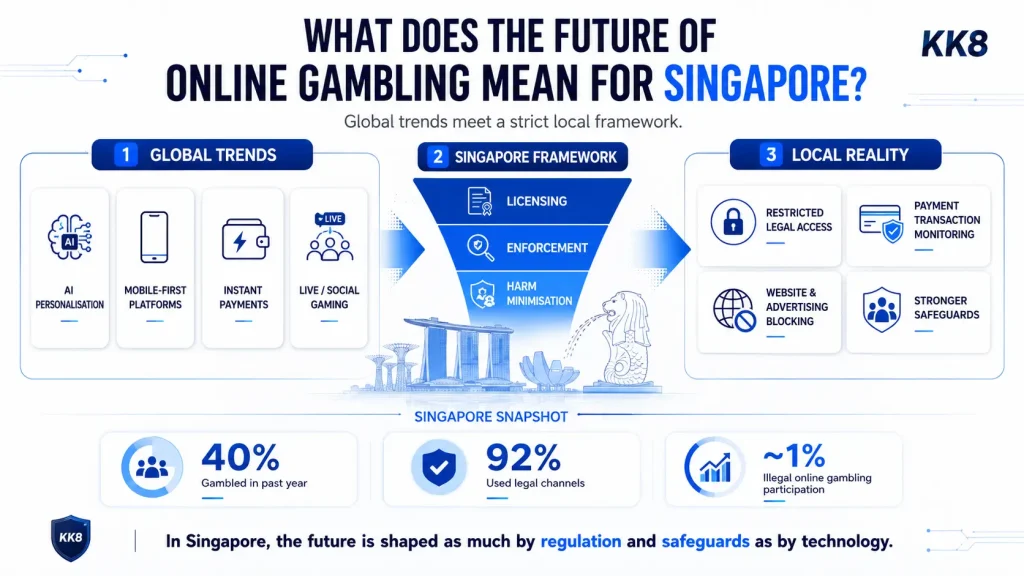
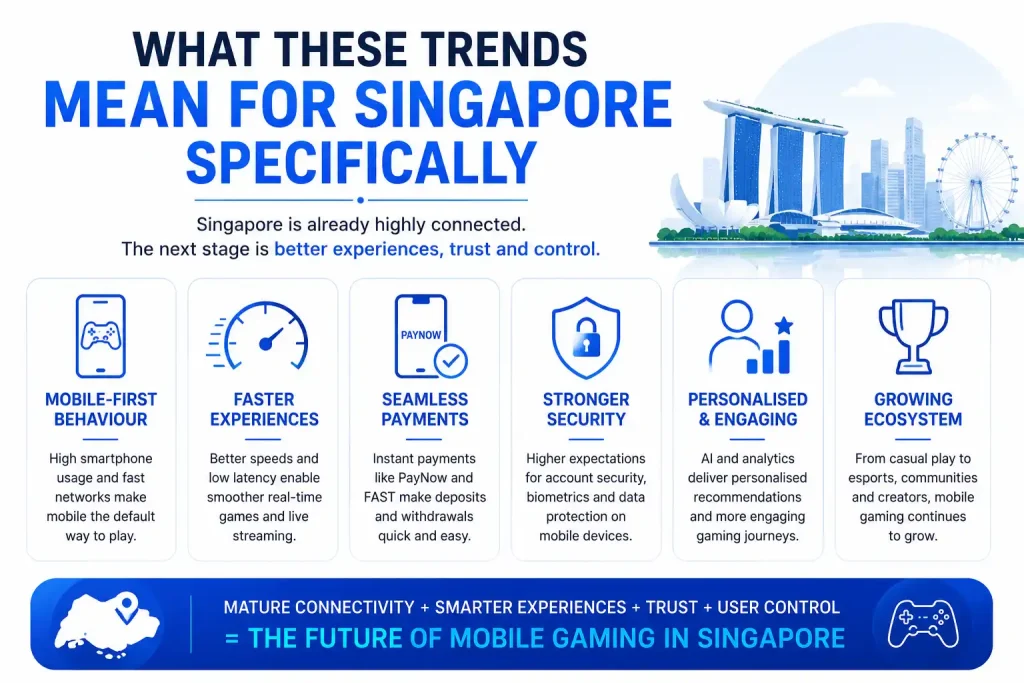
    What Does the Future of Online Gambling Mean for Singapore

    Global trends do not arrive in Singapore unchanged. They arrive filtered through a framework built around licensing, enforcement and harm minimisation.

    Gambling in Singapore is regulated through licensing rather than open access. The Ministry of Home Affairs reaffirmed in June 2026 that all gambling activity is illegal unless licensed, authorised or exempted under the Gambling Control Act, and that this applies to online and in-person operators alike. If you are unsure where a specific site stands, read is online gambling legal in Singapore? before anything else.

    Technology may develop faster than local access

    Global operators will keep shipping better apps, faster payouts and more AI-driven features. Legal availability in Singapore is a separate question from whether the technology exists. A platform being technically impressive says nothing about whether it is authorised here, which is why how to verify an online casino website is a more useful skill than tracking feature announcements.

    Enforcement technology will grow alongside gambling technology

    This is the part international trend articles miss. Enforcement is also getting more technical. Since 1 January 2025, the Singapore Police Force has handled blocking of access to unlawful remote gambling services, their advertising and associated payment transactions, and directions can be issued under the Online Criminal Harms Act requiring service providers to restrict access.

    So in Singapore, two technology curves run in parallel: gambling platforms getting more capable, and website blocking, payment controls and digital enforcement getting more capable at the same time.

    Singapore’s future is likely to focus on safeguards

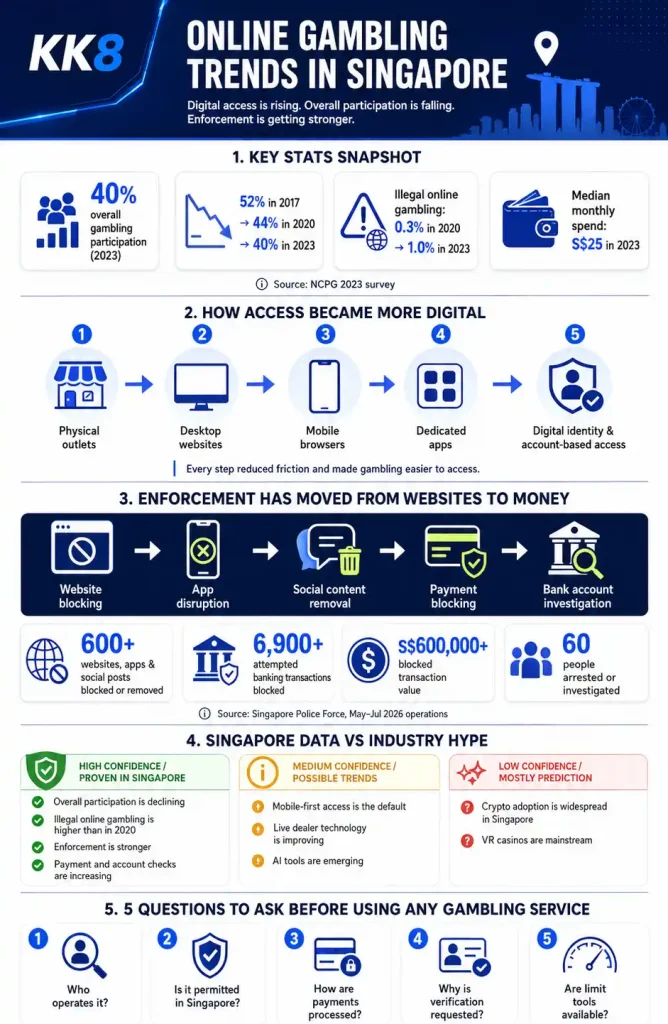
    The local baseline is stable rather than expanding. The National Council on Problem Gambling’s 2023 survey found that 40% of residents aged 18 and above had gambled in the past year, down from 44% in 2020 and 52% in 2017. Around 92% of gamblers bet through legal channels. Illegal online gambling participation was about 1%, up from 0.3% in 2020, which the NCPG noted was consistent with global trends.

    Global trend Singapore consideration
    Online market growth Restricted legal access
    AI personalisation Privacy and responsible use
    Instant payments Payment transaction monitoring
    Mobile-first products Regulatory and licensing controls
    More cross-border platforms Website and advertising blocking

    For more on how these dynamics are playing out locally, see online gambling trends in Singapore.

    Want more local context? Read our full guide to online gambling in Singapore, including how the market works and the rules players should understand.

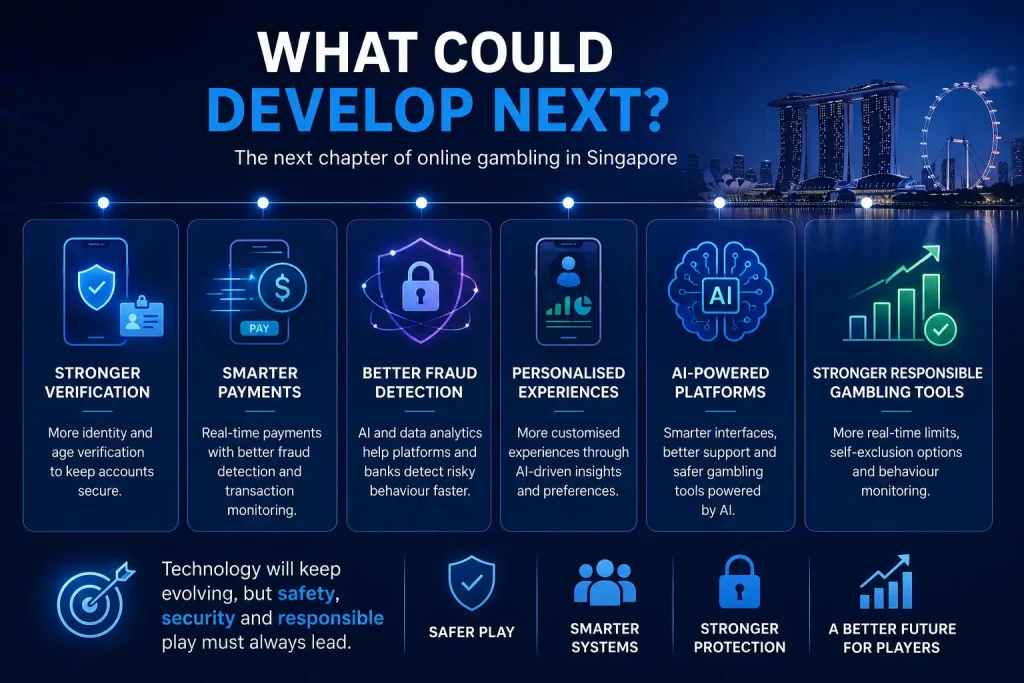
    What Could Online Gambling Look Like by 2030?

    Scenarios, not predictions.

    Confidence What it looks like
    Likely Mobile-first as the norm, wider AI use in personalisation and support, faster payouts, more live and game-show formats, stronger identity checks, automated risk monitoring as standard
    Possible Broader biometric verification, more social and multiplayer formats, narrow blockchain use for records and settlement, more prescriptive affordability rules
    Still uncertain Mainstream VR casinos, metaverse gambling venues, cryptocurrency as a dominant payment method

    Anything in the first row is already visible in operator data today. Anything in the third has been forecast repeatedly without materialising.

    Key takeaway

    1. The future of online gambling will be shaped as much by trust, verification and player protection as by new games and technology. The most consequential changes of the past few years were a stake limit and a wave of automated harm-detection systems, not a new immersive format. Anyone assessing where the industry goes next should watch the regulators as closely as the product roadmaps.

    Frequently Asked Questions

    What is the future of online gambling?

    Mobile-first, more automated and more heavily verified. AI shapes both personalisation and harm detection, payments get faster, and regulation increasingly dictates product design.

    How will AI change online gambling?

    In two directions: recommendations, search and support on the commercial side, and detection of unusual spending, long sessions and fraud on the protection side.

    Will VR casinos become popular?

    Unlikely in the near term. Headset ownership is low and development costs are high. VR looks more like a niche format than a replacement for phone-based play.

    Will cryptocurrency become the main online gambling payment method?

    Doubtful in regulated markets. Volatility, AML obligations and licensing conditions all work against it. Blockchain’s realistic uses are in records and settlement.

    Will online gambling replace physical casinos?

    Not completely. Online wins on convenience and range, physical venues on atmosphere and hospitality. A hybrid future is more likely than replacement.

    What is the future of online gambling in Singapore?

    It depends on the local framework, not global trends. Gambling stays illegal unless licensed, authorised or exempted, and policy focus remains on verification, blocking and harm minimisation.

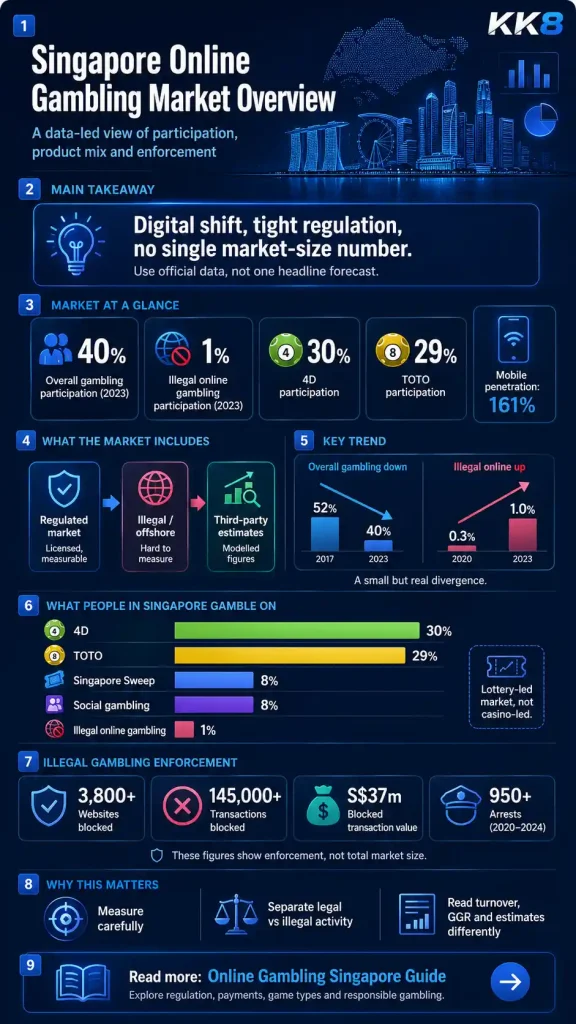
  • Singapore Online Gambling Market Overview

    Singapore Online Gambling Market Overview

    The Singapore online gambling market is unusual for the region. The population is almost entirely connected, betting products such as 4D and TOTO are part of everyday life, and yet licensed remote gambling is one of the most tightly restricted activities in Asia. That combination makes the market difficult to size with a single number, and it explains why published estimates disagree so sharply.

    This overview uses official Singapore sources rather than headline forecasts: participation data from the National Council on Problem Gambling (NCPG), enforcement figures from the Ministry of Home Affairs (MHA), licensing rules from the Gambling Regulatory Authority (GRA), and connectivity data from IMDA. If you want the broader consumer-facing picture instead, start with our guide to online gambling in Singapore.

    Singapore Online Gambling Market at a Glance

    Metric Latest useful figure Source and period
    Overall gambling participation 40% NCPG survey, 2023
    Illegal online gambling participation About 1% NCPG survey, 2023
    4D participation 30% NCPG survey, 2023
    TOTO participation 29% NCPG survey, 2023
    Singapore Sweep participation 8% NCPG survey, 2023
    Illegal gambling websites blocked 3,800+ MHA, as at 31 Dec 2024
    Illegal transactions blocked 145,000+ MHA, as at 31 Dec 2024
    Value of blocked transactions About S$37 million MHA, as at 31 Dec 2024
    Arrests for illegal remote gambling 950+ MHA, 2020 to 2024
    Mobile population penetration About 161% IMDA, August 2025

    Every figure above is dated on purpose. Gambling data in Singapore is released on different cycles, so a 2023 survey number and a 2024 enforcement number describe different moments and should not be blended into one “market value”.

    What “Singapore Online Gambling Market” Actually Means

    The phrase is used loosely, and that is where most confusion starts. It covers three separate things that are measured in completely different ways.

    The regulated market

    Remote gambling means gambling conducted through the internet, telephone, television or any other communication technology. In Singapore, offering remote gambling requires a licence or an exemption under the Gambling Control Act 2022, and those are granted very sparingly. The regulated segment is therefore narrow by design.

    This part of the market is the only part that is directly observable, because licensed activity generates audited accounts, duties and levies that pass through public records. If you want the legal details, see our explainer on remote gambling in Singapore.

    Illegal and offshore gambling

    This covers sites operated from outside Singapore that accept Singapore-based customers without authorisation, plus local illegal bookmaking. No operator in this segment files public accounts, so its size can only be approached indirectly, through survey responses, enforcement statistics and payment-blocking data.

    Those indicators are useful, but none of them is a revenue figure. A blocked transaction total tells you what enforcement caught, not what got through.

    Third-party market estimates

    Commercial research firms publish Singapore online gambling market values and forecasts. These are modelled numbers, built from assumptions about offshore participation, average spend and product mix. Different assumptions produce materially different results, which is why two reports covering the same year can differ by a wide margin.

    None of these estimates is an official Singapore government statistic, and they should be labelled that way whenever they are quoted.

    How Large Is Singapore’s Online Gambling Market?

    There is no single official total. Before comparing any two figures, check which of these they measure.

    Term What it counts Example
    Turnover (handle) Total amount staked $10 staked on a lottery draw counts $10, even if the punter wins and stakes again
    Gross gaming revenue (GGR) Stakes minus winnings paid out $10 staked, $9 returned as prizes, GGR is $1
    Operator revenue What the operator keeps after prizes, duties, taxes and other contributions A small fraction of turnover
    Modelled market size An estimate of total spend, often including offshore activity Depends entirely on the model’s assumptions

    The gap between these is not a rounding difference. In a lottery-led market, turnover can be twenty or thirty times larger than what an operator actually retains, because the same money is recycled through repeated bets and prize payouts. Quoting turnover as market value overstates the market by more than an order of magnitude.

    Why market-size estimates differ

    Three drivers explain most of the variation:

    1. Scope. Some estimates count only regulated activity. Others try to include offshore play, which is unverifiable.
    2. Metric. A report quoting turnover will always look far larger than one quoting GGR.
    3. Method. Survey-based models, payment-flow models and top-down regional models produce different answers from the same underlying market.

    How to read any market-size figure

    Four questions separate a usable estimate from a headline:

    • Is this turnover, GGR or modelled total spend?
    • Does it include offshore activity, and if so, how was that quantified?
    • Is the base year actual data or a forecast?
    • Is the source an official statistic or a commercial model?

    If an estimate does not answer those four questions, it cannot be compared with any other estimate. To understand what is actually being measured in the first place, it helps to be clear on what online gambling means.

    How Gambling Participation Is Changing

    The NCPG surveys Singapore residents on gambling participation, and the direction of travel has been consistent.

    Survey year Residents who gambled in the past 12 months
    2017 52%
    2020 44%
    2023 40%

    Participation has fallen by 12 percentage points since 2017. That reflects the market as a whole, dominated by lottery products bought by casual players, and it is the single most reliable trend line available for Singapore.

    A falling headline number does not mean every category is shrinking, which is where the market gets interesting.

    Online Gambling Is Moving in a Different Direction

    Between the 2020 and 2023 surveys, two things happened at once:

    • Overall gambling participation fell from 44% to 40%
    • Reported illegal online gambling rose from 0.3% to 1.0%

    The second movement deserves careful wording. In relative terms it looks dramatic, but the base is roughly three people in a thousand rising to one in a hundred. The honest description is that reported illegal online gambling rose by 0.7 percentage points. Anything framed as a triple-digit percentage increase is technically true and practically misleading.

    Two further caveats belong with that number. Self-reported surveys almost certainly understate illegal activity, because respondents are being asked to disclose something unlawful. And a shift in survey wording or sampling can move a small number more than real behaviour does.

    What the data supports is a modest but real divergence: the overall market is contracting while the digital and unlicensed corner of it is not. That pattern is covered in more depth in our analysis of online gambling trends in Singapore.

    What People in Singapore Actually Gamble On

    Product Participation (2023)
    4D 30%
    TOTO 29%
    Singapore Sweep 8%
    Social gambling (with friends or family) 8%
    Illegal online gambling About 1%

    The shape of this list matters. Singapore’s gambling market is overwhelmingly a lottery market. 4D and TOTO alone account for the bulk of participation, and both are physical-and-digital products rather than casino-style games.

    The mix has also narrowed in recent years. The closure of horse racing at the Singapore Turf Club removed a long-standing betting category, concentrating legal activity further into lottery and sports products.

    Anyone applying an international iGaming template to Singapore, where slots and live casino dominate, will misread the market badly. The distinction between product categories is worth understanding, and our guides on types of online gambling and online casino vs sports betting break it down.

    Illegal and Offshore Online Gambling

    Because offshore operators publish nothing, enforcement data is the most concrete evidence available.

    Enforcement indicator Figure (as at 31 Dec 2024)
    Illegal gambling websites blocked More than 3,800
    Illegal transactions blocked More than 145,000
    Value of blocked transactions About $37 million
    People arrested for illegal remote gambling, 2020 to 2024 More than 950

    Singapore uses a layered approach: website blocking at the direction of the authorities, payment blocking that stops transactions to identified illegal operators, restrictions on gambling-related advertising, and police enforcement against those who organise or participate in illegal remote gambling.

    Read those numbers carefully. $37 million in blocked transactions measures enforcement activity across a multi-year period. It is not the size of the illegal market, and it should never be presented as one. The same applies to site-blocking totals, since operators routinely register replacement domains within days. A rising blocking count can indicate more enforcement resources, more illegal supply, or both, and the figure alone cannot tell you which.

    Why Mobile Access Matters

    Singapore’s digital infrastructure is what makes remote gambling practical at scale. IMDA reported mobile population penetration of around 161% in August 2025, alongside residential wired broadband penetration of about 89%.

    Penetration above 100% is not an error. It counts active mobile subscriptions against population, and many people hold more than one SIM or line. These are subscription measures, not user counts, and certainly not gambling-user counts.

    The correct reading is that near-universal connectivity removes any access barrier to online gambling, legal or otherwise. It does not by itself demonstrate that gambling is growing, and the participation data suggests the opposite for the market overall. For how device choice affects the player experience specifically, see mobile gambling and browser-based play.

    Sports Betting and Major Events

    Sports betting is the most event-sensitive part of the market. Interest spikes around major tournaments, and so does exposure to illegal operators who advertise aggressively during those windows.

    The 2026 FIFA World Cup

    MHA flagged the elevated risk of illegal and offshore betting activity around the 2026 World Cup, tightening controls on gambling-related advertising and stepping up enforcement measures aimed at limiting exposure among vulnerable groups.

    This is a recurring pattern rather than a one-off. Major tournaments create temporary demand surges, offshore operators target that demand, and enforcement intensifies in response. Expect the same cycle around future World Cups, regional championships and heavy football calendars.

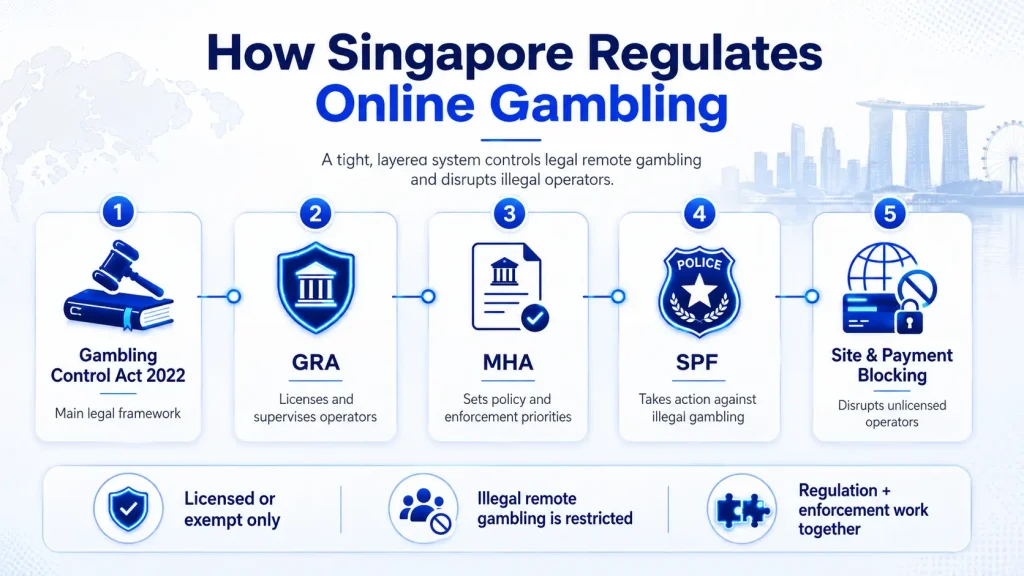
    How Singapore Regulates Online Gambling

    How Singapore regulates online gambling through the Gambling Control Act, GRA, MHA, SPF, and site and payment blocking

    The framework is straightforward in outline:

    • Gambling Control Act 2022 consolidated Singapore’s gambling laws into a single regime
    • Gambling Regulatory Authority (GRA) licenses and supervises gambling operators
    • Ministry of Home Affairs (MHA) sets policy and directs enforcement priorities
    • Singapore Police Force (SPF) enforces against illegal gambling operations
    • Site and payment blocking are used to disrupt access to unlicensed operators

    Two points are often missed. First, remote gambling is prohibited unless the operator is licensed or exempt, so the default position is restriction rather than permission. Second, gambling with an unlicensed remote operator is an offence for the customer, not only the operator. The full detail sits in our dedicated articles on Singapore gambling laws and Singapore gambling regulations.

    Key Trends Shaping the Market

    Gambling is becoming more digital. Betting increasingly runs through account-based online channels, supported by near-universal connectivity.

    Overall participation continues to fall. Three consecutive NCPG surveys point the same way, and nothing in the current data suggests a reversal.

    Illegal operators remain an enforcement problem. Blocking is effective but not permanent, since domains and payment routes are replaced.

    Major sports events create temporary spikes. These are short-lived surges in activity and in enforcement, not structural growth.

    Responsible gambling controls are tightening. Advertising restrictions, self-exclusion and account-level limits have expanded rather than loosened.

    Notably absent from this list are metaverse casinos, VR gambling and blockchain betting. There is no Singapore-specific data supporting them as market forces, and including them would be speculation.

    Singapore Online Gambling Market Outlook

    The evidence points towards continued digital migration inside a tightly controlled market rather than any move towards deregulation. Overall participation is more likely to keep drifting down than to rebound, licensing is unlikely to widen, and offshore operators will stay an enforcement problem rather than disappearing.

    For anyone sizing this market commercially, the practical constraint is unchanged: the regulated segment is narrow and measurable, while the unregulated segment is unmeasurable by design. Any confident total for the Singapore online gambling market is combining a real number with an estimate.

    Key Takeaways

    • Gambling participation in Singapore has fallen from 52% in 2017 to 40% in 2023.
    • Reported illegal online gambling rose by 0.7 percentage points between 2020 and 2023, from a very small base.
    • 4D and TOTO dominate participation, making this a lottery-led market rather than a casino-led one.
    • Enforcement data shows more than 3,800 sites and 145,000 transactions blocked as at the end of 2024, but that measures enforcement rather than market size.
    • No official total exists for the Singapore online gambling market, and third-party estimates are modelled figures rather than government statistics.

    Frequently Asked Questions

    Is online gambling growing in Singapore?

    Overall gambling participation has been falling, from 52% in 2017 to 40% in 2023. Reported illegal online gambling moved the other way over the same period, rising from 0.3% in 2020 to 1.0% in 2023. The market is contracting overall while shifting towards digital channels.

    How big is Singapore’s online gambling market?

    There is no single official figure. Offshore activity is not measurable from official data, and published market-size estimates are models built on assumptions, so they vary widely.

    What is the most popular form of gambling in Singapore?

    4D, with 30% participation in the 2023 NCPG survey, followed closely by TOTO at 29%.

    Who regulates online gambling in Singapore?

    The Gambling Regulatory Authority licenses and supervises operators, under policy set by the Ministry of Home Affairs. The Singapore Police Force handles enforcement against illegal gambling.

    Is online gambling legal in Singapore?

    Only through a licensed or exempt operator. Gambling with an unlicensed remote operator is an offence. Our guide to Singapore gambling laws covers the specifics.

    How does Singapore block illegal online gambling?

    Through a combination of website blocking, payment blocking, advertising restrictions and police enforcement. As at the end of 2024, more than 3,800 sites and 145,000 transactions worth around $37 million had been blocked.

    How much illegal online gambling occurs in Singapore?

    The value cannot be measured reliably. The available indicators are survey participation of about 1% in 2023 and the enforcement figures above.

    Why do Singapore gambling market-size estimates differ?

    Because they measure different things. Turnover counts every stake, GGR counts stakes minus winnings, and modelled market sizes make assumptions about unverifiable offshore spend.

    Continue exploring:

    Read our Online Gambling Singapore Guide for more on regulations, payments, game types, security and Responsible Gambling in Singapore.

  • How Online Casino Withdrawals Work: Process, Times & Delays

    How Online Casino Withdrawals Work: Process, Times & Delays

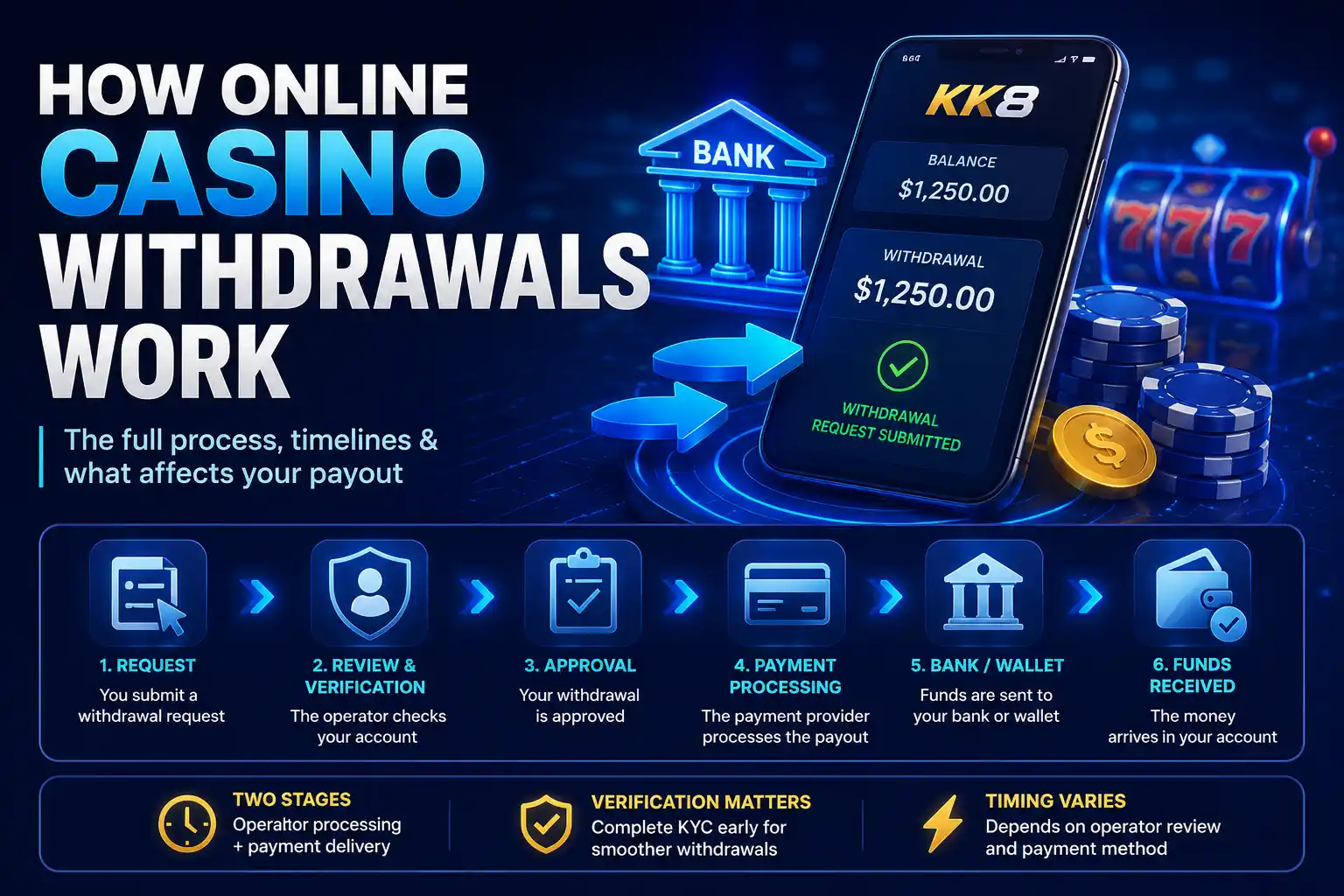
    Most guides to online casino withdrawals stop at the button. You pick a method, type an amount, press Withdraw, and the article ends there. The part people actually have questions about is everything that happens next: the review, the verification request, the status that sits on “pending” for hours, and the payment that shows as completed on the site but has not landed in the bank yet.

    This guide explains the full process from both sides. One side is the operator deciding whether to approve and release your payout. The other side is the payment network actually delivering the money. Those are two separate stages with two separate timings, and almost every confusing withdrawal experience comes down to not knowing which of the two you are waiting on.

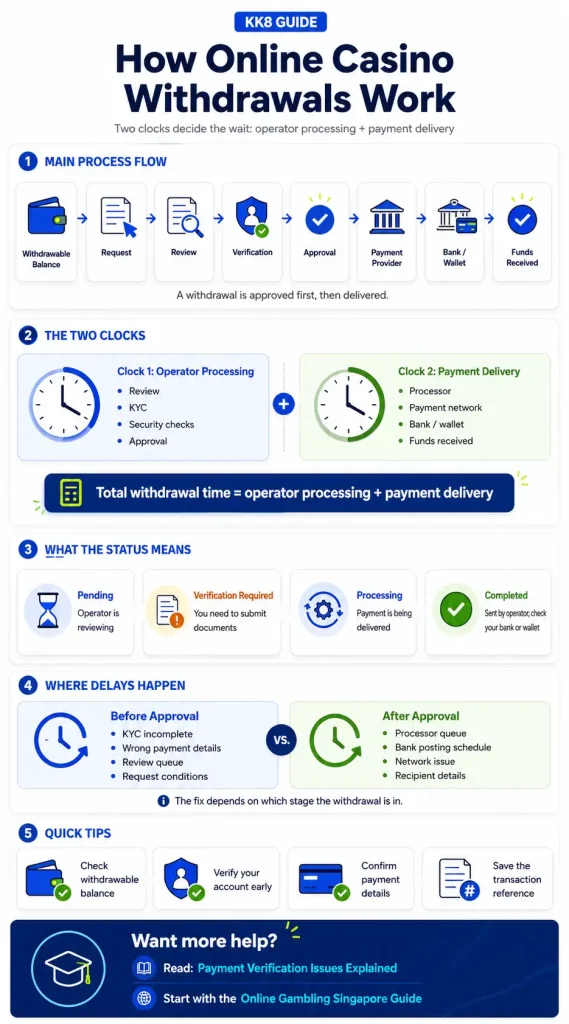
    Quick answer: How does an online casino withdrawal work?

    A withdrawal moves eligible funds from your account balance to a payment account you own. You submit a request, the operator checks the account and the request against its own conditions, verification is completed if it has not been done before, and the withdrawal is approved and released. A payment provider and a receiving bank or wallet then deliver the funds. Both stages take time, and only the second one is affected by how fast your payment method is.

    The full path looks like this:

    Withdrawable balance → withdrawal request → account checks → verification → approval → payment provider → bank or wallet → funds received

    What is an online casino withdrawal?

    A deposit and a withdrawal are not mirror images of each other. A deposit is a payment you push to the platform, and it usually clears quickly because you are the one authorising it. A withdrawal is a payout the platform sends to you, which means it has to be checked and approved before any money moves.

    Three balance concepts matter here:

    • Account balance. Everything showing in your account, including funds that are not free to move.
    • Withdrawable balance. The portion that can actually leave, once unsettled bets, pending transactions and any bonus conditions are excluded.
    • Payment account. The bank account or wallet receiving the money, which normally has to be in your own name.

    That last point explains a lot of friction. Payouts generally have to travel back through an approved route to an account that belongs to the account holder, which is why platforms ask for verification when the receiving details are new or do not match the profile on file.

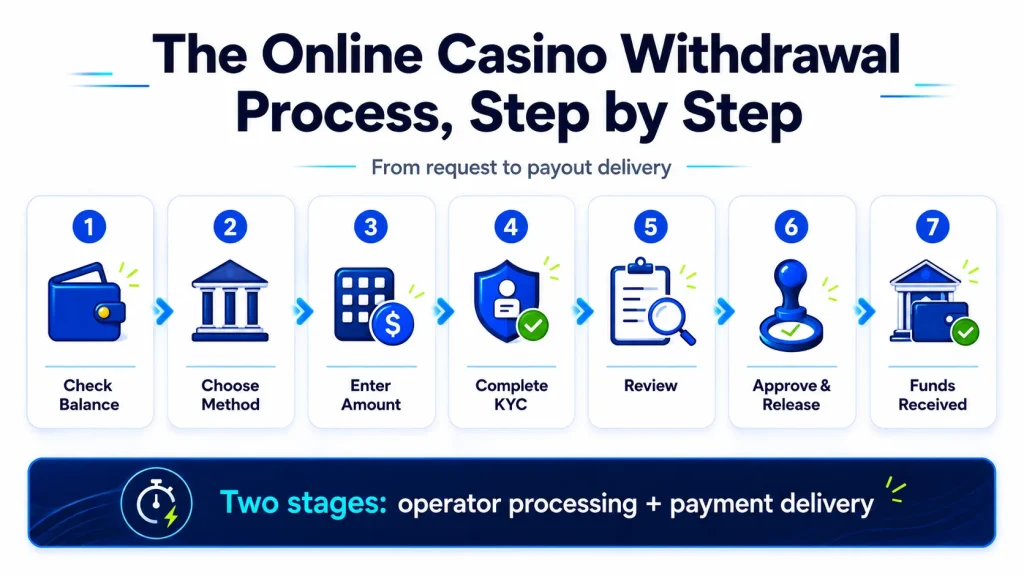
    The online casino withdrawal process, step by step

    The online casino withdrawal process moves from balance checks and verification to operator approval, payment processing and funds received

    Step 1: Check your withdrawable balance

    Account balance is not always the same as withdrawable balance. Say you have $500 showing, but $120 sits on a bet that has not settled and $60 came from a bonus that still has conditions attached. Your withdrawable balance is $320, and requesting $500 will fail or be reduced rather than approved.

    Check this first, because a request that exceeds the withdrawable amount is one of the most common reasons a withdrawal never gets off the ground.

    Step 2: Choose a withdrawal method

    Withdrawal methods generally fall into a few categories: bank transfers, e-wallets, real-time payment services such as PayNow where supported, and other provider-specific rails. Each has its own delivery behaviour, cut-off times and failure modes.

    There is no single best option for everyone. What matters is whether the method is supported for withdrawals on the platform you are using, whether the receiving account is in your name, and how that method behaves outside business hours.

    Step 3: Enter the withdrawal amount

    Most platforms set a minimum withdrawal, a maximum per transaction, and daily or weekly caps. Some apply fees on certain methods or after a certain number of free withdrawals in a period.

    These policies vary widely, so read the specific numbers on the platform you are using rather than assuming an industry standard exists. A practical tip: requesting an amount just under a maximum limit is usually smoother than splitting one large payout into several requests, which can trigger extra review.

    Step 4: Complete any required verification

    Know Your Customer (KYC) checks sound bureaucratic, but the purpose is simple. The platform needs to confirm that the person holding the account and the person owning the receiving payment account are the same person.

    Checks can include identity documents, age confirmation, proof that the payment account belongs to you, and confirmation of the address or contact details on file. Requirements differ between operators and are not identical everywhere, so treat any list as an example rather than a universal rule.

    The practical advice is to complete verification before you need it. Verification requested at the point of withdrawal adds its own waiting period to a process you are already waiting on.

    Step 5: The withdrawal enters review

    This is the stage most people never see, and the one that explains the majority of pending statuses.

    A review can cover the verification status of the account, whether the payment details are valid and correctly formatted, transaction history, whether the request meets stated conditions and limits, and general security or compliance checks. Some of this is automated. Some of it is a person looking at a queue, which is why time of day, weekends and public holidays can matter.

    Step 6: The withdrawal is approved and released

    Approved does not mean received. It means the operator has finished its side and instructed the payment to go out.

    This distinction is worth holding onto, because it is where most “the site says paid but my bank shows nothing” situations come from. At the moment of approval, the money has left the operator’s process but has not necessarily reached your account.

    Step 7: The payment provider delivers the funds

    After release, a different set of systems takes over:

    Operator → payment processor → bank or payment network → your account

    Each hop has its own processing behaviour. A processor may batch payouts. A receiving bank may post credits on its own schedule. A real-time rail may deliver in seconds. None of this is controlled by the operator once the payment is released, which is why the same platform can produce very different total times for two different methods.

    The two clocks behind withdrawal time

    The single most useful way to think about online casino withdrawals is that two separate clocks run one after the other.

    Clock 1: Casino processing time

    This covers request review, KYC if required, security and compliance checks, approval, and release. It is set by the operator’s policy, staffing and queue, not by your payment method.

    Clock 2: Payment delivery time

    This covers the payment provider, the banking network and the receiving account. It is set by the rail you chose and the institution receiving the money.

    Total withdrawal time = operator processing + payment delivery

    Here is what that looks like in practice. A player submits a withdrawal at 11pm on a Saturday using an instant payment rail. The operator’s review finishes at 2pm on Sunday. The transfer itself lands in roughly ten seconds. Total time from request to money in hand: about 15 hours, on a payment method that is genuinely instant.

    Nothing went wrong in that example. The instant part of the process was instant. The waiting happened entirely on the first clock. This is the reason “instant withdrawal” claims should be read carefully: a payment rail can only ever describe the second clock.

    What each withdrawal status means

    Pending, processing and completion are not interchangeable. Each one tells you which clock is running.

    Status What it means Who controls it now Your next step
    Requested The request has been submitted Operator Wait for review to begin
    Pending The operator has not finished reviewing it Operator Check the stated processing window
    Verification required More information is needed before approval You Submit the requested documents
    Approved The request has passed review Operator, briefly Wait for the payment to be released
    Processing The payment has been sent for delivery Payment provider Check your method’s typical timing
    Completed The operator considers the payment sent Receiving bank or wallet Check the receiving account and reference
    Rejected The request was not accepted You Read the stated reason before resubmitting

    The line worth remembering: completed is an operator status, not a bank status.

    How long do online casino withdrawals take?

    Any article that gives you one universal number is guessing. The honest answer is that total time depends on a handful of variables, most of which sit on the operator side.

    Factor Which clock it affects Why it matters
    Operator processing policy Operator Sets the baseline review window
    KYC status Operator Unverified accounts add a document review step
    First versus repeat withdrawal Operator First payouts often involve more checks
    Withdrawal method Payment Rails differ from seconds to several days
    Receiving bank or wallet Payment Posting schedules vary between institutions
    Payment processor Payment Some batch payouts rather than sending individually
    Weekends and public holidays Both Affects manual review queues and some banking rails
    Incorrect payment details Both Causes rejection or a failed transfer after release
    Additional account checks Operator Larger or unusual requests can trigger extra review

    Why first withdrawals often take longer

    The first payout on an account is a different transaction from the tenth, even if the amount and method are identical.

      First withdrawal Later withdrawals
    Identity verification Usually reviewed for the first time May already be on file
    Payment account ownership Needs to be established Already established if unchanged
    Document review Manual, adds a queue Often not repeated
    Typical experience Longest processing of any payout Fewer steps, but not guaranteed faster

    Repeat withdrawals are not automatically quicker. Previously completed verification can remove some steps, but a new payment account, a much larger amount or an unusual pattern can put a later withdrawal back into full review.

    Why online casino withdrawals get delayed

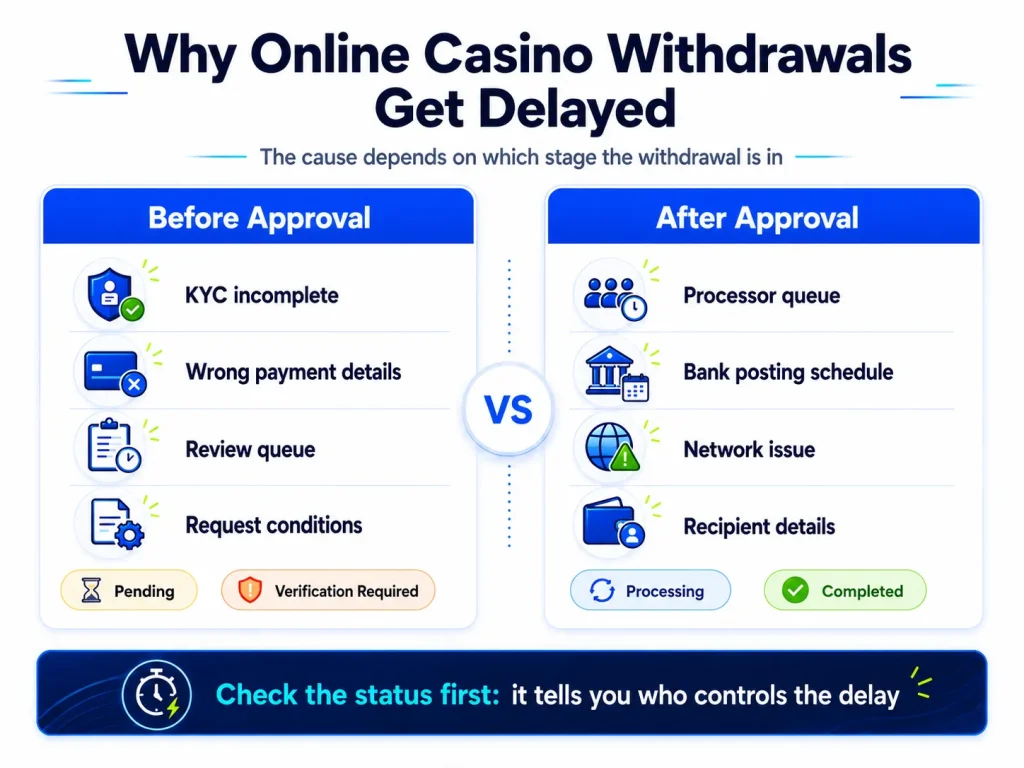
    why online casino withdrawals get delayed before and after approval, including KYC, payment details, processor queues and bank processing

    Generic delay lists are not much help when you are waiting. It is more useful to split delays by where they happen, because the fix is different on each side.

    Delays before approval

    These sit with the operator, and the status will usually read pending or verification required.

    • Verification is incomplete or a submitted document was unclear
    • Payment details are wrong, mismatched or in another person’s name
    • The account has been flagged for additional review
    • The request does not meet stated conditions or limits
    • The review queue is long, often outside business hours

    Delays after approval

    These sit with the payment side, and the status will usually read processing or completed.

    • The payment processor is batching or has queued the payout
    • The receiving bank posts credits on its own schedule
    • A payment network issue or maintenance window
    • Recipient details were accepted but do not match the destination account, causing a return

    Knowing which list you are in tells you who to ask. Before approval, the operator can act. After approval, the answer usually lies with the receiving institution and the payment reference.

    Why a withdrawal may be rejected

    Rejection is not the same as a delay, and the reason given is normally specific. Possible reasons include:

    • Incorrect or unreadable payment information
    • Verification not completed within the requested period
    • A payment method that can receive deposits but not payouts
    • An amount below the minimum or above the stated maximum
    • A mismatch between the account holder and the payment account owner
    • Platform-specific conditions attached to the funds

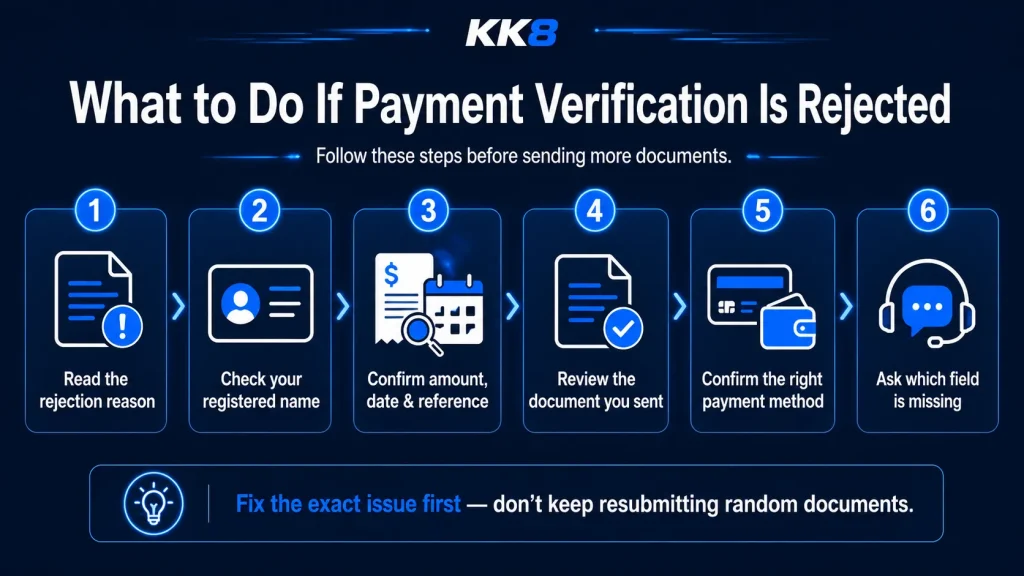
    These are examples rather than a universal list. The practical response is always the same: read the stated reason first, fix that specific issue, and only then submit a new request. Resubmitting an identical request without changing anything tends to produce an identical outcome.

    Does the withdrawal method affect speed?

    It affects the second clock only.

    Method What determines the timing
    Bank transfer Operator approval, processor handling, receiving bank posting schedule
    E-wallet Operator approval, wallet provider processing
    Real-time payment rail Operator approval, then near-instant delivery
    Other provider-specific methods Provider’s own processing rules and cut-offs

    Fast payment technology does not shorten operator review. A rail that settles in seconds still waits behind whatever approval process comes before it.

    How PayNow fits into casino withdrawals

    PayNow runs on FAST and lets participating banks and major payment institutions transfer SGD between accounts using a mobile number, NRIC or UEN, around the clock. As a payment rail, it is genuinely fast.

    What PayNow does not do is change the first clock. If a withdrawal has not been approved yet, PayNow has nothing to deliver. This is the single most common misunderstanding among Singapore users: the transfer speed they experience person-to-person is not the same as total withdrawal time from a gambling platform.

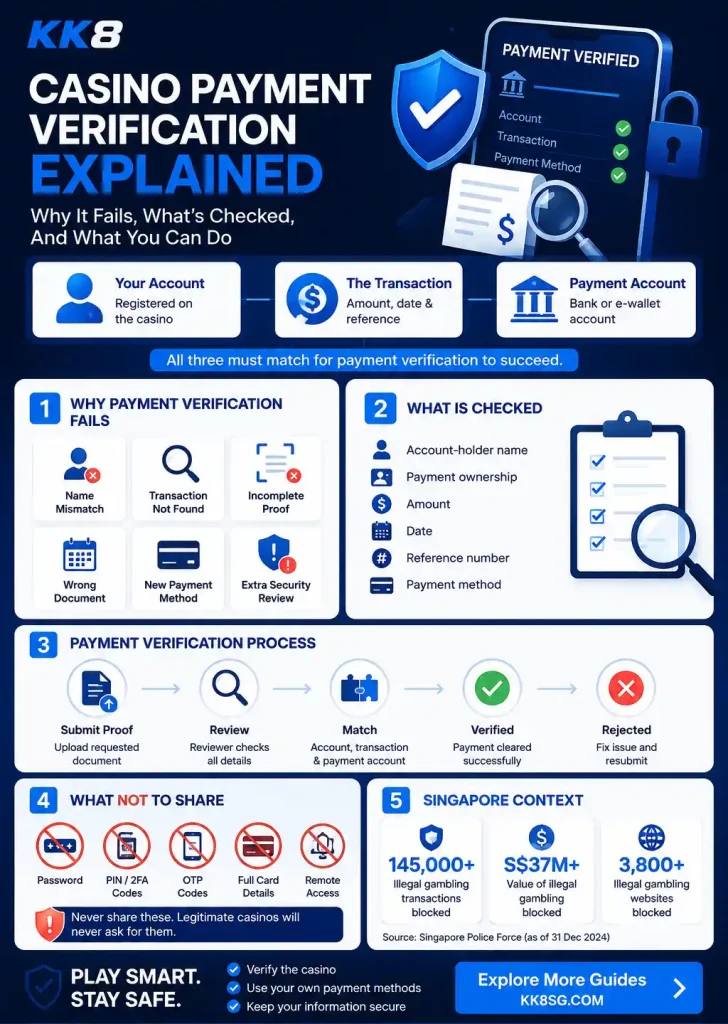
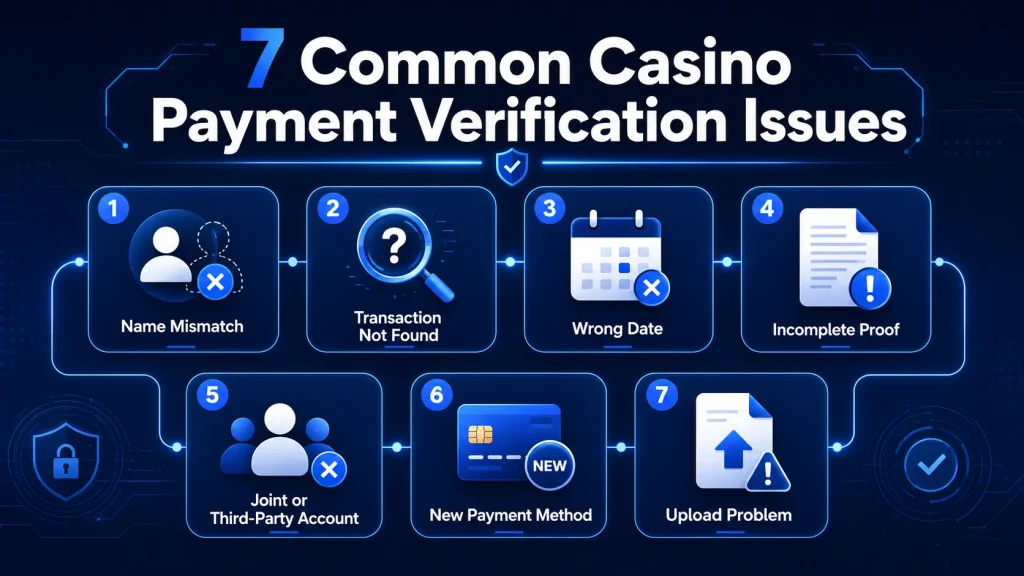
    Two useful reads on this: Why Casino Withdrawals Take Longer for the common reasons a payout may be delayed, and Payment Verification Issues Explained for the checks that can affect withdrawal processing.

    What to check before requesting a withdrawal

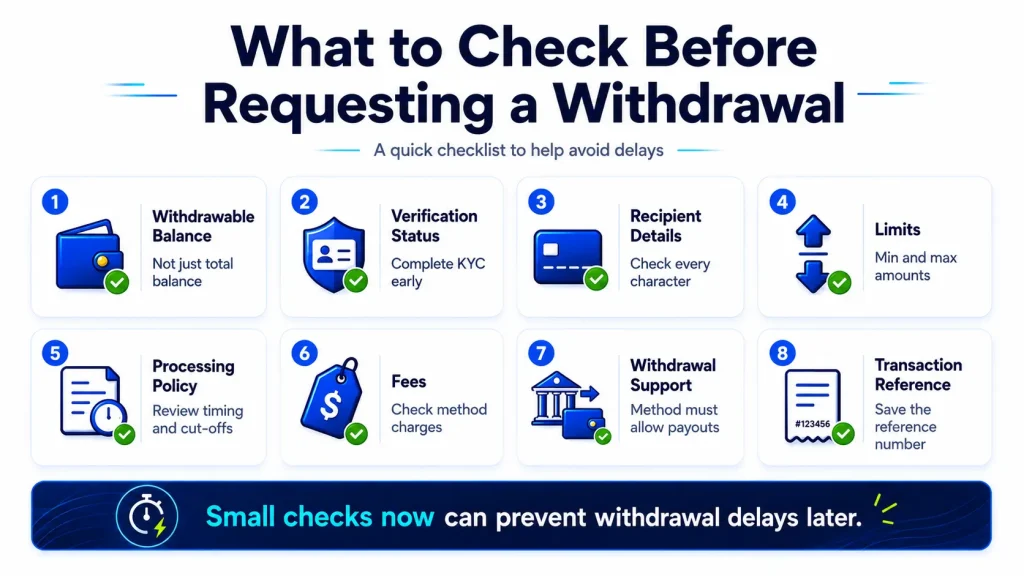
    what to check before requesting an online casino withdrawal

    • Withdrawable balance, not just account balance
    • Verification status on the account, completed in advance where possible
    • Recipient details, checked character by character
    • Minimum and maximum limits for your chosen method
    • The stated processing policy and any cut-off times
    • Any fees attached to the method or the frequency of withdrawals
    • Whether the method actually supports withdrawals, not only deposits
    • The transaction reference, saved somewhere you can find it later

    That last item is the one people skip and later need. A reference number is what turns “my money is missing” into a question a bank or support team can actually answer.

    What to do if a withdrawal has not arrived

    Start with the status, because it tells you which clock you are on.

    Pending. The operator has not finished its review. Check the stated processing window and whether any verification request is sitting unanswered in your account or email.

    Verification required. Nothing will move until you respond. Submit exactly what was asked for, in the format requested.

    Processing. The payment has been released. Check the typical delivery time for your method before chasing it.

    Completed. Check the receiving account carefully, including pending or unposted credits, and look up the payment reference. If a real-time rail was used and nothing has arrived after a reasonable period, the receiving details are the first thing to verify.

    Rejected. Read the reason, correct that specific issue, then submit a fresh request.

    Key takeaway

    An online casino withdrawal is not one instant transaction. It is an operator-side process followed by a payment-delivery process, and each has its own timing. Once you know where a withdrawal sits, whether that is requested, pending, approved, processed or completed, and which clock is running, most of the confusion about withdrawal times disappears.

    If you want to go deeper into withdrawal checks, read Payment Verification Issues Explained next. For more on payments, security and local regulation across the topic, start with our Online Gambling Singapore Guide.

    Frequently Asked Questions

    How do online casino withdrawals work?

    You submit a request, the operator reviews and approves it, then a payment provider delivers the funds. Both stages add time.

    How long does an online casino withdrawal take?

    Operator review time plus payment delivery time. A fast payment method does not shorten the review.

    Why is my casino withdrawal pending?

    The operator has not finished reviewing it. Usually incomplete verification, wrong payment details, or a review queue.

    What does “processing” mean on a casino withdrawal?

    The payment has been released for delivery. It has not reached your account yet.

    Why does a casino ask for verification before a withdrawal?

    To confirm the account holder and the owner of the receiving payment account are the same person.

    My withdrawal is completed but I have not received it. Why?

    Completed means the operator has sent it. Your bank or wallet still has to post the credit, so check the payment reference and the receiving account.

    Does PayNow make casino withdrawals instant?

    No. PayNow transfers are instant, but only after the operator has approved and released the payout.

    Will cryptocurrency replace traditional casino payment methods?

    Unlikely in markets with strong domestic real-time payments. Crypto addresses cross-border and banking-access problems, but it introduces volatility, complexity and regulatory friction that most mainstream users have no reason to accept.

    Are online gambling payments legal in Singapore?

    It depends on whether the gambling service is legally allowed to operate in Singapore. Under Singapore law, providing unlicensed remote gambling services is unlawful, and individuals may also commit an offence by participating in unlicensed remote gambling. Always check the latest rules from the Gambling Regulatory Authority (GRA) before using any online gambling service.

  • Casino Withdrawal Delay: Why Withdrawals Take Longer

    Casino Withdrawal Delay: Why Withdrawals Take Longer

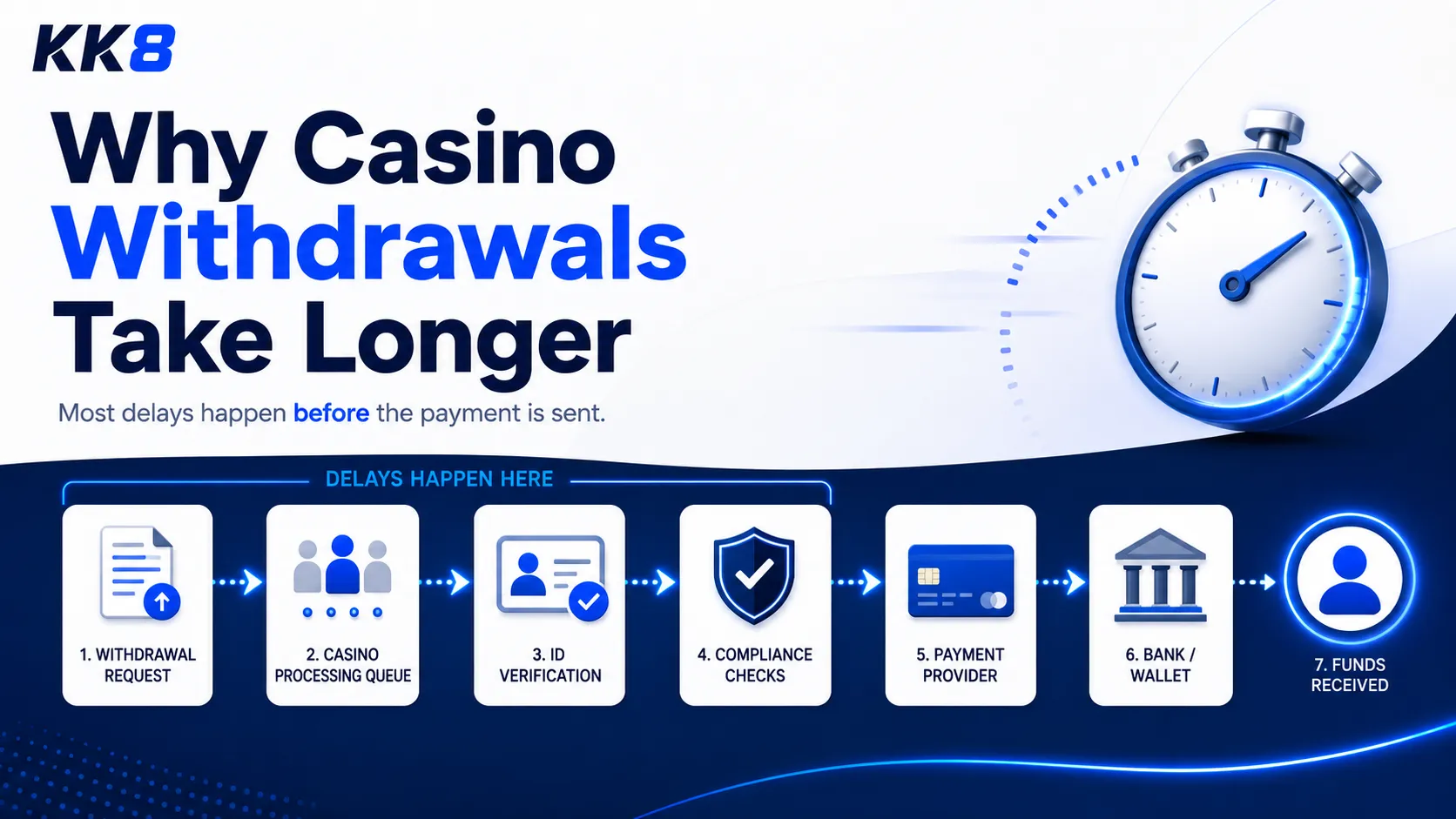
    A casino withdrawal delay usually happens before the money ever reaches a payment network. Your request may sit in the operator’s processing queue, wait for identity or payment verification, go through a compliance review, and only then get sent to a bank, e-wallet or payment provider that has its own processing time. Each of those stages is controlled by a different party. That is why a deposit can land in seconds while the withdrawal of the same money takes hours or days. The useful question is not “how long does a withdrawal take” but “which stage is my withdrawal sitting in right now”.

    How a casino withdrawal actually works

    Most guides treat a withdrawal as a single event with a single processing time. It is not. It is a chain, and the money changes hands between organisations along the way.

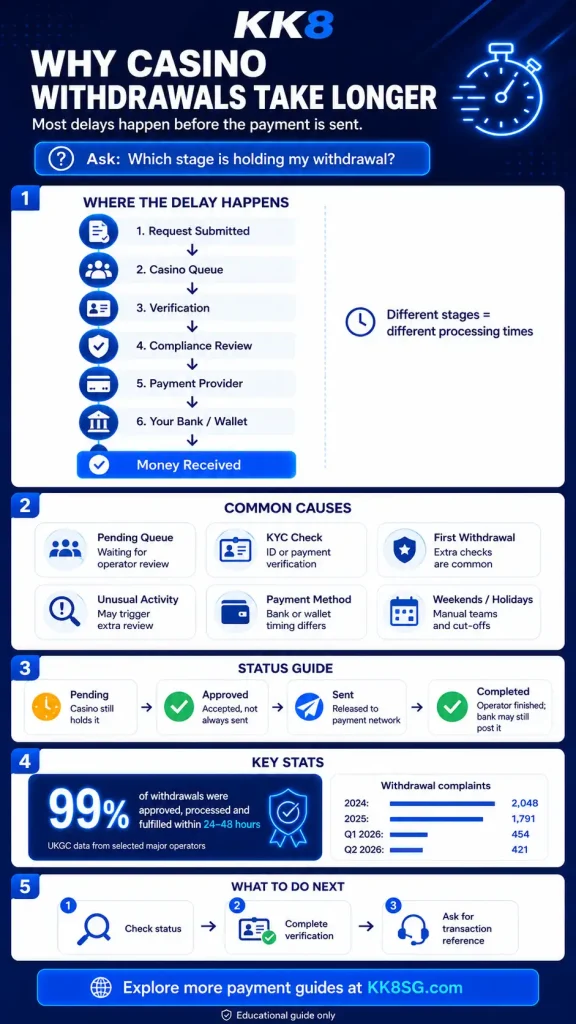
    The withdrawal journey

    1. Withdrawal requested: You submit the request in your account.
    2. Casino processing queue:The operator picks the request up, either automatically or through a manual payments team.
    3. Account verification: Identity, address or payment-ownership checks, if they have not already been completed.
    4. Risk or compliance review: Applied to some transactions, not all.
    5. Withdrawal approved: The operator agrees to release the funds.
    6. Payment provider processes the transaction: A bank, e-wallet or payment service provider moves the money.
    7. Receiving account credits the money: Your bank or wallet posts it to your balance.

    Knowing which stage you are in changes what you should do. A withdrawal stuck at stage 3 is solved by uploading a document. A withdrawal stuck at stage 7 cannot be solved by messaging the casino at all.

    Casino withdrawals can be delayed at different stages, including operator processing, verification, compliance review and payment processing

    The 7 most common reasons casino withdrawals are delayed

    1. It is still in the casino’s processing queue

    Operators typically publish two separate numbers, though many blur them together: their own internal processing time, and the payment method’s processing time. Internal processing is the period between you clicking withdraw and the operator releasing the payment. Some operators automate this for small amounts. Others batch requests and review them manually during business hours.

    If your withdrawal shows as pending and no documents have been requested, this is usually where it is.

    2. Your account needs KYC verification

    Know Your Customer checks confirm that you are who you say you are. They normally involve an identity document, sometimes a proof of address, and often a check that the payment account belongs to you.

    Verification requests are routine, not an accusation. Regulated operators are required to perform customer due diligence, and payment providers frequently require it too. What matters is whether the request is clearly explained, reasonable in scope, and consistent with what the operator published in its terms.

    Where verification is worth questioning is when the requirements keep expanding after each submission with no explanation.

    3. Additional compliance checks are required

    Beyond basic identity checks, some transactions attract further review. Common triggers include a transaction pattern that differs sharply from the account’s history, a mismatch between deposit and withdrawal methods, or an amount that falls outside the account’s usual range.

    These reviews can include source-of-funds questions and enhanced due diligence. The Financial Action Task Force, the global standard setter for anti-money-laundering rules, explicitly includes internet casinos in its risk-based guidance and expects higher-risk situations to attract additional checks rather than uniform treatment of every customer.

    The UK Gambling Commission has taken a similar line from the operator side: legitimate checks can result in a withdrawal being held while a concern is looked at, but operators are not meant to use verification as a general source of friction when customers try to take money out.

    4. It is your first withdrawal

    First withdrawals are slower for a structural reason. Depositing requires almost no checks because money is flowing towards the operator. Withdrawing is the first point at which the operator has to be confident about who you are and where the money is going.

    Once identity and payment ownership have been confirmed and stored on your account, later withdrawals skip those steps. The payment method has not changed. The number of stages has.

    5. The withdrawal amount or activity is unusual

    It is tempting to say large withdrawals are always slower. That is not accurate. A large withdrawal on an account with a long history of similar transactions may pass straight through, while a modest withdrawal on a brand-new account with an unusual deposit pattern can trigger a review.

    The trigger is usually deviation from the account’s own pattern, not the absolute figure.

    6. The payment method needs more time

    There are three separate clocks running, and operators rarely label them clearly:

    Clock Who controls it Typical driver
    Operator processing time The casino Queue depth, manual review, business hours
    Payment provider time Bank, e-wallet or PSP Settlement cycles, provider checks
    Receiving institution time Your bank or wallet Crediting rules, incoming-transfer screening

    7. Weekends, holidays and manual processing

    Some operators process payments continuously. Others run a payments team on a schedule, which means a Friday-evening request may not be picked up until Monday. Receiving banks may also apply their own cut-off times for certain transfer types.

    Operator schedules are not standardised, so this one is worth checking in the operator’s published terms rather than assuming.

    Why deposits can be instant but withdrawals are not

    This is the single biggest source of confusion, and the explanation is structural.

    Deposit: Player → Payment system → Operator

    Withdrawal: Operator → Account checks → Verification → Approval → Payment provider → Player

    A deposit is money arriving. The operator has very little reason to slow it down and every reason to accept it. A withdrawal is money leaving, which is the point at which identity, payment ownership and compliance obligations all become relevant.

    The key takeaway is worth stating plainly:

    Payment speed is not the same as withdrawal speed.

    A payment rail may move funds in seconds once the payment has been released. Everything that happens before release is a separate process with its own timing. For the other side of the same journey, see How Online Casino Deposits Work.

    Casino withdrawal statuses explained

    Status labels are one of the least standardised things in online gambling. Two operators can use the same word to mean different things. Use this as a general map, then check your operator’s own definitions.

    Status What it usually means Who may control the next step
    Requested Withdrawal submitted, not yet actioned Casino
    Pending Waiting in a queue or for review Casino
    Verification required Documents or checks outstanding Casino and player
    Processing Being prepared or transmitted Casino or payment provider
    Approved Casino has accepted the withdrawal Casino or provider
    Sent Funds released to the payment network Payment provider
    Completed Operator considers its part finished Provider or receiving bank

    Two points matter more than the table itself.
    First, completed does not always mean received. On many platforms it means the operator has finished its side of the transaction. Money can still be in transit.
    Second, status wording differs between operators, so do not assume that “processing” at one site means the same as “processing” at another. If the definitions are not published anywhere, that is itself a small signal about how transparent the operator is.

    First withdrawal vs repeat withdrawal

    Factor First withdrawal Repeat withdrawal
    Identity check More likely Usually already completed
    Payment ownership check More likely May already be verified
    Manual review More likely Depends on the operator
    Compliance review Possible Possible
    Payment processing Required Required

    The practical implication: the payment method can be identical on both occasions while the total time is very different. If your first withdrawal took two days and you conclude the payment method is slow, you may be blaming the wrong stage entirely.

    Worked example. Two withdrawals of the same amount, to the same bank account, from the same operator:

    • First withdrawal: 6 hours in the queue, 5 hours waiting for you to upload an ID, 2 hours for review, then a near-instant transfer. Total: about 13 hours.
    • Fifth withdrawal: 40 minutes in the queue, no verification needed, then a near-instant transfer. Total: under an hour.

    Same rail. Same bank. Different number of stages.

    KYC, payment verification and source-of-funds checks are not the same thing

    These get lumped together as “KYC”, which makes it harder to work out what is actually being asked of you.

    KYC (identity verification) confirms who you are. Usually a government ID, sometimes with a selfie or address document.

    Payment verification confirms that the account receiving the money belongs to you. This is why operators often insist on withdrawing to the same method used for the deposit.

    Source of funds asks where the money you gambled came from. This is applied selectively, not to everyone, and is normally triggered by transaction size or pattern.

    Enhanced due diligence is a broader set of checks used in situations assessed as higher risk. FATF guidance supports exactly this kind of risk-based approach: proportionate monitoring, with deeper checks reserved for higher-risk cases rather than applied uniformly.

    Knowing which of the four you are being asked for tells you roughly how long it will take. An ID upload is usually resolved in hours. A source-of-funds request involves human review and takes longer.

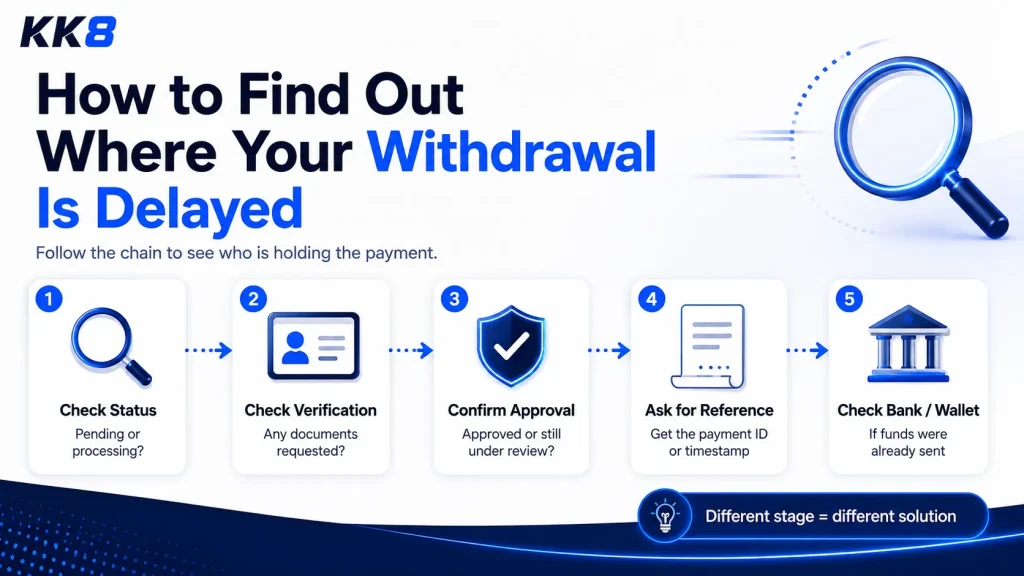
    How to find out where your withdrawal is delayed

    How to Find Out Where Your Withdrawal Is Delayed

    Work through this in order. Each step narrows down which party currently holds your transaction.

    Step 1: Check the withdrawal status. If it says pending or processing, the operator almost certainly still holds it. Start there.

    Step 2: Check whether verification is outstanding. Look in your account notifications, the verification or documents section, and your email spam folder. A surprising share of “stuck” withdrawals are waiting on a document request the player never saw.

    Step 3: Confirm whether the withdrawal has been approved. Ask support directly: has this withdrawal been approved and released, or is it still under review? Those are two different answers and support will often give a vague one unless you separate them.

    Step 4: Request the transaction reference. If funds have been sent, there is normally a payment reference, transaction ID or timestamp. Ask for it in writing.

    Step 5: Check with the receiving payment provider. Once you have confirmation that the money was released, along with a reference, the delay may no longer be within the operator’s control. At that point your bank or wallet provider is the right place to ask.

    If you get to step 4 and the operator cannot or will not provide any evidence that a payment was sent, that is a meaningfully different situation from a slow transfer.

    When is a casino withdrawal delay a warning sign?

    Most delays are ordinary. A few are not. The distinction is less about how long you have waited and more about how the operator behaves while you wait.

    Normal friction

    • Verification requests that are specific and explained
    • Processing periods that match what the operator published
    • A payment provider or bank taking its documented settlement time
    • A one-off compliance review with a clear status

    Possible warning signs

    • Stated processing times that change each time you ask
    • Support that will not say whether the withdrawal has been approved
    • New requirements appearing one at a time after each submission
    • Withdrawal terms that are hard to find or vaguely worded
    • Valid withdrawal requests being cancelled or reversed
    • Encouragement to keep playing instead of withdrawing
    • No transaction record or reference available at any point

    The pattern that separates the two lists is information. An operator handling a legitimate delay can tell you where your money is. An operator that cannot answer a simple factual question about your transaction is telling you something.

    If you are weighing up an operator rather than a single transaction, our guide on How to Verify an Online Casino goes into the checks worth doing before you deposit.

    Singapore payment speed vs casino withdrawal speed

    Singapore readers have a particular reason to find withdrawal delays confusing: domestic transfers here are genuinely fast. PayNow operates over FAST, allowing participating banks and financial institutions to send and receive Singapore dollars almost immediately, around the clock.

    That speed applies to one stage of the chain. Here is what a realistic timeline can look like:

    • Operator review: 8 hours
    • Verification: 4 hours
    • Payment released: –
    • Transfer over FAST: seconds

    Total elapsed time: over 12 hours, of which the actual payment took almost none. The transfer was instant. The withdrawal was not. This is why “instant withdrawal” claims tied to a fast payment method should be read carefully.

    How long should you wait before checking?

    There is no universal answer, and any article that gives you one is guessing. What you should do instead is check the operator’s published:

    • internal processing period
    • verification requirements
    • payment-method timeframe
    • weekend and holiday policy
    • withdrawal terms and limits

    For a sense of scale, the UK Gambling Commission wrote in July 2023 that data supplied by some of Britain’s largest gambling companies showed those firms approve, process and fulfil around 99% of withdrawal requests within 24 to 48 hours. That is a description of practice among large licensed operators in one market, not a rule, and not a benchmark that applies everywhere.

    It is also worth noting that withdrawals remain one of the most complained-about topics even in a heavily regulated market. Complaints to the Commission’s contact centre about withdrawals and financial transactions:

    Period Complaints
    Year to December 2022 2,416
    Year to December 2023 2,405
    Year to December 2024 2,048
    Year to December 2025 1,791
    January to March 2026 454
    April to June 2026 421

    The volumes are trending down over the four full years shown, but withdrawals and financial transactions still sit at or near the top of the complaint categories every quarter. Being unsure about a delayed withdrawal is a common experience, not a sign that you have missed something obvious.

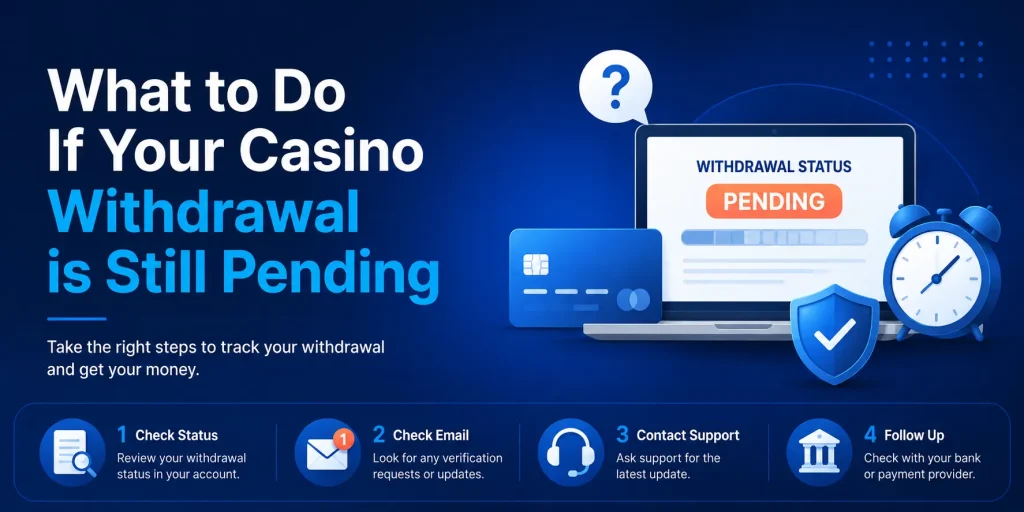
    What to do if your casino withdrawal is still pending

    What to Do If Your Casino Withdrawal Is Still Pending

    1. Check the current withdrawal status in your account.
    2. Check for outstanding verification or document requests.
    3. Compare the elapsed time against the operator’s stated processing time.
    4. Check whether any wagering, bonus or account conditions apply to the balance.
    5. Ask support directly whether the withdrawal has been approved.
    6. Ask separately whether the funds have actually been sent.
    7. Request the transaction reference if it has been sent.
    8. Contact your bank or payment provider once the operator confirms release.
    9. Keep screenshots and written records of every exchange.

    Key takeaway

    1. A casino withdrawal delay does not usually happen at the payment stage. It happens somewhere along this chain:

      Casino processing → Verification → Compliance → Payment provider → Receiving institution

      Working out which stage currently holds your transaction tells you who to contact, what to ask for, and whether the wait is ordinary or worth worrying about. That is a more useful question than whether a payment method is fast.

    Frequently Asked Questions

    Why is my casino withdrawal taking so long?

    The delay can sit at operator processing, verification, compliance review, payment processing or your receiving bank. Identify which stage holds it before contacting anyone.

    Why is my casino withdrawal still pending?

     Pending usually means the operator has the request but has not released the funds. Definitions vary by operator, so check their status guide.

    Why do casino withdrawals take longer than deposits?

    A deposit only has to reach the operator. A withdrawal may need verification and compliance checks before any money is released.

    Can KYC delay a casino withdrawal?

    Yes. Verification normally has to be completed before funds are released. Finishing it before your first withdrawal removes this delay.

    Why is my casino withdrawal approved but not received?

    Approval means the operator accepted it. The payment provider or your bank may still be processing. Ask for the transaction reference.

    What should I do if my withdrawal is completed but I have not received it?

    Completion often means the operator’s part is finished, not that the money landed. Get the transaction reference and release time, then contact your bank.

    Related guides

  • Online Gambling Payment Trends

    Online Gambling Payment Trends

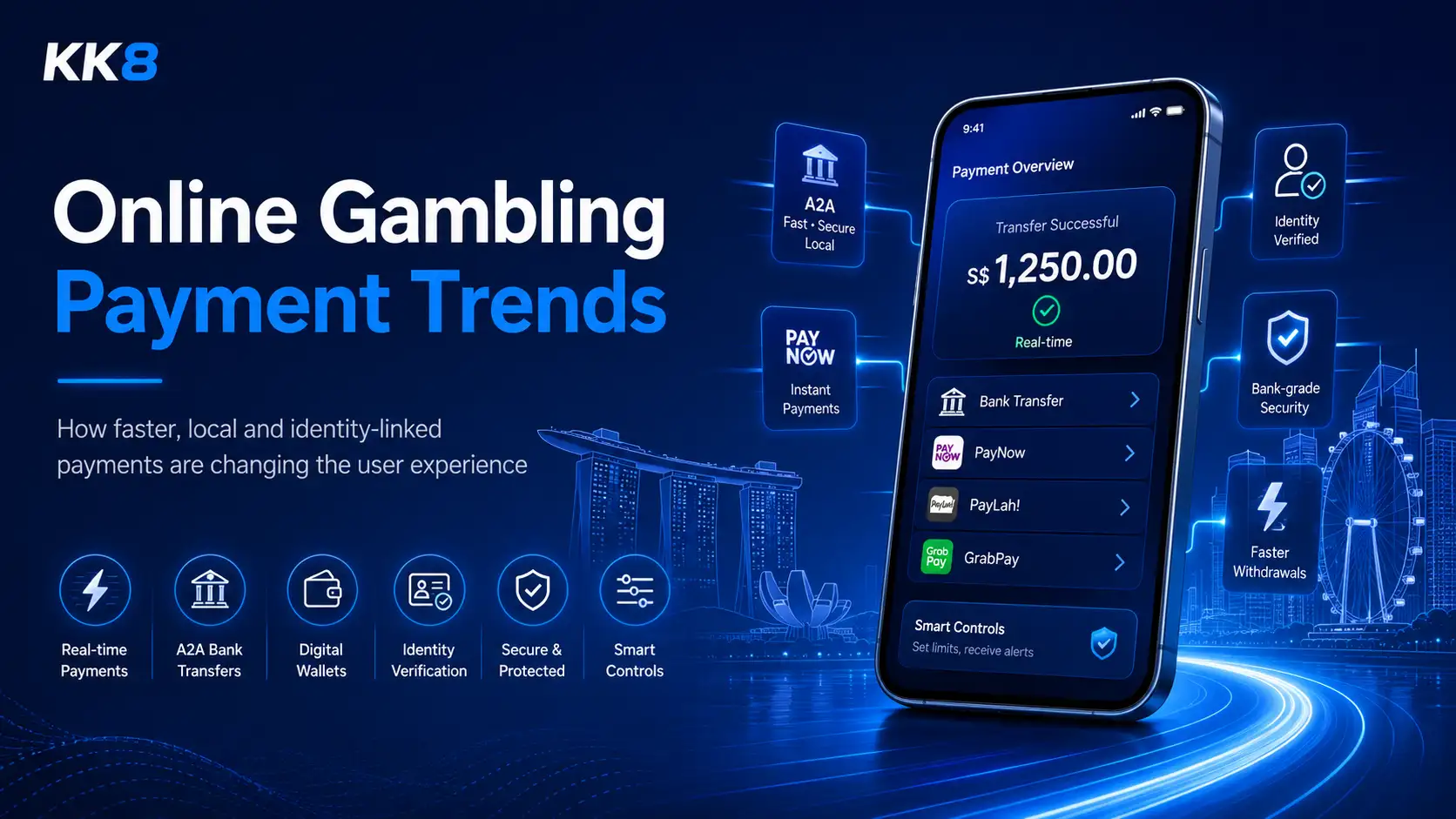
    For most of the internet’s history, funding an online gambling account meant one thing: type in a card number and wait. That model is breaking down. Deposits now arrive through bank rails, QR codes, wallets and mobile apps. Withdrawals are being judged as a trust signal rather than an afterthought. And underneath all of it, payments are quietly being fused with identity verification and fraud controls.

    This guide explains the main online gambling payment trends shaping the industry, why they are happening, and what they look like in Singapore specifically. 

    One thing to be clear about upfront: this article covers payment technology, not legality. A payment method working is not evidence that a gambling service is lawful. We cover Singapore’s legal position in detail further down.

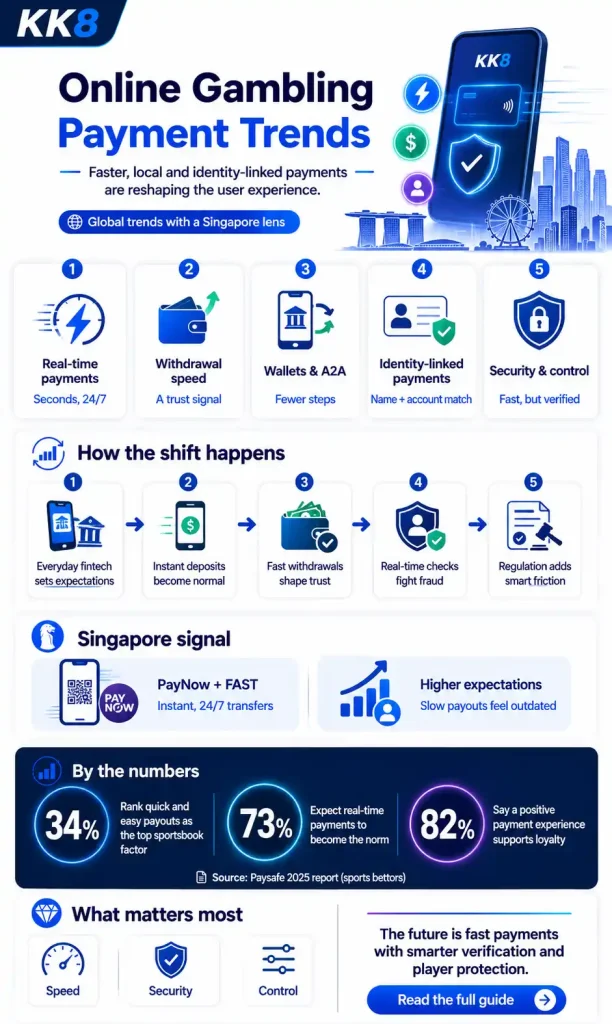
    Key Online Gambling Payment Trends at a Glance

    Trend What is changing Why it matters
    Real-time payments Bank transfers settle in seconds, 24/7 Multi-day waits now feel broken
    Withdrawal speed Payouts treated as a product feature Strongest driver of operator choice
    Digital wallets Stored credentials, mobile-first Convenience, plus a privacy buffer
    Account-to-account (A2A) Money moves bank to bank, no card network Fewer failure points, lower cost
    Local payment rails PayNow, PIX, UPI over global cards Familiarity beats universality
    Identity-linked payments Payment method proves account ownership Fraud and money laundering controls
    Deliberate friction Limits, cooling-offs, verification holds Player protection, legal compliance
    Payment blocking Regulators intercept transactions Legality, not just technology

    online gambling payment trends including real-time payments, faster withdrawals, digital wallets, A2A payments, PayNow, identity verification and security controls

    Why Online Gambling Payments Are Changing

    Gambling payments are not evolving in isolation. They are being dragged along by what people experience everywhere else.

    A Singapore resident splitting a dinner bill sends money by PayNow and it lands before anyone has stood up. They pay a hawker by QR. They move funds between banks at 2am on a Sunday and it clears immediately. Once instant, free, always-on transfers become normal in daily life, a three-day payout window stops reading as “standard processing” and starts reading as a red flag.

    This is the mechanism behind almost every trend below. Consumer payment infrastructure sets the expectation. Gambling operators either meet it or lose to operators that do.

    Trend 1: Real-Time Payments Are Becoming the Default Expectation

    What is a real-time payment?

    A real-time payment moves money between accounts and settles it immediately, at any hour, with the recipient able to use the funds straight away. This is different from a card transaction, where an authorisation happens instantly but the actual money movement is batched and settled later.

    Singapore’s version is FAST, the real-time interbank transfer system. PayNow sits on top of it, letting people send Singapore-dollar funds using a mobile number or NRIC rather than an account number, around the clock. Brazil’s PIX and India’s UPI do broadly the same job in their markets.

    Deposits and withdrawals are not the same problem

    This distinction matters more than most trend articles admit.

    A deposit is easy to make instant. The operator receives money. There is no fraud exposure in accepting funds, only in what happens afterwards.

    A withdrawal is the operator sending money out, permanently. That triggers checks: is this the right person, is the source of funds clean, has the account met its verification requirements, does the transaction pattern look like money laundering? None of that is optional for a licensed operator.

    So the payment rail may be capable of settling in two seconds while the withdrawal still takes a day. The delay usually is not the rail. It is the review sitting in front of it.

    Trend 2: Withdrawal Speed Has Become a Trust Signal

    Deposit friction costs an operator a signup. Withdrawal friction costs an operator its reputation.

    Paysafe’s 2025 “All the Ways Players Pay” report surveyed 4,300 online sports bettors and found that quick and easy payouts were the single most important factor when choosing a sportsbook, cited by 34%. That put payouts ahead of brand trust (33%), and well ahead of promotions and odds (24% each). The same research found 82% said a positive payment experience is part of why they stay with a brand.

    Worth reading carefully: that survey covered sports bettors across six US states, Ontario, the UK, France, Italy, Spain, Romania, and several Latin American markets. It did not survey Asia, and it did not cover casino products. It tells you about the direction of player expectations in regulated Western markets. It is not a Singapore statistic, and anyone presenting it as one is overreaching.

    The structural point holds regardless of geography. Fast deposits are an acquisition feature. Fast withdrawals are a retention and credibility feature. They are solving different problems, and operators that optimise only the first are optimising the easy half.

    Trend 3: Digital Wallets Keep Expanding, but Will Not Take Over

    Wallets earned their place for practical reasons: stored credentials mean fewer re-entered card numbers, they work well on mobile, they consolidate multiple funding sources, and they put a layer between a gambling merchant and a user’s primary bank statement.

    That last point is genuinely useful to some users and genuinely awkward for compliance teams, which is part of why wallets face heavier scrutiny in regulated markets.

    Why wallets are unlikely to fully replace banks and cards

    Three reasons. First, a wallet still has to be funded from somewhere, usually a bank account or card, so it adds a hop rather than removing one. Second, real-time bank rails have closed most of the speed gap that made wallets attractive in the first place. Third, wallets add a layer where money can sit outside the banking system, which regulators increasingly dislike in a gambling context.

    Notably, the Paysafe research found debit cards were still the most-used payment method at 42% in the markets surveyed. Wallets are growing alongside traditional methods rather than displacing them.

    Trend 4: Account-to-Account Payments Are Growing

    An account-to-account (A2A) payment moves money directly from one bank account to another. No card network in the middle, no card number to steal, no issuer to decline the transaction.

    For gambling operators, A2A is attractive because it removes a common failure point. Card issuers frequently decline or flag gambling merchant codes, sometimes inconsistently. A2A sidesteps that entirely. It is also typically cheaper per transaction, and it settles rather than authorising.

    For users, the appeal is simpler: it uses the bank app they already have open.

    PayNow is a clean example of the model. So are PIX in Brazil and UPI in India. What these systems share is that they became dominant in their home markets because they were free, instant and universally supported, not because anyone marketed them at gamblers. The gambling sector is a follower here, not a driver.

    What These Payment Trends Mean for Singapore

    PayNow reset what “normal” means

    Singapore consumers already have free, instant, 24/7 bank transfers through PayNow and FAST, addressable by mobile number. That infrastructure is mature and ordinary.

    The consequence is expectation transfer. Someone who moves money instantly every week is not going to accept a two-day payout gracefully. This is the main way Singapore differs from markets where domestic transfers are still slow or costly: the baseline is already high.

    Be careful with the inference, though. PayNow’s consumer adoption figures describe general payments across the whole economy. They say nothing about gambling volumes, and treating them as a proxy for gambling activity would be bad analysis.

    Trend 5: Payments and Identity Verification Are Merging

    The old model treated these as separate steps. A user completed KYC once during onboarding, and payments ran independently afterwards.

    The direction of travel is different:

    Old model Emerging model
    Verify identity at signup Verify identity continuously
    Payment is a transfer Payment is also proof of ownership
    KYC as a one-time gate Name and account matching on every transaction
    Withdrawal to any method Withdrawal only to a verified, matched source

    Trend 6: Security Is Scaling Alongside Speed

    Faster settlement means less time to catch a bad transaction before the money is gone. So real-time payments have forced real-time risk controls.

    What that looks like in practice: biometric or device-bound login, device fingerprinting, behavioural analysis, transaction monitoring that scores each payment in milliseconds, velocity checks on deposit frequency, and step-up authentication when something looks unusual.

    An important caveat: speed and security are not the same axis, and faster does not mean safer. An instant payment is also an instantly irreversible one. Card payments have chargeback mechanisms that A2A transfers generally do not. That is a real trade-off, not a marketing footnote. Our guide to online casino security features covers the controls in more depth.

    A good payment experience is not just speed. It is speed, security and control together. An operator that delivers only the first is delivering the least demanding third of the problem.

    Trend 7: Faster Payments Do Not Mean Zero Friction

    Some friction in gambling payments is not a defect. It can be an intentional part of player protection.

    Controls built into payment and account systems may include deposit limits, withdrawal verification, name matching, cooling-off periods, self-exclusion tools, and fraud reviews. These checks can slow down certain transactions, but they can also help reduce fraud, prevent unauthorised payments, and give players more control over their spending.

    This creates an important difference between normal digital payments and gambling payments. Consumers increasingly expect fast deposits and withdrawals, but gambling platforms may still need extra checks before some transactions are completed.

    The future of gambling payments is therefore unlikely to be completely frictionless. A more realistic direction is faster payments combined with smarter security, verification, and responsible gambling controls.

    For more information about player protection, see our Responsible Gambling Singapore guide.

    Payment Convenience Does Not Mean Gambling Is Legal

    This section matters more than any trend above.

    A payment method being technically usable does not mean that a gambling service is lawful. Payment systems such as bank transfers, digital wallets and real-time payment rails are general-purpose tools. The availability of a payment option should therefore not be treated as proof that an operator is licensed or authorised to serve users in Singapore.

    Singapore regulates remote gambling under the Gambling Control Act 2022. Providing unlicensed remote gambling services in or from Singapore, or providing such services from overseas to people in Singapore, is unlawful. Holding a gambling licence in another country does not automatically give an operator permission to offer gambling services to Singapore residents.

    The rules also apply to individuals. Participating in unlawful remote gambling can result in penalties under Singapore law, including fines, imprisonment, or both.

    Enforcement can also take place at the payment level. From 1 January 2025, the Singapore Police Force took over responsibility for blocking access to unlawful remote gambling services, related advertising and associated payment transactions. Between 2015 and the end of 2024, Singapore authorities blocked more than 3,800 illegal gambling websites and intercepted over 145,000 payment transactions worth around S$37 million.

    Payment availability is not proof that a gambling service is licensed or lawful. Check the latest guidance from Singapore’s Gambling Regulatory Authority before using any gambling service, and see our guide on how to verify an online casino website.

    Trend 8: Payment Fees Are Becoming Harder to Justify

    There is also a clear shift in how payment fees are handled. The trend is not simply that transaction fees are disappearing. Instead, users increasingly expect common digital payment methods to be low-cost or free at the point of use.

    This is especially relevant for real-time bank transfers and national payment systems, where low transaction friction is part of the user experience. When extra charges are added to widely used payment methods, they can make the payment process feel less competitive and less convenient.

    For online gambling operators, this creates pressure to reduce visible payment fees or absorb more of the processing cost. As payment speed and convenience improve, users are also becoming more sensitive to unnecessary transaction charges.

    The broader trend is clear: payment competition is no longer only about speed. Cost, transparency and convenience are becoming part of the overall payment experience as well.

    Where Cryptocurrency Actually Fits

    where cryptocurrency fits in online gambling payments, including cross-border transfers, 24/7 settlement, volatility, wallet complexity and AML checks

    Crypto gets disproportionate coverage in gambling payment articles relative to its role.

    Where it genuinely helps: cross-border transfers without correspondent banking, settlement independent of banking hours, and an alternative rail in markets where local payment infrastructure is weak or where operators struggle to obtain banking relationships.

    Where it does not: price volatility between deposit and withdrawal, wallet complexity for non-technical users, inconsistent regulatory treatment, heightened AML scrutiny, and irreversibility with no recourse. Crypto also does not change the legal status of the gambling itself. Using a different payment rail to reach an unlicensed operator does not make the activity lawful.

    The honest read is that for mainstream adoption, real-time domestic bank payments and local methods matter considerably more than cryptocurrency. In a market like Singapore, where instant free transfers already exist and are universally supported, crypto solves a problem most users do not have.

    Online Gambling Payment Trends by the Numbers

    All figures below are from Paysafe’s 2025 “All the Ways Players Pay” report, surveying 4,300 sports bettors across the Americas and Europe in November 2024. No Asian markets were included.

    Figure What it measures
    34% Ranked quick and easy payouts as the top factor when choosing a sportsbook, ahead of brand trust at 33%
    73% Expect real-time payments to become the norm at sportsbooks within two years
    82% Say a positive payment experience is part of why they stay with an operator
    66% Are more confident in transaction security than a year earlier
    42% Still use debit cards, the most common single method in the markets surveyed
    32% Of bettors who had not wagered in six months or more cited fraud concerns as their main blocker

    What Comes Next

    Five things worth expecting, rather than fifteen:

    More instant withdrawals. Payout speed is now a competitive dimension, and the rails already support it in most developed markets.

    More direct bank payments. A2A keeps taking share from cards wherever a good domestic rail exists.

    More local methods, fewer universal ones. Cashiers are becoming market-specific rather than globally uniform.

    Payments bound more tightly to identity. Name matching, account matching and continuous verification become standard rather than optional.

    Faster payments inside stronger controls. This is the one that ties the rest together, and it is the real conclusion.

    The headline trend in online gambling payments is not speed on its own. It is that payments are becoming fast, local and identity-linked at the same time that regulation, fraud prevention and player-protection controls are tightening around them. Those two movements are not in conflict. They are the same shift.

    Frequently Asked Questions

    What are the biggest online gambling payment trends?

    Real-time payments, faster withdrawals, growth in account-to-account transfers, a shift toward local payment methods, and the merging of payments with identity verification. Alongside these, regulatory controls over gambling transactions are increasing.

    Are instant casino withdrawals becoming more common?

    Yes, where the underlying rails support it. But the payment rail is rarely the bottleneck. Verification and anti-money laundering checks are, and those exist for good reasons.

    Why do gambling withdrawals take longer than deposits?

    A deposit only requires an operator to receive money. A withdrawal requires it to verify identity, confirm the destination account belongs to the account holder, and clear anti-money laundering checks before sending money out permanently.

    What are A2A payments?

    Account-to-account payments move money directly between bank accounts without passing through a card network. PayNow, PIX and UPI are examples.

    Is PayNow a real-time payment method?

    Yes. PayNow transfers Singapore-dollar funds through the FAST rail and is available 24/7, using a mobile number or NRIC as the identifier.

    Why are digital wallets popular for online gambling?

    Stored credentials, mobile convenience, consolidation of funding sources, and a separation layer between a gambling merchant and a user’s main bank account. They are growing, but they have not replaced cards or bank transfers.

    How does KYC affect gambling payments?

    Increasingly, it does not sit separately from payments at all. Payment details are becoming part of the verification itself, through name matching and account ownership checks on each transaction.

    Will cryptocurrency replace traditional casino payment methods?

    Unlikely in markets with strong domestic real-time payments. Crypto addresses cross-border and banking-access problems, but it introduces volatility, complexity and regulatory friction that most mainstream users have no reason to accept.

    Are online gambling payments legal in Singapore?

    It depends on whether the gambling service is legally allowed to operate in Singapore. Under Singapore law, providing unlicensed remote gambling services is unlawful, and individuals may also commit an offence by participating in unlicensed remote gambling. Always check the latest rules from the Gambling Regulatory Authority (GRA) before using any online gambling service.

    Continue reading

    This article explains payment technology and industry trends. It is not legal advice and does not endorse any gambling service. Check current Singapore gambling regulations with the Gambling Regulatory Authority before using any gambling service. If gambling is causing you or someone you know difficulty, the National Council on Problem Gambling provides support.

  • AI in Online Gambling: How Artificial Intelligence Is Changing the Industry

    AI in Online Gambling: How Artificial Intelligence Is Changing the Industry

    Open an online gambling platform and very little of what you see is arranged by accident. The games near the top of the lobby were ordered by a model. The deposit you made was scored for risk before it settled. The chat window that answered a question at 2am was probably a language model, with a human waiting behind it for anything difficult.

    That is the honest starting point for understanding AI in online gambling. It rarely looks like a robot dealer or a talking assistant. It looks like a decision layer sitting between the player and the platform, ranking content, scoring transactions, flagging behaviour and deciding what gets escalated to a person.

    This guide explains what those systems actually do, what data they use, where they work, where they fail, and how Singapore’s regulatory and AI governance environment shapes the picture. If you are new to the subject, it helps to first understand how online gambling platforms work and the rules that apply to Online Gambling Singapore.

    Quick answer: How is AI used in online gambling?

    Gambling operators use AI in five main places:

    1. Personalisation. Ranking games, ordering content, targeting promotions.
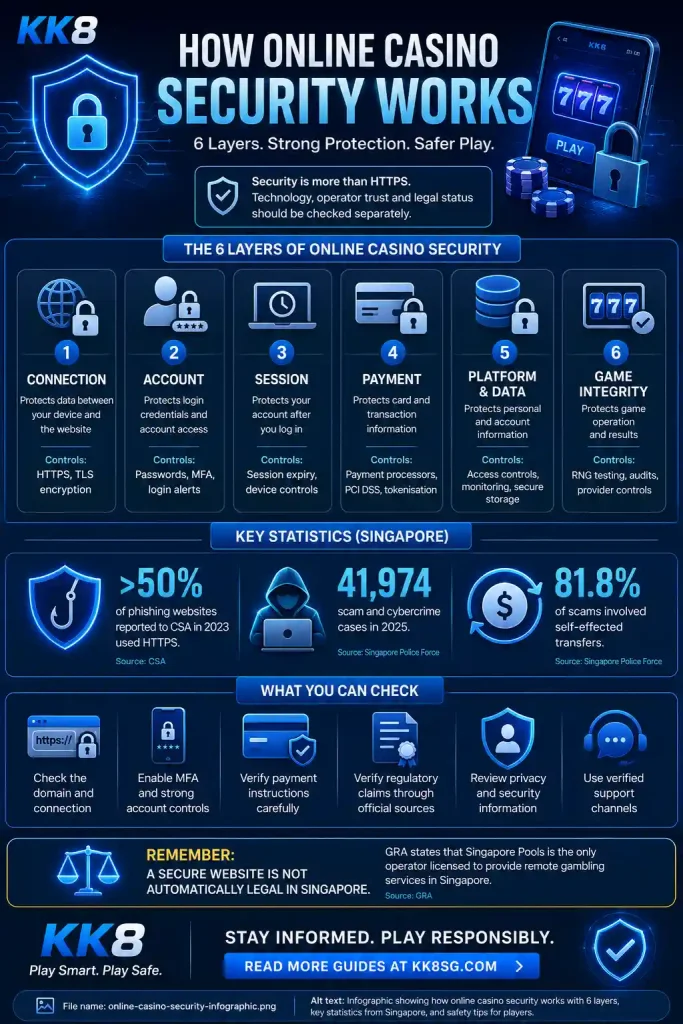
    2. Fraud and payments. Scoring transactions, spotting account takeover, catching duplicate accounts.
    3. Compliance. Supporting identity verification (KYC) and anti-money laundering (AML) review.
    4. Responsible gambling. Monitoring behavioural change and flagging accounts for review.
    5. Customer support. Chatbots, ticket routing, drafting agent replies.

    One distinction matters more than any other, and most articles skip it:

    AI does not understand a player. It finds statistical patterns in data and uses them to make predictions, classifications and recommendations. A prediction is a probability, not a fact about a person.

    Hold on to that and the rest of this article makes sense.

    how AI is used in online gambling for personalisation, fraud detection, compliance, player protection and customer support

    What does AI actually mean in online gambling?

    Most gambling platforms have run on software for decades. What changed is the type of software.

    A rule-based system does exactly what an engineer told it to do:

    Three failed logins in five minutes, lock the account.

    That rule is predictable, auditable and easy to explain to a regulator. It is also easy to work around. A fraudster who knows the threshold simply tries twice.

    A machine-learning system learns the rule from historical data instead:

    Given device fingerprint, IP history, time of day, typing rhythm, past session patterns and roughly two hundred other signals, estimate the probability that this login is not the account owner.

    The model outputs a score, say 0.87. Someone then has to decide what 0.87 triggers: nothing, a step-up verification, a hold, or a human review.

    That decision, the threshold, is where most of the real policy sits. It is also the part that is invisible to players and, in many companies, poorly documented.

    Three properties of machine-learning systems are worth remembering:

    • They are probabilistic. They produce likelihoods, not verdicts.
    • They are historical. They learn from past data, so they inherit past bias and past blind spots.
    • They are opaque by default. Explaining why a specific score came out at 0.87 takes deliberate engineering effort.

    Not all gambling AI is the same

    Lumping every system under “AI” makes the topic harder to think about. Four categories behave very differently.

    Predictive AI

    Trained on historical outcomes to score something about the future: fraud risk, churn likelihood, payment anomaly, behavioural risk. This is the workhorse of the industry and the most mature.

    Recommendation AI

    Ranks and orders content. Which slot appears first, which promotion a player sees, which live table gets surfaced. Players interact with this constantly without noticing it.

    Generative AI

    Large language models used for chat support, summarising a case file for an agent, drafting content. Adoption here has been rapid. In the KPMG and UNLV State of AI in Gaming 2026 study, more than 80% of surveyed gambling companies reported using generative AI in some form.

    Agentic AI

    Systems that plan and take multi-step actions rather than just producing an output. In gambling, the realistic near-term uses are internal: routing a support ticket, gathering documents for a compliance case, running a first-pass review before a human sees it.

    The same KPMG and UNLV research found agentic adoption remains uncommon in gambling, largely because of regulatory sensitivity and player-protection concerns. That caution is reasonable. An agent that can act rather than merely suggest needs a much clearer accountability structure behind it, which is exactly what Singapore’s IMDA framework addresses later in this article.

    AI type Example use Does the player see it? Maturity in gambling
    Predictive AI Fraud and risk scoring Usually not High
    Recommendation AI Game and promo ranking Yes High
    Generative AI Chat support, summaries Sometimes Growing fast
    Agentic AI Automated internal workflows Usually not Early

    Where AI appears across the player journey

    This is the clearest way to see how much of the experience is mediated by automated systems.

    Registration. Document checks, facial matching against ID, duplicate account detection, device and IP clustering to spot one person running several accounts.

    Deposits. Every transaction is scored. Card testing, mismatched billing details, sudden changes in deposit size or frequency, unusual funding sources.

    Gameplay. Content ranking, player segmentation, bonus targeting, session-level behavioural tracking.

    Customer support. Ticket classification and routing, chatbot handling of routine queries, suggested replies for human agents, sentiment flags that push a conversation to a person.

    Responsible gambling monitoring. Continuous comparison of a player’s current behaviour against their own baseline and against population patterns.

    Withdrawals. Verification checks, AML screening, review of whether a withdrawal pattern looks like normal cashing out or like money movement.

    What can gambling AI actually learn about a player?

    Operators do not need declared personal information to build a detailed behavioural profile. Ordinary product telemetry is enough.

    Signal What it is used for What it cannot tell you
    Login times and frequency Habit modelling, anomaly detection Why the habit changed
    Session length and time of day Engagement scoring, risk flags Whether the player is distressed or just off work
    Deposit size and frequency Value segmentation, risk flags Where the money came from
    Games viewed vs games played Recommendation training What the player actually enjoys
    Bonus usage patterns Promo targeting, bonus abuse detection Intent
    Device, browser, network Fraud and multi-account detection Who is physically at the keyboard
    Support contact history Sentiment and escalation The full context of a complaint
    Rate of change in any of the above Both engagement and harm models The reason for the change

    The last row is the important one, and it deserves stating plainly:

    Seeing a behavioural pattern is not the same as understanding why it happened.

    Take a player whose deposits triple over ten days. That single pattern is consistent with a work bonus, a holiday, someone else using the account, or chasing losses after a bad week. The data looks identical in all four cases. A model can only tell you the pattern is unusual. Deciding what it means, and what to do about it, still requires context that the data does not contain.

    How AI personalises online gambling

    The mechanics are the same as any recommendation system. The model learns which content a player engages with, finds similar players, and reorders the lobby accordingly. Layered on top are segmentation models (grouping players by value and behaviour), churn models (predicting who is about to stop playing), and timing models (when to send a message).

    This is the part of the topic competitors cover heavily, so there is not much more to say about the mechanism. The more useful question is what happens when personalisation collides with player protection.

    The gambling AI paradox: engagement versus protection

    Here is the tension at the centre of this whole subject, and it is rarely stated directly.

    A marketing model and a risk model can look at the same player, using the same underlying data, and reach opposite conclusions.

    The signal Engagement model reads it as Protection model reads it as
    Session length up 40% Highly engaged, recommend more Possible loss of control
    Deposit frequency rising High-value player, increase targeting Escalating spend, review the account
    Playing at 3am Available, send a notification Disrupted routine, risk indicator
    Long unbroken sessions Strong product fit Extended play without breaks
    Returning immediately after a loss Retained Possible chasing behaviour

    Both models are working correctly. They were built to optimise different things.

    So the real question is not whether an operator has responsible gambling AI. It is:

    When the engagement system and the protection system flag the same player, which one wins, who decides, and is that decision recorded?

    That is a governance question, not a technical one. And governance is where the industry currently scores worst. In the KPMG and UNLV benchmark, gambling companies scored an average of 45 out of 100 on overall AI maturity, but governance was the weakest dimension at just 30 out of 100, with only about one in five companies having a dedicated AI governance role. Strategic ambition scored 57. The gap between wanting to use AI and being able to govern it is the story of the current moment.

    How AI can support responsible gambling

    Used carefully, behavioural models can surface things a human reviewer would never catch across thousands of accounts. Typical indicators include:

    • A sharp increase in session frequency or duration relative to the player’s own baseline
    • Rising deposit frequency, especially multiple deposits within a single session
    • Repeated failed deposits followed by successful ones
    • Play concentrated in unusual hours
    • Cancelled withdrawals followed by immediate play
    • Increased contact with support around limits or account access

    What these systems can legitimately do is flag. What they cannot do is diagnose.

    Avoid the framing that AI “identifies problem gamblers.” A model that outputs a risk score has not identified anything about a person’s clinical state. The accurate framing is that AI systems can flag behavioural patterns that may justify further review, a check-in, a limit prompt, or human intervention.

    The difference matters practically as well as ethically. Models produce false positives, and a wrongly restricted account damages trust. They also produce false negatives, and treating a clean score as evidence that someone is fine is exactly the wrong conclusion to draw.

    How AI detects gambling fraud

    Fraud detection is where machine learning earns its keep, because fraud is adversarial and rules go stale fast.

    The core technique is anomaly detection. Rather than checking whether each transaction satisfies a fixed rule, the system builds a picture of what normal looks like for this player, this payment method and this population, then measures how far a given event sits from that picture.

    Common patterns it catches:

    • Account takeover. Same credentials, different device, different geography, different behavioural rhythm.
    • Multi-accounting. Separate accounts sharing device fingerprints, payment instruments or behavioural signatures.
    • Bonus abuse. Coordinated accounts extracting promotional value with play patterns that never appear in genuine users.
    • Payment fraud. Card testing, stolen instrument use, deposit and immediate withdrawal patterns that suggest money movement rather than gambling.
    • Synthetic identity. Documents that pass a surface check but whose supporting data does not cohere.

    The advantage over rules is that a model can catch a pattern nobody wrote a rule for. The disadvantage is that it can be confidently wrong, and the person on the receiving end is a customer whose withdrawal just got held.

    Can AI predict casino game results?

    No, and the reason is structural rather than a matter of computing power.

    Digital casino games are driven by a random number generator (RNG). In a properly implemented and independently tested RNG, each outcome is generated independently. The previous spin carries no information about the next one.

    This is what “independent” means in practice: there is no pattern in the sequence for a model to learn, because the sequence has no memory. Feeding ten million past roulette results into a neural network produces a model that has learned the distribution of a fair wheel, which you already knew from the rules of the game.

    The confusion usually comes from mixing up two very different tasks:

    Task Is there a learnable pattern? Can AI help?
    Predicting player behaviour Yes, humans are habitual Yes
    Predicting fraud Yes, fraud has structure Yes
    Predicting a fair RNG outcome No No

    AI is genuinely powerful at the first two. That success does not transfer to the third.

    Can AI beat online gambling platforms?

    There is no general AI system that guarantees profit from gambling. Anyone selling one is selling something else.

    AI can analyse historical data, estimate probabilities and identify patterns in datasets that contain patterns. Sports betting is the closest thing to a genuine application, because sports outcomes are not random and modelling does have predictive value. Even there, betting markets already incorporate sophisticated modelling, prices adjust, and the operator’s margin applies to every bet regardless.

    What AI cannot do:

    • Remove randomness from a random process
    • Make a negative expected value positive
    • Guarantee any individual future outcome

    Treat “AI casino predictor,” “AI betting bot” and “guaranteed AI system” claims as scam indicators rather than product categories. These tools are one of the most common online gambling scams currently circulating.

    AI is also creating new gambling risks

    The same technology is available to bad actors, and their cost of production has collapsed.

    Deepfake endorsements. Synthetic video of recognisable public figures promoting gambling platforms, used to lend credibility to unlicensed operators.

    Mass-produced gambling websites. Generative tools can produce a convincing site, terms of service, licence page and review content in an afternoon. Singapore’s Ministry of Home Affairs has acknowledged the structural problem directly: blocking measures work to a degree, but illegal operators can create new websites easily and no authority can know of every gambling site. Cheap generation makes that harder.

    Fabricated staff and reviews. AI-generated profile photos and support personas, plus review manipulation at a scale that used to require paid human writers.

    Synthetic identity fraud. Composite identities and altered documents designed to pass automated KYC checks. This is AI attacking AI.

    Fake prediction tools. Products claiming to forecast slots, roulette, baccarat or sports results, often using genuine-looking dashboards to sell a mathematically impossible promise.

    The practical defence for players has not changed much: verify the operator’s regulatory status directly with the regulator rather than trusting the site’s own claims. Our guide on how to spot fake online casino websites covers the specific warning signs.

    When should a human still make the decision?

    Not every automated decision carries the same weight. A wrong game recommendation costs nothing. A wrong account restriction costs a customer and possibly a complaint to a regulator.

    Situation Appropriate AI role Human oversight needed
    Routine FAQ response Full automation Low
    Game or content recommendation Full automation Low
    Promotional targeting Automation with policy limits Medium
    Suspicious payment Flag and hold High
    Identity verification issue Assist the reviewer High
    Possible gambling harm Detect and escalate High
    Withdrawal dispute Assist only Very high
    Account restriction or closure Recommend only Very high

    Singapore offers a useful reference point for thinking about this. IMDA published the Model AI Governance Framework for Agentic AI in January 2026, updated in May 2026, and it is structured around four dimensions: bounding the risks up front, ensuring meaningful human accountability, implementing technical controls, and enabling end-user responsibility. It also describes a spectrum of oversight, from an agent proposing actions that a human approves individually, through to greater autonomy within defined limits.

    An important clarification: this framework is voluntary and general-purpose. It does not regulate online gambling, and nothing here should be read as saying it does. But its central principle travels well. The higher the consequence of an automated decision, the more explicit the human accountability needs to be.

    The future of AI in online gambling

    future AI trends in online gambling, including real-time risk detection, generative AI, agentic workflows, stronger governance and AI-driven fraud prevention

    Skipping the vague predictions, four developments look reasonably well supported:

    Risk detection moves from retrospective to real time. Most behavioural monitoring today reviews yesterday’s data. The direction of travel is intervention during a session rather than after it.

    Generative AI settles into operations. Less player-facing chat, more internal work: case summarisation, compliance drafting, agent assistance.

    Agentic systems arrive slowly, in low-risk workflows first. Internal document gathering and ticket handling before anything touching money or account status.

    Governance becomes the differentiator. With industry governance maturity at 30 out of 100, there is a long way to go on explainability, audit trails, and clear human accountability for automated decisions. Regulators are already asking, and the KPMG and UNLV research found regulators reporting limited visibility into how operators actually use AI.

    Underneath all of it sits an arms race. Operators deploy AI fraud detection while fraudsters deploy AI-generated identities. Regulators build automated monitoring while illegal operators generate websites and advertising at scale. Neither side gets a permanent advantage.

    Frequently Asked Questions

    What is AI in online gambling?

    It refers to machine-learning systems used by gambling platforms to analyse player behaviour, rank and recommend content, score transactions for fraud, support identity and compliance checks, automate customer service, and flag behavioural patterns that may indicate gambling harm. Most of it operates invisibly to the player.

    How do online casinos use AI?

    Mainly in four areas: personalisation of the lobby and promotions, fraud and payment monitoring, KYC and AML support, and responsible gambling monitoring. Generative AI is also widely used for customer support and internal operations.

    Can AI predict online casino games?

    No. Casino games run on random number generators where each outcome is independent of the last, so there is no pattern in past results for a model to learn. AI can predict player behaviour, which is habitual. It cannot predict a fair random outcome.

    Can AI detect problem gambling?

    AI can flag behavioural patterns that may warrant review or intervention, such as sharp increases in session length or deposit frequency relative to a player’s own baseline. It cannot diagnose a person. A risk score is a statistical signal, not a clinical assessment, and it should trigger human review rather than an automatic conclusion.

    How does AI detect gambling fraud?

    Through anomaly detection. Instead of checking transactions against fixed rules, the system models what normal behaviour looks like for a given player and payment method, then measures how far a specific event deviates from it. This catches account takeover, multi-accounting, bonus abuse and payment fraud patterns that no one wrote a rule for.

    Can AI make online gambling safer?

    It can, but the outcome depends entirely on implementation and oversight. The same behavioural data powers both engagement optimisation and harm detection, so whether AI improves player safety comes down to which system an operator prioritises, what thresholds trigger intervention, and whether humans review consequential decisions.

    What are the main risks of AI in online gambling?

    Privacy, given how much can be inferred from ordinary product telemetry. Opacity, since automated decisions about accounts and payments are difficult to explain or appeal. Bias inherited from historical data. And a growing category of AI-enabled scams: deepfake endorsements, mass-produced fake casino sites, synthetic identities and fraudulent prediction tools.

    Learn more

    Understand Singapore’s online gambling environment
    How online gambling works, the rules that apply here, and what players should know before using any platform.
    Online Gambling Singapore guide

    Spot the warning signs
    Fake websites, misleading AI claims and the scams currently in circulation.
    Common online gambling scams

  • Mobile Gaming Trends

    Mobile Gaming Trends

    Most trend articles about mobile gaming start by telling you that more people own smartphones than ever. In Singapore, that observation stopped being useful several years ago.

    Look at the two numbers that matter. Singapore had 9.79 million active cellular mobile connections at the end of 2025, equal to 166% of the population, but that figure actually fell by roughly 99,000 connections over the previous twelve months. Over broadly the same period, the median mobile download speed rose by 50.45 Mbps, a 44.1% increase. (Source: DataReportal, Digital 2026: Singapore, drawing on GSMA Intelligence and Ookla data.)

    That is the whole story in miniature. The number of people to connect is no longer growing. What people can do once connected is growing fast.

    So the interesting question for 2026 is not whether Singaporeans will play on their phones. It is what they now expect once they do: how quickly a game loads, how fast money moves, how few steps stand between opening an app and playing, and how much control they have over their own activity.

    For readers who want the wider picture of formats, payments and rules, our guide to online gambling in Singapore covers the ground beyond mobile devices.

    mobile gaming trends in Singapore, including mobile-first design, faster payments, security, retention and mobile connectivity statistics

    Mobile gaming in Singapore: the numbers behind the trend

    Singapore’s connectivity profile is close to a ceiling. Understanding where the headroom actually is matters more than repeating the penetration figure.

    Metric Singapore Direction
    Internet users 5.78 million +0.9% year on year
    Internet penetration 98.4% of population Effectively saturated
    Cellular mobile connections 9.79 million Down 1.0% year on year
    Mobile connections vs population 166% Multiple SIMs and eSIMs are normal
    Broadband-capable connections (3G/4G/5G) 99.3% Near-complete
    Median mobile download speed 164.75 Mbps Up 44.1% year on year
    Median fixed download speed 394.30 Mbps Up 32.5% year on year

    Figures from DataReportal’s Digital 2026: Singapore report, published November 2025 and based on data collected in October 2025. Mobile speed data is from Ookla and covers cellular networks only, not Wi-Fi.

    Two clarifications worth making, because both are frequently misread.

    First, 166% does not mean everyone owns 1.66 phones. Mobile connections include work SIMs, travel eSIMs, tablets, mobile broadband dongles and connected devices. It is a measure of connections, not people.

    Second, “broadband-capable” is not the same as “uses mobile data.” Some of those connections are voice and SMS plans. DataReportal is explicit about this caveat, and it is a distinction most trend articles quietly drop.

    The honest summary: Singapore has already finished the adoption phase. What is still improving is capacity and quality. That is why the meaningful changes in mobile gaming are now happening in experience design rather than in reach.

    Trend 1: mobile-first design is now the baseline

    There is a real difference between mobile compatible and mobile first, and most players can feel it within about ten seconds even if they cannot name it.

    Mobile compatible means a desktop product that has been made to fit a smaller screen. The lobby still shows 200 game tiles in a grid. Navigation still assumes a mouse. Menus sit at the top of the screen, out of reach of a thumb.

    Mobile first means the phone was the design starting point. In practice that looks like:

    • Primary actions placed in the lower third of the screen, where a thumb naturally rests
    • Tap targets sized generously, since fingers are far less precise than cursors
    • Search and “recently played” surfaced before browsing, because scrolling a long grid on a phone is tiring
    • Portrait orientation supported properly, not just tolerated
    • Loading that prioritises what the player sees first rather than the whole page at once

    That last point has a measurable dimension. Google’s Core Web Vitals now include Interaction to Next Paint, which measures how quickly a page visibly responds when a user taps something. A platform can have a fast first load and still feel broken if every tap lags. Mobile users read that lag as untrustworthiness, not slowness.

    The insight worth taking away: a desktop interface compressed onto a phone is not a mobile product. It is a desktop product that a phone user has to work harder to use.

    Trend 2: the industry has shifted from downloads to retention

    This is the most consequential change in mobile gaming, and it is largely invisible to players.

    The older growth model: more downloads produce more users, which produce more revenue. Companies competed primarily on user acquisition, which is the paid marketing spend used to get an app installed.

    The current model: a better experience produces higher retention, which produces longer player relationships and more revenue per player. Acquisition still matters, but it is no longer the main lever.

    Three things pushed the industry this way.

    First, install growth in mature markets flattened. In a country where almost everyone is already online and already has games installed, there is no large untapped pool left to convert.

    Second, acquisition got more expensive and harder to measure after platform-level privacy changes reduced how precisely advertisers could track which ads produced which installs. When you cannot measure acquisition well, you stop over-investing in it.

    Third, and most tellingly, revenue kept growing even as install growth slowed. Newzoo’s 2026 Global Games Market Report forecasts a total games market of US$213.9 billion, up 6.1% year on year, with mobile the largest segment at US$121.1 billion (+6.8%). Newzoo also revised its final 2025 estimate upward to US$201.6 billion, attributing part of the difference to stronger mobile performance including direct-to-consumer and mini-game revenue.

    That revision is the interesting detail. Growth is coming from deeper monetisation of existing players and from new distribution channels, not from a fresh wave of first-time mobile gamers.

      Earlier model 2026 model
    Primary metric Installs Day 7 and Day 30 retention
    Main investment Paid acquisition Live operations and content cadence
    Growth assumption Market is expanding Market is mature
    Player value Measured at install Measured over months
    Biggest risk Rising ad costs Churn after the first week

    Two terms explained, since the brief audience may not know them:

    Retention is simply the percentage of players who come back. Day 1 retention means those who return the day after first playing. Day 30 retention is the harder and more valuable number.

    LiveOps, short for live operations, means running a game as an ongoing service: seasonal events, rotating content, scheduled updates and offers. It is the difference between a game that ships once and a game that has something new on a Tuesday.

    One caveat on the market figures above: Newzoo’s games market data covers consumer spending on games software and services and explicitly excludes gambling. It describes the mobile games industry, not the online gambling industry. They are related businesses with different economics and very different regulation.

    Trend 3: short, interrupted sessions are reshaping mobile UX

    Desktop play tends to be deliberate. You sit down, you have time, you close the laptop when you are done.

    Mobile play is different in a way that design has been slow to accommodate. A session on a phone is routinely interrupted by a message, a call, a screen lock, an app switch, or a handover between Wi-Fi and cellular data as someone walks out of a building.

    This is not a claim about where Singaporeans play or what they play. It is a claim about how phones work. Any product used on a phone in a dense, highly connected city will encounter these interruptions constantly.

    Good mobile design assumes interruption rather than treating it as an error:

    • Session recovery. If the connection drops mid-round, the state is preserved and restored rather than lost.
    • Graceful network handover. Moving from Wi-Fi to 5G should not force a re-login.
    • Fast resume. Returning to a backgrounded app should not mean reloading everything.
    • Persistent preferences. Settings, favourites and filters survive the session.
    • Fewer authentication steps on return, without weakening security, which is where biometrics have become genuinely useful.

    A concrete example: a player is in the middle of a live-dealer round when a call comes in. On a poorly built platform, they return to a logged-out lobby with no clear record of what happened. On a well-built one, they return to the table with the round resolved and visible in their history. The underlying game is identical. The experience is not.

    Trend 4: faster payments have become part of the experience

    Payments used to sit outside the product. You went away, did a bank transfer, came back later. That gap has closed in almost every category of digital service, and expectations have transferred.

    Singapore is an unusually clear case. PayNow lets people transfer funds using a mobile number or identifier rather than account details, settling in near real time on the FAST rails. SGQR standardised QR payments across providers. For most Singaporean adults, “money moves instantly and I confirm it on my phone” is simply how money now works.

    Once that becomes normal, a service that takes two working days to process something feels not just slow but suspicious. The expectations now carried into any transactional app include:

    • Confirmation within seconds, not hours
    • No manual entry of long account numbers
    • Clear status at every stage, including pending states
    • Verification handled in-app rather than by email chain

    For a general explanation of how transactions are structured on gaming platforms, see how online casino payments work and our comparison of PayNow and other payment methods.

    An important qualification. The existence of fast payment rails says nothing about what those rails may lawfully be used for. In Singapore, the Singapore Police Force took over responsibility for blocking payment transactions connected to unlawful remote gambling from 1 January 2025. Speed of settlement and legality of purpose are separate questions, and readers should not treat one as evidence of the other. See the regulatory section below.

    Trend 5: live and real-time formats keep expanding

    Live formats, meaning anything streamed or synchronised in real time between multiple participants, have grown across mobile gaming: real-time multiplayer matches, streamed competitive events, and live-dealer table games where a human dealer is broadcast to players.

    The technical reason is worth understanding because it is commonly explained wrongly.

    Real-time experiences are limited less by bandwidth (how much data you can move) than by latency (how long each piece takes to arrive) and jitter (how inconsistent that timing is). A 165 Mbps connection with unstable timing produces a worse live experience than a slower connection with steady timing. This is why a video call can stutter on a fast connection.

    What has improved in Singapore is not only headline speed but network consistency, which is what makes synchronous formats viable on a phone at all. When latency is low and stable, a live-streamed table feels responsive. When it is not, the delay between action and response breaks the illusion immediately.

    For readers new to the distinction between live-streamed and software-generated games, our explainer on live casino versus RNG games covers it. RNG stands for random number generator, the software that determines outcomes in games without a live dealer.

    Trend 6: AI has moved from development tool into the player experience

    It is worth being unromantic about this. AI in mobile gaming in 2026 is mostly doing quiet operational work rather than transforming anything.

    Where it is genuinely in use:

    • Recommendations. Surfacing relevant content from large catalogues, which matters more on a phone where browsing is expensive in attention.
    • Support triage. Classifying and routing queries, resolving routine ones, escalating the rest.
    • Fraud and anomaly detection. Flagging unusual login locations, device changes or transaction patterns. This is probably the highest-value application and the least discussed.
    • Difficulty and pacing adjustment in skill-based games.
    • Asset and content production in development pipelines.
    • Segmentation, meaning grouping players by behaviour to decide what to show whom.

    Where it creates problems:

    • Privacy. Personalisation requires behavioural data. In Singapore that sits under the Personal Data Protection Act, and the more granular the profiling, the more careful the handling has to be.
    • Transparency. Players are rarely told why they are being shown something.
    • Cold starts and bad inferences. Recommendation systems generalise from thin data and get people wrong.
    • Over-personalisation. This one deserves emphasis. In any context involving spending, a system optimised purely for engagement can push people toward more activity than they intended. Personalisation and player protection can pull in opposite directions, and pretending otherwise is not credible.

    Anyone claiming AI has revolutionised mobile gaming is overselling it. Anyone claiming it is irrelevant has not looked at fraud detection.

    Trend 7: security has become part of the interface

    Security used to be treated as backend infrastructure. On mobile it is now something players see and judge, and it directly affects whether they stay.

    The shift is from security that adds friction to security that removes it. Biometric unlock through the device’s own secure hardware is faster than typing a password, not slower. Passkeys, which use cryptographic keys stored on the device instead of a shared secret, are both harder to phish and quicker to use.

    What mobile users increasingly expect as standard:

    Feature What it does Why mobile users notice
    Biometric login Uses the device’s face or fingerprint sensor Removes typing on a small keyboard
    Passkeys Replaces passwords with device-held keys Nothing to phish or reuse
    Device recognition Flags logins from unfamiliar hardware Catches account takeover early
    Transaction verification Confirms payments separately from login Limits damage if a session is compromised
    Account alerts Notifies on changes to email, password, payout details Early warning the user actually sees
    Session timeouts Ends idle sessions Protects a phone left unattended

    One local signal of where this is heading: Singapore’s banks have been moving customers away from SMS one-time passwords toward in-app digital tokens, because SMS codes are vulnerable to interception and SIM-swap attacks. Consumer expectations are being set by banking apps, and other services are measured against that standard whether they like it or not.

    Trend 8: apps and browsers are serving different needs

    The claim that apps are replacing browsers is repeated constantly and is not accurate. The two have diverged toward different jobs.

      Mobile app Mobile browser
    Installation Required None
    First access Slower, requires download Immediate
    Notifications Native push Limited, permission-dependent
    Biometric login Well supported Supported via passkeys, less consistently
    Updates User or store-managed Automatic on the server
    Device switching Per-device install Follows the user across devices
    Storage on device Ongoing Minimal
    Commitment Higher Lower

    The practical pattern: browsers win at trial and low-commitment access, apps win at frequency and depth. A person evaluating a service for the first time will almost always start in a browser. A person using something several times a week will usually prefer an app.

    Progressive web apps sit between the two, offering an installed-app feel from a browser, though with some platform limitations.

    One point specific to gambling apps that is often missed: major app stores impose their own requirements on real-money gambling applications, including restrictions on which jurisdictions an app may be distributed in and who may submit it. Distribution is therefore shaped by store policy and licensing, not only by user preference.

    Our full comparison sits at mobile casino app vs browser.

    Compare your options: see how mobile apps and browser-based play differ in access, updates, security and everyday usability.

    Trend 9: mobile esports is now an established structure

    Singapore’s competitive mobile scene is a useful proof point precisely because it is unglamorous and organised.

    MPL Singapore, the Mobile Legends Professional League for Singapore, ran its eleventh season in 2026. The format includes a regular season, playoffs, and a challenger bracket with promotion and relegation, with the champion qualifying for regional competition. That structure matters more than any single result: promotion, relegation and qualification pathways are the marks of an actual competitive ecosystem rather than a series of one-off tournaments.

    Mobile Legends: Bang Bang is also scheduled to appear as a medal event at the 2026 Asian Games, which places mobile competition inside mainstream multi-sport structures.

    The broader point for this article is short: mobile is no longer treated as a lesser platform for competitive play. It is simply a platform.

    Trend 10: player protection tools are moving onto the phone

    If mobile makes participation easier and more frequent, then the tools that help people manage that participation have to live on mobile too. Leaving them buried in a desktop account settings page is a design failure with real consequences.

    Tools that are becoming standard:

    • Deposit and spending limits, set in advance rather than in the moment
    • Session reminders, which display elapsed time during play
    • Activity history, presented plainly rather than as a downloadable statement
    • Cooling-off periods, a short self-imposed break
    • Self-exclusion, a longer or permanent block
    • Notification controls, so a person can stop marketing prompts

    In Singapore, the National Council on Problem Gambling administers exclusion orders, including self-exclusion, and family members can apply in defined circumstances. These are formal mechanisms, separate from any tool an individual platform provides.

    The principle underneath all of this is simple. Convenience is not neutral. A format that reduces friction for playing should also reduce friction for stopping. Our responsible gambling guide covers the available tools in more detail.

    What these trends mean for Singapore specifically

    Singapore combines five conditions that few markets have simultaneously:

    • Near-total internet penetration with no meaningful growth left in reach
    • Mobile connection numbers that exceed population and are no longer rising
    • Rapidly improving network speed and consistency
    • Mature, near-instant digital payments that have reset consumer expectations
    • A strict and actively enforced gambling regulatory framework

    Put together, these produce a specific conclusion, and it is not “mobile gambling is growing in Singapore.”

    It is that the competitive ground has moved entirely to quality. When everyone already has access, when connections are already fast, and when the legal boundaries are firmly drawn, the variables that remain are experience, speed, trust, payment handling, security and player control. Those are the things that differentiate, and they are also the things that are hardest to fake.

    A market that has run out of new users has to get better at serving the ones it has. That is the actual 2026 story.

    Mobile gaming trends to watch beyond 2026

    Predictions age badly, so these are kept conservative and limited to things already visibly underway:

    • Deeper personalisation, with the accompanying pressure for clearer disclosure about how it works
    • Cross-device continuity, where a session genuinely resumes across phone, tablet and desktop
    • Passwordless authentication becoming the default rather than an option
    • Better fraud detection, driven by account-takeover pressure rather than by innovation for its own sake
    • Payments embedded further into the experience, with fewer redirects
    • Player-protection tooling improving, partly through regulatory pressure
    • More regulatory attention to mobile specifically, since that is where activity now sits

    Deliberately excluded: metaverse casinos, VR displacing smartphones, and blockchain restructuring mainstream gaming. Each has been forecast repeatedly for years without materialising at scale. If that changes, the evidence will be visible before the predictions are worth making.

    Singapore regulatory context

    Technical accessibility and legal availability are two different things, and this distinction is the single most important item in this article for Singapore readers.

    According to the Gambling Regulatory Authority (GRA), it is unlawful for any person to provide unlicensed remote gambling services in or from Singapore, or from outside Singapore to persons situated in Singapore. The GRA states that Singapore Pools (Private) Limited is the only operator it has licensed to provide remote gambling services.

    Since 1 January 2025, the Singapore Police Force has handled the blocking of access to unlawful remote gambling services, the advertising of such services, and related payment transactions.

    Three implications follow:

    1. A website loading on a Singapore phone is not evidence that the service is authorised here.
    2. A licence issued by an overseas regulator does not authorise a service to be provided to people located in Singapore.
    3. Enforcement covers advertising and payments, not only the services themselves.

    Anyone unsure of the current position should check the GRA directly rather than relying on commercial websites, including this one. For fuller explanations, see Singapore gambling laws explained and remote gambling in Singapore explained.

    Frequently Asked Questions

    What are the biggest mobile gaming trends in 2026?

    Mobile-first design, a shift from downloads toward player retention, AI used mainly for recommendations and fraud detection, growth in live and real-time formats, faster payments, security built into the interface, and stronger player-protection tools.

    Is mobile gaming growing in Singapore?

    Not in terms of reach. Internet penetration is 98.4% and mobile connections actually declined slightly in the year to October 2025. Growth now comes from deeper engagement, faster networks and better experiences rather than from new users.

    Why is mobile gaming so popular in Singapore?

    High smartphone usage, fast and consistent mobile networks, mature digital payments and a population accustomed to doing most daily tasks on a phone.

    How is 5G changing mobile gaming?

    Mainly through lower and more consistent latency, which matters more than raw speed for live and multiplayer formats. Singapore’s median mobile download speed rose 44.1% in the year to August 2025, but for real-time play, timing consistency is the more important improvement.

    Are mobile gaming apps better than browsers?

    Neither is better in general. Browsers suit first-time and occasional access with no installation. Apps suit frequent use, offering notifications, biometric login and stored preferences.
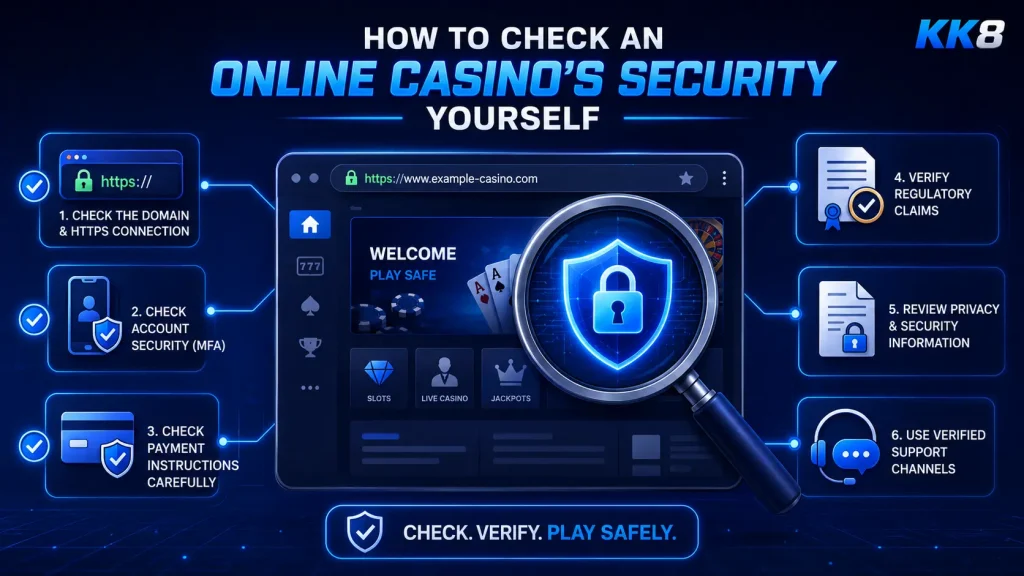
    Explore more online gaming guides

    Learn how payments, mobile access, security and Singapore’s regulations shape the wider online gaming experience.

    Sources

    • DataReportal, Digital 2026: Singapore (published November 2025, data from October 2025), incorporating GSMA Intelligence and Ookla figures
    • Newzoo, Global Games Market Report 2026
    • Gambling Regulatory Authority of Singapore, guidance on unlawful remote gambling activities
    • Liquipedia / MOONTON, MPL Singapore Season 11 competition structure
  • Online Gambling Trends in Singapore

    Online Gambling Trends in Singapore

    Singapore keeps getting more digital. Payments clear in seconds, identity checks happen on a phone, and almost every service assumes you are on mobile. It would be easy to assume gambling has simply followed that curve upward.

    The data says something more interesting. Overall gambling participation in Singapore has fallen for three survey cycles in a row, while reported illegal online gambling has risen from a very low base. Those two lines are moving in opposite directions, and most trend articles miss it entirely.

    This guide separates what Singapore data actually supports from what is global industry marketing. It covers participation, mobile access, payments, enforcement, verification and the technologies people keep asking about. If you want the foundations first, start with our overview of Online Gambling Singapore.

    online gambling trends in Singapore, including declining gambling participation, rising illegal online gambling reports, digital access and stronger enforcement

    Online Gambling in Singapore at a Glance

    Indicator What the data shows
    Overall gambling participation 40% of residents in 2023
    2020 participation 44%
    2017 participation 52%
    Reported illegal online gambling About 1% in 2023, up from 0.3% in 2020
    Problem and pathological gambling rate 1.1%, broadly stable since 2017
    Median monthly gambling spend S$25 in 2023, up from S$15 in 2020
    Only GRA-licensed remote gambling operator Singapore Pools (Private) Limited
    Enforcement direction Websites, apps, advertising, payments and bank accounts

    Participation figures: National Council on Problem Gambling, Survey on Participation in Gambling Activities among Singapore Residents 2023, published November 2024.

    Two terms matter before going further.

    Remote gambling is gambling conducted through the internet or other remote communication, which is the legal category that covers online casino games, online betting and gambling apps. Regulated remote gambling in Singapore means a service provided by an operator licensed by the Gambling Regulatory Authority (GRA). The GRA states that Singapore Pools is currently the only operator it has licensed to provide remote gambling services. Everything else offered to people in Singapore falls outside that licence, which is what the law calls an unlicensed or unlawful remote gambling service.

    That distinction runs through every trend below. For the full legal picture, see our guide to Singapore gambling laws.

    Trend 1: Overall Gambling Is Declining While Online Behaviour Shifts

    The NCPG runs a national survey roughly every three years. Its gambling participation rate is simply the share of residents aged 18 and above who took part in at least one gambling activity in the past year.

    That rate has fallen consistently:

    Survey year Participation rate
    2017 52%
    2020 44%
    2023 40%

    The 2023 figure is the lowest since the survey series began in 2005, when it stood at 58%. The 2023 round polled 3,007 residents between July 2023 and March 2024, with a 73% response rate.

    At the same time, the share of respondents reporting illegal online gambling rose from 0.3% in 2020 to about 1% in 2023. NCPG described that increase as consistent with rising global trends.

    Here is where most articles overreach. A move from 0.3% to 1% is a meaningful proportional jump, but it is still roughly one respondent in a hundred, and it is measured within a shrinking pool of gamblers overall. It is not evidence of an online gambling boom in Singapore.

    The honest reading is narrower and more useful:

    Fewer Singapore residents gamble at all, but among those who do, a small and growing minority report using illegal online channels. Meanwhile, 92% of gamblers in the 2023 survey placed bets through Singapore Pools.

    Two more details add texture. Median monthly gambling spend rose from $15 in 2020 to $25 in 2023, though that is still below the $30 recorded in 2017. And 69% of gamblers bet less than once a week. Fewer people are gambling, and most of them are doing it infrequently.

    One limitation is worth stating plainly. Surveys rely on self-reporting, and people are less likely to admit to activity that is illegal. The 1% figure should be treated as a floor, not a precise measurement.

    Trend 2: Access Is Becoming More Digital and Lower Friction

    The clearest structural trend is not about how many people gamble. It is about how easy access has become.

    The path has shifted over roughly two decades:

    Physical outlets → desktop websites → mobile browsers → dedicated apps → account-based digital identities

    Each step removed friction. A trip to a physical outlet has natural limits: opening hours, travel time, cash in hand. An app on a home screen has almost none. This is the same friction reduction that made food delivery and mobile banking mainstream, applied to a category where friction had a protective function.

    If you want the mechanics of how these platforms actually operate, our guide on how online gambling works walks through the components.

    Mobile Access

    Mobile-first design is now the default across digital services, and gambling platforms are no exception. Practical implications include responsive layouts built for a phone screen, apps with saved login credentials, biometric sign-in, push notifications, and video streaming that holds up on mobile data.

    You will see claims like “80% of Singapore gamblers now use mobile casinos” circulating in trend roundups. There is no reliable public Singapore dataset supporting a number like that. What can be said, accurately, is that mobile-first access is the global norm and that Singapore has high smartphone penetration and mature mobile payment infrastructure, which makes mobile-first access the realistic default here too.

    Live Casino Technology

    A live dealer game is a table game streamed in real time from a studio, with a human dealer, where players place bets through an interface rather than with physical chips. It sits between a random number generator (RNG) game, where outcomes are produced by software, and a physical table.

    The technology has improved steadily: lower streaming latency, better mobile video compression, multi-camera angles and real-time chat with dealers. That improvement is well documented globally.

    What is not documented is Singapore-specific adoption. Treat live dealer growth as a global product trend that shapes what users encounter, not as a measured Singapore behaviour.

    Understand the bigger picture: Read our Online Gambling Singapore Guide for a clear overview of formats, payments, safety and regulations.

    Trend 3: Digital Payments Are Changing User Expectations

    Singapore consumers have been trained by everyday services to expect a specific payment experience: instant transfers, QR codes, real-time confirmation in a banking app, and digital wallets that work without thinking about them.

    That expectation transfers. Users now assume any online transaction will be immediate, traceable and visible in real time, and they read delays as a failure rather than as a normal process.

    An important caution here. It is tempting to claim that instant payment rails are widely used for online casino deposits in Singapore. There is no reliable public data establishing that, and stating it would be guesswork. The defensible point is about expectations, not usage: a population accustomed to instant, confirmable payments will judge every platform against that standard.

    For how deposit flows are structured in practice, see how online casino deposits work.

    Faster Payments Also Create New Risks

    Speed cuts both ways. When money moves in seconds, so does money connected to fraud, and financial institutions have responded with more monitoring rather than less.

    That produces a set of controls users now run into regularly:

    • Payment verification, where a transaction is held pending additional confirmation
    • Transaction monitoring, where unusual patterns trigger review
    • Payment blocking, where a financial institution is directed or chooses to prevent a transaction from completing
    • Account misuse detection, where an account is flagged for behaving inconsistently with its stated owner

    Faster payments do not always mean automatic approval. Banks and platforms may apply additional checks, which can lead to casino payment verification requests.

    Having trouble with a payment? Learn why some payments require additional verification before they clear.

    Trend 4: Enforcement Has Moved From Websites to Money

    This is the most concrete, best-evidenced trend in Singapore, and it deserves more than a disclaimer paragraph.

    Since 1 January 2025, the Singapore Police Force has taken over responsibility for blocking access to unlawful remote gambling services, the advertising of those services, and related payment transactions. That consolidation matters. Blocking a website, blocking an ad and blocking a payment now sit under one enforcement body.

    The Escalation Chain

    Enforcement has expanded well beyond a domain blocklist:

    Website blocking → app disruption → social media content removal → payment blocking → bank account investigation → prosecution of people facilitating transactions

    The last two links are the significant change. Enforcement now reaches individuals who never placed a bet, but who supplied the financial infrastructure that let others do so.

    What the 2026 Enforcement Numbers Show

    Police reported on 25 July 2026 that between 1 May and 20 July 2026 they conducted intensified gambling suppression operations around the 2026 FIFA World Cup period.

    Enforcement measure Reported figure
    People arrested or under investigation 60, aged 17 to 79 (46 men, 14 women)
    Websites, apps and social media content blocked or removed More than 600
    Attempted banking transactions blocked At least 6,900
    Value of blocked transactions More than S$600,000

    Source: Singapore Police Force update, 25 July 2026.

    The site and app takedowns were carried out under the Online Criminal Harms Act 2023, and the transaction blocking was done in cooperation with payment network operators and financial institutions.

    Two individual cases show what this looks like on the ground. In a single operation on 6 July 2026, police arrested 19 people aged 45 to 76 and seized more than S$730,000 in cash. Later that month, between 22 and 24 July, nine people aged 17 to 55 were arrested over the suspected creation of shell companies and corporate bank accounts handed over to a syndicate running an illegal online gambling platform.

    Note the arithmetic on the blocked transactions: 6,900 transactions worth just over $600,000 averages under $90 each. These are not whale-sized transfers. They are ordinary consumer-scale payments, which tells you enforcement is operating at the retail layer, not only against operators.

    Learn the rules: See our guides to Singapore gambling laws and remote gambling in Singapore.

    Trend 5: Identity and Account Checks Are Becoming More Important

    The enforcement pattern above creates a second-order trend: verification is tightening on both sides.

    Regulators and financial institutions are focused on account provenance, meaning whether the person using an account is the person who owns it. The 2026 cases involved individuals suspected of setting up corporate entities and bank accounts specifically so that a gambling syndicate could move money through them.

    The practical consequences for ordinary users:

    • More identity verification requests before withdrawals
    • More scrutiny of accounts receiving frequent unexplained inbound transfers
    • Greater risk in lending an account or credential to someone else, even a friend, even once
    • More friction as a normal feature of legitimate services, not a red flag

    That last point cuts against instinct. A platform that asks nothing at all is not being convenient. It is skipping obligations that regulated services do not get to skip.

    Anyone being offered payment to “just receive a transfer” or to register a company on someone else’s behalf should treat it as a serious legal risk, not a favour.

    Know the warning signs: Learn how to identify fake online casino websites and common online gambling scams.

    Trend 6: Major Sports Events Create Spikes, Not Permanent Trends

    The 2026 World Cup is a clean local case study in why timing matters when reading gambling data.

    Ahead of the tournament, the Ministry of Home Affairs and the Ministry of Social and Family Development announced stepped-up enforcement against illegal gambling. Police stated that operations were intensified to address the elevated risk of illegal betting before and during the World Cup season. Activity around a global tournament is not the same as a durable behavioural shift.

    The distinction is straightforward:

    Type Characteristics Example
    Structural trend Builds over years, persists after the trigger Shift to mobile-first access
    Event-driven spike Sharp rise, sharp fall, tied to a calendar Betting activity around a World Cup

    This matters when you read industry reports. A market-size chart drawn through a tournament quarter will show growth that partly evaporates by the next one. Always check what period a figure covers.

    Trend 7: AI Is Growing Globally, but Singapore Evidence Is Limited

    Artificial intelligence appears in almost every gambling trends article, usually without evidence.

    The plausible applications are real and mostly unglamorous:

    • Fraud and anomaly detection on transactions
    • Identity document verification
    • Customer support triage
    • Content and game recommendation
    • Behavioural monitoring for responsible gambling flags, such as detecting escalating deposit patterns

    The last one is arguably the most consequential and the least discussed. Systems that detect risky play patterns early are a harm-reduction tool, not a growth tool.

    What should be stated clearly:

    AI is a genuine global gambling technology trend. There is limited public data showing how widely specific AI features are deployed or experienced by online gambling users in Singapore.

    Both halves of that sentence are true, and a trend article that only publishes the first half is selling rather than informing.

    Trend 8: Cryptocurrency Gets Attention, but Evidence Matters

    Crypto gambling exists globally and generates a lot of coverage. Singapore-specific adoption data among residents is thin to nonexistent in reliable public sources.

    There is also a legal point that gets lost in the technology discussion. Whether a platform accepts cryptocurrency has no bearing on whether it is permitted to offer remote gambling to people in Singapore. The GRA’s position is about licensing, not payment method. An offshore platform accepting crypto is subject to the same restrictions as one accepting card payments.

    This section illustrates the rule that should govern how you read every gambling trends article, including this one:

    Global Trend Does Not Equal Proven Singapore Trend

    A technology can be genuinely widespread worldwide and still have no measured Singapore footprint. The two claims require different evidence.

    Which Trends Are Actually Supported by Singapore Data?

    Trend Singapore evidence Confidence
    Overall gambling participation declining NCPG national survey, three cycles High
    Reported illegal online gambling higher than 2020 NCPG national survey High
    Stronger enforcement against illegal online gambling SPF operational data, 2026 High
    Payment and transaction blocking SPF and financial institution data, 2026 High
    Bank account and corporate entity misuse SPF case reporting, 2026 High
    Mobile-first access Global and infrastructure evidence, no local gambling dataset Medium
    Live dealer growth Mostly industry sources Medium
    AI personalisation Emerging, mostly global Medium-Low
    Cryptocurrency gambling adoption Limited local evidence Low
    VR casinos Mostly forward-looking prediction Low

    Notice the pattern. The high-confidence rows are all things a government body counted. The low-confidence rows are all things an industry expects. That gap is the single most useful thing to carry away from this article.

    What Could Develop Next

    possible future online gambling trends in Singapore, including stronger verification, smarter payments, AI, fraud detection and responsible gambling tools

    Predictions are marked as predictions. None of the following is established fact.

    Stronger payment monitoring

    Given that payment blocking is already producing measurable results, further integration between enforcement bodies, banks and payment network operators seems likely to continue.

    More identity and account verification

    The pattern of account misuse cases points toward more rigorous checks on account ownership and unusual transfer activity.

    Continued mobile optimisation

    Mobile-first is already the baseline. Refinement is more likely than reinvention.

    Better fraud detection

    Automated anomaly detection is a natural extension of what banks already do elsewhere.

    More AI-powered platform features

    This remains an emerging area locally, with more announced than demonstrated.

    Stronger responsible gambling tools

    Deposit limits, self-exclusion and cooling-off periods could become more automated and harder to bypass.

    Avoid the language of inevitability. Cryptocurrency and VR may develop, could become more common, or may remain niche. There is not yet enough Singapore-specific evidence to say.

    What These Trends Mean for People in Singapore

    Two things are happening at once, and they pull in opposite directions.

    Access to online gambling has never been technologically easier. At the same time, Singapore has tightened controls around unlicensed operators, advertising, payments and the bank accounts used to move money.

    If you take one practical thing from this article, make it a short set of questions worth asking about any online gambling service:

    1. Who operates it, and where? An overseas licence does not authorise service to people in Singapore.
    2. Is it permitted here? The GRA states that Singapore Pools is the only operator it has licensed for remote gambling. Participating in unlicensed remote gambling is an offence, carrying a fine of up to $10,000, imprisonment of up to six months, or both.
    3. How are payments processed? Unusual routing, third-party accounts or requests to transfer to an individual are serious warning signs.
    4. What information is requested, and why? Legitimate verification has a stated purpose. Requests for your credentials, or for use of your account, do not.
    5. Are there limits available? Deposit limits, time limits and self-exclusion tools exist to be used.

    Anyone concerned about their own gambling, or someone else’s, can contact the National Council on Problem Gambling, which operates a helpline and web chat service and administers exclusion orders. Building responsible gambling practices early is considerably easier than unwinding a problem later.

    For the full foundation, return to our guide to Online Gambling Singapore.

    Frequently Asked Questions

    What are the biggest online gambling trends in Singapore?

    The best-evidenced trends are falling overall gambling participation, a small rise in reported illegal online gambling since 2020, and significantly stronger enforcement covering websites, apps, advertising, payments and bank accounts. Mobile-first access and instant payment expectations are shaping how services are built, though these are global patterns rather than measured Singapore behaviours.

    Is online gambling increasing in Singapore?

    The answer is genuinely two-sided. Overall gambling participation fell to 40% in the 2023 NCPG survey, down from 44% in 2020 and 52% in 2017. Over the same period, respondents reporting illegal online gambling rose from 0.3% to about 1%. Fewer people gamble overall, while a small share of those who do report shifting to unlawful online channels. Because the figure is self-reported, it likely understates actual activity.

    Why is mobile gambling becoming more important?

    Because mobile is the default access layer for nearly all digital services, and mobile removes the friction that physical access naturally imposed: opening hours, travel and cash handling. Be sceptical of specific Singapore mobile gambling usage percentages, as no reliable public dataset supports them.

    How are digital payments changing online gambling?

    Mainly by resetting expectations. Users accustomed to instant transfers and real-time confirmation expect the same speed everywhere. In parallel, faster payments have driven more monitoring, which is why verification requests, transaction holds and payment blocking have become more common.

    Are cryptocurrency casinos popular in Singapore?

    There is limited reliable public data on cryptocurrency gambling adoption among Singapore residents. It is also worth noting that accepting cryptocurrency does not change a platform’s legal position: what matters is whether it is licensed to provide remote gambling to people in Singapore.

    Will AI change online gambling?

    Probably, in areas like fraud detection, identity verification, support and responsible gambling monitoring. Current deployment should be separated from prediction. There is limited public evidence about how widely specific AI features are used by online gambling services reaching Singapore users today.

    Explore More Online Gambling Guides

    1. Online Gambling Singapore Guide
    2. Singapore Gambling Laws Explained
    3. How Online Gambling Works
  • Casino Payment Verification Issues Explained

    Casino Payment Verification Issues Explained

    Casino payment verification is the check that connects three things: your account, a specific transaction, and the bank or e-wallet account the money came from. If those three do not line up, the payment gets flagged.

    That is why plenty of people run into this after they have already passed identity checks. Their ID was fine. The problem was something else, usually a name that reads differently on a bank statement, a screenshot missing a reference number, or a transaction the reviewer simply cannot find.

    This guide explains what is being compared, why it fails, and what to check before sending anything else.

    Explore more: Online Gambling Singapore Guide

    Quick answer: Why does casino payment verification fail?

    Most rejections come down to a mismatch that the reviewer cannot resolve from what you sent. The account-holder name on the payment does not match the name registered on the gaming account. The transaction cannot be located because the amount, date or reference does not match the record. The document is cropped, blurred, or shows the wrong statement period. Or the payment came from a method that has not been reviewed yet.

    Fewer failures are caused by the payment being genuinely wrong. Most are caused by the evidence being incomplete.

    Common cause What it usually looks like
    Name mismatch Payment sent from an account in someone else’s name
    Transaction not found Amount, date or reference does not match
    Incomplete proof Cropped screenshot, name or transaction cut off
    Wrong document Statement covers the wrong month
    New payment method A second method used that has not been reviewed
    Extra security review Larger amount, new device, or unusual activity

    Casino payment verification infographic explaining common verification issues, payment checks, failed verification reasons and safety tips for Singapore players

    What is casino payment verification?

    Think of it as three records that need to agree:

    Gaming account → the transaction → bank or payment account

    The gaming account says who the registered holder is. The transaction says how much moved, when, and with what reference. The bank or e-wallet account says whose money it was.

    Payment verification asks whether those three records describe the same person and the same event. When they do, it clears. When one link is missing or contradicts another, it does not.

    An operator may run this check for anti-money laundering and fraud-prevention reasons, and because paying withdrawals out to a person who is not the depositor creates obvious risk. Whether an individual operator applies these checks properly is a separate question, and one worth reading about in our guide on How Online Casino Security Works.

    Payment verification vs account verification

    These get confused constantly, and the confusion is the reason so many people say “but I’m already verified.”

    Account or KYC verification

    This checks who you are. It usually looks at:

    • full name
    • date of birth
    • an identity document
    • residential address

    Pass it once and it generally stays passed.

    Payment verification

    This checks the payment and who owns it. It usually looks at:

    • the account-holder name on the payment source
    • the payment method itself
    • the transaction amount
    • the transaction date
    • the transaction reference

    This one can be triggered again and again, because every new payment method or unusual transaction is a new thing to check.

    Check Account verification Payment verification
    Identity document Yes Sometimes
    Account-holder name Yes Yes
    Payment method No Yes
    Transaction details No Yes
    Proof of payment No Yes

    A verified identity does not verify a payment. That is the single most useful thing to understand here.

    What is actually being checked

    When a reviewer opens your submission, they are trying to match a short list of data points.

    Data point What they compare it against
    Account-holder name The name registered on the gaming account
    Payment ownership Whether the payer and the account holder are the same person
    Amount The credited or requested transaction amount
    Date The date on the internal transaction record
    Reference number The transaction ID or bank reference
    Payment method Whether that method is already linked and reviewed

    If any one of these cannot be confirmed from what you submitted, the whole submission usually bounces back. The reviewer is not guessing on your behalf.

    7 common casino payment verification issues

    common casino payment verification issues including name mismatch, missing transactions, wrong dates, incomplete proof, third-party accounts, new payment methods and upload problems

    1. The account-holder name does not match

    This is the most frequent cause and the hardest to fix.

    If the online gaming account is registered as Tan Wei Ming and the payment arrives from a bank account held by Lim Siew Hoon, the reviewer cannot connect the payment to the account holder. It does not matter that the two people know each other.

    Softer versions of this also cause trouble:

    • registered as “Wei Ming Tan,” bank account reads “TAN WEI MING”
    • registered with an English name only, bank account carries the full legal name including a Chinese name
    • a maiden name on one record and a married name on the other

    The first two are usually resolvable by correcting the registered name to match your legal name on your ID. The third normally needs supporting documentation. A payment genuinely made by someone else is a different situation, and there is no workaround for it. Ownership checks exist precisely to catch that.

    2. The transaction cannot be matched

    The reviewer is searching for one specific line item. Common reasons they cannot find it:

    • the amount submitted differs from the amount credited, often because of a bank or intermediary fee
    • no reference or transaction ID is visible
    • the wrong transaction was submitted, for example an earlier deposit of a similar amount
    • the statement covers a period that does not include the transaction date

    Example: you transferred $300 but $298.50 was credited after a fee. The proof shows $300, the internal record shows $298.50. To an automated matcher those are two different transactions.

    3. The transaction date looks different

    Banks record several dates for one payment: the date you initiated it, the date it was processed, and the date it posted to the account. A transfer made late on a Friday night may post on Monday.

    If your proof shows one date and the operator’s record shows another, do not assume the transaction is wrong. Submit the full transaction record showing the reference and status rather than a single date field.

    4. The document is wrong or incomplete

    A cropped screenshot is the classic rejection. If the reviewer cannot see the account-holder name, the transaction, and enough context to know it is a real record, they cannot approve it.

    Frequent problems:

    • account-holder name cropped out of the top of the statement
    • only the amount visible, no reference or date
    • a payment confirmation screen instead of the transaction record itself
    • a statement from the wrong account
    • a photo of a screen, taken at an angle, partly unreadable

    5. The payment came from a joint or third-party account

    A joint account can be legitimate and still trigger review, because two names appear on it. Expect to be asked for additional evidence that you are one of the named holders.

    A genuine third-party payment, where the money came from someone else entirely, is a different matter. Operators are generally required to reject it, and looking for ways around that check creates a worse problem than a delayed deposit.

    6. A different payment method was used

    Payment methods are usually reviewed one at a time.

    • Deposit A: bank transfer from your DBS account. Verified.
    • Deposit B: e-wallet you have never used on the account before. Not verified.

    The second method has its own review, even though your identity and your first method both cleared. This surprises people who assume verification is account-wide.

    7. Technical and upload problems

    Not everything that fails is a data problem:

    • HEIC or unusual file formats that the system cannot open
    • files over the size limit that silently fail to upload
    • a page that appears to submit but does not
    • an image compressed until the text is unreadable

    If a submission disappears without any rejection reason, this is worth ruling out before you re-send documents.

    PayNow and online banking in Singapore

    If you pay by PayNow or local bank transfer, name matching is the part most likely to cause friction, and a recent change makes it more visible.

    The Association of Banks in Singapore discontinued the PayNow nickname feature for retail customers on 6 June 2026. Nicknames had been available since PayNow launched in 2017, and scammers had been exploiting them to impersonate businesses, government agencies and trusted individuals. From that date, selected letters of the payee’s registered account name are shown to the payer instead, with the rest masked for privacy.

    The practical effect is that the registered account name now carries more weight than it used to. It is the name the payer sees, and it is the name that appears on the transaction record.

    Case one

    • Online gaming account: Tan Wei Ming
    • PayNow account holder: Tan Wei Ming

    The payer and the account holder are the same person. Nothing to question.

    Case two

    • Online gaming account: Tan Wei Ming
    • PayNow account holder: a different person

    The money moved, but there is no line connecting it to the account holder. That is what an ownership question looks like, and no amount of resubmitting the same screenshot resolves it.

    Individual operators handle PayNow proof differently. Some ask for the transaction record from your banking app, some ask for a statement extract. Ask which one they need rather than sending both and hoping.

    For background on how the deposit itself moves before any of this happens, see How Online Casino Deposits Work.

    What to do if payment verification is rejected

    what to do if casino payment verification is rejected, including checking the rejection reason, registered name, transaction details, documents and payment method

    Work through this in order. Sending more documents before you know what failed is the main reason people end up on their fourth rejection.

    Step 1. Read the exact rejection reason. “Verification failed” and “document does not show account-holder name” are different problems. If the message is generic, that is your first question to support.

    Step 2. Check the registered name against your ID. Not against what you assume it is. Open the account settings and compare it character by character with your identity document.

    Step 3. Confirm the amount, date and reference. Match them to the transaction record on your banking or e-wallet app, not to memory. Watch for fee deductions changing the amount.

    Step 4. Check what your submitted document actually shows. Open the file you sent. Can a stranger see the account-holder name, the transaction line, the amount, the date and the reference? If not, that is the fix.

    Step 5. Confirm you are verifying the right payment method. People routinely submit proof for the method they usually use rather than the one under review.

    Step 6. Ask support what specific field is missing. One precise question beats five different documents. “Which field on the proof could you not read?” gets a useful answer.

    This process is for correcting genuine information. If the underlying facts do not support the payment, for instance the money really did come from someone else’s account, no document fixes that.

    If the delay is on a deposit rather than a verification request, What to Do If a Casino Deposit Is Delayed covers that separately.

    What you should never share

    There is a firm line between verification information and account credentials. Verification never requires the second category.

    Reasonable to be asked for Never share with anyone
    Transaction reference number Online banking password
    Amount and date of payment Card PIN
    Redacted statement showing the transaction One-time password (OTP)
    Identity document 2FA authentication code
    Account-holder name Singpass password
    Payment method last digits Remote access to your device

    ScamShield, Singapore’s national anti-scam resource, advises people not to disclose passwords, banking credentials, card details or OTPs, and warns against payment links and QR codes sent by unknown parties.

    No legitimate payment review needs your OTP. An OTP authorises a transaction. It does not prove one happened.

    Payment verification vs withdrawal processing

    People often assume a withdrawal on a fast payment method should arrive within minutes. Verification usually sits before processing even begins.

    A withdrawal typically moves through:

    1. Account review (is the account in good standing?)
    2. Payment method review (is this method verified and owned by the account holder?)
    3. Security and risk review (does anything look unusual?)
    4. Payment processing (the money actually moves)

    A fast rail like PayNow only affects step four. If a withdrawal is sitting at step two, the speed of the payment method is irrelevant. This is the usual explanation for “instant withdrawals” that are not instant.

    More detail on the sequence is in How Online Casino Withdrawals Work.

    When verification requests become a red flag

    A single delayed or rejected verification is normal and proves nothing. A pattern is different.

    Treat these as warnings:

    • repeated rejections with no explanation of which field failed
    • any request for a banking password, PIN or OTP
    • being asked to deposit again to “unlock,” “release” or “activate” a withdrawal
    • being told to send documents to a personal WhatsApp, Telegram or Gmail account rather than an official channel
    • requirements that keep changing after each submission
    • pressure to act immediately

    The “pay to release your winnings” request deserves particular attention. A legitimate withdrawal is never contingent on sending more money in. That framing is a well-documented scam pattern, covered further in Common Online Gambling Scams.

    Before sending identity or financial documents anywhere, it is worth checking whether the website itself can be verified at all. Our guide on How to Verify an Online Casino covers what to look for.

    Frequently Asked Questions

    What is casino payment verification?

    A check used to confirm that a payment method, a specific transaction and the registered account holder all belong together. It focuses on the payment rather than on your identity alone.

    Why did my casino payment verification fail?

    Usually a mismatched account-holder name, transaction details that cannot be located, an incomplete or cropped document, or the use of a payment method that has not been reviewed yet.

    Why is a casino asking for proof of payment?

    To match a specific transaction to a payment method and to the person who holds the account. Without a reference, amount and date, the transaction often cannot be identified.

    Is payment verification the same as KYC verification?

    No. KYC checks who you are. Payment verification checks a particular payment and its ownership, which is why an already-verified account can still be asked for it.

    Why is my payment verification still pending?

    It may still be in document, transaction, ownership or security review. Manual reviews take longer outside business hours and on weekends.

    How long should payment verification take?

    It varies by operator and there is no universal standard. If it stretches well beyond the timeframe stated in the terms with no explanation of what is outstanding, ask for the specific field that is missing.

    Can payment verification delay a withdrawal?

    Yes. Payment review normally happens before the withdrawal reaches processing, so the speed of the payment method itself is not the limiting factor.

    Should I give a casino my banking password or OTP for verification?

    No. ScamShield advises never disclosing banking credentials or OTPs to anyone. No legitimate verification process requires them.

    Can I use my spouse’s bank account to deposit?

    Payments from an account held by another person generally fail ownership checks and can cause withdrawals to be blocked. Joint accounts you are named on are a separate case and usually need extra documentation.

    This guide is informational and does not constitute legal or financial advice. Verification requirements, document standards and processing times vary between operators, banks and payment providers, and they change over time. Always check the current terms of the service you are using, and confirm anything relating to your own bank or e-wallet account directly with the provider that holds it.

    Sources

    • Gambling Regulatory Authority, Unlawful Remote Gambling Activities: https://www.gra.gov.sg/harm-minimisation/unlawful-remote-gambling-activities
    • Association of Banks in Singapore, PayNow nickname discontinuation (29 April 2026): https://www.abs.org.sg/e-payments/pay-now
    • Ministry of Home Affairs, Number of Illegal Gambling Websites and Apps Blocked and Banned in Singapore: https://www.mha.gov.sg/media-room/newsroom/number-of-illegal-gambling-websites-and-apps-blocked-and-banned-in-singapore/
    • ScamShield, Phishing Scams: https://www.scamshield.gov.sg/i-want-protection-from-scams/learn-to-recognise-scams/phishing-scams/
  • How Online Casino Security Works

    How Online Casino Security Works

    Online casino security is not a single tool or certificate. It is a group of systems designed to protect the connection between a player and a website, secure account access, handle payment data, protect personal information and reduce the risk of unauthorised activity.

    Some of these protections are easy to see. HTTPS appears in the browser, for example, while two-factor authentication may appear during login. Other controls, such as fraud monitoring, access restrictions and session management, normally operate in the background.

    Understanding these layers is useful because a website can have some security features without being trustworthy, fair or legally available where you live. For Singapore users in particular, technical security and legal status should be checked separately.

    Important: This guide is for general educational purposes. It does not provide legal advice. Gambling laws and regulatory requirements can change.

    Quick Answer: How Does Online Casino Security Work?

    Online casino security normally uses several layers of protection. HTTPS and TLS encrypt information travelling between the browser and website. Account controls such as passwords and multi-factor authentication help prevent unauthorised logins. Payment systems use separate security controls to protect financial data, while monitoring systems can flag unusual activity. Casinos may also use identity verification and independent game testing for other parts of their operations.

    No individual security feature proves that a website is safe or legitimate. Security should be considered alongside the operator’s identity, regulatory status, payment practices and reputation.

    For broader context, read our guide to Online Gambling Singapore Guide.

    The 6 Layers of Online Casino Security

    It is easier to understand online casino security by separating it into layers.

    Security layer What it protects Common controls
    Connection Information moving between your device and the website HTTPS, TLS encryption
    Account Login credentials and account access Passwords, MFA, login alerts
    Session Your account after you log in Session expiry, device controls
    Payment Card and transaction information Payment processors, PCI DSS controls
    Platform and data Personal and account information Access controls, monitoring, secure storage
    Game integrity Game operation and results RNG testing, audits, provider controls

    These layers solve different problems. HTTPS protects information while it moves across the internet, for example, but it cannot stop someone from willingly entering a password on a convincing phishing website.

    That difference matters when judging whether a platform is actually secure.

    Layer 1 — How HTTPS and Encryption Protect Your Connection

    When you visit a website using HTTPS, the connection between your browser and the website is encrypted using TLS, or Transport Layer Security.

    Encryption makes intercepted information much harder for an unauthorised third party to read. This can include login information, forms and other data sent between your browser and the server.

    You may still see people use the term SSL encryption. SSL is an older technology, and modern websites generally use TLS, but “SSL” remains common in everyday marketing language.

    A secure connection is important because casino accounts can involve personal and financial information. However, the padlock in your browser only answers one part of the security question.

    What HTTPS Does Not Prove

    HTTPS does not prove that:

    • the casino operator is trustworthy;
    • its licence claims are genuine;
    • the website is legally available in Singapore;
    • withdrawals will be processed fairly;
    • its promotions are honest; or
    • the website itself is not part of a phishing campaign.

    This distinction is especially important because phishing websites can also use HTTPS. The Cyber Security Agency of Singapore reported that more than half of the phishing websites reported to it in 2023 were served through HTTPS. That was a major increase from 9% in 2022.

    A browser padlock therefore means “your connection to this domain is encrypted”, not “this business is trustworthy.”

    Layer 2 — How Casino Login Security Protects Accounts

    Passwords are usually the first barrier protecting an online account. The problem is that passwords can be stolen, reused across websites or exposed through phishing.

    This is why stronger account systems do not rely only on a password.

    Security controls may include:

    • multi-factor authentication;
    • one-time passwords;
    • authenticator apps;
    • login notifications;
    • failed-login limits;
    • new-device verification; and
    • checks for unusual account activity.

    Multi-factor authentication, or MFA, requires another form of verification after the password. This means that knowing the password alone may not be enough to enter the account.

    Why Two-Factor Authentication Helps

    Imagine that a user accidentally enters their password on a fake login page. If the real account requires another authentication step, the stolen password alone may not give the attacker full access.

    This does not make the account impossible to compromise. Phishing attacks can also target one-time codes, which is why users still need to check the website address and login page carefully.

    A useful rule is:

    Password only < password plus a second factor < phishing-resistant authentication

    The exact security options depend on the platform.

    Layer 3 — What Happens After You Log In

    Security does not stop once the correct password has been entered.

    After login, the website normally creates a session. The session allows the website to recognise that the user has already authenticated instead of asking for a password every time a new page loads.

    Session security matters because an attacker who gains access to an active session may be able to act as the account holder without knowing the original password.

    Security measures can include:

    • automatic session expiry;
    • logging out inactive users;
    • ending sessions after a password change;
    • allowing users to remove old devices;
    • requiring verification for sensitive account changes; and
    • asking for additional authentication before certain transactions.

    For example, changing a profile picture should not need the same level of protection as changing a registered phone number or withdrawal method.

    Why Account Recovery Is Part of Security

    Password-reset systems are sometimes overlooked when people discuss online casino security.

    Suppose an account has a strong password and two-factor authentication. Those controls become much less useful if another person can easily convince customer support to replace the account’s email address and reset the security settings.

    A well-designed recovery process should therefore verify that the person requesting the change is really the account owner.

    Sensitive actions may include:

    • resetting a password;
    • replacing a registered phone number;
    • changing an email address;
    • resetting MFA;
    • changing payment details; or
    • recovering a locked account.

    This is one reason users should protect the email account connected to their casino account as carefully as the casino login itself.

    Layer 4 — How Online Casino Payment Security Works

    A deposit does not simply travel directly from a player’s bank account into a casino database.

    For card transactions, the Payment Card Industry Data Security Standard, better known as PCI DSS, provides technical and operational requirements for organisations that store, process or transmit payment account data. The PCI Security Standards Council describes PCI DSS as a baseline for protecting payment account information.

    Common payment-security controls can include:

    • encrypted transmission;
    • secure payment processors;
    • access restrictions;
    • transaction authentication;
    • fraud monitoring; and
    • tokenisation.

    What Is Payment Tokenisation?

    Tokenisation replaces sensitive payment information with another value that can be used by the payment system.

    For example, instead of repeatedly sending or storing the full card number, a payment system may use a token that represents that card within a specific system.

    If the token is exposed, it may be less useful to an attacker than the original payment details.

    PCI DSS and similar security standards reduce risk, but they should not be described as a guarantee that fraud or data breaches can never happen.

    For more detail on the transaction process, see How Online Casino Deposits Work.

    Layer 5 — How Casinos Protect Personal and KYC Data

    Online gambling accounts can contain more than a username and password.

    Depending on the service and its requirements, personal information may include:

    • full name;
    • date of birth;
    • phone number;
    • email address;
    • identification documents;
    • proof of address;
    • transaction records; and
    • payment information.

    Some operators use Know Your Customer, or KYC, checks to verify identity. Because identity documents contain sensitive information, users should pay attention to how documents are requested and submitted, not just why the company wants them.

    A formal verification system should clearly explain what information is required and where it should be submitted.

    Be cautious if someone claiming to represent a gambling website suddenly asks for identity documents, passwords or verification codes through an unrelated social-media account or private messaging service.

    Before sending sensitive information, confirm that you are using the platform’s real website or verified support channel.

    Layer 6 — How Online Casinos Protect Game Integrity

    Game security is often discussed together with account cybersecurity, but they are not exactly the same thing.

    Account security asks:

    Can someone gain unauthorised access to my account or data?

    Game integrity asks:

    Is the game operating according to its stated rules?

    For digital casino games, one important component can be the Random Number Generator, or RNG. An RNG produces the values used to determine outcomes in games where random results are required.

    Independent testing organisations may examine game software or RNG systems to check whether they operate according to specified technical standards.

    Other controls may involve:

    • software testing;
    • game-provider certification;
    • version controls;
    • audit records; and
    • monitoring for unauthorised changes.

    However, seeing an auditor’s logo on a website is not enough by itself. Where possible, users should check whether the claim can be verified through the testing organisation or relevant regulator.

    How Casinos Can Detect Suspicious Activity

    how online casinos detect suspicious activity through login monitoring, device checks, location signals, payment alerts and identity verification

    Some security controls are designed to prevent an attack. Others are designed to detect behaviour that looks unusual.

    A platform may examine signals such as:

    • repeated failed login attempts;
    • login from a new device;
    • unexpected changes in location;
    • rapid changes to account details;
    • password changes followed immediately by withdrawals;
    • unusual transaction patterns; or
    • attempts to access several accounts from the same environment.

    A single unusual event does not automatically mean fraud has occurred.

    For example, someone travelling overseas may naturally log in from a different location. Security systems therefore often look at several signals together before deciding whether additional verification is needed.

    A suspicious transaction might result in an extra identity check rather than an immediate account block.

    Online Casino Security, Safety, Fairness and Legality Are Different

    These terms are often mixed together, but they answer different questions.

    Term Main question
    Security Are systems, accounts and data protected?
    Safety What risks does the user face overall?
    Fairness Do games operate according to their stated rules?
    Trustworthiness Does the operator behave reliably and transparently?
    Legality Is the activity permitted under applicable law?

    A website could use HTTPS and strong login security while still having questionable business practices. Similarly, a technically secure overseas gambling platform is not automatically authorised to serve people in Singapore. That is why users should never use one security feature as proof of everything else.

    What Singapore Users Need to Know

    Singapore has strict rules covering remote gambling. The Gambling Regulatory Authority states that it is unlawful to provide unlicensed remote gambling services in or from Singapore, or from outside Singapore to people situated in Singapore. GRA also states that Singapore Pools is the only operator licensed by GRA to provide remote gambling services.

    GRA further states that participating in unlicensed remote gambling is an offence in Singapore.

    A Secure Website Is Not Automatically Legal in Singapore

    This is an important distinction. A website may have:

    • HTTPS;
    • account authentication;
    • encrypted payments;
    • a polished app;
    • privacy controls; and
    • security certifications.

    None of these technical features determine whether the gambling service is legally authorised in Singapore.

    Legal status should be checked separately through official sources such as the Gambling Regulatory Authority.

    Why Phishing Still Matters Even When Security Is Strong

    Many account compromises do not begin with someone breaking encryption. They begin with someone convincing the user to give away information. A phishing page may look almost identical to a real login page. The domain name may differ by only one letter, and the fake site may still use HTTPS.

    The victim enters a password, OTP or payment information believing they are dealing with the real service. This is why user behaviour remains part of online security.

    Singapore Police reported 41,974 scam and cybercrime cases in 2025, with scam losses reaching about S$913.1 million. The Police also reported that 81.8% of scams involved self-effected transfers, where victims were deceived into carrying out the transaction themselves.

    This does not mean those cases were related to online casinos. It shows a wider security lesson: strong technology cannot fully protect someone who is persuaded to send money or reveal credentials to the wrong person.

    For related warning signs, see Common Online Gambling Scams.

    How to Check an Online Casino’s Security Yourself

    how to check online casino security by reviewing the domain, HTTPS, account protection, payment instructions, regulatory claims, privacy information and support channels

    You cannot see every security system operating behind a website, but there are still checks you can make.

    Check the Domain and Connection

    Look at the full website address rather than only the design.

    Check for:

    • the correct spelling of the domain;
    • HTTPS;
    • no browser certificate warnings; and
    • unexpected redirects to unrelated domains.

    Do not treat HTTPS alone as proof that the website is genuine.

    Check Account Security

    Look for controls such as:

    • multi-factor authentication;
    • password-change options;
    • login alerts;
    • device management; and
    • clear account-recovery procedures.

    If MFA is available, consider enabling it.

    Check Payment Instructions Carefully

    Be cautious if payment instructions suddenly change or if you are asked to transfer money to an unrelated personal account without a clear explanation.

    Before making a payment, confirm:

    • the recipient;
    • the amount;
    • the payment channel; and
    • whether the instructions match information shown through the official platform.

    Verify Regulatory Claims

    Do not rely only on a regulator’s logo displayed in the website footer. Check whether the regulator exists and, where possible, verify the operator directly through the regulator’s official records.

    Check Security and Privacy Information

    A useful privacy or security page should explain things such as:

    • what information is collected;
    • why it is collected;
    • who may receive it;
    • how users can manage their information; and
    • what security measures are described.

    Generic claims such as “100% secure” provide little useful detail.

    For a wider website-checking process, read How to Spot Fake Online Casino Websites.

    Security Claims That Deserve a Closer Look

    Security language is often used in marketing. Some phrases sound impressive without explaining much.

    Claim Why to look closer
    “100% secure” No online system can realistically promise zero risk
    “Hacker-proof” Absolute security claims should be treated carefully
    “Military-grade encryption” The phrase tells you little without technical context
    “SSL certified, therefore trusted” HTTPS does not prove operator reliability
    “Fully anonymous” May conflict with identity or regulatory requirements
    “Guaranteed safe payments” Security controls reduce risk; they do not eliminate it

    More useful security information explains what system is being protected, how it is protected and who has independently checked the claim.

    What to Do If You Think Your Account Has Been Compromised

    Act quickly if you notice an unfamiliar login, unexpected password reset, changed payment details or transactions you do not recognise.

    A sensible response is:

    1. Change your password through the official website.
    2. Sign out of other sessions or devices if that option is available.
    3. Enable or reset multi-factor authentication.
    4. Check account and transaction history.
    5. Contact the platform using a verified support channel.
    6. Contact your bank or payment provider if financial information may be affected.
    7. Change the password of the connected email account if it may also be compromised.
    8. Report suspected phishing or scams through the appropriate official channels.

    Do not use contact details contained in a suspicious message to report the problem. Go to the official website independently.

    Online Casino Security Checklist

    Before trusting security claims, look at the whole picture.

    Check Better sign Warning sign
    Website address Correct, expected domain Misspelled or copycat domain
    Connection HTTPS with no browser warning Certificate warning
    Login MFA and account controls Password only with weak recovery process
    Payments Clear and consistent instructions Sudden transfer to unrelated accounts
    KYC Clear verification process Documents requested through random accounts
    Security claims Specific explanation “100% secure” with no details
    Regulation Claim can be independently checked Regulator logo with no verification
    Privacy Clear policy and data explanation Little information about data handling
    Support Verified contact channels Support only through private messaging accounts

    The important point is not whether a website passes one check. It is whether the different pieces make sense together.

    Frequently Asked Questions

    How does online casino security work?

    Online casino security uses several layers. HTTPS and TLS protect information travelling between a browser and website, account controls help prevent unauthorised access, payment systems protect financial information, and monitoring tools can detect suspicious behaviour. Other systems may protect personal data and game integrity.

    Does HTTPS mean an online casino is safe?

    No. HTTPS means the connection between your browser and the website is encrypted. It does not prove that the operator is trustworthy, legally authorised or reliable. Phishing websites can also use HTTPS.

    What security features should an online casino have?

    Useful controls can include HTTPS, multi-factor authentication, secure payment processing, clear account-recovery procedures, privacy protections and monitoring for unusual account activity. The presence of these features should still be considered alongside operator and regulatory information.

    Is two-factor authentication important for casino accounts?

    Two-factor authentication adds another security step beyond a password. This can make unauthorised access harder if the password is stolen. It is still important to avoid phishing because attackers may also try to steal verification codes.

    How are online casino payments protected?

    Payment protection may involve encrypted connections, secure payment processors, authentication, fraud monitoring and standards such as PCI DSS for payment-card environments. The exact controls depend on the payment method and service provider.

    How can I tell if an online casino website is fake?

    Check the exact domain, operator identity, payment instructions, regulatory claims and contact channels. Do not rely on website design, HTTPS or regulator logos alone. Where possible, verify claims through independent official sources.

    Final Takeaway

    The best way to identify an online gambling scam is not to focus only on how professional the website looks.

    Pay attention to behaviour.

    Who receives the money? Are the rules clear before you deposit? What happens when you try to withdraw? Do the requirements suddenly change? Are you being asked to send more money to recover money already shown in your account?

    Those questions often reveal more than a logo, bonus banner or licence badge.

    For Singapore readers, it is also important to separate overseas licensing claims from local legal status. Check official information from the Gambling Regulatory Authority and Singapore Police Force when in doubt.

    For a broader understanding of regulation, payments and player safety, explore our Online Gambling Singapore Guide.