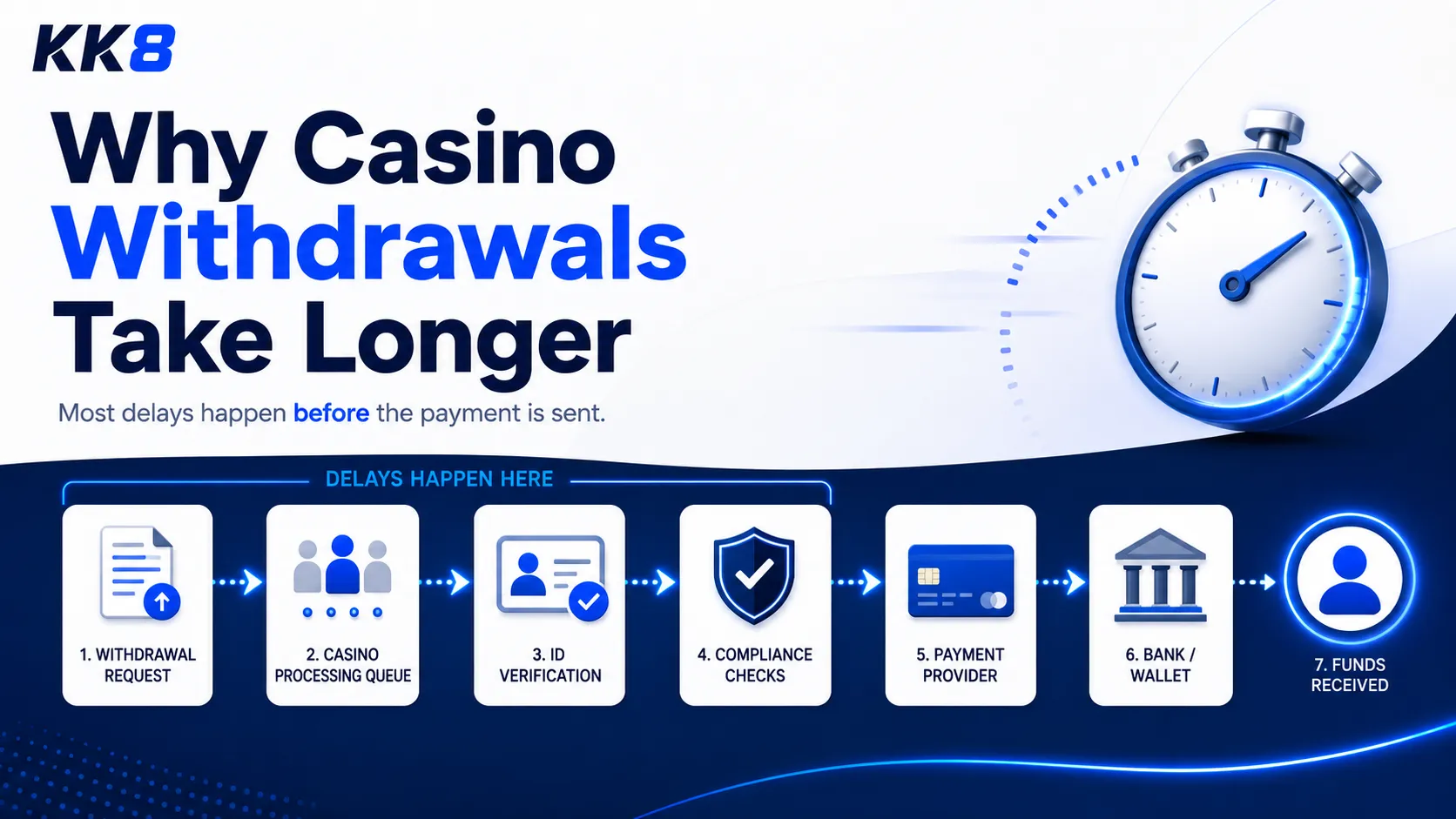
A casino withdrawal delay usually happens before the money ever reaches a payment network. Your request may sit in the operator’s processing queue, wait for identity or payment verification, go through a compliance review, and only then get sent to a bank, e-wallet or payment provider that has its own processing time. Each of those stages is controlled by a different party. That is why a deposit can land in seconds while the withdrawal of the same money takes hours or days. The useful question is not “how long does a withdrawal take” but “which stage is my withdrawal sitting in right now”.
How a casino withdrawal actually works
Most guides treat a withdrawal as a single event with a single processing time. It is not. It is a chain, and the money changes hands between organisations along the way.
The withdrawal journey
- Withdrawal requested: You submit the request in your account.
- Casino processing queue:The operator picks the request up, either automatically or through a manual payments team.
- Account verification: Identity, address or payment-ownership checks, if they have not already been completed.
- Risk or compliance review: Applied to some transactions, not all.
- Withdrawal approved: The operator agrees to release the funds.
- Payment provider processes the transaction: A bank, e-wallet or payment service provider moves the money.
- Receiving account credits the money: Your bank or wallet posts it to your balance.
Knowing which stage you are in changes what you should do. A withdrawal stuck at stage 3 is solved by uploading a document. A withdrawal stuck at stage 7 cannot be solved by messaging the casino at all.
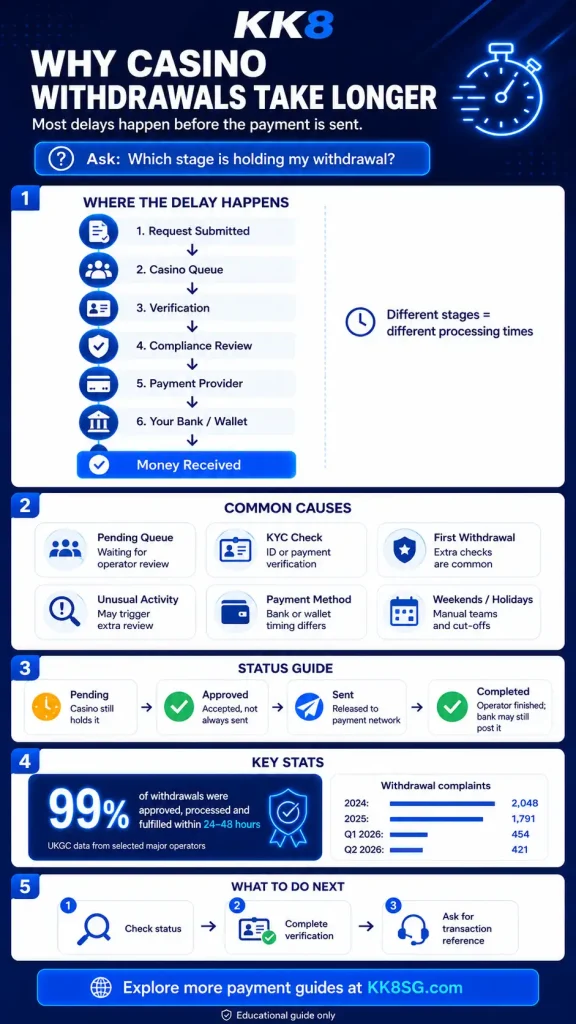
The 7 most common reasons casino withdrawals are delayed
1. It is still in the casino’s processing queue
Operators typically publish two separate numbers, though many blur them together: their own internal processing time, and the payment method’s processing time. Internal processing is the period between you clicking withdraw and the operator releasing the payment. Some operators automate this for small amounts. Others batch requests and review them manually during business hours.
If your withdrawal shows as pending and no documents have been requested, this is usually where it is.
2. Your account needs KYC verification
Know Your Customer checks confirm that you are who you say you are. They normally involve an identity document, sometimes a proof of address, and often a check that the payment account belongs to you.
Verification requests are routine, not an accusation. Regulated operators are required to perform customer due diligence, and payment providers frequently require it too. What matters is whether the request is clearly explained, reasonable in scope, and consistent with what the operator published in its terms.
Where verification is worth questioning is when the requirements keep expanding after each submission with no explanation.
3. Additional compliance checks are required
Beyond basic identity checks, some transactions attract further review. Common triggers include a transaction pattern that differs sharply from the account’s history, a mismatch between deposit and withdrawal methods, or an amount that falls outside the account’s usual range.
These reviews can include source-of-funds questions and enhanced due diligence. The Financial Action Task Force, the global standard setter for anti-money-laundering rules, explicitly includes internet casinos in its risk-based guidance and expects higher-risk situations to attract additional checks rather than uniform treatment of every customer.
The UK Gambling Commission has taken a similar line from the operator side: legitimate checks can result in a withdrawal being held while a concern is looked at, but operators are not meant to use verification as a general source of friction when customers try to take money out.
4. It is your first withdrawal
First withdrawals are slower for a structural reason. Depositing requires almost no checks because money is flowing towards the operator. Withdrawing is the first point at which the operator has to be confident about who you are and where the money is going.
Once identity and payment ownership have been confirmed and stored on your account, later withdrawals skip those steps. The payment method has not changed. The number of stages has.
5. The withdrawal amount or activity is unusual
It is tempting to say large withdrawals are always slower. That is not accurate. A large withdrawal on an account with a long history of similar transactions may pass straight through, while a modest withdrawal on a brand-new account with an unusual deposit pattern can trigger a review.
The trigger is usually deviation from the account’s own pattern, not the absolute figure.
6. The payment method needs more time
There are three separate clocks running, and operators rarely label them clearly:
| Clock | Who controls it | Typical driver |
| Operator processing time | The casino | Queue depth, manual review, business hours |
| Payment provider time | Bank, e-wallet or PSP | Settlement cycles, provider checks |
| Receiving institution time | Your bank or wallet | Crediting rules, incoming-transfer screening |
7. Weekends, holidays and manual processing
Some operators process payments continuously. Others run a payments team on a schedule, which means a Friday-evening request may not be picked up until Monday. Receiving banks may also apply their own cut-off times for certain transfer types.
Operator schedules are not standardised, so this one is worth checking in the operator’s published terms rather than assuming.
Why deposits can be instant but withdrawals are not
This is the single biggest source of confusion, and the explanation is structural.
Deposit: Player → Payment system → Operator
Withdrawal: Operator → Account checks → Verification → Approval → Payment provider → Player
A deposit is money arriving. The operator has very little reason to slow it down and every reason to accept it. A withdrawal is money leaving, which is the point at which identity, payment ownership and compliance obligations all become relevant.
The key takeaway is worth stating plainly:
Payment speed is not the same as withdrawal speed.
A payment rail may move funds in seconds once the payment has been released. Everything that happens before release is a separate process with its own timing. For the other side of the same journey, see How Online Casino Deposits Work.
Casino withdrawal statuses explained
Status labels are one of the least standardised things in online gambling. Two operators can use the same word to mean different things. Use this as a general map, then check your operator’s own definitions.
| Status | What it usually means | Who may control the next step |
| Requested | Withdrawal submitted, not yet actioned | Casino |
| Pending | Waiting in a queue or for review | Casino |
| Verification required | Documents or checks outstanding | Casino and player |
| Processing | Being prepared or transmitted | Casino or payment provider |
| Approved | Casino has accepted the withdrawal | Casino or provider |
| Sent | Funds released to the payment network | Payment provider |
| Completed | Operator considers its part finished | Provider or receiving bank |
Two points matter more than the table itself.
First, completed does not always mean received. On many platforms it means the operator has finished its side of the transaction. Money can still be in transit.
Second, status wording differs between operators, so do not assume that “processing” at one site means the same as “processing” at another. If the definitions are not published anywhere, that is itself a small signal about how transparent the operator is.
First withdrawal vs repeat withdrawal
| Factor | First withdrawal | Repeat withdrawal |
| Identity check | More likely | Usually already completed |
| Payment ownership check | More likely | May already be verified |
| Manual review | More likely | Depends on the operator |
| Compliance review | Possible | Possible |
| Payment processing | Required | Required |
The practical implication: the payment method can be identical on both occasions while the total time is very different. If your first withdrawal took two days and you conclude the payment method is slow, you may be blaming the wrong stage entirely.
Worked example. Two withdrawals of the same amount, to the same bank account, from the same operator:
- First withdrawal: 6 hours in the queue, 5 hours waiting for you to upload an ID, 2 hours for review, then a near-instant transfer. Total: about 13 hours.
- Fifth withdrawal: 40 minutes in the queue, no verification needed, then a near-instant transfer. Total: under an hour.
Same rail. Same bank. Different number of stages.
KYC, payment verification and source-of-funds checks are not the same thing
These get lumped together as “KYC”, which makes it harder to work out what is actually being asked of you.
KYC (identity verification) confirms who you are. Usually a government ID, sometimes with a selfie or address document.
Payment verification confirms that the account receiving the money belongs to you. This is why operators often insist on withdrawing to the same method used for the deposit.
Source of funds asks where the money you gambled came from. This is applied selectively, not to everyone, and is normally triggered by transaction size or pattern.
Enhanced due diligence is a broader set of checks used in situations assessed as higher risk. FATF guidance supports exactly this kind of risk-based approach: proportionate monitoring, with deeper checks reserved for higher-risk cases rather than applied uniformly.
Knowing which of the four you are being asked for tells you roughly how long it will take. An ID upload is usually resolved in hours. A source-of-funds request involves human review and takes longer.
How to find out where your withdrawal is delayed
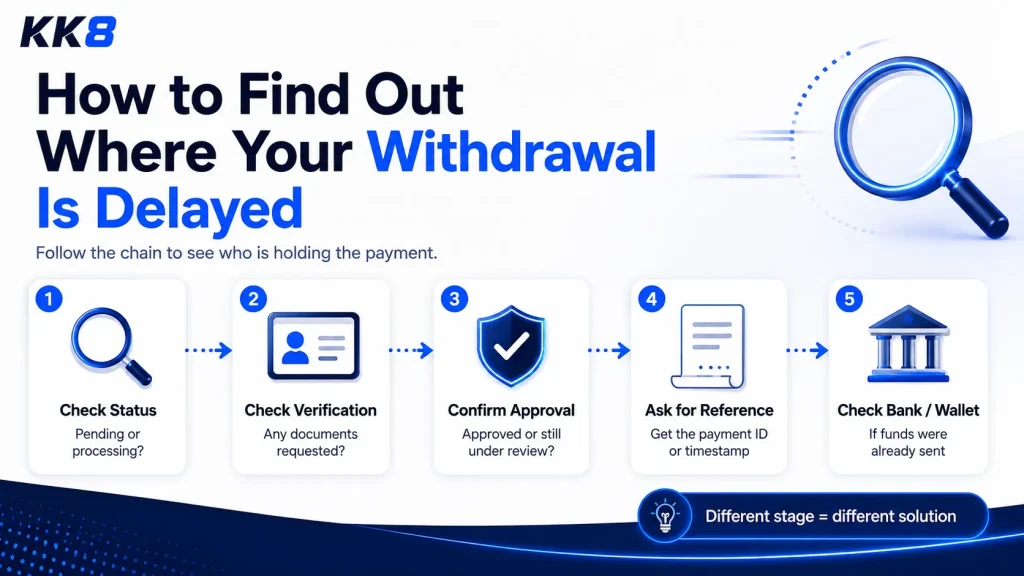
Work through this in order. Each step narrows down which party currently holds your transaction.
Step 1: Check the withdrawal status. If it says pending or processing, the operator almost certainly still holds it. Start there.
Step 2: Check whether verification is outstanding. Look in your account notifications, the verification or documents section, and your email spam folder. A surprising share of “stuck” withdrawals are waiting on a document request the player never saw.
Step 3: Confirm whether the withdrawal has been approved. Ask support directly: has this withdrawal been approved and released, or is it still under review? Those are two different answers and support will often give a vague one unless you separate them.
Step 4: Request the transaction reference. If funds have been sent, there is normally a payment reference, transaction ID or timestamp. Ask for it in writing.
Step 5: Check with the receiving payment provider. Once you have confirmation that the money was released, along with a reference, the delay may no longer be within the operator’s control. At that point your bank or wallet provider is the right place to ask.
If you get to step 4 and the operator cannot or will not provide any evidence that a payment was sent, that is a meaningfully different situation from a slow transfer.
When is a casino withdrawal delay a warning sign?
Most delays are ordinary. A few are not. The distinction is less about how long you have waited and more about how the operator behaves while you wait.
Normal friction
- Verification requests that are specific and explained
- Processing periods that match what the operator published
- A payment provider or bank taking its documented settlement time
- A one-off compliance review with a clear status
Possible warning signs
- Stated processing times that change each time you ask
- Support that will not say whether the withdrawal has been approved
- New requirements appearing one at a time after each submission
- Withdrawal terms that are hard to find or vaguely worded
- Valid withdrawal requests being cancelled or reversed
- Encouragement to keep playing instead of withdrawing
- No transaction record or reference available at any point
The pattern that separates the two lists is information. An operator handling a legitimate delay can tell you where your money is. An operator that cannot answer a simple factual question about your transaction is telling you something.
If you are weighing up an operator rather than a single transaction, our guide on How to Verify an Online Casino goes into the checks worth doing before you deposit.
Singapore payment speed vs casino withdrawal speed
Singapore readers have a particular reason to find withdrawal delays confusing: domestic transfers here are genuinely fast. PayNow operates over FAST, allowing participating banks and financial institutions to send and receive Singapore dollars almost immediately, around the clock.
That speed applies to one stage of the chain. Here is what a realistic timeline can look like:
- Operator review: 8 hours
- Verification: 4 hours
- Payment released: –
- Transfer over FAST: seconds
Total elapsed time: over 12 hours, of which the actual payment took almost none. The transfer was instant. The withdrawal was not. This is why “instant withdrawal” claims tied to a fast payment method should be read carefully.
How long should you wait before checking?
There is no universal answer, and any article that gives you one is guessing. What you should do instead is check the operator’s published:
- internal processing period
- verification requirements
- payment-method timeframe
- weekend and holiday policy
- withdrawal terms and limits
For a sense of scale, the UK Gambling Commission wrote in July 2023 that data supplied by some of Britain’s largest gambling companies showed those firms approve, process and fulfil around 99% of withdrawal requests within 24 to 48 hours. That is a description of practice among large licensed operators in one market, not a rule, and not a benchmark that applies everywhere.
It is also worth noting that withdrawals remain one of the most complained-about topics even in a heavily regulated market. Complaints to the Commission’s contact centre about withdrawals and financial transactions:
| Period | Complaints |
| Year to December 2022 | 2,416 |
| Year to December 2023 | 2,405 |
| Year to December 2024 | 2,048 |
| Year to December 2025 | 1,791 |
| January to March 2026 | 454 |
| April to June 2026 | 421 |
The volumes are trending down over the four full years shown, but withdrawals and financial transactions still sit at or near the top of the complaint categories every quarter. Being unsure about a delayed withdrawal is a common experience, not a sign that you have missed something obvious.
What to do if your casino withdrawal is still pending
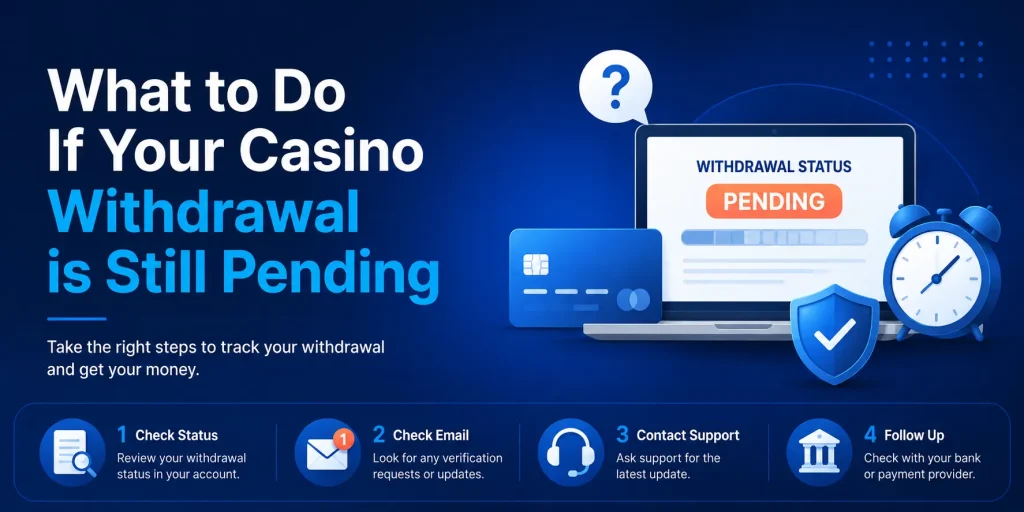
- Check the current withdrawal status in your account.
- Check for outstanding verification or document requests.
- Compare the elapsed time against the operator’s stated processing time.
- Check whether any wagering, bonus or account conditions apply to the balance.
- Ask support directly whether the withdrawal has been approved.
- Ask separately whether the funds have actually been sent.
- Request the transaction reference if it has been sent.
- Contact your bank or payment provider once the operator confirms release.
- Keep screenshots and written records of every exchange.
Key takeaway
-
A casino withdrawal delay does not usually happen at the payment stage. It happens somewhere along this chain:
Casino processing → Verification → Compliance → Payment provider → Receiving institution
Working out which stage currently holds your transaction tells you who to contact, what to ask for, and whether the wait is ordinary or worth worrying about. That is a more useful question than whether a payment method is fast.
Frequently Asked Questions
Why is my casino withdrawal taking so long?
The delay can sit at operator processing, verification, compliance review, payment processing or your receiving bank. Identify which stage holds it before contacting anyone.
Why is my casino withdrawal still pending?
Pending usually means the operator has the request but has not released the funds. Definitions vary by operator, so check their status guide.
Why do casino withdrawals take longer than deposits?
A deposit only has to reach the operator. A withdrawal may need verification and compliance checks before any money is released.
Can KYC delay a casino withdrawal?
Yes. Verification normally has to be completed before funds are released. Finishing it before your first withdrawal removes this delay.
Why is my casino withdrawal approved but not received?
Approval means the operator accepted it. The payment provider or your bank may still be processing. Ask for the transaction reference.
What should I do if my withdrawal is completed but I have not received it?
Completion often means the operator’s part is finished, not that the money landed. Get the transaction reference and release time, then contact your bank.