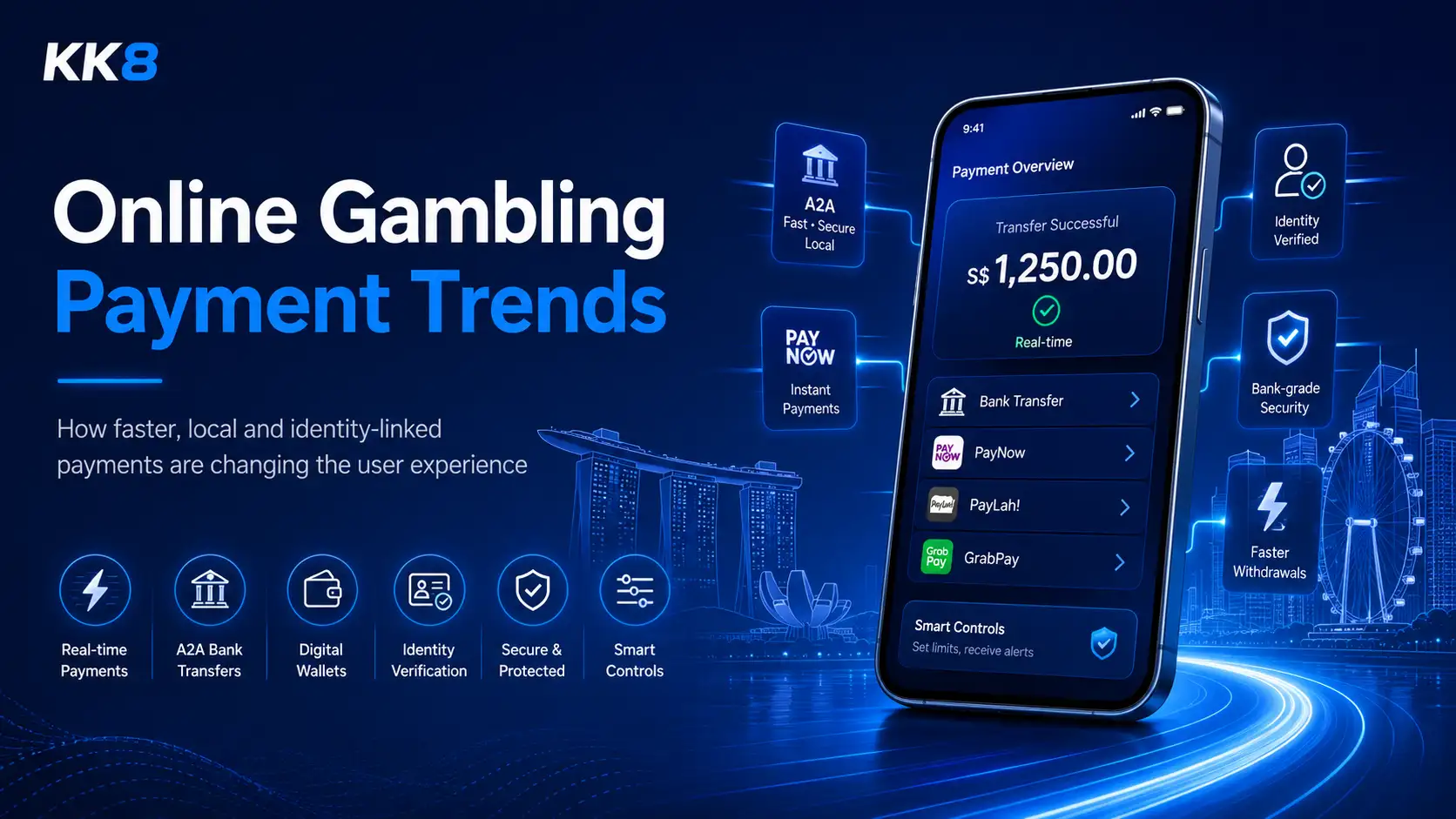
For most of the internet’s history, funding an online gambling account meant one thing: type in a card number and wait. That model is breaking down. Deposits now arrive through bank rails, QR codes, wallets and mobile apps. Withdrawals are being judged as a trust signal rather than an afterthought. And underneath all of it, payments are quietly being fused with identity verification and fraud controls.
This guide explains the main online gambling payment trends shaping the industry, why they are happening, and what they look like in Singapore specifically.
One thing to be clear about upfront: this article covers payment technology, not legality. A payment method working is not evidence that a gambling service is lawful. We cover Singapore’s legal position in detail further down.
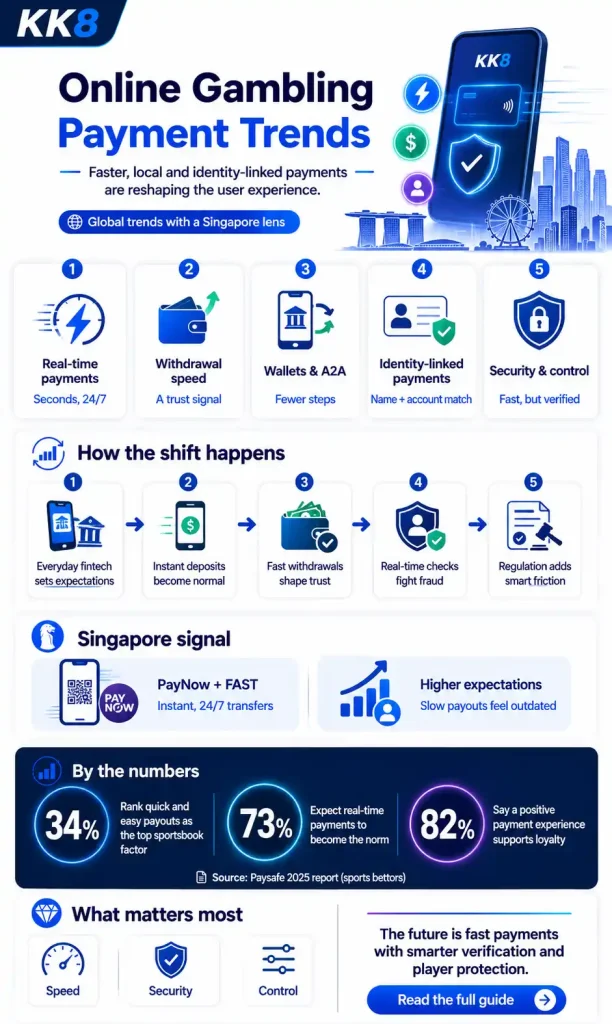
Key Online Gambling Payment Trends at a Glance
| Trend | What is changing | Why it matters |
| Real-time payments | Bank transfers settle in seconds, 24/7 | Multi-day waits now feel broken |
| Withdrawal speed | Payouts treated as a product feature | Strongest driver of operator choice |
| Digital wallets | Stored credentials, mobile-first | Convenience, plus a privacy buffer |
| Account-to-account (A2A) | Money moves bank to bank, no card network | Fewer failure points, lower cost |
| Local payment rails | PayNow, PIX, UPI over global cards | Familiarity beats universality |
| Identity-linked payments | Payment method proves account ownership | Fraud and money laundering controls |
| Deliberate friction | Limits, cooling-offs, verification holds | Player protection, legal compliance |
| Payment blocking | Regulators intercept transactions | Legality, not just technology |
Why Online Gambling Payments Are Changing
Gambling payments are not evolving in isolation. They are being dragged along by what people experience everywhere else.
A Singapore resident splitting a dinner bill sends money by PayNow and it lands before anyone has stood up. They pay a hawker by QR. They move funds between banks at 2am on a Sunday and it clears immediately. Once instant, free, always-on transfers become normal in daily life, a three-day payout window stops reading as “standard processing” and starts reading as a red flag.
This is the mechanism behind almost every trend below. Consumer payment infrastructure sets the expectation. Gambling operators either meet it or lose to operators that do.
Trend 1: Real-Time Payments Are Becoming the Default Expectation
What is a real-time payment?
A real-time payment moves money between accounts and settles it immediately, at any hour, with the recipient able to use the funds straight away. This is different from a card transaction, where an authorisation happens instantly but the actual money movement is batched and settled later.
Singapore’s version is FAST, the real-time interbank transfer system. PayNow sits on top of it, letting people send Singapore-dollar funds using a mobile number or NRIC rather than an account number, around the clock. Brazil’s PIX and India’s UPI do broadly the same job in their markets.
Deposits and withdrawals are not the same problem
This distinction matters more than most trend articles admit.
A deposit is easy to make instant. The operator receives money. There is no fraud exposure in accepting funds, only in what happens afterwards.
A withdrawal is the operator sending money out, permanently. That triggers checks: is this the right person, is the source of funds clean, has the account met its verification requirements, does the transaction pattern look like money laundering? None of that is optional for a licensed operator.
So the payment rail may be capable of settling in two seconds while the withdrawal still takes a day. The delay usually is not the rail. It is the review sitting in front of it.
Trend 2: Withdrawal Speed Has Become a Trust Signal
Deposit friction costs an operator a signup. Withdrawal friction costs an operator its reputation.
Paysafe’s 2025 “All the Ways Players Pay” report surveyed 4,300 online sports bettors and found that quick and easy payouts were the single most important factor when choosing a sportsbook, cited by 34%. That put payouts ahead of brand trust (33%), and well ahead of promotions and odds (24% each). The same research found 82% said a positive payment experience is part of why they stay with a brand.
Worth reading carefully: that survey covered sports bettors across six US states, Ontario, the UK, France, Italy, Spain, Romania, and several Latin American markets. It did not survey Asia, and it did not cover casino products. It tells you about the direction of player expectations in regulated Western markets. It is not a Singapore statistic, and anyone presenting it as one is overreaching.
The structural point holds regardless of geography. Fast deposits are an acquisition feature. Fast withdrawals are a retention and credibility feature. They are solving different problems, and operators that optimise only the first are optimising the easy half.
Trend 3: Digital Wallets Keep Expanding, but Will Not Take Over
Wallets earned their place for practical reasons: stored credentials mean fewer re-entered card numbers, they work well on mobile, they consolidate multiple funding sources, and they put a layer between a gambling merchant and a user’s primary bank statement.
That last point is genuinely useful to some users and genuinely awkward for compliance teams, which is part of why wallets face heavier scrutiny in regulated markets.
Why wallets are unlikely to fully replace banks and cards
Three reasons. First, a wallet still has to be funded from somewhere, usually a bank account or card, so it adds a hop rather than removing one. Second, real-time bank rails have closed most of the speed gap that made wallets attractive in the first place. Third, wallets add a layer where money can sit outside the banking system, which regulators increasingly dislike in a gambling context.
Notably, the Paysafe research found debit cards were still the most-used payment method at 42% in the markets surveyed. Wallets are growing alongside traditional methods rather than displacing them.
Trend 4: Account-to-Account Payments Are Growing
An account-to-account (A2A) payment moves money directly from one bank account to another. No card network in the middle, no card number to steal, no issuer to decline the transaction.
For gambling operators, A2A is attractive because it removes a common failure point. Card issuers frequently decline or flag gambling merchant codes, sometimes inconsistently. A2A sidesteps that entirely. It is also typically cheaper per transaction, and it settles rather than authorising.
For users, the appeal is simpler: it uses the bank app they already have open.
PayNow is a clean example of the model. So are PIX in Brazil and UPI in India. What these systems share is that they became dominant in their home markets because they were free, instant and universally supported, not because anyone marketed them at gamblers. The gambling sector is a follower here, not a driver.
What These Payment Trends Mean for Singapore
PayNow reset what “normal” means
Singapore consumers already have free, instant, 24/7 bank transfers through PayNow and FAST, addressable by mobile number. That infrastructure is mature and ordinary.
The consequence is expectation transfer. Someone who moves money instantly every week is not going to accept a two-day payout gracefully. This is the main way Singapore differs from markets where domestic transfers are still slow or costly: the baseline is already high.
Be careful with the inference, though. PayNow’s consumer adoption figures describe general payments across the whole economy. They say nothing about gambling volumes, and treating them as a proxy for gambling activity would be bad analysis.
Trend 5: Payments and Identity Verification Are Merging
The old model treated these as separate steps. A user completed KYC once during onboarding, and payments ran independently afterwards.
The direction of travel is different:
| Old model | Emerging model |
| Verify identity at signup | Verify identity continuously |
| Payment is a transfer | Payment is also proof of ownership |
| KYC as a one-time gate | Name and account matching on every transaction |
| Withdrawal to any method | Withdrawal only to a verified, matched source |
Trend 6: Security Is Scaling Alongside Speed
Faster settlement means less time to catch a bad transaction before the money is gone. So real-time payments have forced real-time risk controls.
What that looks like in practice: biometric or device-bound login, device fingerprinting, behavioural analysis, transaction monitoring that scores each payment in milliseconds, velocity checks on deposit frequency, and step-up authentication when something looks unusual.
An important caveat: speed and security are not the same axis, and faster does not mean safer. An instant payment is also an instantly irreversible one. Card payments have chargeback mechanisms that A2A transfers generally do not. That is a real trade-off, not a marketing footnote. Our guide to online casino security features covers the controls in more depth.
A good payment experience is not just speed. It is speed, security and control together. An operator that delivers only the first is delivering the least demanding third of the problem.
Trend 7: Faster Payments Do Not Mean Zero Friction
Some friction in gambling payments is not a defect. It can be an intentional part of player protection.
Controls built into payment and account systems may include deposit limits, withdrawal verification, name matching, cooling-off periods, self-exclusion tools, and fraud reviews. These checks can slow down certain transactions, but they can also help reduce fraud, prevent unauthorised payments, and give players more control over their spending.
This creates an important difference between normal digital payments and gambling payments. Consumers increasingly expect fast deposits and withdrawals, but gambling platforms may still need extra checks before some transactions are completed.
The future of gambling payments is therefore unlikely to be completely frictionless. A more realistic direction is faster payments combined with smarter security, verification, and responsible gambling controls.
For more information about player protection, see our Responsible Gambling Singapore guide.
Payment Convenience Does Not Mean Gambling Is Legal
This section matters more than any trend above.
A payment method being technically usable does not mean that a gambling service is lawful. Payment systems such as bank transfers, digital wallets and real-time payment rails are general-purpose tools. The availability of a payment option should therefore not be treated as proof that an operator is licensed or authorised to serve users in Singapore.
Singapore regulates remote gambling under the Gambling Control Act 2022. Providing unlicensed remote gambling services in or from Singapore, or providing such services from overseas to people in Singapore, is unlawful. Holding a gambling licence in another country does not automatically give an operator permission to offer gambling services to Singapore residents.
The rules also apply to individuals. Participating in unlawful remote gambling can result in penalties under Singapore law, including fines, imprisonment, or both.
Enforcement can also take place at the payment level. From 1 January 2025, the Singapore Police Force took over responsibility for blocking access to unlawful remote gambling services, related advertising and associated payment transactions. Between 2015 and the end of 2024, Singapore authorities blocked more than 3,800 illegal gambling websites and intercepted over 145,000 payment transactions worth around S$37 million.
Payment availability is not proof that a gambling service is licensed or lawful. Check the latest guidance from Singapore’s Gambling Regulatory Authority before using any gambling service, and see our guide on how to verify an online casino website.
Trend 8: Payment Fees Are Becoming Harder to Justify
There is also a clear shift in how payment fees are handled. The trend is not simply that transaction fees are disappearing. Instead, users increasingly expect common digital payment methods to be low-cost or free at the point of use.
This is especially relevant for real-time bank transfers and national payment systems, where low transaction friction is part of the user experience. When extra charges are added to widely used payment methods, they can make the payment process feel less competitive and less convenient.
For online gambling operators, this creates pressure to reduce visible payment fees or absorb more of the processing cost. As payment speed and convenience improve, users are also becoming more sensitive to unnecessary transaction charges.
The broader trend is clear: payment competition is no longer only about speed. Cost, transparency and convenience are becoming part of the overall payment experience as well.
Where Cryptocurrency Actually Fits
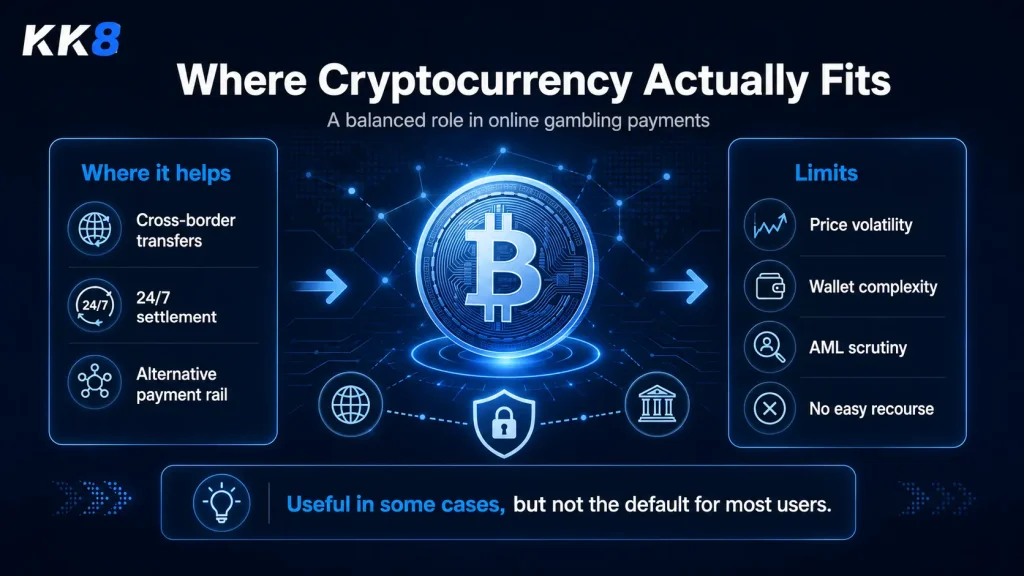
Crypto gets disproportionate coverage in gambling payment articles relative to its role.
Where it genuinely helps: cross-border transfers without correspondent banking, settlement independent of banking hours, and an alternative rail in markets where local payment infrastructure is weak or where operators struggle to obtain banking relationships.
Where it does not: price volatility between deposit and withdrawal, wallet complexity for non-technical users, inconsistent regulatory treatment, heightened AML scrutiny, and irreversibility with no recourse. Crypto also does not change the legal status of the gambling itself. Using a different payment rail to reach an unlicensed operator does not make the activity lawful.
The honest read is that for mainstream adoption, real-time domestic bank payments and local methods matter considerably more than cryptocurrency. In a market like Singapore, where instant free transfers already exist and are universally supported, crypto solves a problem most users do not have.
Online Gambling Payment Trends by the Numbers
All figures below are from Paysafe’s 2025 “All the Ways Players Pay” report, surveying 4,300 sports bettors across the Americas and Europe in November 2024. No Asian markets were included.
| Figure | What it measures |
| 34% | Ranked quick and easy payouts as the top factor when choosing a sportsbook, ahead of brand trust at 33% |
| 73% | Expect real-time payments to become the norm at sportsbooks within two years |
| 82% | Say a positive payment experience is part of why they stay with an operator |
| 66% | Are more confident in transaction security than a year earlier |
| 42% | Still use debit cards, the most common single method in the markets surveyed |
| 32% | Of bettors who had not wagered in six months or more cited fraud concerns as their main blocker |
What Comes Next
Five things worth expecting, rather than fifteen:
More instant withdrawals. Payout speed is now a competitive dimension, and the rails already support it in most developed markets.
More direct bank payments. A2A keeps taking share from cards wherever a good domestic rail exists.
More local methods, fewer universal ones. Cashiers are becoming market-specific rather than globally uniform.
Payments bound more tightly to identity. Name matching, account matching and continuous verification become standard rather than optional.
Faster payments inside stronger controls. This is the one that ties the rest together, and it is the real conclusion.
The headline trend in online gambling payments is not speed on its own. It is that payments are becoming fast, local and identity-linked at the same time that regulation, fraud prevention and player-protection controls are tightening around them. Those two movements are not in conflict. They are the same shift.
Frequently Asked Questions
What are the biggest online gambling payment trends?
Real-time payments, faster withdrawals, growth in account-to-account transfers, a shift toward local payment methods, and the merging of payments with identity verification. Alongside these, regulatory controls over gambling transactions are increasing.
Are instant casino withdrawals becoming more common?
Yes, where the underlying rails support it. But the payment rail is rarely the bottleneck. Verification and anti-money laundering checks are, and those exist for good reasons.
Why do gambling withdrawals take longer than deposits?
A deposit only requires an operator to receive money. A withdrawal requires it to verify identity, confirm the destination account belongs to the account holder, and clear anti-money laundering checks before sending money out permanently.
What are A2A payments?
Account-to-account payments move money directly between bank accounts without passing through a card network. PayNow, PIX and UPI are examples.
Is PayNow a real-time payment method?
Yes. PayNow transfers Singapore-dollar funds through the FAST rail and is available 24/7, using a mobile number or NRIC as the identifier.
Why are digital wallets popular for online gambling?
Stored credentials, mobile convenience, consolidation of funding sources, and a separation layer between a gambling merchant and a user’s main bank account. They are growing, but they have not replaced cards or bank transfers.
How does KYC affect gambling payments?
Increasingly, it does not sit separately from payments at all. Payment details are becoming part of the verification itself, through name matching and account ownership checks on each transaction.
Will cryptocurrency replace traditional casino payment methods?
Unlikely in markets with strong domestic real-time payments. Crypto addresses cross-border and banking-access problems, but it introduces volatility, complexity and regulatory friction that most mainstream users have no reason to accept.
Are online gambling payments legal in Singapore?
It depends on whether the gambling service is legally allowed to operate in Singapore. Under Singapore law, providing unlicensed remote gambling services is unlawful, and individuals may also commit an offence by participating in unlicensed remote gambling. Always check the latest rules from the Gambling Regulatory Authority (GRA) before using any online gambling service.
Continue reading
This article explains payment technology and industry trends. It is not legal advice and does not endorse any gambling service. Check current Singapore gambling regulations with the Gambling Regulatory Authority before using any gambling service. If gambling is causing you or someone you know difficulty, the National Council on Problem Gambling provides support.