Open an online gambling platform and very little of what you see is arranged by accident. The games near the top of the lobby were ordered by a model. The deposit you made was scored for risk before it settled. The chat window that answered a question at 2am was probably a language model, with a human waiting behind it for anything difficult.
That is the honest starting point for understanding AI in online gambling. It rarely looks like a robot dealer or a talking assistant. It looks like a decision layer sitting between the player and the platform, ranking content, scoring transactions, flagging behaviour and deciding what gets escalated to a person.
This guide explains what those systems actually do, what data they use, where they work, where they fail, and how Singapore’s regulatory and AI governance environment shapes the picture. If you are new to the subject, it helps to first understand how online gambling platforms work and the rules that apply to Online Gambling Singapore.
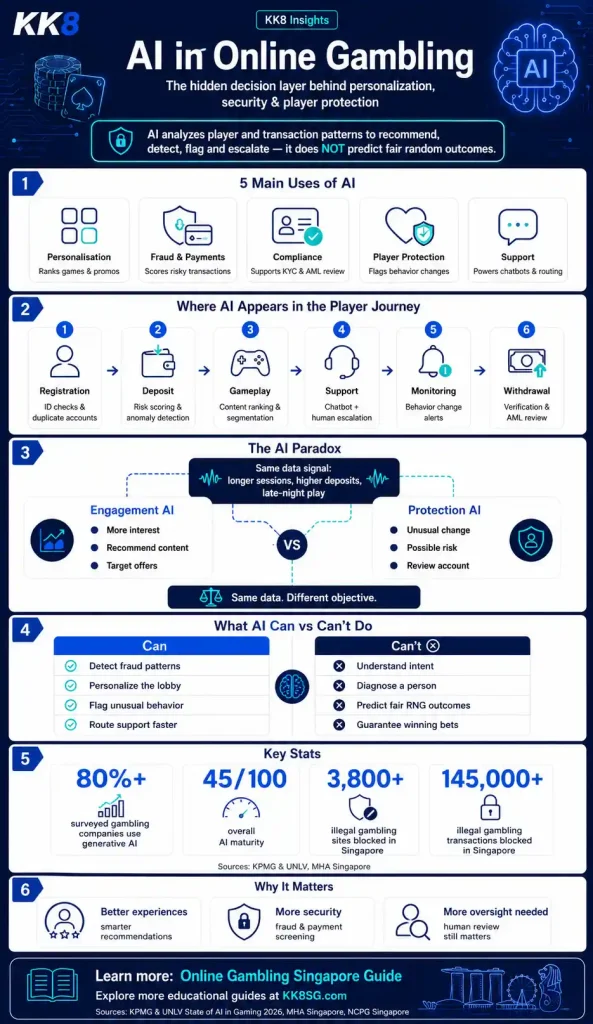
Quick answer: How is AI used in online gambling?
Gambling operators use AI in five main places:
- Personalisation. Ranking games, ordering content, targeting promotions.
- Fraud and payments. Scoring transactions, spotting account takeover, catching duplicate accounts.
- Compliance. Supporting identity verification (KYC) and anti-money laundering (AML) review.
- Responsible gambling. Monitoring behavioural change and flagging accounts for review.
- Customer support. Chatbots, ticket routing, drafting agent replies.
One distinction matters more than any other, and most articles skip it:
AI does not understand a player. It finds statistical patterns in data and uses them to make predictions, classifications and recommendations. A prediction is a probability, not a fact about a person.
Hold on to that and the rest of this article makes sense.
What does AI actually mean in online gambling?
Most gambling platforms have run on software for decades. What changed is the type of software.
A rule-based system does exactly what an engineer told it to do:
Three failed logins in five minutes, lock the account.
That rule is predictable, auditable and easy to explain to a regulator. It is also easy to work around. A fraudster who knows the threshold simply tries twice.
A machine-learning system learns the rule from historical data instead:
Given device fingerprint, IP history, time of day, typing rhythm, past session patterns and roughly two hundred other signals, estimate the probability that this login is not the account owner.
The model outputs a score, say 0.87. Someone then has to decide what 0.87 triggers: nothing, a step-up verification, a hold, or a human review.
That decision, the threshold, is where most of the real policy sits. It is also the part that is invisible to players and, in many companies, poorly documented.
Three properties of machine-learning systems are worth remembering:
- They are probabilistic. They produce likelihoods, not verdicts.
- They are historical. They learn from past data, so they inherit past bias and past blind spots.
- They are opaque by default. Explaining why a specific score came out at 0.87 takes deliberate engineering effort.
Not all gambling AI is the same
Lumping every system under “AI” makes the topic harder to think about. Four categories behave very differently.
Predictive AI
Trained on historical outcomes to score something about the future: fraud risk, churn likelihood, payment anomaly, behavioural risk. This is the workhorse of the industry and the most mature.
Recommendation AI
Ranks and orders content. Which slot appears first, which promotion a player sees, which live table gets surfaced. Players interact with this constantly without noticing it.
Generative AI
Large language models used for chat support, summarising a case file for an agent, drafting content. Adoption here has been rapid. In the KPMG and UNLV State of AI in Gaming 2026 study, more than 80% of surveyed gambling companies reported using generative AI in some form.
Agentic AI
Systems that plan and take multi-step actions rather than just producing an output. In gambling, the realistic near-term uses are internal: routing a support ticket, gathering documents for a compliance case, running a first-pass review before a human sees it.
The same KPMG and UNLV research found agentic adoption remains uncommon in gambling, largely because of regulatory sensitivity and player-protection concerns. That caution is reasonable. An agent that can act rather than merely suggest needs a much clearer accountability structure behind it, which is exactly what Singapore’s IMDA framework addresses later in this article.
| AI type | Example use | Does the player see it? | Maturity in gambling |
| Predictive AI | Fraud and risk scoring | Usually not | High |
| Recommendation AI | Game and promo ranking | Yes | High |
| Generative AI | Chat support, summaries | Sometimes | Growing fast |
| Agentic AI | Automated internal workflows | Usually not | Early |
Where AI appears across the player journey
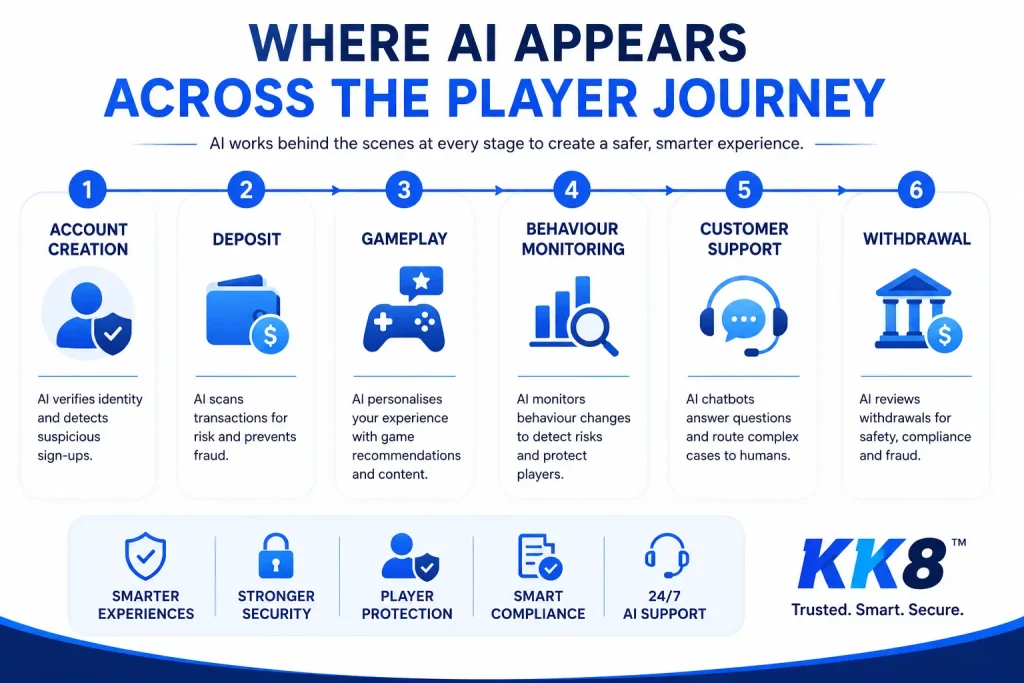
This is the clearest way to see how much of the experience is mediated by automated systems.
Registration. Document checks, facial matching against ID, duplicate account detection, device and IP clustering to spot one person running several accounts.
Deposits. Every transaction is scored. Card testing, mismatched billing details, sudden changes in deposit size or frequency, unusual funding sources.
Gameplay. Content ranking, player segmentation, bonus targeting, session-level behavioural tracking.
Customer support. Ticket classification and routing, chatbot handling of routine queries, suggested replies for human agents, sentiment flags that push a conversation to a person.
Responsible gambling monitoring. Continuous comparison of a player’s current behaviour against their own baseline and against population patterns.
Withdrawals. Verification checks, AML screening, review of whether a withdrawal pattern looks like normal cashing out or like money movement.
What can gambling AI actually learn about a player?
Operators do not need declared personal information to build a detailed behavioural profile. Ordinary product telemetry is enough.
| Signal | What it is used for | What it cannot tell you |
| Login times and frequency | Habit modelling, anomaly detection | Why the habit changed |
| Session length and time of day | Engagement scoring, risk flags | Whether the player is distressed or just off work |
| Deposit size and frequency | Value segmentation, risk flags | Where the money came from |
| Games viewed vs games played | Recommendation training | What the player actually enjoys |
| Bonus usage patterns | Promo targeting, bonus abuse detection | Intent |
| Device, browser, network | Fraud and multi-account detection | Who is physically at the keyboard |
| Support contact history | Sentiment and escalation | The full context of a complaint |
| Rate of change in any of the above | Both engagement and harm models | The reason for the change |
The last row is the important one, and it deserves stating plainly:
Seeing a behavioural pattern is not the same as understanding why it happened.
Take a player whose deposits triple over ten days. That single pattern is consistent with a work bonus, a holiday, someone else using the account, or chasing losses after a bad week. The data looks identical in all four cases. A model can only tell you the pattern is unusual. Deciding what it means, and what to do about it, still requires context that the data does not contain.
How AI personalises online gambling
The mechanics are the same as any recommendation system. The model learns which content a player engages with, finds similar players, and reorders the lobby accordingly. Layered on top are segmentation models (grouping players by value and behaviour), churn models (predicting who is about to stop playing), and timing models (when to send a message).
This is the part of the topic competitors cover heavily, so there is not much more to say about the mechanism. The more useful question is what happens when personalisation collides with player protection.
The gambling AI paradox: engagement versus protection
Here is the tension at the centre of this whole subject, and it is rarely stated directly.
A marketing model and a risk model can look at the same player, using the same underlying data, and reach opposite conclusions.
| The signal | Engagement model reads it as | Protection model reads it as |
| Session length up 40% | Highly engaged, recommend more | Possible loss of control |
| Deposit frequency rising | High-value player, increase targeting | Escalating spend, review the account |
| Playing at 3am | Available, send a notification | Disrupted routine, risk indicator |
| Long unbroken sessions | Strong product fit | Extended play without breaks |
| Returning immediately after a loss | Retained | Possible chasing behaviour |
Both models are working correctly. They were built to optimise different things.
So the real question is not whether an operator has responsible gambling AI. It is:
When the engagement system and the protection system flag the same player, which one wins, who decides, and is that decision recorded?
That is a governance question, not a technical one. And governance is where the industry currently scores worst. In the KPMG and UNLV benchmark, gambling companies scored an average of 45 out of 100 on overall AI maturity, but governance was the weakest dimension at just 30 out of 100, with only about one in five companies having a dedicated AI governance role. Strategic ambition scored 57. The gap between wanting to use AI and being able to govern it is the story of the current moment.
How AI can support responsible gambling
Used carefully, behavioural models can surface things a human reviewer would never catch across thousands of accounts. Typical indicators include:
- A sharp increase in session frequency or duration relative to the player’s own baseline
- Rising deposit frequency, especially multiple deposits within a single session
- Repeated failed deposits followed by successful ones
- Play concentrated in unusual hours
- Cancelled withdrawals followed by immediate play
- Increased contact with support around limits or account access
What these systems can legitimately do is flag. What they cannot do is diagnose.
Avoid the framing that AI “identifies problem gamblers.” A model that outputs a risk score has not identified anything about a person’s clinical state. The accurate framing is that AI systems can flag behavioural patterns that may justify further review, a check-in, a limit prompt, or human intervention.
The difference matters practically as well as ethically. Models produce false positives, and a wrongly restricted account damages trust. They also produce false negatives, and treating a clean score as evidence that someone is fine is exactly the wrong conclusion to draw.
How AI detects gambling fraud
Fraud detection is where machine learning earns its keep, because fraud is adversarial and rules go stale fast.
The core technique is anomaly detection. Rather than checking whether each transaction satisfies a fixed rule, the system builds a picture of what normal looks like for this player, this payment method and this population, then measures how far a given event sits from that picture.
Common patterns it catches:
- Account takeover. Same credentials, different device, different geography, different behavioural rhythm.
- Multi-accounting. Separate accounts sharing device fingerprints, payment instruments or behavioural signatures.
- Bonus abuse. Coordinated accounts extracting promotional value with play patterns that never appear in genuine users.
- Payment fraud. Card testing, stolen instrument use, deposit and immediate withdrawal patterns that suggest money movement rather than gambling.
- Synthetic identity. Documents that pass a surface check but whose supporting data does not cohere.
The advantage over rules is that a model can catch a pattern nobody wrote a rule for. The disadvantage is that it can be confidently wrong, and the person on the receiving end is a customer whose withdrawal just got held.
Can AI predict casino game results?
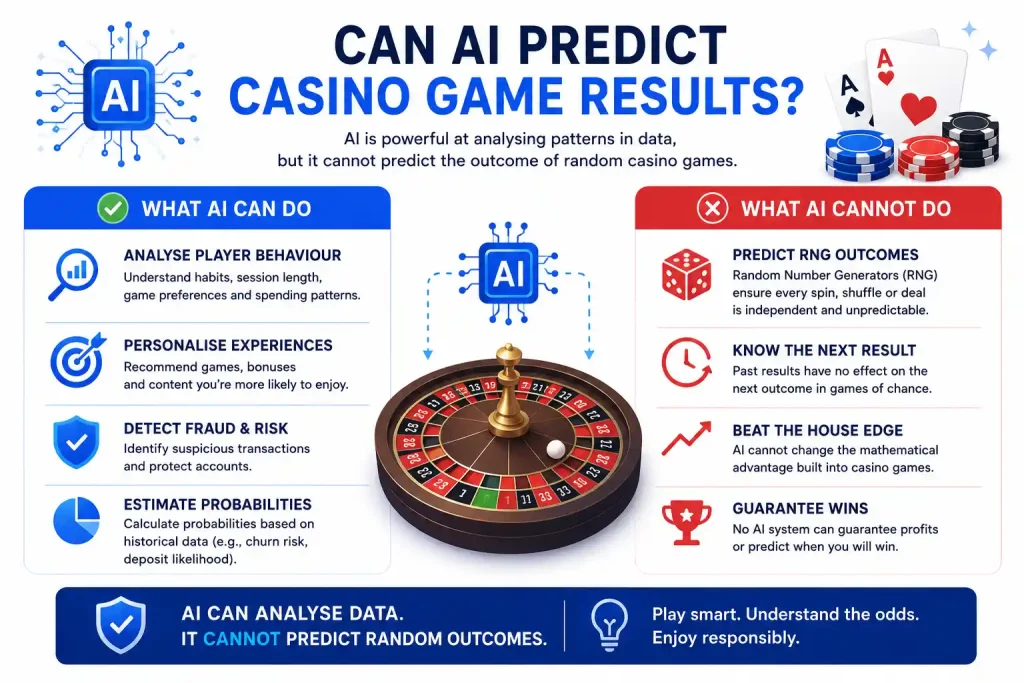
No, and the reason is structural rather than a matter of computing power.
Digital casino games are driven by a random number generator (RNG). In a properly implemented and independently tested RNG, each outcome is generated independently. The previous spin carries no information about the next one.
This is what “independent” means in practice: there is no pattern in the sequence for a model to learn, because the sequence has no memory. Feeding ten million past roulette results into a neural network produces a model that has learned the distribution of a fair wheel, which you already knew from the rules of the game.
The confusion usually comes from mixing up two very different tasks:
| Task | Is there a learnable pattern? | Can AI help? |
| Predicting player behaviour | Yes, humans are habitual | Yes |
| Predicting fraud | Yes, fraud has structure | Yes |
| Predicting a fair RNG outcome | No | No |
AI is genuinely powerful at the first two. That success does not transfer to the third.
Can AI beat online gambling platforms?
There is no general AI system that guarantees profit from gambling. Anyone selling one is selling something else.
AI can analyse historical data, estimate probabilities and identify patterns in datasets that contain patterns. Sports betting is the closest thing to a genuine application, because sports outcomes are not random and modelling does have predictive value. Even there, betting markets already incorporate sophisticated modelling, prices adjust, and the operator’s margin applies to every bet regardless.
What AI cannot do:
- Remove randomness from a random process
- Make a negative expected value positive
- Guarantee any individual future outcome
Treat “AI casino predictor,” “AI betting bot” and “guaranteed AI system” claims as scam indicators rather than product categories. These tools are one of the most common online gambling scams currently circulating.
AI is also creating new gambling risks
The same technology is available to bad actors, and their cost of production has collapsed.
Deepfake endorsements. Synthetic video of recognisable public figures promoting gambling platforms, used to lend credibility to unlicensed operators.
Mass-produced gambling websites. Generative tools can produce a convincing site, terms of service, licence page and review content in an afternoon. Singapore’s Ministry of Home Affairs has acknowledged the structural problem directly: blocking measures work to a degree, but illegal operators can create new websites easily and no authority can know of every gambling site. Cheap generation makes that harder.
Fabricated staff and reviews. AI-generated profile photos and support personas, plus review manipulation at a scale that used to require paid human writers.
Synthetic identity fraud. Composite identities and altered documents designed to pass automated KYC checks. This is AI attacking AI.
Fake prediction tools. Products claiming to forecast slots, roulette, baccarat or sports results, often using genuine-looking dashboards to sell a mathematically impossible promise.
The practical defence for players has not changed much: verify the operator’s regulatory status directly with the regulator rather than trusting the site’s own claims. Our guide on how to spot fake online casino websites covers the specific warning signs.
When should a human still make the decision?
Not every automated decision carries the same weight. A wrong game recommendation costs nothing. A wrong account restriction costs a customer and possibly a complaint to a regulator.
| Situation | Appropriate AI role | Human oversight needed |
| Routine FAQ response | Full automation | Low |
| Game or content recommendation | Full automation | Low |
| Promotional targeting | Automation with policy limits | Medium |
| Suspicious payment | Flag and hold | High |
| Identity verification issue | Assist the reviewer | High |
| Possible gambling harm | Detect and escalate | High |
| Withdrawal dispute | Assist only | Very high |
| Account restriction or closure | Recommend only | Very high |
Singapore offers a useful reference point for thinking about this. IMDA published the Model AI Governance Framework for Agentic AI in January 2026, updated in May 2026, and it is structured around four dimensions: bounding the risks up front, ensuring meaningful human accountability, implementing technical controls, and enabling end-user responsibility. It also describes a spectrum of oversight, from an agent proposing actions that a human approves individually, through to greater autonomy within defined limits.
An important clarification: this framework is voluntary and general-purpose. It does not regulate online gambling, and nothing here should be read as saying it does. But its central principle travels well. The higher the consequence of an automated decision, the more explicit the human accountability needs to be.
The future of AI in online gambling
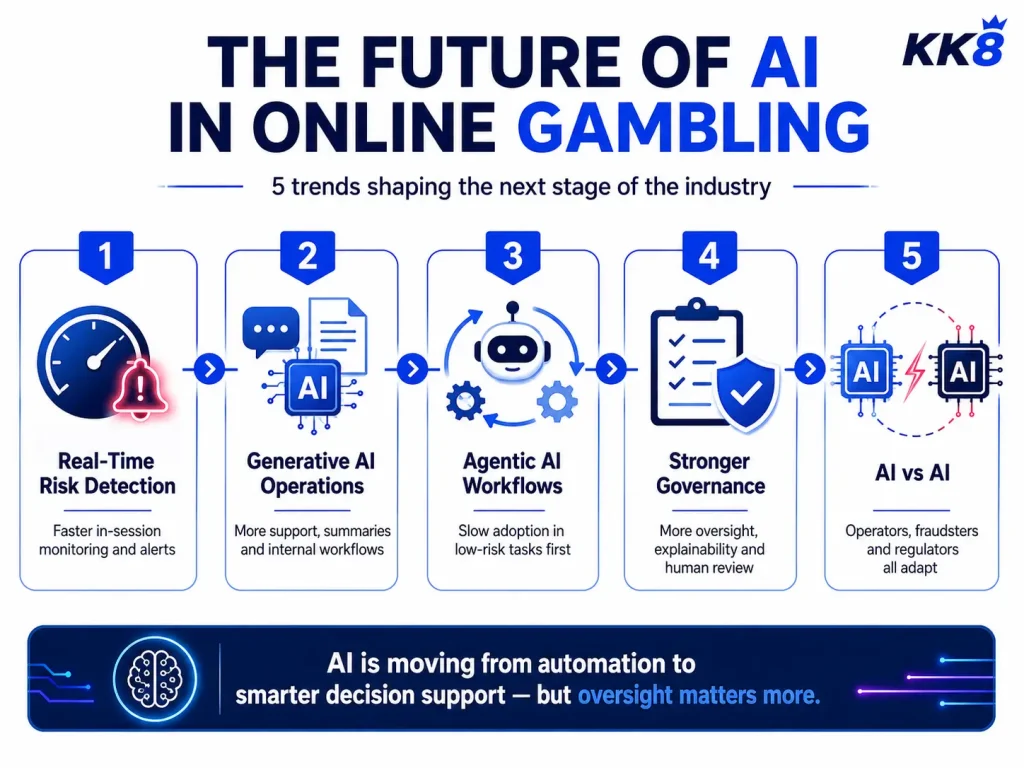
Skipping the vague predictions, four developments look reasonably well supported:
Risk detection moves from retrospective to real time. Most behavioural monitoring today reviews yesterday’s data. The direction of travel is intervention during a session rather than after it.
Generative AI settles into operations. Less player-facing chat, more internal work: case summarisation, compliance drafting, agent assistance.
Agentic systems arrive slowly, in low-risk workflows first. Internal document gathering and ticket handling before anything touching money or account status.
Governance becomes the differentiator. With industry governance maturity at 30 out of 100, there is a long way to go on explainability, audit trails, and clear human accountability for automated decisions. Regulators are already asking, and the KPMG and UNLV research found regulators reporting limited visibility into how operators actually use AI.
Underneath all of it sits an arms race. Operators deploy AI fraud detection while fraudsters deploy AI-generated identities. Regulators build automated monitoring while illegal operators generate websites and advertising at scale. Neither side gets a permanent advantage.
Frequently Asked Questions
What is AI in online gambling?
It refers to machine-learning systems used by gambling platforms to analyse player behaviour, rank and recommend content, score transactions for fraud, support identity and compliance checks, automate customer service, and flag behavioural patterns that may indicate gambling harm. Most of it operates invisibly to the player.
How do online casinos use AI?
Mainly in four areas: personalisation of the lobby and promotions, fraud and payment monitoring, KYC and AML support, and responsible gambling monitoring. Generative AI is also widely used for customer support and internal operations.
Can AI predict online casino games?
No. Casino games run on random number generators where each outcome is independent of the last, so there is no pattern in past results for a model to learn. AI can predict player behaviour, which is habitual. It cannot predict a fair random outcome.
Can AI detect problem gambling?
AI can flag behavioural patterns that may warrant review or intervention, such as sharp increases in session length or deposit frequency relative to a player’s own baseline. It cannot diagnose a person. A risk score is a statistical signal, not a clinical assessment, and it should trigger human review rather than an automatic conclusion.
How does AI detect gambling fraud?
Through anomaly detection. Instead of checking transactions against fixed rules, the system models what normal behaviour looks like for a given player and payment method, then measures how far a specific event deviates from it. This catches account takeover, multi-accounting, bonus abuse and payment fraud patterns that no one wrote a rule for.
Can AI make online gambling safer?
It can, but the outcome depends entirely on implementation and oversight. The same behavioural data powers both engagement optimisation and harm detection, so whether AI improves player safety comes down to which system an operator prioritises, what thresholds trigger intervention, and whether humans review consequential decisions.
What are the main risks of AI in online gambling?
Privacy, given how much can be inferred from ordinary product telemetry. Opacity, since automated decisions about accounts and payments are difficult to explain or appeal. Bias inherited from historical data. And a growing category of AI-enabled scams: deepfake endorsements, mass-produced fake casino sites, synthetic identities and fraudulent prediction tools.
Learn more
Understand Singapore’s online gambling environment
How online gambling works, the rules that apply here, and what players should know before using any platform.
→ Online Gambling Singapore guide
Spot the warning signs
Fake websites, misleading AI claims and the scams currently in circulation.
→ Common online gambling scams