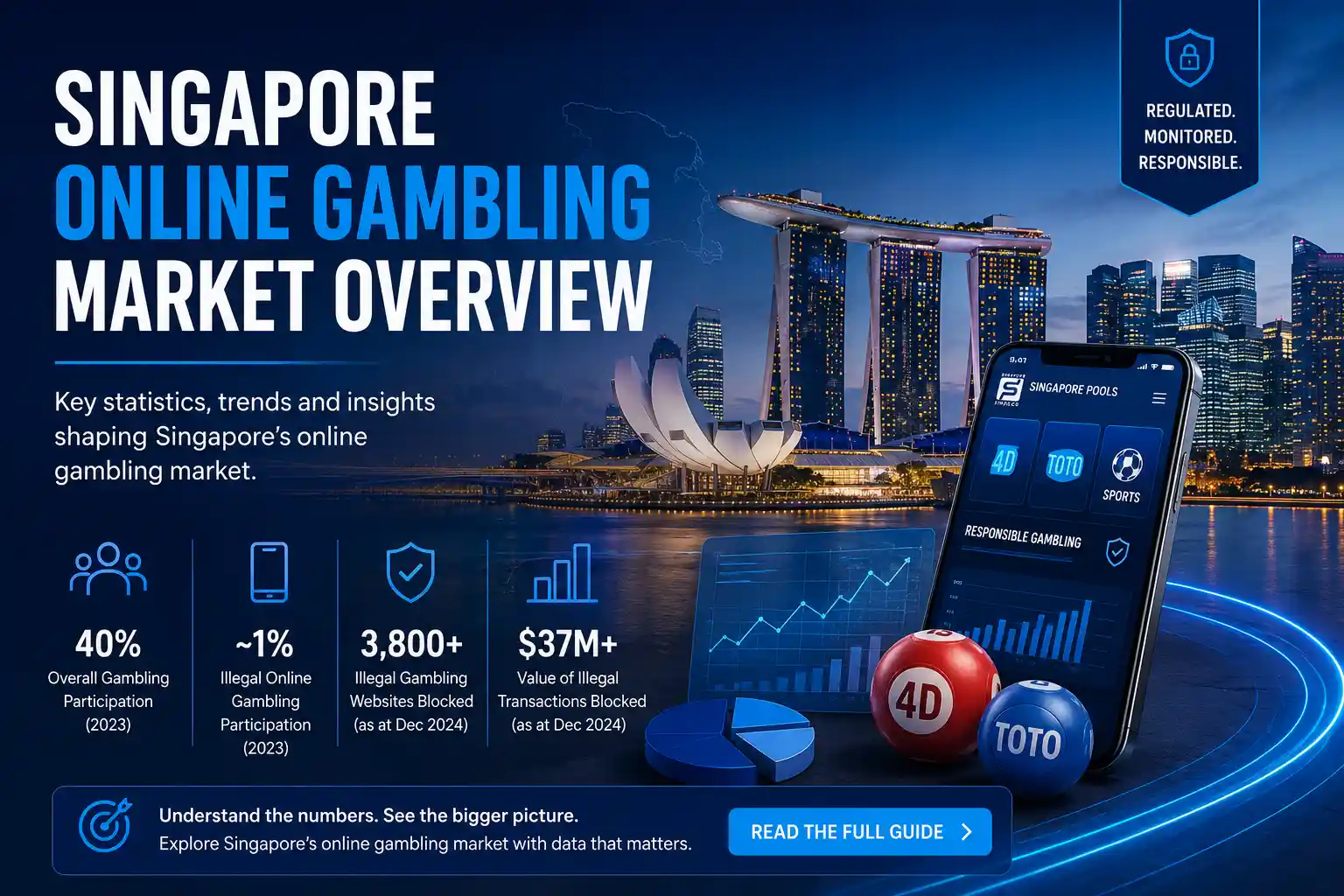
The Singapore online gambling market is unusual for the region. The population is almost entirely connected, betting products such as 4D and TOTO are part of everyday life, and yet licensed remote gambling is one of the most tightly restricted activities in Asia. That combination makes the market difficult to size with a single number, and it explains why published estimates disagree so sharply.
This overview uses official Singapore sources rather than headline forecasts: participation data from the National Council on Problem Gambling (NCPG), enforcement figures from the Ministry of Home Affairs (MHA), licensing rules from the Gambling Regulatory Authority (GRA), and connectivity data from IMDA. If you want the broader consumer-facing picture instead, start with our guide to online gambling in Singapore.
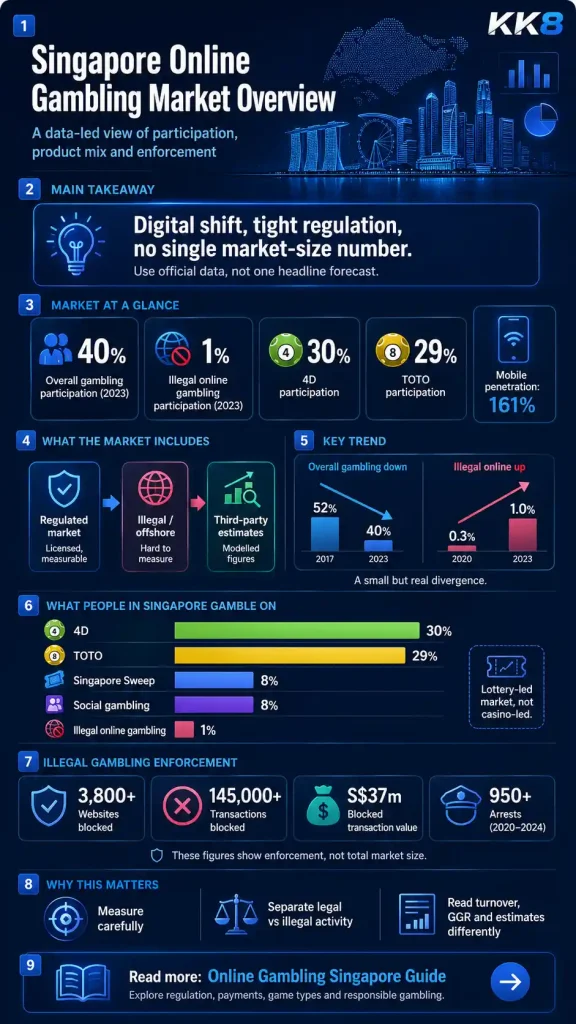
Singapore Online Gambling Market at a Glance
| Metric | Latest useful figure | Source and period |
| Overall gambling participation | 40% | NCPG survey, 2023 |
| Illegal online gambling participation | About 1% | NCPG survey, 2023 |
| 4D participation | 30% | NCPG survey, 2023 |
| TOTO participation | 29% | NCPG survey, 2023 |
| Singapore Sweep participation | 8% | NCPG survey, 2023 |
| Illegal gambling websites blocked | 3,800+ | MHA, as at 31 Dec 2024 |
| Illegal transactions blocked | 145,000+ | MHA, as at 31 Dec 2024 |
| Value of blocked transactions | About S$37 million | MHA, as at 31 Dec 2024 |
| Arrests for illegal remote gambling | 950+ | MHA, 2020 to 2024 |
| Mobile population penetration | About 161% | IMDA, August 2025 |
Every figure above is dated on purpose. Gambling data in Singapore is released on different cycles, so a 2023 survey number and a 2024 enforcement number describe different moments and should not be blended into one “market value”.
What “Singapore Online Gambling Market” Actually Means
The phrase is used loosely, and that is where most confusion starts. It covers three separate things that are measured in completely different ways.
The regulated market
Remote gambling means gambling conducted through the internet, telephone, television or any other communication technology. In Singapore, offering remote gambling requires a licence or an exemption under the Gambling Control Act 2022, and those are granted very sparingly. The regulated segment is therefore narrow by design.
This part of the market is the only part that is directly observable, because licensed activity generates audited accounts, duties and levies that pass through public records. If you want the legal details, see our explainer on remote gambling in Singapore.
Illegal and offshore gambling
This covers sites operated from outside Singapore that accept Singapore-based customers without authorisation, plus local illegal bookmaking. No operator in this segment files public accounts, so its size can only be approached indirectly, through survey responses, enforcement statistics and payment-blocking data.
Those indicators are useful, but none of them is a revenue figure. A blocked transaction total tells you what enforcement caught, not what got through.
Third-party market estimates
Commercial research firms publish Singapore online gambling market values and forecasts. These are modelled numbers, built from assumptions about offshore participation, average spend and product mix. Different assumptions produce materially different results, which is why two reports covering the same year can differ by a wide margin.
None of these estimates is an official Singapore government statistic, and they should be labelled that way whenever they are quoted.
How Large Is Singapore’s Online Gambling Market?
There is no single official total. Before comparing any two figures, check which of these they measure.
| Term | What it counts | Example |
| Turnover (handle) | Total amount staked | $10 staked on a lottery draw counts $10, even if the punter wins and stakes again |
| Gross gaming revenue (GGR) | Stakes minus winnings paid out | $10 staked, $9 returned as prizes, GGR is $1 |
| Operator revenue | What the operator keeps after prizes, duties, taxes and other contributions | A small fraction of turnover |
| Modelled market size | An estimate of total spend, often including offshore activity | Depends entirely on the model’s assumptions |
The gap between these is not a rounding difference. In a lottery-led market, turnover can be twenty or thirty times larger than what an operator actually retains, because the same money is recycled through repeated bets and prize payouts. Quoting turnover as market value overstates the market by more than an order of magnitude.
Why market-size estimates differ
Three drivers explain most of the variation:
- Scope. Some estimates count only regulated activity. Others try to include offshore play, which is unverifiable.
- Metric. A report quoting turnover will always look far larger than one quoting GGR.
- Method. Survey-based models, payment-flow models and top-down regional models produce different answers from the same underlying market.
How to read any market-size figure
Four questions separate a usable estimate from a headline:
- Is this turnover, GGR or modelled total spend?
- Does it include offshore activity, and if so, how was that quantified?
- Is the base year actual data or a forecast?
- Is the source an official statistic or a commercial model?
If an estimate does not answer those four questions, it cannot be compared with any other estimate. To understand what is actually being measured in the first place, it helps to be clear on what online gambling means.
How Gambling Participation Is Changing
The NCPG surveys Singapore residents on gambling participation, and the direction of travel has been consistent.
| Survey year | Residents who gambled in the past 12 months |
| 2017 | 52% |
| 2020 | 44% |
| 2023 | 40% |
Participation has fallen by 12 percentage points since 2017. That reflects the market as a whole, dominated by lottery products bought by casual players, and it is the single most reliable trend line available for Singapore.
A falling headline number does not mean every category is shrinking, which is where the market gets interesting.
Online Gambling Is Moving in a Different Direction
Between the 2020 and 2023 surveys, two things happened at once:
- Overall gambling participation fell from 44% to 40%
- Reported illegal online gambling rose from 0.3% to 1.0%
The second movement deserves careful wording. In relative terms it looks dramatic, but the base is roughly three people in a thousand rising to one in a hundred. The honest description is that reported illegal online gambling rose by 0.7 percentage points. Anything framed as a triple-digit percentage increase is technically true and practically misleading.
Two further caveats belong with that number. Self-reported surveys almost certainly understate illegal activity, because respondents are being asked to disclose something unlawful. And a shift in survey wording or sampling can move a small number more than real behaviour does.
What the data supports is a modest but real divergence: the overall market is contracting while the digital and unlicensed corner of it is not. That pattern is covered in more depth in our analysis of online gambling trends in Singapore.
What People in Singapore Actually Gamble On
| Product | Participation (2023) |
| 4D | 30% |
| TOTO | 29% |
| Singapore Sweep | 8% |
| Social gambling (with friends or family) | 8% |
| Illegal online gambling | About 1% |
The shape of this list matters. Singapore’s gambling market is overwhelmingly a lottery market. 4D and TOTO alone account for the bulk of participation, and both are physical-and-digital products rather than casino-style games.
The mix has also narrowed in recent years. The closure of horse racing at the Singapore Turf Club removed a long-standing betting category, concentrating legal activity further into lottery and sports products.
Anyone applying an international iGaming template to Singapore, where slots and live casino dominate, will misread the market badly. The distinction between product categories is worth understanding, and our guides on types of online gambling and online casino vs sports betting break it down.
Illegal and Offshore Online Gambling
Because offshore operators publish nothing, enforcement data is the most concrete evidence available.
| Enforcement indicator | Figure (as at 31 Dec 2024) |
| Illegal gambling websites blocked | More than 3,800 |
| Illegal transactions blocked | More than 145,000 |
| Value of blocked transactions | About $37 million |
| People arrested for illegal remote gambling, 2020 to 2024 | More than 950 |
Singapore uses a layered approach: website blocking at the direction of the authorities, payment blocking that stops transactions to identified illegal operators, restrictions on gambling-related advertising, and police enforcement against those who organise or participate in illegal remote gambling.
Read those numbers carefully. $37 million in blocked transactions measures enforcement activity across a multi-year period. It is not the size of the illegal market, and it should never be presented as one. The same applies to site-blocking totals, since operators routinely register replacement domains within days. A rising blocking count can indicate more enforcement resources, more illegal supply, or both, and the figure alone cannot tell you which.
Why Mobile Access Matters
Singapore’s digital infrastructure is what makes remote gambling practical at scale. IMDA reported mobile population penetration of around 161% in August 2025, alongside residential wired broadband penetration of about 89%.
Penetration above 100% is not an error. It counts active mobile subscriptions against population, and many people hold more than one SIM or line. These are subscription measures, not user counts, and certainly not gambling-user counts.
The correct reading is that near-universal connectivity removes any access barrier to online gambling, legal or otherwise. It does not by itself demonstrate that gambling is growing, and the participation data suggests the opposite for the market overall. For how device choice affects the player experience specifically, see mobile gambling and browser-based play.
Sports Betting and Major Events
Sports betting is the most event-sensitive part of the market. Interest spikes around major tournaments, and so does exposure to illegal operators who advertise aggressively during those windows.
The 2026 FIFA World Cup
MHA flagged the elevated risk of illegal and offshore betting activity around the 2026 World Cup, tightening controls on gambling-related advertising and stepping up enforcement measures aimed at limiting exposure among vulnerable groups.
This is a recurring pattern rather than a one-off. Major tournaments create temporary demand surges, offshore operators target that demand, and enforcement intensifies in response. Expect the same cycle around future World Cups, regional championships and heavy football calendars.
How Singapore Regulates Online Gambling
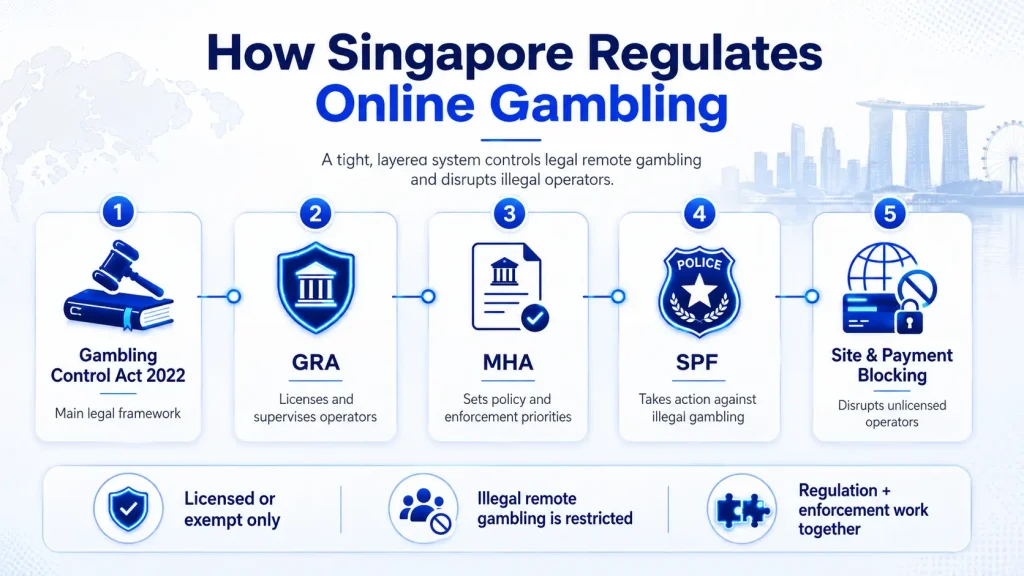
The framework is straightforward in outline:
- Gambling Control Act 2022 consolidated Singapore’s gambling laws into a single regime
- Gambling Regulatory Authority (GRA) licenses and supervises gambling operators
- Ministry of Home Affairs (MHA) sets policy and directs enforcement priorities
- Singapore Police Force (SPF) enforces against illegal gambling operations
- Site and payment blocking are used to disrupt access to unlicensed operators
Two points are often missed. First, remote gambling is prohibited unless the operator is licensed or exempt, so the default position is restriction rather than permission. Second, gambling with an unlicensed remote operator is an offence for the customer, not only the operator. The full detail sits in our dedicated articles on Singapore gambling laws and Singapore gambling regulations.
Key Trends Shaping the Market
Gambling is becoming more digital. Betting increasingly runs through account-based online channels, supported by near-universal connectivity.
Overall participation continues to fall. Three consecutive NCPG surveys point the same way, and nothing in the current data suggests a reversal.
Illegal operators remain an enforcement problem. Blocking is effective but not permanent, since domains and payment routes are replaced.
Major sports events create temporary spikes. These are short-lived surges in activity and in enforcement, not structural growth.
Responsible gambling controls are tightening. Advertising restrictions, self-exclusion and account-level limits have expanded rather than loosened.
Notably absent from this list are metaverse casinos, VR gambling and blockchain betting. There is no Singapore-specific data supporting them as market forces, and including them would be speculation.
Singapore Online Gambling Market Outlook
The evidence points towards continued digital migration inside a tightly controlled market rather than any move towards deregulation. Overall participation is more likely to keep drifting down than to rebound, licensing is unlikely to widen, and offshore operators will stay an enforcement problem rather than disappearing.
For anyone sizing this market commercially, the practical constraint is unchanged: the regulated segment is narrow and measurable, while the unregulated segment is unmeasurable by design. Any confident total for the Singapore online gambling market is combining a real number with an estimate.
Key Takeaways
- Gambling participation in Singapore has fallen from 52% in 2017 to 40% in 2023.
- Reported illegal online gambling rose by 0.7 percentage points between 2020 and 2023, from a very small base.
- 4D and TOTO dominate participation, making this a lottery-led market rather than a casino-led one.
- Enforcement data shows more than 3,800 sites and 145,000 transactions blocked as at the end of 2024, but that measures enforcement rather than market size.
- No official total exists for the Singapore online gambling market, and third-party estimates are modelled figures rather than government statistics.
Frequently Asked Questions
Is online gambling growing in Singapore?
Overall gambling participation has been falling, from 52% in 2017 to 40% in 2023. Reported illegal online gambling moved the other way over the same period, rising from 0.3% in 2020 to 1.0% in 2023. The market is contracting overall while shifting towards digital channels.
How big is Singapore’s online gambling market?
There is no single official figure. Offshore activity is not measurable from official data, and published market-size estimates are models built on assumptions, so they vary widely.
What is the most popular form of gambling in Singapore?
4D, with 30% participation in the 2023 NCPG survey, followed closely by TOTO at 29%.
Who regulates online gambling in Singapore?
The Gambling Regulatory Authority licenses and supervises operators, under policy set by the Ministry of Home Affairs. The Singapore Police Force handles enforcement against illegal gambling.
Is online gambling legal in Singapore?
Only through a licensed or exempt operator. Gambling with an unlicensed remote operator is an offence. Our guide to Singapore gambling laws covers the specifics.
How does Singapore block illegal online gambling?
Through a combination of website blocking, payment blocking, advertising restrictions and police enforcement. As at the end of 2024, more than 3,800 sites and 145,000 transactions worth around $37 million had been blocked.
How much illegal online gambling occurs in Singapore?
The value cannot be measured reliably. The available indicators are survey participation of about 1% in 2023 and the enforcement figures above.
Why do Singapore gambling market-size estimates differ?
Because they measure different things. Turnover counts every stake, GGR counts stakes minus winnings, and modelled market sizes make assumptions about unverifiable offshore spend.
Continue exploring:
Read our Online Gambling Singapore Guide for more on regulations, payments, game types, security and Responsible Gambling in Singapore.